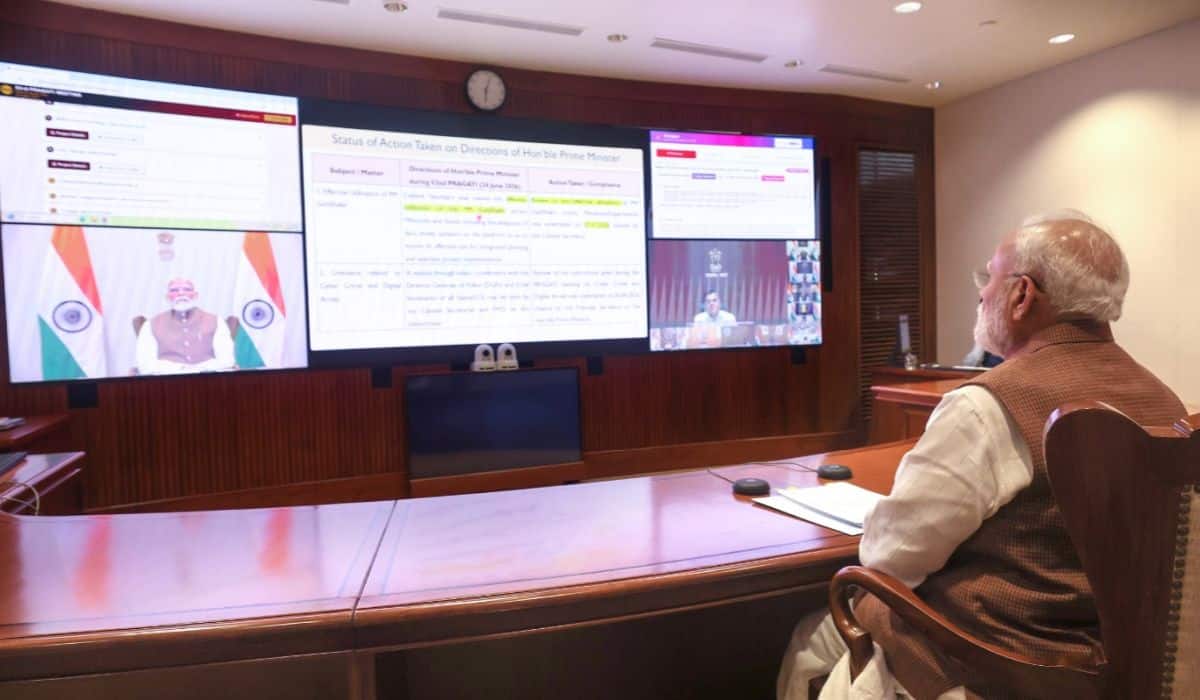
Namaskar,
Today all of you are associating yourselves with this crucial responsibility of teaching in this historical period. This year, I have spoken in detail from the ramparts of the Red Fort about how national character plays an important role in the development of the country. It is the responsibility of all of you to shape the future generation of India, mould them into modernity and give them a new direction. I extend my best wishes to more than 5500 teachers who are appointed in the primary schools of Madhya Pradesh. I have been told that in the last 3 years about 50 thousand teachers have been recruited in MP. I congratulate the state government too for the same.
Friends,
All of you are also going to play a major role in implementing the National Education Policy. The National Education Policy is making a huge contribution in the direction of fulfilling the resolution of a developed India. Under this, equal importance has been laid upon both traditional knowledge as well as state-of-the-art technology. A new curriculum has also been chalked out for primary education. Another commendable work has been done in terms of imparting education in mother tongue. A great injustice was done to those students who did not know English, by not allowing them education in their mother tongue. It was against social justice. Now our government has done away with this injustice. Now in the curriculum, emphasis is being laid on books in regional languages. This will be the basis of the massive reform in the education system of the country.
Friends,
When decisions are made with a positive mindset, right intention, and full devotion, then the whole environment is filled with positivity. We have come across two major positive news stories in the first year of 'Amritkaal'. These inform us about the decreasing poverty and increasing prosperity in the country. As per the report of NITI Aayog, within just five years, 13.5 crore Indians have moved above the poverty line in India. A few days back another report was published. According to this report, the number of income tax returns filed this year also indicates something very important. There has been a huge increase in the average income of the people in the last 9 years. According to ITR data, the average income which was around Rs 4 lakh in 2014 has increased to Rs 13 lakh in 2023. In India, the number of people moving from lower income group to upper income group has also increased. These figures, apart from raising excitement, also assure that every sector of the country is getting strengthened and many new employment opportunities are growing.
Friends,
There is one more thing to note in the new figures of income tax return. That is, the trust of the citizens of the country in their government is continuously becoming stronger. As a result, the citizens of the country are coming forward in large numbers to pay their taxes honestly. They know that every penny of their tax is being used for the development of the country. It is clearly visible to them that the economy which ranked number 10 in the world before 2014, has reached 5th position today. The citizens of the country cannot forget the period before 2014, which was an era of scams and corruption. The poor were robbed of their rights, their money even before it reached them. Today, all the money meant for the poor is directly reaching their accounts.
Friends,
One of the outcomes of plugging the leakage in the system is that the government is now capable of spending more on the welfare of the poor than before. The investment made on such a large scale has also created jobs in every nook and corner of the country. One such example is the Common Service Centres. Since 2014, 5 lakh new common service centres have been set up in the villages of the country. Every Common Service Centre is providing jobs to many people today. So, the welfare of the villages and the poor was ensured and at the same time employment opportunities were also created.
Friends,
Today several financial initiatives are being taken in the country with far-reaching policies and decisions at all the three levels like education, skill development and employment generation. On this 15th August, I have also announced PM Vishwakarma Yojana from the ramparts of the Red Fort. This scheme is also a reflection of this vision. PM Vishwakarma Yojana has been formulated to mould the traditional skills of our Vishwakarma friends according to the needs of the 21st century. About Rs 13 thousand crore will be invested in this. Under this scheme, all kinds of assistance will be provided to the families who are associated with 18 different types of skills; and they will be benefitted. This will benefit that section of the society, whose importance was discussed, but no concerted efforts were ever made to improve their condition. Under the Vishwakarma scheme, along with training, vouchers will also be given to the beneficiaries to buy modern tools. That is, through PM Vishwakarma, the youth will get more opportunities to enhance their skills.
Friends,
I would like to say one more thing to these wonderful people who have become teachers today. All of you have reached here through hard work. I hope that you will continue to learn. To help you, the government has started an online learning platform IGoT Karmayogi. Try to take maximum advantage of this facility. Now that you have got a great opportunity to fulfil your dreams, I wish you and your family members all the very best for this new success, for this new journey. Thank you