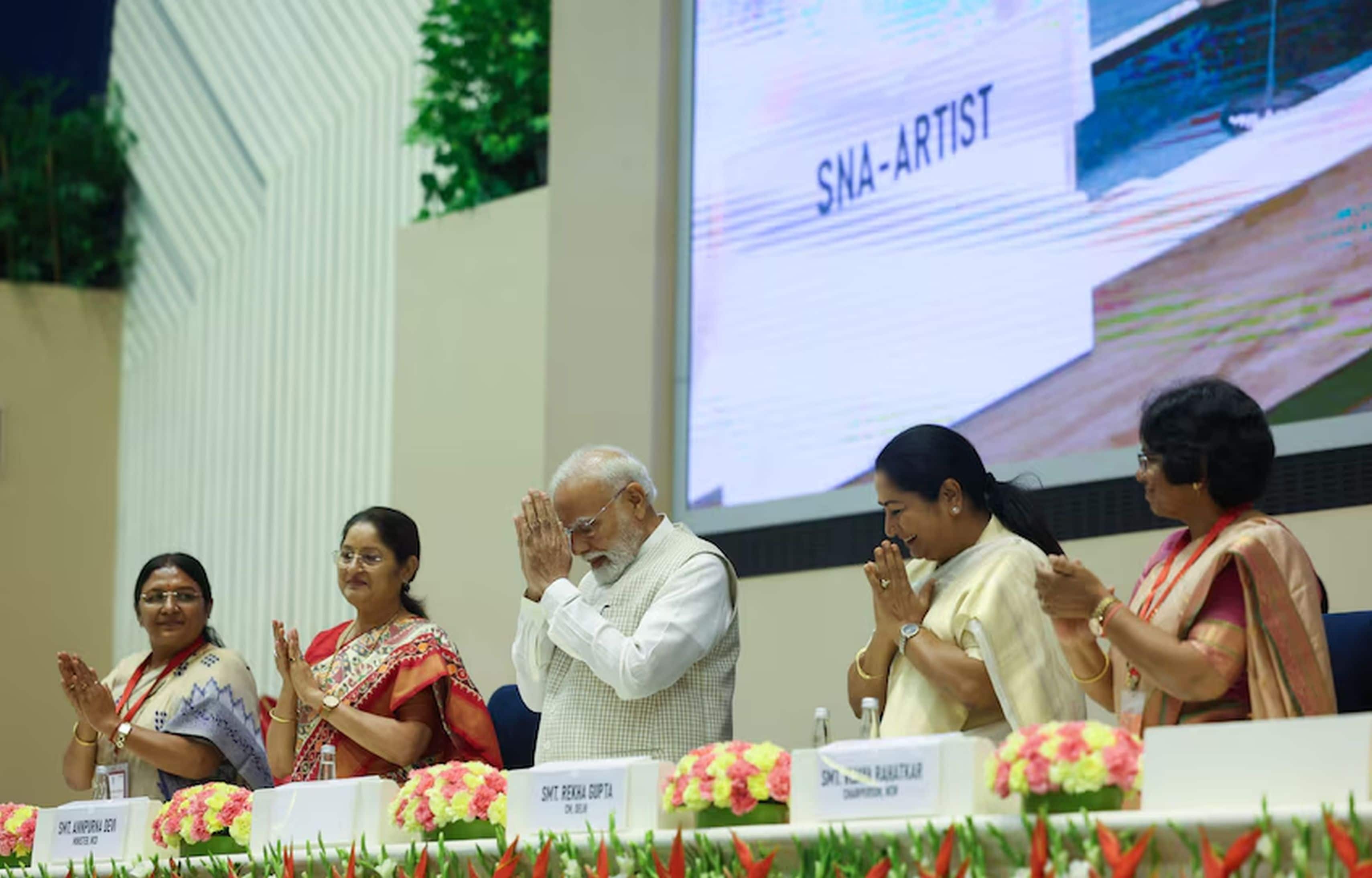
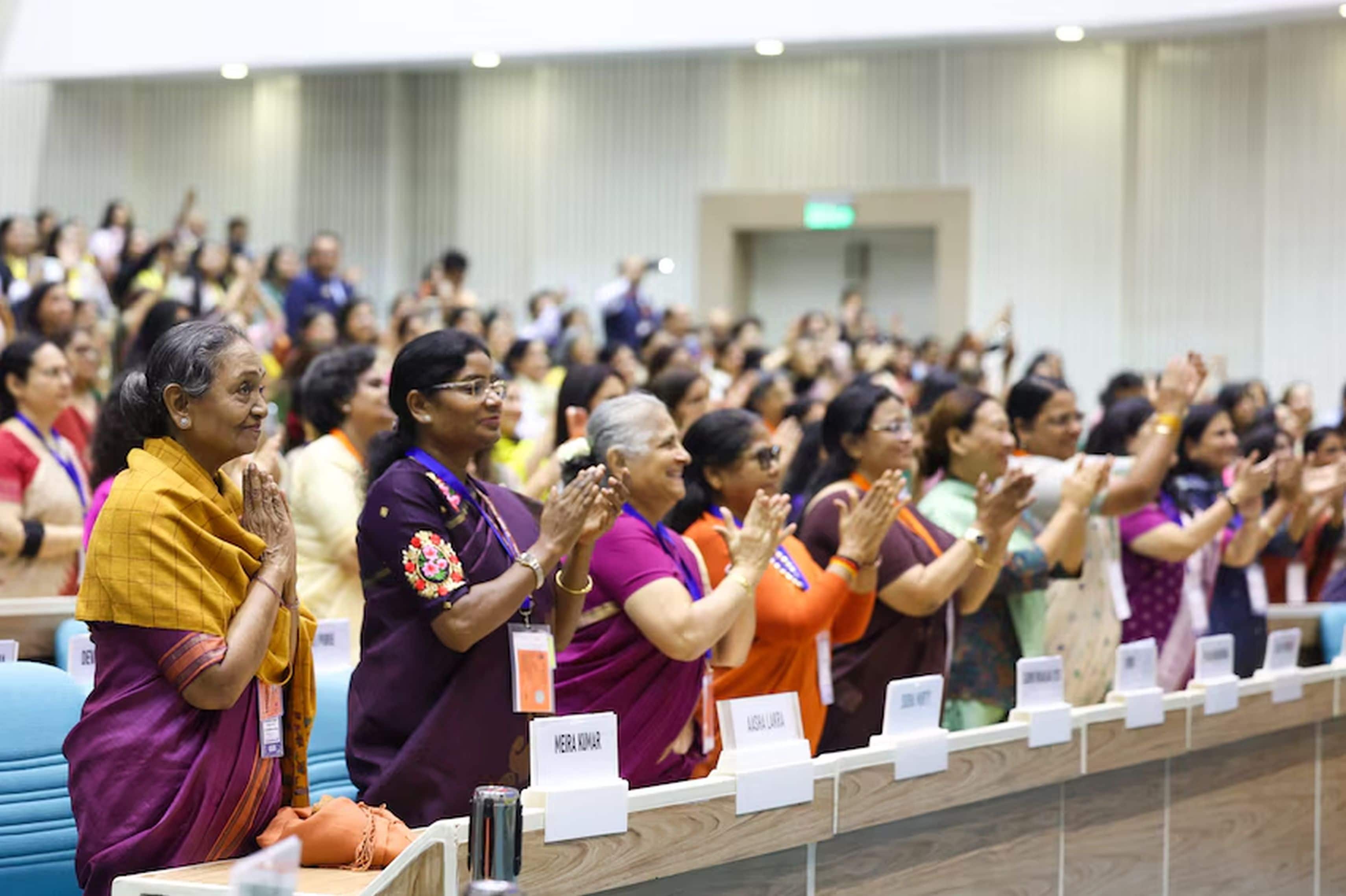
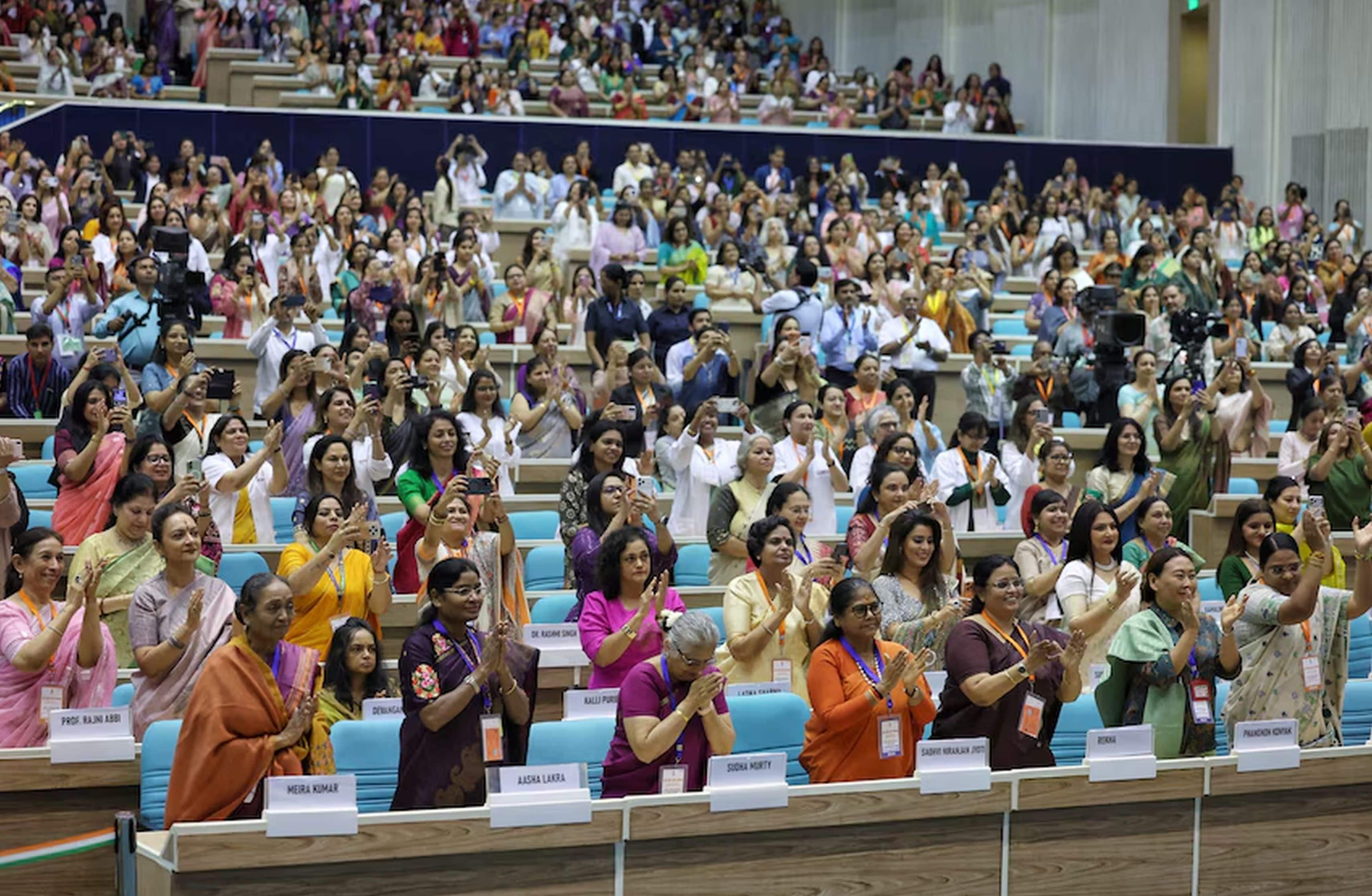
On the stage, Delhi’s popular Chief Minister Smt. Rekha Gupta Ji, Union Minister Smt. Annapurna Devi Ji, Smt. Savitri Thakur Ji, Chairperson of the National Commission for Women Smt. Vijaya Rahatkar Ji. Among you are also many senior people, Members of Parliament, Members of Legislative Assemblies, and our former Speaker of the Lok Sabha, the honorable Meira Kumar Ji, who is also among us. All my respected sisters are present here, at this time the country is filled with the joy of the Baisakhi festival. Tomorrow, the New Year will also be celebrated in different parts of the country. Today, I also pay tribute to the brave martyrs of the Jallianwala Bagh massacre.
Friends,
Amidst these important milestones in India’s development journey, the nation is about to take one of the greatest decisions of the 21st century. I say this with full responsibility-that this is among the most significant decisions of our time. This decision is dedicated to women’s power, to honoring women’s strength. Our Parliament is on the verge of creating new history-a history that will fulfill the aspirations of the past and realize the commitments of the future. It is the resolve of an India that is equal, where social justice is not just a slogan but a natural part of our work culture and decision-making process.
Friends,
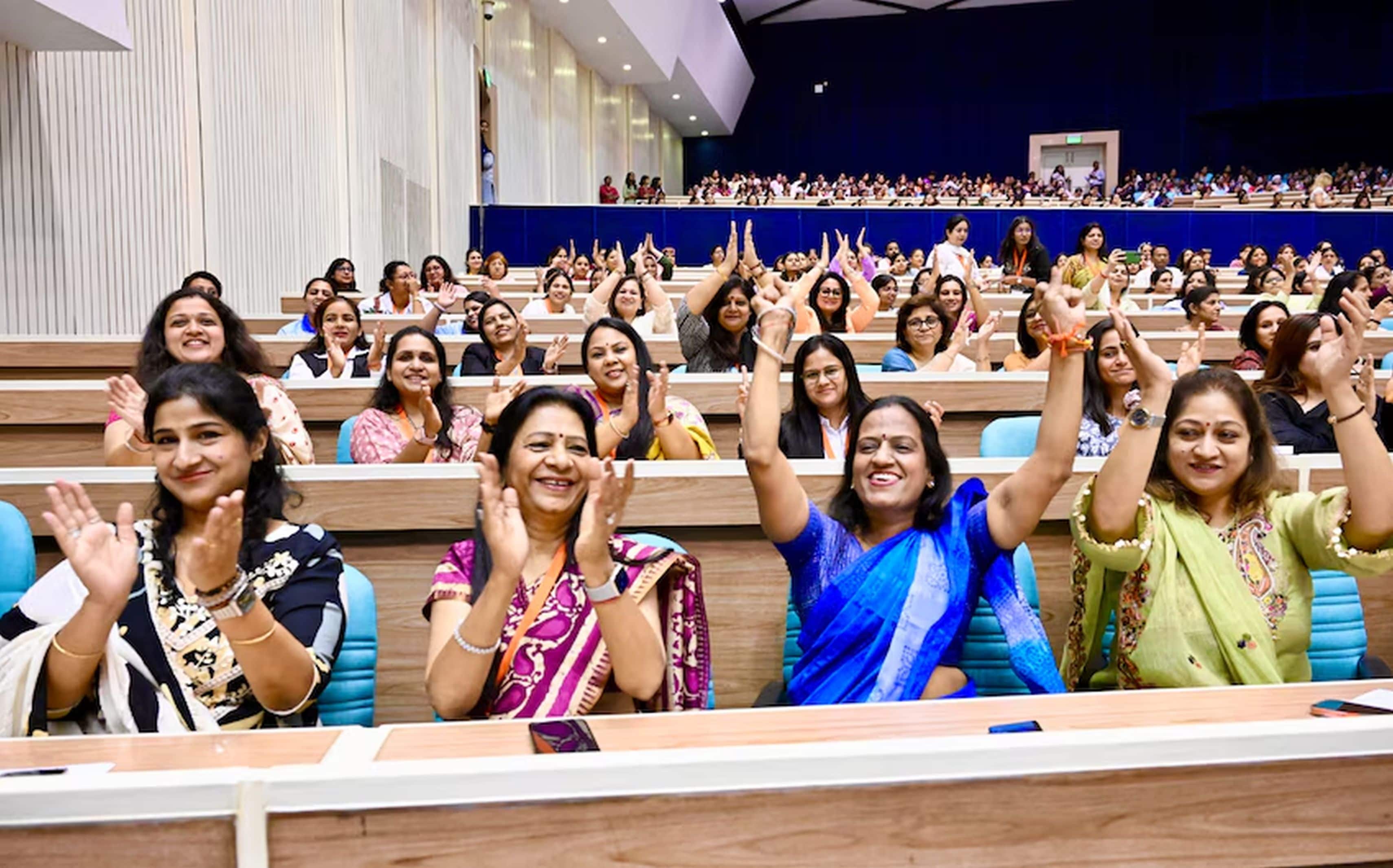
From state assemblies to the Parliament of India, the decades-long wait is coming to an end on the 16th, 17th, and 18th. In 2023, when the new Parliament building was inaugurated, we took the first step in the form of the Nari Shakti Vandan Adhiniyam. To ensure its timely implementation and to strengthen women’s participation in our democracy, a special session of Parliament’s budget sitting is being convened from 16 April. Before that, today’s program of Nari Shakti Vandan is receiving the blessings of millions of mothers and sisters across the country. I have not come here to preach or awaken you. I have come to seek your blessings. You have come from every corner of the country, and I warmly welcome your presence and the time you have devoted to this important cause. I also congratulate all the women of India on the dawn of a new era.
Friends,
In our democratic structure, the need for women’s reservation has been felt for decades, and discussions have taken place. This debate has lasted nearly four decades-40 years. Efforts from all parties and generations have been involved. Every party has advanced this idea in its own way. In 2023, when the Nari Shakti Vandan Adhiniyam was introduced, all parties unanimously passed it. At that time, it was also unanimously emphasized that it must be implemented by 2029. Everyone agreed that passing a law without implementing it was unacceptable. In particular, our colleagues in the opposition strongly insisted that it must be implemented by 2029. Keeping this timeline in mind, the government has taken the opposition’s concerns seriously. We have continued deliberations, explored new paths, and sought advice from constitutional experts. From 16 April, Parliament will hold a comprehensive discussion on this matter.
Friends,
Our effort and priority remain that this work should be accomplished through dialogue, cooperation, and participation. I am confident that just as the passage of this Act enhanced the dignity of Parliament, this time too, through collective effort, Parliament will reach new heights of honor. Every woman in the country will feel proud that all parties rose above politics to take this important decision in their interest. In recent days, I have seen women across the country speaking strongly on this issue. A wide debate is underway, and this is a great strength of democracy. Their dreams of reaching assemblies and Parliament are about to gain new wings. I sense a positive atmosphere emerging across the nation.
Friends,
From the freedom struggle to the decisions of the Constituent Assembly, women’s power has made immense contributions to laying the foundation of independent India-history bears witness. Even after independence, the women who were given opportunities for representation did outstanding work for the country. From President to Prime Minister, wherever women have served, they have created their own legacy. Even today, from the President to the Finance Minister, women hold key positions in our country. They have enhanced both the dignity and the pride of the nation.
Friends,
Our Panchayati Raj institutions are another excellent example of women’s leadership. Today, more than 1.4 million women are successfully working in local government bodies across India. In nearly 21 states, their participation in panchayats has reached almost 50 percent. Whenever I share this figure with foreign guests, they are astonished, their mouths left open in surprise.
Friends,
This is no ordinary matter. The active participation of millions of women in politics and social life amazes even the world’s greatest leaders and political experts. And it greatly enhances the pride of India as a whole.
Friends,
Many studies have shown that when women’s participation in decision-making processes increased, sensitivity also came into the systems. And this is a very great strength, and the result has been more dedicated, more sensitive, and effective work on many subjects such as water, education, health, nutrition. The Jal Jeevan Mission, I believe, is its greatest example, in which women’s participation at the panchayat level has played a very major role.
Friends,
In our local bodies and institutions, for so many years, the millions of women who are working, who are leading, they have very rich and long experience at the grassroots level. They are now ready and prepared for a bigger role. I will tell you one of my own personal experiences. What this capability means-I became a new Chief Minister in 2001, I had no great experience of running a government, of governance systems, in a way I was a new person. Perhaps it was an incident of 2002 or 2003, one of our MLAs came to me. He said that in his area some sisters from a village panchayat wanted to meet me. This was in Kheda district, Anand district area, where Sardar Sahib was born. So I said, if they have some panchayat work, let them meet the Panchayat Minister. He said, no sir, they want to meet you. I asked why? He said, in the panchayat all the members are women, not a single male member is there in our panchayat. I said, how is that possible? He said the villagers decided that this time the head would be a woman, so all members would also be women, so no man contested the election. Naturally my attention went to it, I said surely I will meet them. It was a small village, perhaps a panchayat of 13 members, so I gave them time, they all came to meet me. There were 13 sisters, the one who became the head of the village had studied up to class 8. The rest of the sisters, one or two even had their faces covered with veil. Many perhaps had never even seen school. So they all came, I thought maybe some big people had put them up as members, maybe they had brought some demands, like do this in my village, do that in my village. I was surprised, they had no papers in their hands. So they sat, I introduced myself. I asked, you had asked for time, what was the work? They said, no work, we just came because we were elected, so we came to meet you. For me this was a big surprise, otherwise leaders come only with memorandums. Then I asked them, tell me, you have got such a big responsibility for 5 years, you sisters are going to manage the village, what is your dream, what will you do in 5 years, how will you make the village? Normally what answer would be given, those of us who look big, what answer would we give-build a school, build a hospital, build a road, such answers. That day the head who had studied up to class 8 and the women members who came with her gave me an answer that perhaps the biggest economist in the world could not give. And that answer is still like a lesson for me. I became CM, I became PM, but that statement of those women of the panchayat is still a guide for me. You will be surprised, what answer did they give. When I asked them, what will you do, you have 5 years, the village chose you, then they answered me, sir we have only one wish. I asked, what? And that answer still echoes in my ears. They said, our wish is that in our village no one should remain poor. For even the greatest economists, there can be no bigger message than this. This was in itself a pleasant experience for me, and those words still echo in my ears. And therefore, the speech that comes from experience connected to the ground becomes like a Vedic statement.
And therefore, friends,
Implementing the Nari Shakti Vandan Adhiniyam is going to become a very big opportunity in the lives of all such women. Now their journey from panchayat to Parliament is going to become easier.
Friends,
Today, in our journey of a developed India, the role of women has become even more important. I am satisfied that in 2014, you all, the countrymen, gave us the opportunity to serve here, and since then, our government has made schemes for every stage of women’s life cycle and implemented them successfully. Today, from the first breath to the last breath, our government is present with some scheme or other in the service of the sisters and daughters of India. To ensure that daughters are not killed in the womb, we started the ‘Beti Bachao-Beti Padhao’ campaign. To ensure that mothers get proper nutrition during pregnancy, every pregnant mother was given financial assistance of 5,000 rupees under the ‘Matru Vandana Yojana’. To ensure that daughters do not face difficulty in studies after birth, we started the ‘Sukanya Samriddhi Yojana’ with higher interest benefits. To protect daughters from serious diseases, to ensure timely vaccination in childhood, we started ‘Mission Indradhanush’. To ensure that daughters do not face toilet problems in schools, under the ‘Swachh Bharat Abhiyan’, crores of toilets were built in the country. To ensure that daughters do not face problems during periods, a campaign was started to provide sanitary napkins almost free. If daughters want to advance in sports, under the ‘Khelo India’ campaign, they are getting assistance up to one lakh rupees annually. If daughters, when grown up, want to join the army in the future, the government has opened doors for admission in Sainik Schools, and opened the path to the National Defence Academy. In later stages of life, to ensure that daughters do not suffer from smoke in the kitchen, we started the ‘Ujjwala Yojana’, giving crores of free gas connections. To ensure that daughters do not have to carry water on their heads for miles, we started the ‘Har Ghar Nal Se Jal’ campaign. To ensure that daughters do not have to worry about rationing for their families, a free ration scheme was started. In family life, to ensure that daughters do not have to worry about treatment, they were given support through the Ayushman Yojana, which provides free treatment up to 5 lakh rupees. For cheap medicines with up to 80 percent discount, Jan Aushadhi Kendras were established, and all these benefits are reaching our sisters and daughters the most.
Friends,
You all know very well that to empower women in India, it is necessary to increase their economic participation. Therefore, in every decision of our government, in every scheme, we have kept this aspect in mind. Earlier, family property was mainly in the name of men. If there was a house, it was in the man’s name, if there was land, it was in the man’s name, if there was a shop, it was in the man’s name, if there was a vehicle, it was in the man’s name, even a scooter was in the man’s name, and this was taken as natural. In the ‘PM Awas Yojana’, we started registering houses primarily in the names of women of the family. When children go to school, naturally the father’s name is written, so we started that the mother’s name will also be written. In the past 11 years, more than 3 crore women have benefited from this decision, becoming owners of their own houses. This has made women economically empowered in households. Usually, father and son talk about some business, and if the mother brings tea and stands for a while, they say, go, go to the kitchen, we are talking. I am not a householder, but I know a lot. But now, when she has become economically strong, even the son says, please call mother to join the conversation, call her.
Friends,
In 2014, there were crores of women in our country who had never even seen the door of a bank. Women were not connected to the banking sector, so how could they get the benefit of banking? When we started the Jan Dhan Yojana, more than 32 crore women’s bank accounts were opened in the country. When I was in Gujarat, one decision at the beginning was very difficult for me. Gujarat has a big cooperative dairy empire, a very large operation, and most of the work of animal husbandry is done by our mothers and sisters. They go to deposit milk, and then after a week they are given money, but the money was given to the men. When I became Chief Minister, I said I would not give money to men. At that time, I had bank accounts opened for the sisters who came to deposit milk in the dairies, and then the money for the milk started going directly into the women’s bank accounts.
Friends,
Today our daughters are making their identity in new businesses. In the Mudra Yojana, more than 60 percent of loans have been taken by women. Women are also leading the country’s startup revolution. Today, in more than 42 percent of registered startups, there is at least one woman director. To ensure that women’s careers are not affected, we increased maternity leave to 26 weeks. Even in the rich countries of the world, this is not there. When I tell them, their eyes widen in surprise.
Friends,
You will remember, a few years ago the country launched the ‘Skill India Mission’. We started vocational training programs. Today, we are seeing its results in the form of an agricultural revolution through thousands of Drone Didis. Once I was talking with these Drone Didis on video conference. They are daughters of villages, some are daughters-in-law, by flying drones. They told me that until now in the village no one called us anything, now they call us pilots. Our identity has been made, we are pilots. That means perception can change so greatly and quickly with one small decision. Women are learning modern farming through technology. You will be happy to know that in the past 11 years, about 10 crore women have joined self-help groups. The government has set a target to make 6 crore such sisters, who are driving the rural economy, into Lakhpati Didis. Out of these, more than 3 crore rural women have already become Lakhpati Didis. And these women self-help groups get money from banks for work. And you will be happy to know, if they have to deposit money on Wednesday, they go and deposit it on Tuesday, one day earlier. The sisters’ behavior is such that there is no NPA, all the money that goes from the bank comes back. And I have seen, after coming into governance, I have seen the richness of the poor in the banks’ business and also the poverty of the rich.
Not only this, friends,
Our mothers and sisters are becoming brand ambassadors of ‘Vocal for Local’. Sisters, the great success of the vision of Women-led Development is that it has challenged the old thinking about women. When the G-20 summit was going on, we were chairing, I had to explain to the countries of the world what is the difference between Women Development and Women-led Development. A large part of the world agreed up to Women Development, but for Women-led Development I had to put in effort, and we succeeded. The result of this thinking is that today women are reaching heights even in sectors where once men’s monopoly was considered. Today our daughters are becoming fighter pilots and touching the heights of the sky. Today in India, compared to any country in the world, this figure will also make you happy, compared to any country in the world, the percentage of women pilots is the highest in India. Today, the number of daughters enrolled in PhD has doubled compared to 2014. In higher education and research, nearly half the participation is of our daughters. In the study of mathematics and science, in STEM education, the number of daughters has reached nearly 43 percent. I remember once I went to a rich country of the world, there the education minister was with me in the lift, he asked me how is women’s education in India? I said very good, higher, in some places even more than men. Then he asked with great curiosity, in STEM education what is the women’s share? I said 50 percent share is theirs. For him it was a surprise. I am talking about the education minister of a rich country of the world.
Friends,
In our society, a big challenge has also been about women’s safety. For centuries, women had to remain silent for their own safety. Our government has taken strong steps in this direction. To make the justice system more sensitive, to make decision-making faster, we have made legal changes, and also established fast-track special courts. In the Bharatiya Nyaya Sanhita, women’s safety has also been given priority. The process of filing FIR has been simplified, now e-FIR or zero-FIR can be filed from any place. Arrangements such as recording the victim’s statement through audio-video have been implemented. There are many such steps through which we are realizing the concept of a progressive society.
Friends,
At every stage of life, every concern, happiness and sorrow, every occasion, in every situation, paying attention, our government has empowered women through many small and big steps. As a result of this, the country is now ready to take its democracy to new heights.
Friends,
The women’s power of the country has touched new heights with their hard work, courage, and self-confidence. Now we have to together give new energy to this power, expand opportunities for it. Today from this stage I want to assure every mother, sister, daughter of the country that the nation understands their aspirations and is taking every necessary step to realize their dreams.
Friends,
Before the discussion in Parliament, I also appeal to the women’s power of the country to maintain their active participation in this whole process. You must also meet your MPs from your respective areas. The women of the country should present their side to their MPs, tell them their expectations. And on the day they leave to come to the House, give them a farewell with flowers and garlands. So that when MPs leave with the blessings of mothers and sisters, then they cannot make any other decision. So that my fellow MPs take the right decision, take decisions in the interest of women, take decisions with consensus.
Friends,
I have one more request to you. Take the discussions happening in the Nari Shakti Vandan program to the villages of the country. Through personal meetings, through social media, through other means of communication, we have to take this big decision of the country to every woman of the country. We have to make them aware, so that they can understand the strength of this big decision, so that they can understand their role, and openly dream that in the coming days, from the states to the Parliament of the country, they can mark their presence. Come, let us together, all together take this resolve, that women’s power will have their rights, and they will also be full participants in the decision-making process. This is the biggest guarantee of our bright future. I would even say that on the 16th, 17th, 18th-though that is the domain of the Speaker-but I would want that at that time the visitors’ gallery should be filled only with women. A festive atmosphere will be created in the whole country. And this will not remain a subject of this party or that party, who won, who lost, who did it, no one, all the credit is to the mothers’ power of the country, all the credit is to the Parliament of the country, all the credit is to all the political parties of India, all the credit is to all those who have been continuously working for the past 3–4 decades. This belongs to everyone, it is with everyone’s cooperation, and it is for everyone’s welfare. With this faith, you all took out so much time, participated in this program with so much enthusiasm and excitement, I heartily congratulate you all, I express my gratitude.
Thank you very much.