Text of PM’s Address to the Sri Lankan Parliament

Published By : Admin | March 13, 2015 | 16:04 IST

Honourable Speaker of Parliament, Mr. Chamal Rajapaksa ji,

Honourable Prime Minister of Sri Lanka, Shrimaan Ranil Wickremesinghe ji,

Honourable Leader of the Opposition, Mr. Nimal Siripala De Silva,

Honourable Members of Parliament,

Distinguished Guests,

30 PM Modi to Address Sri Lankan Parliament (4)

I am truly delighted to visit Sri Lanka - a land of beauty, culture and friendship.

I am deeply honoured to be in this Parliament. I am conscious of its rich history.

This Parliament represents one of Asia`s oldest democracies; and, one of its most vibrant.

Long before many others in the world, Sri Lanka gave every individual a vote and voice.

To the people of Sri Lanka, ayubuvan, Vanakkam.

I bring the greetings of 1.25 billion friends; and millions of fans of Sri Lankan cricket.

I bring the blessings from the land of Bodh Gaya to the land of Anuradhapura.

I stand here in respect for our shared heritage; and, in commitment to our shared future.

Last May, when I took the oath of office, I was honoured by the presence of South Asian leaders at the ceremony.

Their presence was a celebration of democracy`s march in our region. It was also recognition of our common destiny.

I am convinced that the future of any country is influenced by the state of its neighbourhood.

The future that I dream for India is also the future that I wish for our neighbours.

We in this region are on the same journey: to transform the lives of our people.

30 PM Modi to Address Sri Lankan Parliament (3)

Our path will be easier, the journey quicker and destination nearer when we walk step in step.

As I stand here in Colombo and look north towards the Himalaya, I marvel at our region`s uniqueness – of our rich diversity and our common civilisational links.

We have been formed from the same elements; and, from our interconnected histories.

Today, we stand together as proud independent nations – sovereign and equal.

India and Sri Lanka do not have a land boundary, but we are the closest neighbours in every sense.

No matter where you look in India or Sri Lanka, the many strands of our links - religion, language, culture, food, customs, traditions and epics - come together into a deep and strong bond of familiarity and friendship.

Ours is a relationship that is beautifully defined by the journey of Mahindra and Sanghamitra. They carried the message of peace, tolerance and friendship more than two millenniums ago.

It is evoked by Kannagi, the central character of the great Tamil epic Silapathikaram, who is worshipped as goddess the Pattini in Sri Lanka.

It lives in the Ramayan trail in Sri Lanka.

It expresses itself in devotion at the dargah of the Nagore Andavar and the Christian shrine of Velankanni.

It is reflected in the friendship of Swami Vivekananda and Anagarika Dharmapala, the founder of the Maha Bodhi Society in Sri Lanka and India.

It lives in the work of Mahatma Gandhi`s followers in India and Sri Lanka.

Above all, our relationship thrives through the inter-woven lives of ordinary Indians and Sri Lankans.

Our independent life began at about the same time.

Sri Lanka has made remarkable progress since then.

The nation is an inspiration for our region in human development. Sri Lanka is home to enterprise and skill; and extraordinary intellectual heritage.

There are businesses of global class here.

Sri Lanka is a leader in advancing cooperation in South Asia.

And, it is important for the future of the Indian Ocean Region.

Sri Lanka`s progress and prosperity is also a source of strength for India.

So, Sri Lanka`s success is of great significance to India.

And, as a friend, our good wishes, and our support and solidarity have always been with Sri Lanka.

And, it will always be there for you.

For all of us in our region, our success depends on how we define ourselves as a nation.

All of us in this region, indeed every nation of diversity, have dealt with the issues of identities and inclusion, of rights and claims, of dignity and opportunity for different sections of our societies.

We have all seen its diverse expressions. We have faced tragic violence. We have encountered brutal terrorism. We have also seen successful examples of peaceful settlements.

Each of us has sought to address these complex issues in our own ways.

However we choose to reconcile them, to me something is obvious:

Diversity can be a source of strength for nations.

When we accommodate the aspirations of all sections of our society, the nation gets the strength of every individual.

And, when we empower states, districts and villages, we make our country stronger and stronger.

You can call this my bias. I have been a Chief Minister for 13 years; a Prime Minister for less than a year!

Today, my top priority is to make the states in India stronger. I am a firm believer in cooperative federalism.

So, we are devolving more power and more resources to the states. And, we are making them formal partners in national decision making processes.

Sri Lanka has lived through decades of tragic violence and conflict. You have successfully defeated terrorism and brought the conflict to an end.

You now stand at a moment of historic opportunity to win the hearts and heal the wounds across all sections of society.

Recent elections in Sri Lanka have reflected the collective voice of the nation – the hope for change, reconciliation and unity.

The steps that you have taken in recent times are bold and admirable. They represent a new beginning.

I am confident of a future of Sri Lanka, defined by unity and integrity; peace and harmony; and, opportunity and dignity for everyone.

I believe in Sri Lanka`s ability to achieve it.

It is rooted in our common civilisational heritage.

The path ahead is a choice that Sri Lanka has to make. And, it is a collective responsibility of all sections of the society; and, of all political streams in the country.

But, I can assure you of this:

For India, the unity and integrity of Sri Lanka are paramount.

It is rooted in our interest. It stems from our own fundamental beliefs in this principle.

Hon`ble Speaker and Distinguished Members,

My vision of an ideal neighbourhood is one in which trade, investments, technology, ideas and people flow easily across borders; when partnerships in the region are formed with the ease of routine.

In India, the growth momentum has been restored. India has become the fastest growing major economy in the world.

The world sees India as the new frontier of economic opportunity.

But, our neighbours should have the first claim on India. And I again repeat, the first claim on India is of our neighbours – of Sri Lanka.

I will be happy if India serves a catalyst in the progress of our neighbours.

In our region, Sri Lanka has the potential to be our strongest economic partner.

We will work with you to boost trade and make it more balanced.

India`s trade environment is becoming more open. Sri Lanka should not fall behind others in this competitive world.

That is why we should conclude an ambitious Comprehensive Economic Partnership Agreement.

30 PM Modi to Address Sri Lankan Parliament (10)

India can also be a natural source of investments – for exports to India and elsewhere; and to build your infrastructure. We have made good progress today. Let us get together to harness the vast potential of the Ocean Economy.

Our two nations must also take the lead in increasing cooperation in the South Asian Region and the linked BIMSTEC Region.

Connecting this vast region by land and sea, our two countries can become engines of regional prosperity.

I also assure you of India`s full commitment to development partnership with Sri Lanka. We see this as a responsibility of a friend and neighbour.

India has committed 1.6 billion U.S. dollars in development assistance. Today, we have committed further assistance of up to 318 million dollars to the railway sector.

We will continue our development partnership. We will be guided by your Government. And, we will do so with the same level of transparency that we expect in our own country.

Last month we signed the agreement on cooperation in peaceful uses of nuclear energy.

More than anywhere else in the region, I see enormous potential to expand cooperation with Sri Lanka in areas like agriculture, education, health, science and technology, and space. Indeed, we are limited only by our imagination.

We hope that Sri Lanka will take full benefit of India`s satellite for the SAARC Region. This should be in Space by December 2016.

People are at the heart of our relationship. When we connect people, bonds between nations become stronger. That is why we have decided to extend the visa-on-arrival facility to Sri Lankan citizens.

We will also increase connectivity between our countries. We will strengthen ties of culture and religion. Last month we announced reduction in fees for Sri Lankan nationals visiting National Museum in Delhi to see the Kapilavastu Relics. We will bring our shared Buddhist heritage closer to you through an exhibition. Together, we will develop our Buddhist and Ramayana Trails. My birth place Varnagarh was an international centre of Buddhist learning in ancient times. Excavations have revealed a hostel for 2000 students and in plans to redevelop the centre.

Mr Speaker,

A future of prosperity requires a strong foundation of security for our countries and peace and stability in the region.

The security of our two countries is indivisible. Equally, our shared responsibility for our maritime neighbourhood is clear.

India and Sri Lanka are too close to look away from each other. Nor can we be insulated from one another.

Our recent histories have shown that we suffer together; and we are more effective when we work with each other.

Our cooperation helped deal with the devastation of Tsunami in 2004. As a Chief Minister, I was pleased to share our experience in reconstruction after the Bhuj earthquake in 2001.

Our cooperation is also integral to our success in combating terrorism and extremism.

For both of us, local threats remain. But, we see threats arising in new forms and from new sources. We are witnessing globalisation of terrorism. The need for our cooperation has never been stronger than today.

The Indian Ocean is critical to the security and prosperity of our two countries. And, we can be more successful in achieving these goals if we work together; build a climate of trust and confidence; and we remain sensitive to each other`s interest.

We deeply value our security cooperation with Sri Lanka. We should expand the maritime security cooperation between India, Sri Lanka and Maldives to include others in the Indian Ocean area.

I often say that the course of the 21st century would be determined by the currents of the Indian Ocean. Shaping its direction is a responsibility for the countries in the region.

We are two countries at the crossroads of the Indian Ocean. Your leadership and our partnership will be vital for building a peaceful, secure, stable and prosperous maritime neighbourhood.

30 PM Modi to Address Sri Lankan Parliament (8)

In our deeply interconnected lives, it is natural to have differences. Sometimes, it touches the lives of ordinary people. We have the openness in our dialogue, the strength of our human values and, the goodwill in our relationship to resolve them.

Mr.Speaker,

Sri Lanka and India are at a moment of a great opportunity and responsibility – for realising the dreams of our people.

This is also a time for renewal in our relationship; for a new beginning and new vigour in our partnership.

We have to ensure that our proximity always translates into closeness.

We were honoured that President Sirisena chose India as his first destination last month. I am honoured to be his first guest here.

This is how it should be between neighbours.

Tomorrow I will go to Talaimannar to flag off the train to Madhu Road. This is part of the old India –Lanka rail link.

I recall the lines of a famous song ‘Sindu Nadiyin Misai’ composed by the great nationalist poet Subramanian Bharati in the early 20th century:

‘Singalatheevukkinor paalam ameippom’(we shall construct a bridge to Sri Lanka)

I have come with the hope of building this bridge – a bridge that rests on strong pillars of our shared inheritance; of shared values and vision; of mutual support and solidarity; of friendly exchanges and productive cooperation; and, above all, belief in each other and our shared destiny. Thank you once again for the honour to be with you.

Thank you very much.

Explore More
Today, the entire country and entire world is filled with the spirit of Bhagwan Shri Ram: PM Modi at Dhwajarohan Utsav in Ayodhya

Popular Speeches

Today, the entire country and entire world is filled with the spirit of Bhagwan Shri Ram: PM Modi at Dhwajarohan Utsav in Ayodhya
With HPV vaccine rollout, AIIMS oncologist says it’s the beginning of the end for cervical cancer in India

Media Coverage

With HPV vaccine rollout, AIIMS oncologist says it’s the beginning of the end for cervical cancer in India
NM on the go

Nm on the go

Always be the first to hear from the PM. Get the App Now!
...
India's Digital Public Infrastructure has today become a subject of global discussion: PM Modi at the Rising Bharat Summit
February 27, 2026
Developed nations are eager to sign trade deals with India because a confident India is rising beyond doubt and despair: PM
In the last 11 years, a new energy has flowed into the nation's consciousness, India is determined to regain its rightful strength: PM
India's Digital Public Infrastructure has today become a subject of global discussion: PM
Today, every move India makes is closely watched and analysed across the world, the AI Summit is a clear example of this: PM
Nation-building never happens through short-term thinking; It is shaped by a long-term vision, patience and timely decisions: PM

The air of Israel has reached here too.

Namaskar!

All journalists of Network 18, all colleagues overseeing this arrangement, all distinguished guests present here, ladies and gentlemen!

You are all discussing Rising India. And in this, your emphasis is on strength within-in simple words, your focus is on the nation’s own inherent capability. In our scriptures it is said: Tat Tvam Asi!-that which we seek in the Brahman is within us, it is us ourselves. The strength lies within us, and we must recognize it. In the past 11 years, India has recognized that very strength, and today the nation is continuously striving to empower it.

Friends,

Strength in a nation does not suddenly emerge; it is built over generations. It is refined through knowledge, tradition, hard work, and experience. But during a long period of history, through centuries of slavery, the very spirit of being strong was filled with inferiority. Imported ideologies instilled deeply into society the belief that we were uneducated and mere followers. Our scriptures say: Yādṛśī bhāvanā yasya, siddhir bhavati tādṛśī-as is one’s belief, so is the accomplishment. When the belief itself was inferior, the accomplishment was also inferior. We copied foreign technologies, waited for foreign approval-this was slavery not just political or geographical, but mental. Unfortunately, even after independence, India could not free itself from this mentality of slavery. And we are still paying the price for it. A fresh example can be seen in the discussions around trade deals. Some people are surprised-how did this happen, why are developed nations so eager to make trade deals with India? The answer lies in a confident India, emerging out of despair and hopelessness. If the country were still stuck in the pre-2014 gloom, counted among the “Fragile Five,” trapped in policy paralysis-who would have made trade deals with us, who would have even looked at us?

But friends,

In the past 11 years, new energy has flowed into the nation’s consciousness. India is now striving to regain its lost strength. Once upon a time, when India had the greatest dominance in the global economy, what was our strength? India’s manufacturing, the quality of Indian products, India’s economic policies. Today’s India is once again focusing on these aspects. That is why we worked on manufacturing, emphasized Make in India, strengthened our banking system, controlled inflation that was running in double digits, and made India the growth engine of the world. It is this strength of India that has developed nations themselves coming forward to make trade deals with us.

Friends,

When the hidden power of a nation awakens, it achieves new milestones. Let me give you some more examples. Whenever I meet heads of government from other countries, they are eager to hear about the immense power of Jan Dhan, Aadhaar, and Mobile. In a country where ATMs arrived much later compared to developed nations, how did India achieve global leadership in digital payments? Where leakage in government aid was accepted as bitter truth, how did India, through DBT, transfer 24 lakh crore rupees-twenty-four trillion rupees-to beneficiaries? India’s digital public infrastructure has today become a subject of global discussion.

Friends,

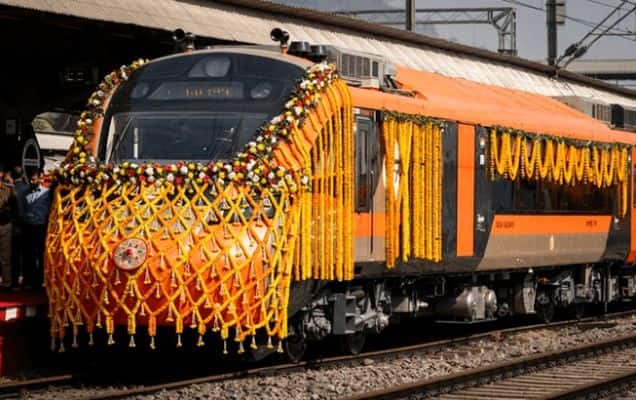
The world is astonished-how India where until 2014 nearly 30 million families lived in darkness, became one of the top countries in solar power capacity? How did India whose cities had no hope of improved public transport, become the third-largest metro network country in the world? How did India whose railways were known only for delays and slow speed achieve semi-high-speed connectivity with Vande Bharat and Namo Bharat?

Friends,

There was a time when India was only a consumer of new technology. Today, India is also a creator of new technology and is setting new standards. And this has happened because we recognized our own strength-the very strength within you are discussing is an example of this.

Friends,

When we move forward with pride, the way the world looks at us also changes. Remember, just a few years ago, how little global media discussed India’s events. Events in India were not given much importance. And today, see how every action of India is analyzed globally. The AI Summit is an example-it was held right here in this building. More than 100 countries participated. Whether Global North or Global South, all sat together at one table. From large corporations to small startups, all gathered together.

Friends,

In all the industrial revolutions so far, India and the entire Global South were only followers. But in this era of Artificial Intelligence, India is not only a participant in decisions but is also shaping them. Today we have our own AI startup ecosystem, the strength to invest in data centers, and we are working rapidly on the power most needed to store and process AI data. The reforms we have made in the nuclear power sector will also help strengthen India’s AI ecosystem.

Friends,

The organization of the AI Summit was a moment of pride for the whole of India. But unfortunately, the country’s oldest party tried to tarnish this celebration. In front of foreign guests, Congress did not just strip off clothes, but also exposed its ideological bankruptcy. When failure breeds despair and arrogance takes over, such thinking emerges that seeks to defame the nation. Clearly, Congress’s actions have angered the country. To justify its sin, they brought Mahatma Gandhi forward. Congress always does this-when it wants to hide its sins, it puts Bapu forward; when it wants to glorify itself, it gives all credit to one family.

Friends,

Congress has now reduced itself to a mere toolkit of opposition in the name of ideology. This mentality of blind opposition has grown so much that they do not miss any chance to belittle the nation on every stage, every platform. Whatever good happens for the country, whatever auspicious occurs, Congress only knows how to oppose.

Friends,

I have a long list-the new Parliament building was constructed, they opposed it. The lions of the Ashoka pillar atop Parliament-they opposed it. Those whose lions once ran away after eating ordinary citizens’ shoes, were frightened by the teeth of the Parliament’s lions. The Kartavya Path was built, they opposed it. The armed forces carried out surgical strikes, they opposed it. The Balakot air strike happened, they opposed it. Operation Sindoor was conducted, they opposed it. In short, for every achievement of the nation, Congress’s toolkit produces only one thing-opposition.

Friends,

The nation brought down the wall of Article 370, the country rejoiced. But Congress opposed it. We enacted the CAA law-they opposed it. We introduced the Women’s Reservation Bill-they opposed it. We brought a law against triple talaq-they opposed it. We launched UPI-they opposed it. We initiated the Swachh Bharat Mission-they opposed it. The country developed its own COVID vaccine, and even that they opposed.

Friends,

In a democracy, opposition does not mean blind resistance. In democracy, opposition means presenting an alternative vision. That is why the enlightened citizens of the country have been teaching Congress a lesson-not just today, but continuously for the past four decades. What I am about to say, I urge my media colleagues to analyze as well. You will see that Congress’s votes are not being stolen; rather, the people of the country no longer consider Congress worthy of their vote. And this decline began after 1984. In 1984, Congress received 39 percent of the vote and more than 400 seats. In subsequent elections, Congress’s vote share kept declining. And today, Congress’s condition is such that only four states remain where Congress has more than 50 legislators. Over the past 40 years, the number of young voters has increased, and Congress has steadily disappeared. Congress has become a club of people enslaved to one family. That is why first the millennials taught Congress a lesson, and now Gen Z is also ready.

Friends,

Congress and its allies have such a narrow mindset that they have even made long-term vision a crime. Today, when we talk about a developed India by 2047, some people ask-“Why talk about something so far ahead now?” Some even say, “Modi won’t be alive till then.” The truth is that nation-building never happens through short-term thinking. It happens through a grand vision, patience, and timely decisions. Let me present some facts before Network 18’s viewers. Every year, India spends more than 6 lakh crore rupees on freight through foreign ships. On fertilizer imports, we spend 2.25 lakh crore rupees annually. On petroleum imports, we spend 11 lakh crore rupees annually. That means, every year, trillions of rupees are flowing out of the country. If this investment had been directed towards self-reliance 20–25 years ago, today this capital would have been strengthening India’s infrastructure, research, industry, farmers, and youth. Today, our government is working with this very vision. To avoid paying 6 lakh crore rupees to foreign ships, Indian shipping and port infrastructure is being strengthened. To increase domestic fertilizer production, new plants are being set up, and nano-urea is being promoted. To reduce dependence on petroleum, ethanol blending, the Green Hydrogen Mission, solar energy, and electric mobility are being prioritized.

And friends,

We must take decisions today while keeping the future in mind. That is why India is building a semiconductor ecosystem. In defense production, mobile manufacturing, drone technology, the critical minerals sector, and investments therein-we are laying the foundation for economic security in the coming decades. The 2047 goal is not a political slogan. It is also a resolve to correct the historical mistakes where Congress governments failed to invest in time. Today, if we build indigenous ships, produce our own energy, and develop new technologies ourselves, then future generations will not discuss the burden of imports, but the capacity for exports. The progress of a nation is determined not by “today’s convenience” but by “tomorrow’s preparation.” And the hard work done with foresight is the foundation of a self-reliant, strong, and prosperous India in 2047. And no matter how many clothes Congress tears in protest, we will continue to work tirelessly.

Friends,

One very important condition of nation-building is sincerity of intent. Congress and its allies have failed even here. They have never worked with sincerity. They have no concern for the suffering of the poor. For example, in Bengal, the Ayushman Bharat scheme has still not been implemented. If there were sincerity, would they have blocked a scheme that provides free treatment up to 5 lakh rupees for the poor? No. You also know that under the PM Awas Yojana, permanent houses are being built for the poor. Let me give another figure to Network 18’s viewers. In Tamil Nadu, about 9.5 lakh permanent houses have been allocated for poor families-9.5 lakh. But construction of 3 lakh of these houses has stalled. Why? Because the DMK government is not showing interest in building these homes for the poor. And the reason is clear-their intent is not sincere.

Friends,

Let me also give you an example from the agriculture sector. During Congress’s time, farming was left to its fate. Small farmers were ignored, crop insurance was in shambles, the Swaminathan Committee’s report on MSP was buried in files. Congress made announcements in the budget, but nothing happened on the ground-because they lacked sincerity. We began working sincerely for the farmers of the country, and today the world is witnessing the results. Today, India is becoming one of the major agricultural exporters in the world. We have created a safety net for farmers at every level. Through the PM Kisan Samman Nidhi, more than 4 lakh crore rupees have been deposited directly into farmers’ accounts. We set MSP at 1.5 times the cost and made record purchases. Let me give you just one figure-pulses. The UPA government, in 10 years, purchased only 6 lakh metric tons of pulses at MSP-6 lakh metric tons. Our government has already purchased about 170 lakh metric tons of pulses at MSP-nearly 30 times more. Now you decide who truly works for the farmers.

Friends,

The UPA government was also stingy in providing help to farmers through the Kisan Credit Card. In its 10 years, the UPA government gave 7 lakh crore rupees in agricultural loans-7 lakh crore rupees. Whereas our government has given four times more-28 lakh crore rupees. During UPA’s time, only 5 crore farmers benefited from this. Today, the number has more than doubled, reaching nearly 12 crore farmers. That means, for the first time, even small farmers have received help. Our government has also given farmers the protective shield of the PM Fasal Bima Yojana. Under this, about 2 lakh crore rupees have already been provided to farmers in times of crisis. Because we are working with sincerity, the confidence of India’s farmers is rising, their productivity is increasing, and their incomes are growing.

Friends,

A quarter of the 21st century has already passed. The next phase is the decisive period of India’s development. The decisions taken today will determine the direction of the future. We must move forward by recognizing and enhancing our strength. Every individual must aim for excellence in their field, every institution must make excellence its culture. We should not just produce products, but produce best-quality products. We should not just do routine work, but world-class work. We must convert capability into performance. As I said from the Red Fort-this is the time, the right time. This is the time to take India to new heights. Once again, my heartfelt congratulations and thanks to all of you. Namaskar.