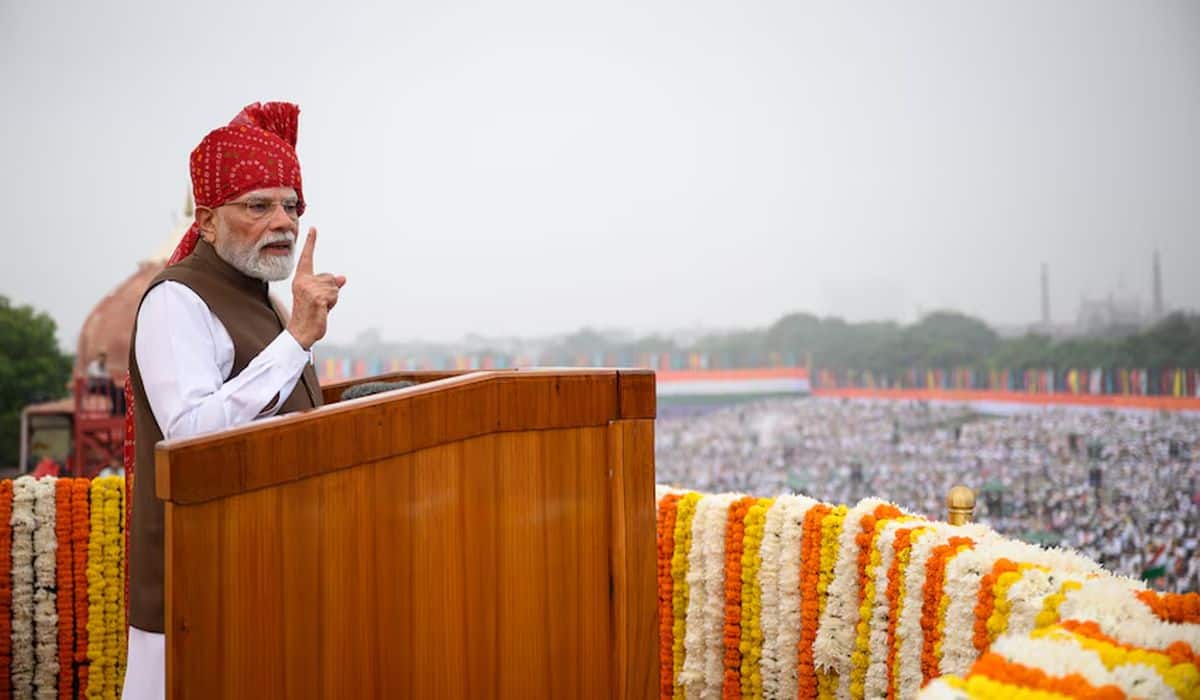
“What can be a greater privilege than to have received the love of a sister from Lata Didi, who has given the gift of love and emotion to generations”
“I dedicate this award to all the countrymen . As Lata Didi belonged to people, this award given to me in her name also belongs to people”
“She gave voice to India before independence, and the country's journey of these 75 years has also been associated with her voice”
“Lata ji worshipped music but patriotism and national service also got inspiration through her songs”
“Lata ji was like a melodious manifestation of ‘Ek Bharat Shreshth Bharat’”
“Lata ji's notes worked to unite the whole country. Globally too, she was India's cultural ambassador”

Shri Saraswataya Namaha!

Present with us in this sacred ceremony is Maharashtra Governor Shri Bhagat Singh Koshyari ji, Leader of Opposition in Maharashtra Legislative Assembly Shri Devendra Fadnavis ji, Minister in Maharashtra Government Shri Subhash Desai ji, respected Usha ji, Asha ji, Adinath Mangeshkar ji, all the members of the Master Deenanath Smruti Pratishthan, all the distinguished colleagues from the world of music and art, other dignitaries, ladies and gentlemen!

Respected Hridaynath Mangeshkar ji was also to attend this important event. But as told by Adinath ji, he could not come here due to ill health. I wish him a speedy recovery.

Friends,

I am not finding myself very worthy here, because I am not well-versed with such a profound subject as music, but from the point of view of cultural appreciation, I feel that music is both ‘sadhana’ (devotion) and ‘bhavana’ (emotion) and that which expresses the inexpressible is the word. One that fills the expression with energy and consciousness is ‘nada’ (sound) and the one that fills consciousness with emotions and feelings and takes it to the extreme of creation and sensitivity is ‘sangeet’ (music). You may be sitting motionless, but music can make tears flow from your eyes. Such is the power of music. Music can also give you a sense of detachment. Music can fill you with valour and motherly affection. It can take one to the pinnacle of patriotism and a sense of duty. We are fortunate to have seen this potential and power of music in the form of Lata Didi. We have had the privilege of seeing her with our own eyes and the Mangeshkar family has been making sacrifices in this ‘yagna’ for many generations. For me, this experience has been much more.

Harish ji made some descriptions about her, but I was wondering how old my relationship with Didi is. It must have been four-and-a-half decades ago when Sudhir Phadke ji introduced me to her. And since then, the immense affection and countless incidents with this family became a part of my life. For me, Lata Didi was the melody queen as well as my elder sister. What can be a greater privilege than to have received the love of a sister from Lata Didi, who has given the gift of love and emotion to many generations? Didi will not be there during this year’s Rakhi festival after so many decades. Generally, I choose to stay away from events in my honor as I am not very comfortable. But when the award is in the name of an elder sister like Lata Didi, it becomes a kind of obligation for me to come here because of her affinity with me and the rights that the Mangeshkar family has on me. And this is the symbol of that love when I received a message from Adinath ji asking me about my programs and how busy I was. I did not ask anything and said yes to him immediately, because it was not possible for me to refuse. I dedicate this award to all the countrymen. Just as Lata Didi belonged to the people, similarly this award given to me in her name also belongs to the people. I used to have frequent conversations with Lata Didi. She used to send her messages and blessings to me. Perhaps one thing that she used to say, which I cannot forget, can be useful to all of us. I used to respect her a lot. She always used to say - “A person does not become great by his age, but by his work. The more one does for the country, the greater he becomes”. We realize the greatness of a person who is at the peak of success and has such thoughts. Lata Didi was mature with age as well as through her deeds.

We know from the time we have spent with Lata Didi that she was the epitome of simplicity. Lata Didi achieved that position in music that people considered her to be the symbol of Maa Saraswati. Her voice left its mark on the music world for nearly 80 years. What a great journey the world of music has traveled along with Lata ji starting with gramophones, then from gramophones to cassettes, CDs, DVDs, pen drives, to online music and apps. She lent her voice to 4-5 generations of cinema. She was conferred with the highest honour ‘Bharat Ratna’ and the country became proud. The entire world considered her to be melody queen. But she did not consider herself to be a queen of notes, but a ‘sadhika’. And we have heard this from many people whenever she used to go for the recording of any song she used to take off her slippers. The practice of music and the worship of God was same for her.

Friends,

If we try to understand Adi Shankara's theory of Advaita, then sometimes we get confused. But when I try to think about the principle of Advaita of Adi Shankara, and if I have to say it in simple words, then the utterance of God to that principle of Advaita is incomplete without music. Music is integrated with God. Where there is music, there is perfection. Music affects our heart and our conscience. If its origin is as pure as that of Lata ji, then that purity and emotion also dissolve in that music. This element of her personality is an inspiration to all of us, and especially to the younger generation.

Friends,

Lata ji's physical journey was completed at a time when our country is celebrating Amrit Mahotsav of its freedom. She gave voice to India before independence, and the country's journey over these 75 years was also associated with her voice. The name of Lata ji's father Deenanath Mangeshkar ji is also associated with this award. All the countrymen are indebted to the Mangeshkar family for their contribution to the country. Along with music, the consciousness of patriotism that was within Lata Didi, her father was the source of it. Deenanath ji sang a song written by Veer Savarkar during a program held in the honor of the British Viceroy in Shimla during the freedom struggle. Only Deenanath ji could do this in front of the British Viceroy through music. He also performed on its theme and the song was written by Veer Savarkar ji challenging the British rule. This courage, this sense of patriotism was given by Deenanath ji to his family. Lata ji had probably once said that she wanted to go into the field of social service. Lata ji made music her worship, but patriotism and national service also got inspiration through her songs. Lata ji immortalized Veer Savarkar ji's song 'Hindu Narasimha' on Chhatrapati Shivaji Maharaj, or the poems of Samarth Guru Ramdas ji by recording the album of Shiv Kalyan Raja. The emotional tracks of "Ae Mere Watan Ke Logon" and "Jai Hind Ki Sena" have become immortal and are on the lips of the people of the country. There are so many aspects related to her life! It is our duty to take the contribution of Lata Didi and her family to the people during Amrit Mahotsav.

Friends,

Today the country is moving ahead with the belief of 'Ek Bharat, Shreshtha Bharat'. Lata ji was like a melodious manifestation of 'Ek Bharat, Shreshtha Bharat'. She sang thousands of songs in more than 30 languages ​​of the country. Lataji's voice is equally at home in every language, be it Hindi, Marathi, Sanskrit or any other Indian language. She is ingrained in the minds of people in every state, in every region. She has demonstrated how music can become immortal with Indian-ness. She recited the Bhagavad Gita as well as the songs of Tulsi, Meera, Sant Dnyaneshwar and Narsi Mehta. Lata ji’s voice revived everything from the ‘chaupais’ (quatrains) of Ramcharitmanas to Bapu's favorite hymn 'Vaishnav Jan to Tene Kahiye'. She had recorded a set of songs and chants for Tirupati Devasthanam, which is still played there every morning. That is, from culture to faith, from east to west, from north to south, Lata ji's notes have worked to unite the whole country. Globally too, she was India's cultural ambassador. Her personal life was also like that. She built Master Deenanath Mangeshkar Hospital in Pune with her earnings and with the help of her friends, which is still serving the poor. Not many people are aware that Mangeshkar Hospital in Pune was one of the select hospitals which worked most for the poor during the Corona period.

Friends,

Today, the country is reflecting on its past and is making new resolutions for the future during the Amrit Mahotsav of Independence. We are one of the largest startup ecosystems in the world. Today India is moving towards becoming self-reliant in every field; this journey of development is part of our resolutions. But India's fundamental vision of development has always been different. For us, development means- 'Sabka Saath, Sabka Vikas, Sabka Vishwas and Sabka Prayas'. The ethos of 'Vasudhaiv Kutumbakam' (welfare of all) is also included in this spirit of development for all. The development of the entire world and the welfare of the entire humanity cannot be achieved by mere material capabilities. For this, human values are very important! For this, spiritual consciousness is critically important. That is why India is providing leadership in areas like yoga, Ayurveda and the environment.

I believe our Indian music is also an important part of this contribution. This responsibility is in your hands. It is the responsibility of all of us to keep this heritage alive with the same values, carry it forward and make a medium of world peace. I am sure that all the people associated with the music world will discharge this responsibility and give direction to a new India. With this belief, I thank all of you from my heart. I also thank the Mangeshkar family for choosing me for the inaugural award in the name of Didi. But when Harish ji was reading the acknowledgment letter, I was thinking that I will have to read it several times to make a note of how much I have yet to achieve, how many drawbacks are there in me and how to overcome that. With the blessings of Didi and the love of the Mangeshkar family, my drawbacks have been presented to me through the acknowledgment letter and I will try to overcome them.

Many thanks!

Namaskar!


Explore More
Today, the entire country and entire world is filled with the spirit of Bhagwan Shri Ram: PM Modi at Dhwajarohan Utsav in Ayodhya

பிரபலமான பேச்சுகள்

Today, the entire country and entire world is filled with the spirit of Bhagwan Shri Ram: PM Modi at Dhwajarohan Utsav in Ayodhya
India eyes 2036 Olympics, PM Modi announces nationwide talent hunt for children aged 5-15

Media Coverage

India eyes 2036 Olympics, PM Modi announces nationwide talent hunt for children aged 5-15
NM on the go

Nm on the go

Always be the first to hear from the PM. Get the App Now!
...
12 Years of Transformation: PM Modi Highlights India’s Progress in Independence Day Address
August 15, 2026

In his Independence Day address, Prime Minister Shri Narendra Modi highlighted India’s transformation over the last 12 years, outlining the progress made across manufacturing, digital infrastructure, basic amenities, energy security, youth empowerment, innovation, social security and other key sectors.

Key highlights from the Prime Minister’s address include:

1. Manufacturing: Scale and Self-Reliance

Over the last 12 years:

  • Defence production has increased nearly 4 times.
  • Khadi and Village Industries production has increased nearly 5 times.
  • Electronics manufacturing has increased nearly 7 times.
  • Modern railway coach production has increased 21 times.
  • Mobile phone production has increased 35 times.

2. Digital India and Innovation

The Prime Minister highlighted the rapid expansion of India’s digital and innovation ecosystem:

  • Internet consumers have increased nearly 4 times.
  • Patent grants have increased 4 times.
  • Digital transactions have increased around 100 times.
  • India has built a significantly larger digital and innovation ecosystem.

3. Faster Delivery of Basic Amenities

The Prime Minister highlighted the faster pace at which basic facilities are reaching ordinary citizens:

  • Tap-water connections have been provided at an average annual pace nearly 15 times faster.
  • LPG connections have been provided at an annual pace nearly 6 times faster.
  • Toilets for the poor have been constructed at an annual pace nearly 4 times faster.
  • Pucca houses for the poor have been provided at an annual pace nearly 3 times faster.
  • Hundreds of obsolete laws have been abolished.
  • Modern public transport, including metro systems, has reached several more cities.

4. Building the Semiconductor Ecosystem

The Prime Minister highlighted India’s progress in building domestic semiconductor capabilities:

  • India earlier had no major semiconductor manufacturing plant.
  • A complete semiconductor ecosystem is now being built in India.
  • Three semiconductor plants have been initiated.
  • India has also started exporting chips.

5. Securing Critical Minerals

Highlighting the importance of critical minerals for emerging technologies, the Prime Minister referred to the steps being taken to strengthen India’s capabilities in this sector:

  • National Critical Mineral Mission has been launched.
  • Critical Mineral Corridor has been announced in the Budget.
  • Agreements have been signed with several countries for critical mineral supplies.

6. Strengthening Energy Security

The Prime Minister underlined that energy security is an essential condition for building a developed India, particularly as technologies such as chips, AI and data centres require huge quantities of electricity.

Underlining the role of nuclear energy, the Prime Minister highlighted:

  • The SHANTI Act as a major reform in the nuclear energy sector.
  • India crossing an important milestone in Fast Breeder Nuclear Technology.
  • The potential of the technology to play a major role in making India self-reliant in nuclear fuel.

7. Expanding Oil and Gas Exploration

The Prime Minister highlighted the change in India’s approach towards offshore exploration:

  • Nearly 99% of India’s offshore area was earlier classified as a No-Go Area.
  • The approach has now changed from No-Go Area to Go Ahead Area.
  • Previously restricted areas have been opened for exploration.
  • This has created possibilities for discovering new oil and gas reserves.

8. Energy Diversification

The Prime Minister highlighted the rapid expansion in different sources of energy.

City Gas Distribution

  • 2014: Available in fewer than 70 cities.
  • Today: Available in around 700 cities.

Piped Cooking Gas


  • 2014: Around 20–22 lakh households.
  • Today: Nearly 1.75 crore households.

Solar Energy


  • 2014: Around 2 GW.
  • Today: Around 160 GW.

PM Surya Ghar Muft Bijli Yojana


  • The scheme has crossed 50 lakh households.
  • Lakhs of families are benefiting through lower or zero electricity bills.
  • Families can also sell surplus electricity and earn.
  • Assistance of up to around ₹80,000 per household is available.

9. Railways: Electrification and Future Fuels

The Prime Minister highlighted the transformation of Indian Railways:

  • In 2014, after nearly 90 years, only around 30% of the railway network had been electrified.
  • Today, Indian Railways has moved towards near-complete electrification.
  • India has started work on its first Made-in-India hydrogen train.
  • It is being developed as the world’s longest and most powerful hydrogen train.

10. India’s Resilience During Global Crises

The Prime Minister said that the capabilities built over the last 10–12 years were tested during:

  • COVID-19 pandemic.
  • Russia-Ukraine war.
  • Conflicts in West Asia.

11. Affordable Fertiliser for Farmers

Highlighting the Government’s efforts to protect farmers from high global fertiliser prices, the Prime Minister stated:

  • Urea: Around ₹3,000 per bag internationally; Indian farmers get it for less than ₹300.
  • DAP: More than ₹5,000 internationally; Indian farmers get it for ₹1,350.

12. Trade and Export Opportunities

The Prime Minister highlighted the new opportunities being created for Indian producers and exporters:

  • Since 2014, India has entered into FTAs with around 40 countries.
  • New opportunities have opened for agriculture, fisheries, MSMEs, textiles and other export sectors.

13. Youth at the Centre of Viksit Bharat

The Prime Minister said that India’s youth have a major role in building Viksit Bharat and highlighted the new pathways opened up for them:

  • Startup India: New avenues for innovation and entrepreneurship.
  • ₹1 lakh crore Research Fund: New opportunities for young researchers.
  • Digital India: Empowerment through affordable data.
  • Skill India: National skills ecosystem.
  • Space Sector: Opened for private participation.
  • National Drone Policy: New opportunities for young entrepreneurs and innovators.
  • Khelo India: Strengthened sports ecosystem.

14. Education and Innovation

The Prime Minister highlighted the expansion of educational and innovation opportunities:

  • National Education Policy 2020: Introduced after a gap of 35 years.
  • Universities: Fewer than 350 during 2004–2014; around 650 new universities added in the following decade.
  • Medical Colleges: Fewer than 400 before 2014; around 850 today.
  • More than 10,000 Atal Tinkering Labs have been established in schools.
  • Focus has been placed on developing a technology and innovation mindset from an early age.

15. Startups, Space and AI

The Prime Minister highlighted India’s growing startup and innovation ecosystem:

  • An Indian space startup has launched a Made-in-India rocket.
  • India now has around 2.5 lakh registered startups.
  • AI is creating new opportunities for young Indians.
  • India hosted the AI Impact Summit this year.

16. New Sectors and New Opportunities

Bioeconomy

  • 2014: Around ₹60,000 crore.
  • Today: Nearly ₹20 lakh crore.
  • The expansion is creating new jobs and entrepreneurial opportunities.

Electric Vehicles


  • Towards the end of the previous decade: Around 1.5 lakh EVs sold annually.
  • Last year: Around 25 lakh EVs sold.

Aviation


  • New airports and routes are creating employment.
  • MRO is opening new opportunities.
  • India is moving towards Made-in-India aircraft manufacturing.
  • The Made-in-India C-295 defence transport aircraft has successfully completed its flight.

17. Rural Empowerment through SVAMITVA

The Prime Minister highlighted the impact of the SVAMITVA initiative:

  • Around 3.25 crore families have received property cards.
  • Around ₹140 lakh crore of economic potential has been unlocked in rural areas.
  • Property records are enabling villagers to access bank loans against their property.
  • New avenues for rural employment, self-employment and entrepreneurship have opened up.

18. Growth in Defence Exports

The Prime Minister highlighted the expansion of India’s defence exports:

  • Defence exports have increased more than 50 times.
  • Indian defence equipment is now exported to around 100 countries.

19. Women-Led Development: Lakhpati Didi

Highlighting the growing role of women in India’s development:

  • The target of 3 crore Lakhpati Didis has been achieved.
  • Women from general, Dalit, backward and tribal families have become Lakhpati Didis.

20. Expanding Social Security

The Prime Minister highlighted the expansion of social security coverage:

  • Before 2014, around 25 crore people were covered by social security.
  • Today, around 100 crore Indians are covered by one or another social security scheme.

21. Ayushman Bharat

The Prime Minister highlighted the financial relief provided to families through Ayushman Bharat:

  • Beneficiary families have avoided an estimated ₹2 lakh crore in medical expenditure.