PM launches the Gyan Bharatam Portal - a dedicated digital platform to accelerate manuscript digitisation, preservation, and public access
Gyan Bharatam Mission is set to become the voice of India's culture, literature and consciousness: PM
Today, India has the world's largest collection of about one crore manuscripts: PM
Throughout history, crores of manuscripts were destroyed, but the ones that remain show how devoted our ancestors were to knowledge, science and learning: PM
India's knowledge tradition is built on four pillars of Preservation, Innovation, Addition & Adaptation: PM
India's history is not just about the rise and fall of dynasties: PM
India is itself a living stream, shaped by its ideas, ideals and values: PM
India's manuscripts contain footprints of the development journey of the entire humanity: PM

Union Minister of Culture and Tourism Shri Gajendra Singh Shekhawat ji, Minister of State for Culture Rao Indrajit Singh ji, all the scholars, ladies and gentlemen!

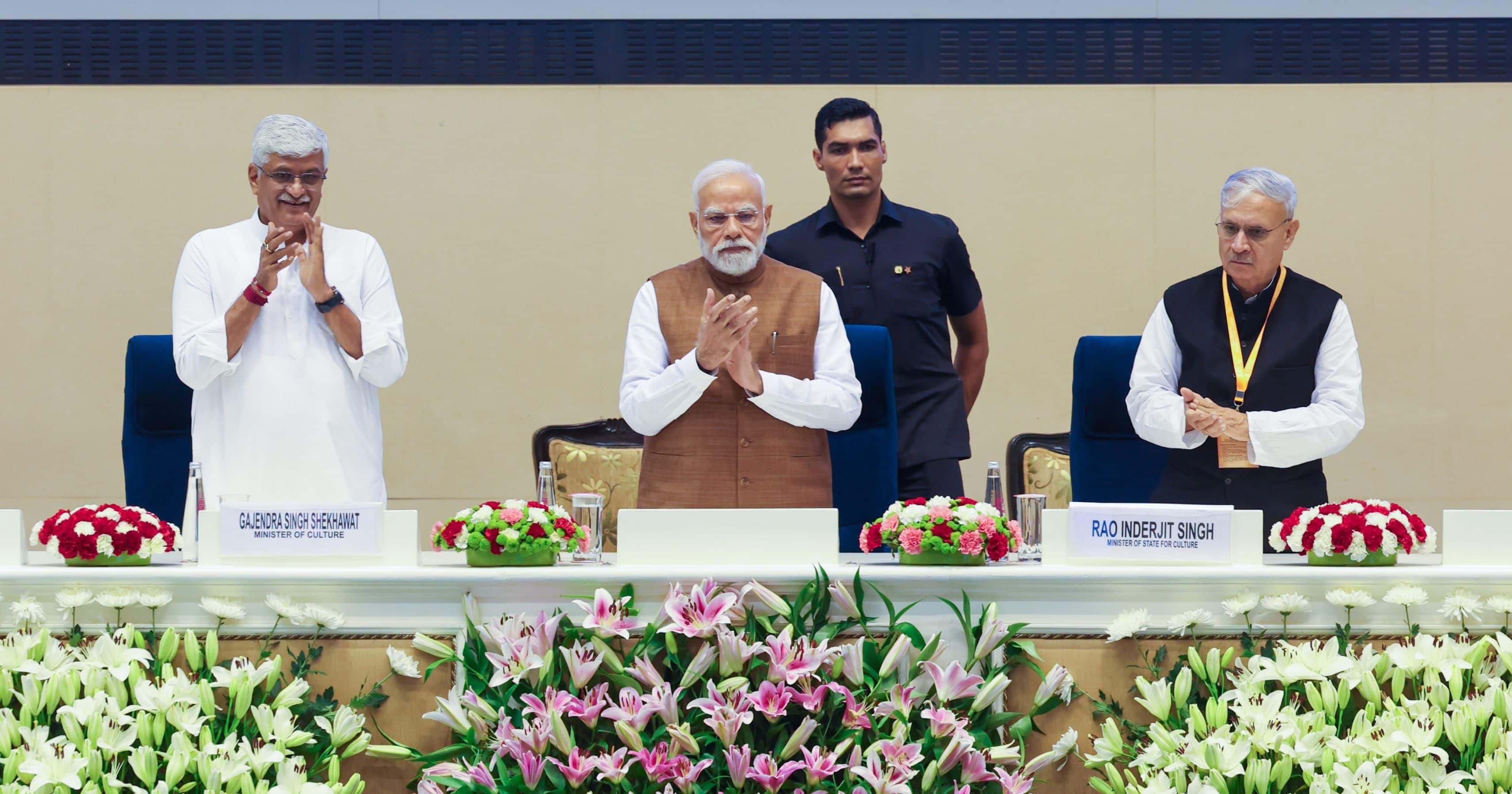
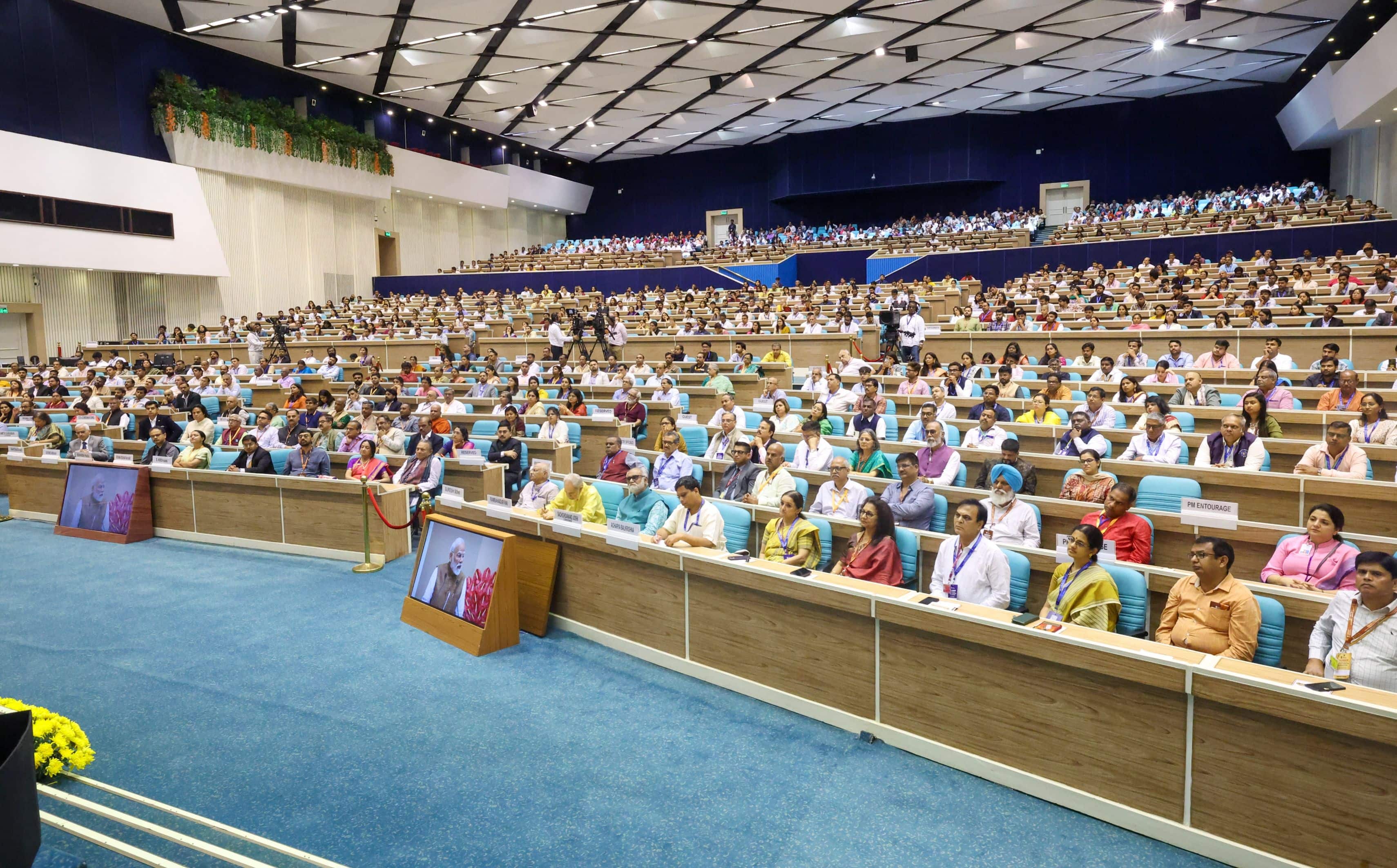
Today Vigyan Bhawan is witnessing the renaissance of India's golden past. Just a few days ago, I announced the Gyan Bharatam Mission. And today in such a short time we are organizing the Gyan Bharatam International Conference. The portal associated with it has also been launched recently. This is not a government or academic event; the Gyan Bharatam Mission is going to become a proclamation of India's culture, literature and consciousness. The thoughts and contemplation of thousands of generations, the wisdom and research of the great sages and scholars of India, our knowledge traditions, our scientific heritage, we are going to digitize them through the Gyan Bharatam Mission. I congratulate all the countrymen for this mission. I wish all the best to the entire team of Gyan Bharatam and also to the Ministry of Culture.

Friends,

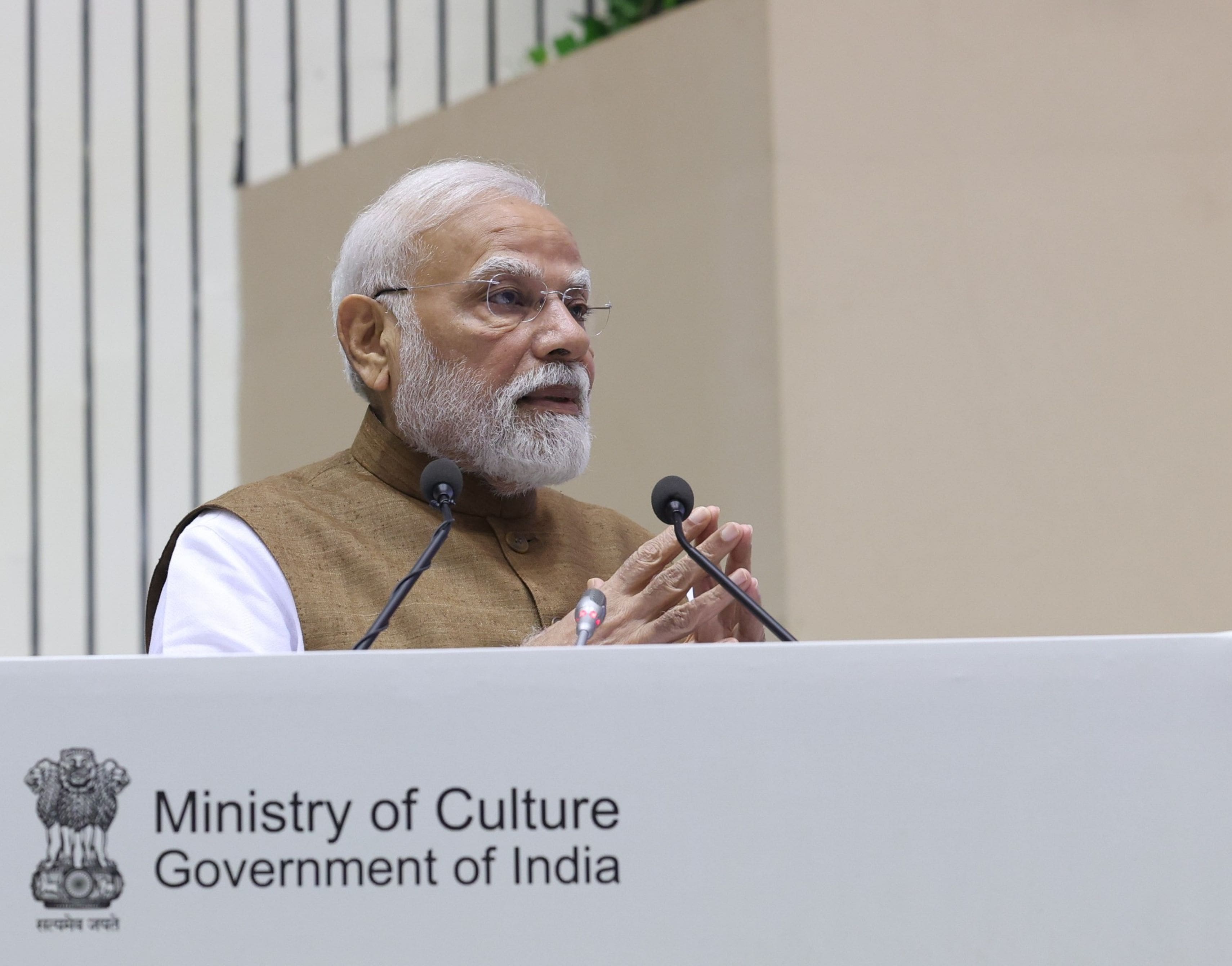
When we look at a manuscript, that experience is like time travel. This thought also comes to mind that there is a huge difference between the circumstances of today and earlier. Today we can write so much with the help of keyboard, there is also the option of delete and correction, we can make thousands of copies of a page with the help of printers, but imagine the world of hundreds of years ago, at that time there were no such modern material resources, our ancestors had to depend on intellectual resources only. How much attention was required while writing each letter, so much hard work was required for each book, and even at that time the people of India had built the biggest libraries in the world. Even today India has the world's largest manuscript collection. We have about 1 crore manuscripts. And the figure of 1 crore is not less.
Friends,

In the cruel blows of history, millions of manuscripts were burnt and disappeared, but those that survived bear witness to how deep and wide was the devotion of our ancestors towards knowledge, science, reading and teaching. Fragile texts made of Bhojpatra and Palm leaves (ताड़पत्र), words written on copper plates (ताम्रपत्र) were at risk of metal corrosion, but our ancestors considered words as God and served them with ‘अक्षर ब्रह्म भाव’. Generation after generation, families kept preserving those books and manuscripts. Immense respect for knowledge, concern for future generations, responsibility towards society, sense of dedication towards the country - where can we find a bigger example than this.

Friends,

India's knowledge tradition has remained so rich till today because its foundation is based on 4 main pillars. First- Preservation, second- Innovation, third- Addition and fourth- Adaptation.

Friends,

If I talk about preservation, you know that our most ancient scriptures, Vedas are considered to be the basis of Indian culture, Vedas are supreme. Earlier the Vedas were passed on to the next generation on the basis of 'Shruti'. And for thousands of years, the Vedas were preserved with authenticity without any error. The second pillar of this tradition of ours is innovation. We have continuously innovated in Ayurveda, Vastu Shastra, Astrology and metallurgy. Every generation progressed beyond the previous one, and made the old knowledge more scientific. Texts like Surya Siddhanta and Varahamihira Samhita were being written continuously, and new knowledge kept getting added to them. The third pillar of our preservation is addition. That is, every generation, along with preserving the old knowledge, also contributed something new. For example, after the original Valmiki Ramayana, many Ramayanas were written. We got texts like Ramcharitmanas. Annotations were written on the Vedas and Upanishads. Our acharyas gave explanations like Dvaita and Advaita.

Friends,

Similarly, the fourth pillar is – adaptation. That is, we also did self-introspection over time, and changed ourselves as per the need. We emphasized on discussions and followed the tradition of Shastrartha. Then the society abandoned the ideas that had become irrelevant, and accepted new ideas. In the medieval period, when many evils came into the society, there also came such eminent personalities who kept the conscience of the society awakened and saved and preserved the heritage.

Friends,

Apart from the modern concepts of nations, India has a cultural identity, its own consciousness, its own soul. The history of India is not just about the victories and defeats of sultanates. The geography of our princely states and kingdoms kept changing, but from the Himalayas to the Indian Ocean, India remained intact. Because India is a living flow in itself, which is created by its thoughts, ideals and values. In the ancient manuscripts of India, we see the lines of the continuous flow of India. These manuscripts are a declaration of our unity in diversity, a proclamation as well. Manuscripts are present in about 80 languages ​​in our country. We have a vast ocean of knowledge in so many languages ​​like Sanskrit, Prakrit, Assamese, Bengali, Kannada, Kashmiri, Konkani, Maithili, Malayalam, Marathi. Gilgit manuscripts tell us the authentic history of Kashmir. I went to see the small exhibition that is being held right now. It is described in detail there and its pictures are also present. In the manuscript of Kautilya Artha shastra, we get to know about India's understanding of political science and economics. In the manuscript of Kalpa sutra of Acharya Bhadrabahu, the ancient knowledge of Jainism is preserved. The knowledge of Lord Buddha is available in the manuscripts of Sarnath. Manuscripts like Ras Manjari and Gita Govinda have preserved the diverse colors of devotion, beauty and literature.

Friends,

These manuscripts of India contain the footprints of the development journey of entire humanity. There is philosophy as well as science in these manuscripts. They contain medicine as well as metaphysics. There is art, astronomy, and architecture in these. You can take as many examples as you want. From Mathematics to binary based Computer Science, the foundation of the entire modern science is based on zero. You all know that zero was discovered in India. And, the evidence of that ancient use of zero and mathematical formulas is still preserved in the Bakhshali Manuscript. The Bower Manuscript of Yashomitra tells us about the centuries old medical science. Manuscripts of texts like Charak Samhita and Sushruta Samhita have preserved the knowledge of Ayurveda till date. In Sulva Sutra we get ancient geometrical knowledge. In Krishi Parashara we get information about traditional knowledge of agriculture. Manuscripts of texts like Natya Shastra help us understand the journey of emotional development of human beings.

Friends,

Every country presents its historical things to the world as a civilizational asset and greatness. If the countries of the world have any manuscript, any artifact, they preserve it as a national treasure. And India has such a huge treasure of manuscripts, it is the pride of the country. Recently, I went to Kuwait, so during my stay, I try to find 4-6 influencers there, and if I have time, I spend some time with them, try to understand their thinking. I met a gentleman in Kuwait who has so many documents on how sea trade was conducted from India centuries ago, and he has collected so much, and he came to me with so much pride, that is, with great pride, I saw what all would be there, where all would it be, we have to preserve all this. Now India is going to present this glory to the world with pride. It was just said here that we should search and bring back all the manuscripts in the world and then it was quietly said that the Prime Minister should do it. But you know that the idols stolen from us were returned in very small quantities earlier, today old idols are being returned in hundreds. They are not coming back because they are coming to give it to me after deciding on my chest, it is not like that. They have faith that if they hand it over to such hands, then every effort will be made to increase its glory. Today India has created this faith in the world, people feel that this is the right place. When I went to Mongolia, I was interacting with Buddhist monks there and I saw that they had a lot of manuscripts. So, I requested them that I could do something with it. I brought all those manuscripts, digitalized them and gave them back to them and now it has become their treasure.

Friends,

Gyan Bharatam Mission is an important part of this great campaign. Many organizations of the country are working with the government in this effort with the spirit of public participation. Kashi Nagari Pracharani Sabha, Asiatic Society of Kolkata, 'Dharohar' of Udaipur, Acharya Shri Kailashsuri Gyan Mandir in Koba, Gujarat, Patanjali of Haridwar, Bhandarkar Oriental Research Institute of Pune, Saraswati Mahal Library of Thanjavur, with the cooperation of hundreds of such organizations, more than one million manuscripts have been digitized so far. So many countrymen have come forward and made their family heritage available for the country. I thank all these organizations and all such countrymen. I would definitely like to focus on one topic, I met some animal lovers recently, why did you laugh? There are many such people in our country, and the specialty is that they do not consider cow as an animal. So, while talking to him I told him that in our country there is a lot of knowledge about animal treatment written in the scriptures; many manuscripts are possible. When I was in Gujarat, I had an interest in the Asiatic Lion of Gujarat and I used to show a lot of interest in it. So, I used to find out that if they hunted too much and if they were in trouble, then they knew that there is a tree and its fruit should be eaten because vomiting can happen, the animal knew this. This means that wherever there are lion settlements, it is necessary to have such fruit trees. Now this is written in our scriptures. We have many manuscripts in which all these things have been written. What I mean to say is that we have so much knowledge available to us, and it is written down, we have to search it, explore it and interpret it in today's context.
Friends,

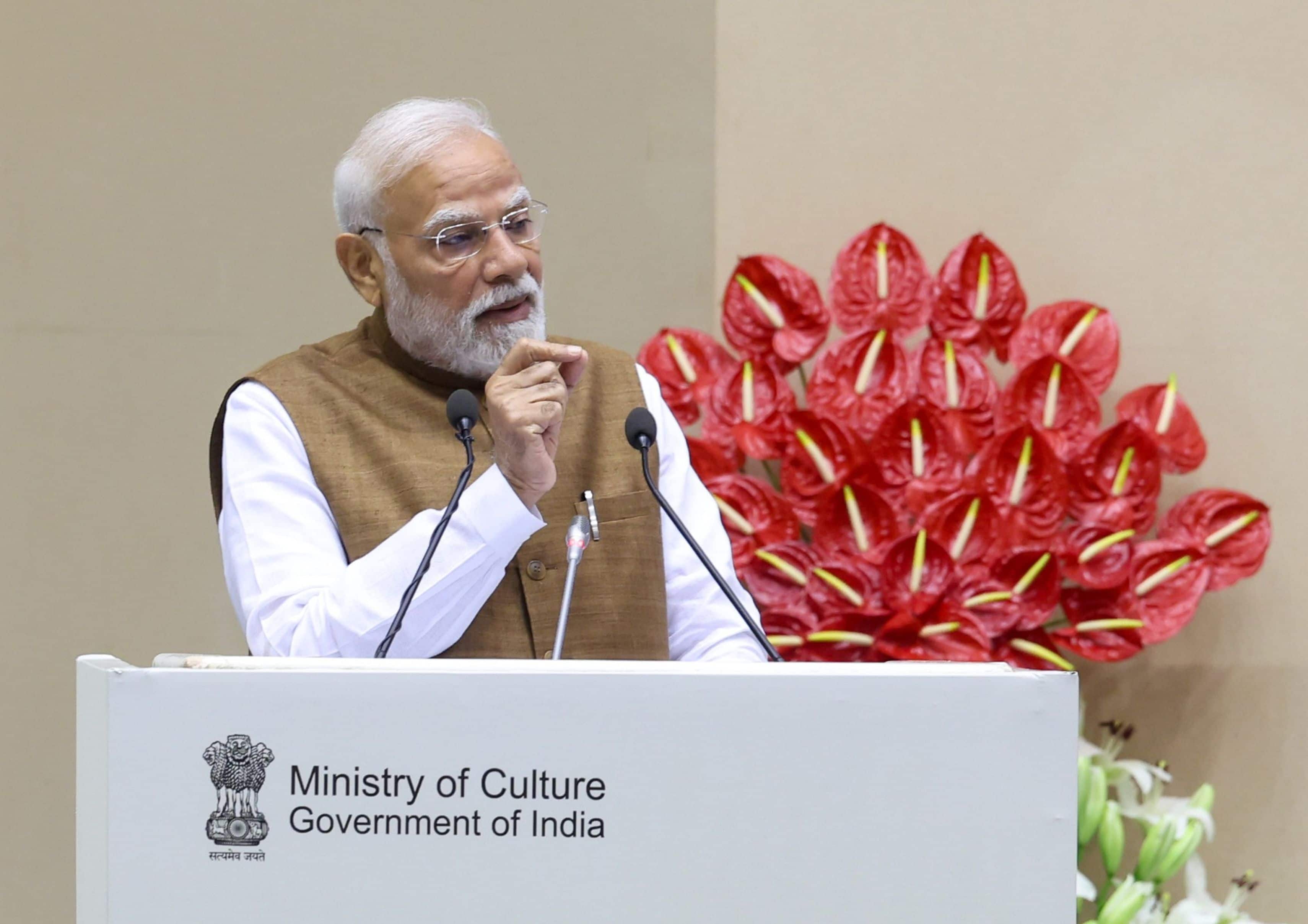
India has never measured its knowledge with the power of money in the past. Our sages have also said - विद्या-दानमतः परम्।. That is, knowledge is the greatest donation. That is why, in ancient times, the people of India have also donated manuscripts freely. When the Chinese traveler Hiuen Tsang came to India, he took with him more than six hundred and fifty manuscripts. And the President of China once told me that he had spent most of his time in my village, where I was born in Vadnagar. But when he returned to China from here, he lived at the birthplace of President Xi. So, he took me to his village and I went with him to see the place where Hiuen Tsang had lived, and President Xi showed me the manuscripts in full detail, and there were some paragraphs of the description of India in it, which the interpreter explained to me there. It is very impressive to the mind. He would look at each and every thing and wonder what treasure he might have. Many manuscripts of India have still reached Japan from China. In 7th century Japan they were preserved as a national treasure at Horyuji Monastery. Even today, ancient manuscripts of India are kept in many countries of the world. Under the Gyan Bharatam Mission, we will also try to unite this shared heritage of humanity.

Friends,

We had also taken this initiative during the G-20 cultural dialogue. We are involving countries which have centuries-old cultural ties with India in this campaign. We gifted reprinted volumes of the Mongolian Kanjur to the Ambassador of Mongolia. In 2022, these 108 volumes were also distributed in monasteries of Mongolia and Russia. We have signed MoUs with universities in Thailand and Vietnam. We are training scholars there to digitize old manuscripts. As a result of these efforts, many manuscripts in Pali, Lanna and Cham languages ​​have been digitized. We will expand these efforts further through the Gyan Bharatam Mission.
Friends,

Another big challenge will also be addressed through the Gyan Bharatam Mission. Many important information related to India's traditional knowledge system, which we have been using for centuries, are copied and patented by others. It is also necessary to stop this piracy. These efforts will gain more momentum through digital manuscripts, and intellectual piracy will be curbed. The world will also get to know the original sources with authenticity on all subjects.

Friends,

Gyan Bharatam Mission has another very important aspect. For this, we are opening many new domains of research and innovation. Today, the world has a cultural and creative industry worth about two and a half trillion dollars. Digitized manuscripts will feed the value chains of this industry. These millions of manuscripts and the ancient information hidden in them will also serve as a huge database. These will give a new push to 'data driven innovation'. This will create new opportunities for the youth in the tech field. As the manuscripts are digitized, new possibilities will be created for academic research.
Friends,

We have to increase the use of new technologies like AI to study these digitized manuscripts. I agree with what was said in the presentation here that AI cannot replace talent or human resources and we also want that it should not be replaced, otherwise we will become victims of new slavery. It is a support system, it strengthens us, boosts our strength, boosts our speed. With the help of AI, these ancient manuscripts can be understood deeply and can also be analyzed. Now see, not all Vedic mathematics texts are available, if we try through AI, then it is possible that many new formulas can be discovered. We can discover them. AI can also be used to bring the knowledge contained in these manuscripts to the world. Another problem is that our manuscripts are scattered, and presented in different ways, in different periods. The advantage of AI will be that all these can be collected and we can get a very good tool to extract nectar from it, that if there are things lying at 10 places, then with the help of AI we can bring them together and observe them. We may... as it was mentioned in the presentation in the beginning that the same words have many uses, it may be that once we solve them, we will make 100 questions, today we are stuck with lakhs of questions, we will bring it to 100. It may be that when we connect with human power, it will bring results, but there are many such difficulties, but there are ways also.

Friends,

I appeal to all the youth of the country to come forward and join this campaign. And the Minister Ji was just telling me that from yesterday till today, 70% of the people who are participating in this are youth. I think this is the biggest sign of its success. If the youth start taking interest in this, then I am sure that we will achieve success very quickly. How can we explore the past through technology? How can we make this knowledge accessible to humanity on evidence-based parameters? We should make efforts in this direction. Our universities and institutes should also take new initiatives for this. Today, the whole country is moving forward with the spirit of Swadeshi and the resolve of self-reliant India. This campaign is also an extension of that. We have to make our heritage synonymous with our strength, i.e. power. I believe that a new chapter of the future is going to begin with the Gyan Bharatam Mission. I know that these are such subjects in which there is no glamour, no glitter. But its power is so much that no one can shake it for centuries, we have to connect with this power. With this belief, best wishes to all of you once again.

Thank you very much.

Explore More
Today, the entire country and entire world is filled with the spirit of Bhagwan Shri Ram: PM Modi at Dhwajarohan Utsav in Ayodhya

பிரபலமான பேச்சுகள்

Today, the entire country and entire world is filled with the spirit of Bhagwan Shri Ram: PM Modi at Dhwajarohan Utsav in Ayodhya
‘Highly Focused’: Canada PM Mark Carney Calls PM Modi A ‘Unique Leader’ After India Visit

Media Coverage

‘Highly Focused’: Canada PM Mark Carney Calls PM Modi A ‘Unique Leader’ After India Visit
NM on the go

Nm on the go

Always be the first to hear from the PM. Get the App Now!
...
India – Finland Joint Statement on the State Visit of President of the Republic of Finland
March 05, 2026

At the invitation of the Hon'ble Prime Minister of India, Shri Narendra Modi, President of the Republic of Finland, H.E. Dr. Alexander Stubb, is on a State Visit to India from 4-7 March 2026. President Stubb, who is on his first visit to India in his present capacity, is visiting New Delhi and Mumbai and is accompanied by Ms. Sari Multala, Minister of Climate and the Environment of Finland, Mr. Matias Marttinen, Minister of Employment of Finland, and a high-level delegation comprising of officials and business leaders. Prime Minister Modi inaugurated the 11th edition of the Raisina Dialogue on 5 March 2026 in New Delhi with President Stubb as the Chief Guest delivering the Inaugural Keynote Address. President Stubb’s visit follows the visit of H.E. Mr. Petteri Orpo, Prime Minister of the Republic of Finland for the AI Impact Summit in February 2026.

On 5 March 2026, President Stubb was warmly welcomed by Hon’ble President of India Smt. Droupadi Murmu at Rashtrapati Bhavan. Prime Minister Modi and President Stubb held wide-ranging discussions during a bilateral meeting, and jointly addressed the media. Prime Minister Modi also hosted a luncheon in honour of the visiting dignitary.

The President of Finland congratulated India for successfully hosting the AI Impact Summit 2026. Both Leaders shared the view that working towards safe, trustworthy, and inclusive development of AI is of paramount importance.

The Leaders affirmed the deep and enduring friendship between India and Finland, built on a foundation of mutual respect and the values of democracy and rule of law, as well as commitment to global peace, security, and international law.

The Prime Minister of India and the President of Finland reiterated their commitment to the rules-based international order and multilateral cooperation, with the UN at its core.

The Leaders underlined the importance of redoubling efforts to reach the Sustainable Development Goals, and the importance of global cooperation against the challenges of climate change and loss of biodiversity.

Welcoming the landmark Free Trade Agreement between India and the European Union concluded in the India-EU Summit on 27 January 2026, the Leaders acknowledged the immense and mutually beneficial opportunities for both parties of increased trade and investments, including for the India-Finland bilateral relationship.

Building on the momentum provided by the India-Finland Virtual Summit on 16 March 2021 and the meetings of the Prime Ministers of both countries in the margins of two editions of India-Nordic Summit in 2018 and 2022 in Stockholm and Copenhagen respectively, as well as during the AI Impact Summit in February 2026, the Leaders emphasized their shared commitment to continue expanding and deepening the cooperation between the two nations. In this spirit, the leaders agreed to elevate the India-Finland relations to a Strategic Partnership in Digitalization and Sustainability, based on converging interests and mutual benefits.

Trade and Investment

The Prime Minister of India and the President of Finland called upon the business community to make use of the vast opportunities unleashed by the landmark India-EU FTA. In this context, The Leaders agreed that the aim should be to double the value of current trade between India and Finland by 2030.

The Leaders took note of the lively interactions between the respective business communities, reflected by the large business delegation visiting India together with the Finnish President, as well as the companies that joined the Finnish Prime Minister in February in connection with the AI Impact Summit in New Delhi. Both leaders expressed confidence that the India-Finland Business Summit and CEOs interaction scheduled to take place in Mumbai on 7 March would help pave the way for enhancing trade, technology collaboration and investments ties.

The Leaders welcomed the growing startup collaboration, manifested by the active participation of innovative Indian startups in Slush in Helsinki and Finnish startups in Startup Mahakumbh in New Delhi, as well as initiatives such as the Indo-Finland Startup Corridor.

Digitalization

Recognizing the transformative power of digitalization as a key driver of inclusive social and economic development, the Leaders identified digital transformation, including new and emerging technologies such as 5G, 6G, high-performance and quantum computing and Artificial Intelligence, as priority areas where collaboration based on mutual trust and benefit can be strengthened. The Leaders noted India’s experience in Digital Public Infrastructure, including digital payments such as the Unified Payments Interface (UPI), and discussed possibilities for cooperation in this area.

Against this backdrop, the Leaders asked the relevant ministries to establish a cross-sectoral Joint Working Group on Digitalization to define priorities and foster work on concrete and substantial actions driving the digital transition.

The Finnish President emphasized the positive impact of the considerable number of Indian professionals in the Finnish R&D and tech innovation ecosystems, contributing to social and economic development by means of digital transition and sustainability for the benefit of all.

The Leaders noted with satisfaction the Joint Calls by the Indian Department of Science and Technology and Business Finland to provide RDI funding for joint initiatives of Indian and Finnish companies and research organizations with focus on semiconductors, 6G, and energy systems. They also took note of the cooperation framework between Bharat 6G Alliance and the University of Oulu, Finland, welcoming all efforts to further strengthen bilateral collaboration on 6G.

Furthermore, the Leaders welcomed the work between the Indian Ministry of Electronics and Information Technology and Business Finland to further explore avenues of RDI collaboration with special focus on AI, noting also the discussions between the Indian Centre for Development of Advanced Computing and the Finnish IT Centre for Science with respect to High-Performance Computing.

In the field of advanced technology, the Leaders also highlighted Space tech as an emerging area of collaboration with considerable future potential and active private sector engagement between Indian and Finnish players.

Sustainability

On sustainability, both Leaders underlined the great potential in advancing clean energy solutions, notably in areas such as low carbon transition, energy efficiency, biofuels, smart grids, and green hydrogen. In addition, they highlighted the importance of cooperation in circular economy, sustainable water management and meteorology.

To this end, the Leaders welcomed the establishment of a Joint Working Group on Sustainability, bringing together relevant actors from both countries to enhance collaboration on sustainability-related issues.

Moreover, the Leaders underscored the importance of implementing the Memorandum of Understanding on Cooperation in the field of Renewable Energy, encompassing many key areas of collaboration that contribute to sustainability, including bioenergy and waste-to-energy solutions, power storage and flexible RE systems, green hydrogen, as well as wind, solar and small hydro power.

They acknowledged the renewal of the Memorandum of Understanding on Environmental Cooperation, and collaboration under the Leadership Group for Industry Transition (LeadIT) and encouraged the parties to advance the deeper collaboration in circular economy, climate action, and sustainability.

Both sides acknowledged that the rapid deployment of Smart Energy solutions, including Advanced Metering Infrastructure (AMI) and other digital grid technologies, has enhanced efficiency while increasing cybersecurity risks to critical power infrastructure. They agreed to explore future areas of cooperation in promoting resilient, reliable and sustainable smart grid systems.

The Finnish President extended his appreciation to India for hosting the next World Circular Economy Forum in the later part of 2026, a Finnish initiative providing a platform to enhance circular economy solutions and bring together leading expertise in the search for new collaborative initiatives.

The Prime Minister of India acknowledged Finland’s active role in bringing together Indian, Finnish and other Nordic stakeholders in the framework of the Indo-Nordic Water Forum, promoting new collaborations and best practices in water resources management and wastewater management for circular economy solutions.

With respect to meteorological collaboration, the Leaders underscored the ongoing cooperation in aerosol monitoring and air quality forecasting between the Finnish Meteorological Institute (FMI) and the Indian Meteorological Department (IMD). They welcomed the work to establish a Virtual Research Center between FMI and the Indian Institute of Technology Madras (IITM), also taking note of the already ongoing FMI-IITM research collaboration with multilateral projects exceeding a total value of Euros 11 million.

The Leaders also took note of the exchange of experiences between the Indian Ministry of Rural Development and the National Land Survey of Finland and the Finnish Environment Institute, cities, and companies about Land Stack, an integrated GIS based digital platform of land and property information.

The Leaders welcomed the signing of Memorandum of Understanding on fostering cooperation in the field of Official Statistics which provides a framework for exchange of best practices, methodologies, and technical expertise in the area of official statistics.

Mobility, education, and people-to-people contacts

The Prime Minister of India and the President of Finland recognized the importance of people-to-people contacts in all fields, including skilled workers, specialists and young professionals, researchers and students, businesspersons, and academics, thereby nurturing economic prosperity, contributing to a rich social fabric, and enhancing mutual understanding.

In this context, the Leaders hailed the signing of a Memorandum of Understanding on Migration and Mobility Partnership, laying the frameworks for smooth, orderly, and mutually beneficial mobility for the years to come. Both sides agreed to take the steps required for the implementation of the MoU in a comprehensive and coordinated manner, that serves both India’s and Finland’s prosperity and economic growth. The Leaders also acknowledged the contacts between the respective Foreign Ministries, looking into possibilities of establishing bilateral dialogue on consular matters.

The Leaders took note of the Joint Statement endorsed by the High-Level Dialogue on Cooperation in Education (31 January 2024) and encouraged the relevant parties to accelerate their joint efforts to advance the common agenda, focusing on the agreed areas of secondary education, higher education, skill development, and student mobility.

In this context, they noted the growing interest in India towards the Finnish education system, the increasing cooperation in teacher training, as well as early childhood education institutions and schools that are being set up according to the Finnish model, as concrete expressions of the stakeholders’ shared will and commitment to continue developing the collaboration on education.

Furthermore, the Leaders highlighted the discussions on a bilateral audiovisual co-production agreement that will provide a solid frame to enhance cooperation in the film and gaming industries.

India-EU-relations

Both Leaders welcomed the new Joint India-EU Comprehensive Strategic Agenda, endorsed in the India-EU Summit on 27 January 2026, based on shared values and principles, mutual trust, converging interests, and shared political will. They agreed that India and the EU can be stable, predictable, and trusted partners, building a multifaceted and deepening long-term relationship with many positive outcomes for both sides.

The Leaders underlined that the conclusion of Free Trade Agreement takes the India-EU relations to a new level. In addition to clear economic benefits by enhancing market access and removing trade barriers, both Leaders noted that the FTA could support economic security and resilience through diversifying critical value chains and opening new markets.

As a platform to address key trade, technology, and economic security issues, the Leaders reaffirmed their support to further enhance the work of the India-EU Trade and Technology Council as the cornerstone of the India-EU technology partnership.

The Prime Minister of India and the President of Finland underscored that the signing of India-EU Security and Defense Partnership added another meaningful dimension to the India-EU Strategic Partnership that will deepen co-operation in areas of shared interests, including maritime security, defense industry, cyber and hybrid threats, space, as well as counter-terrorism.

The leaders lauded the signing of the MoU on Comprehensive Framework of Cooperation on Mobility and the launch of pilot European Union Legal Gateway Office in India.

Multilateral cooperation

The Leaders recognized the need to reform the UN system. In this context, they emphasized the importance of a comprehensive reform of the UN Security Council to make it more efficient, representative, inclusive, and reflective of contemporary geopolitical realities. The President of Finland reiterated Finland’s support for the permanent membership of India in a reformed UNSC.

The leaders underscored the vital role of cooperation within the United Nations and other international bodies to safeguard multilateralism and uphold a rules-based international order, including supporting mutual candidacies and nominations.

Both sides agreed to continue their constructive cooperation in multilateral fora, including on peace and security, human rights, sustainable development as well as climate change and biodiversity.

The Leaders reiterated their shared commitment to promoting a free, open, peaceful and prosperous Indo‑Pacific, in accordance with international law, including the UNCLOS. In this context, India welcomed Finland to join the Indo-Pacific Oceans Initiative.

Both leaders reaffirmed their commitment to further strengthening cooperation and dialogue on Arctic matters, including through joint research initiatives, academic exchanges, and capacity-building programmes. They took note of the first India–Finland Arctic Dialogue titled "The Himalayan and Arctic Ecosystems: India–Finland Partnership for a Sustainable Future” held in January 2026 in Rovaniemi, Finland, which brought together parliamentarians, government officials, academics and experts to deliberate on strategies and pathways for deepening collaboration on Arctic matters. Both leaders also underscored the importance of advancing cooperation in the structures of the Arctic Council, and within the broader framework of the India-Nordic Summit.

Both leaders unequivocally and strongly condemned terrorism and violent extremism in all its forms and manifestations, including cross-border terrorism. They called for decisive and concerted international efforts to combat terrorism in a comprehensive and sustained manner and in accordance with international law. They agreed to enhance cooperation to counter violent radicalization and extremism, combat financing of terrorism, promote internationally agreed anti‑money laundering standards, prevent exploitation of new and emerging technologies for terrorist purposes, and tackle terrorist recruitment. The leaders reaffirmed strong commitment to continue taking active measures to disrupt the terror financing channels including at the UN and FATF. They condemned in the strongest terms the terrorist attack in Pahalgam, Jammu and Kashmir on 22 April 2025 and the terror incident near Red Fort, New Delhi on 10 November 2025.

Both Leaders agreed to continue to support efforts towards the achievement of a comprehensive, just, and lasting peace in Ukraine through dialogue and diplomacy, based on the principles of the UN Charter and international law, including independence, sovereignty, and territorial integrity.

Conclusion

To take forward the cooperation under the India-Finland Strategic Partnership in Digitalization and Sustainability, the Leaders asked the respective Working Groups on Digitalization and Sustainability to develop a future-oriented and concrete Action Plan, including definition of priority areas and related actions, and report back to the Ministry for Foreign Affairs of the Republic of Finland and the Ministry of External Affairs of the Republic of India on the progress achieved.

The President of Finland thanked the Prime Minister of India for the excellent arrangements during his state visit, and both Leaders expressed their appreciation of the open and constructive dialogue, and the forward-reaching and evolving cooperation. They agreed to continue their interaction with a solid foundation in a shared spirit of mutual respect and collaboration. President Stubb invited Prime Minister Modi to pay a visit to Finland, and Prime Minister Modi accepted the invitation.