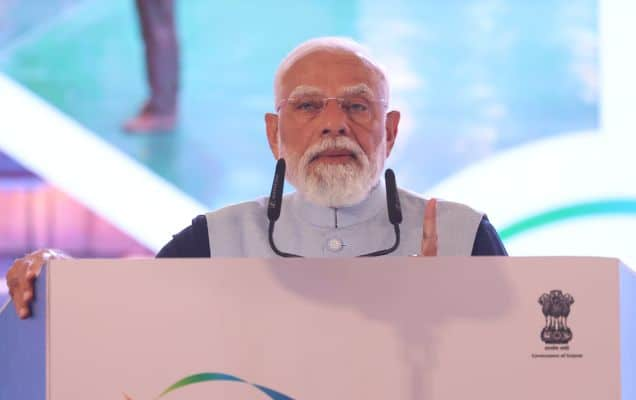
Praise has been showered on Prime Minister Narendra Modi’s charismatic presence and organisational leadership. Less understood and known is the professionalism which characterises his work — a relentless work ethic that has evolved over decades when he was the Chief Minister of Gujarat and later Prime Minister of India.
What sets him apart is not a talent for spectacle but a discipline that turns vision into durable systems. It is action anchored in duty, measured by difference on the ground.
A charter for shared work
That ethic framed the Prime Minister’s Independence Day address from the Red Fort, this year. It was a charter for shared work: citizens, scientists, start-ups and States were invited to co-author Viksit Bharat. Ambitions in deep technology, clean growth and resilient supply chains were set out as practical programmes, with Jan Bhagidari, the partnership between a platform-building state and an enterprising people, as the method.
The recent simplification of the Goods and Services Tax (GST) structure reflects this method. By paring down slabs and ironing out friction points, the GST Council has lowered compliance costs for small firms and quickened pass-through to households. The Prime Minister’s focus was not on abstract revenue curves but on whether the average citizen or small trader would feel the change quickly. This instinct echoes the cooperative federalism that has guided the GST Council: States and the Centre debating rigorously, but all working within a system that adapts to conditions rather than remaining frozen. Policy is treated as a living instrument, tuned to the economy’s rhythm rather than a monument preserved for symmetry on paper.
I recently requested a 15- minute slot to meet the Prime Minister and was struck by the depth and range that he brought to the discussion — micro details and macro linkages that were held together in a single frame. It turned into a 45 minute meeting. Colleagues told me later that he had spent more than two hours preparing, reading through notes, data and counter-arguments. That level of homework is the working norm he sets for himself and expects of the system.
A focus on the citizen
Much of India’s recent progress rests on plumbing and systems which are designed to ensure dignity to our citizens. The triad of digital identity, universal bank accounts and real-time payments has turned inclusion into infrastructure. Benefits move directly to verified citizens, leakages shrink by design, small businesses enjoy predictable cash flow, and policy is tuned by data rather than anecdote. Antyodaya — the rise of the last citizen — becomes a standard, not a slogan and remains the litmus test of every scheme, programme and file that makes it to the Prime Minister’s Office.
I had the privilege to witness this once again, recently, at Numaligarh, Assam, during the launch of India’s first bamboo-based 2G ethanol plant. Standing with engineers, farmers and technical experts, the Prime Minister’s queries went straight to the hinge points: how will farmer payments be credited the same day? Can genetic engineering create bamboo that grows faster and increases the length of bamboo stem between nodes? Can critical enzymes be indigenised? Is every component of bamboo, stalk, leaf, residue, being put to economic use, from ethanol to furfural to green acetic acid?
The discussion was not limited to technology. It widened to logistics, the resilience of the supply chain, and the global carbon footprint. There was clarity of brief, precision in detail and insistence that the last person in the chain must be the first beneficiary.
The same clarity animates India’s economic statecraft. In energy, a diversified supplier basket and calm, firm purchasing have kept India’s interests secure in volatile times. On more than one occasion abroad, I carried a strikingly simple brief: secure supplies, maintain affordability, and keep Indian consumers at the centre. That clarity was respected, and negotiations moved forward more smoothly.
National security, too, has been approached without theatre. Operations that are conducted with resolve and restraint — clear aim, operational freedom to the forces, protection of innocents. The ethic is identical: do the hard work, let outcomes speak.
The work culture
Behind these choices lies a distinctive working style. Discussions are civil but unsparing; competing views are welcomed, drift is not. After hearing the room, he reduces a thick dossier to the essential alternatives, assigns responsibility and names the metric that will decide success. The best argument, not the loudest, prevails; preparation is rewarded; follow-up is relentless.
It is no accident that the Prime Minister’s birthday falls on Vishwakarma Jayanti, the day of the divine architect. The parallel is not literal but instructive: in public life, the most enduring monuments are institutions, platforms and standards. For the citizen, performance is a benefit that arrives on time and a price that stays fair. For the enterprise, it is policy clarity and a credible path to expand. For the state, it is systems that hold under stress and improve with use. That is the measure by which Narendra Modi should be seen, shaping the next chapter of the Indian story.
Hardeep S. Puri is Union Minister for Petroleum and Natural Gas, Government of India