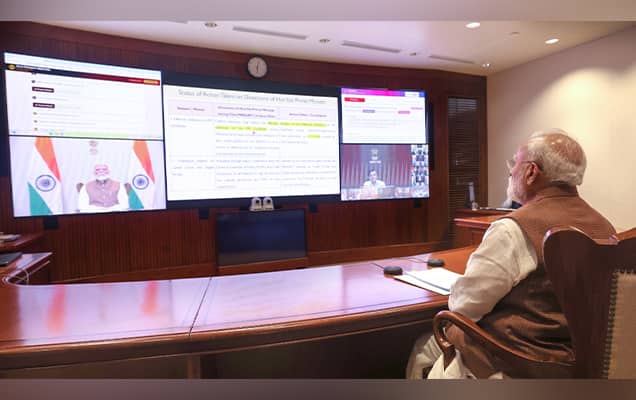
It is the first in a series of Post Budget Webinars being organised on key themes emerging from the Union Budget

Prime Minister Shri Narendra Modi will address the Post Budget Webinar on “Technology, Reforms and Finance for Viksit Bharat” on 27th February at around 11:30 AM via video conferencing. The webinar will entail discussions on public capex, infrastructure, banking sector reforms, financial sector architecture, deepening capital markets, and ease of living through tax reforms.

The webinar is the first in a series of Post Budget Webinars being organised on key themes emerging from the Union Budget 2026–27. These webinars aim to draw lessons from past experiences and obtain structured feedback from participants to strengthen and ensure outcome-oriented implementation of the Budget announcements for FY 2026-27, drawing upon the practical experience and insights of diverse stakeholders. They will bring together stakeholders from industry, financial institutions, market participants, Government, industry regulators and academia to deliberate on effective implementation pathways for key Budget announcements.

Explore More
Today, the entire country and entire world is filled with the spirit of Bhagwan Shri Ram: PM Modi at Dhwajarohan Utsav in Ayodhya

பிரபலமான பேச்சுகள்

Today, the entire country and entire world is filled with the spirit of Bhagwan Shri Ram: PM Modi at Dhwajarohan Utsav in Ayodhya
PM Modi becomes first world leader to cross 100 million Instagram followers

Media Coverage

PM Modi becomes first world leader to cross 100 million Instagram followers
NM on the go

Nm on the go

Always be the first to hear from the PM. Get the App Now!
...
India - Israel Joint Statement
February 26, 2026

A Special Strategic Partnership for Peace, Innovation, and Prosperity

Recognising the warmth, goodwill, and deep strategic partnership between India and Israel, the Prime Minister Shri Narendra Modi made a state visit to Israel from 25 to 26 February 2026 on the invitation of Mr. Benjamin Netanyahu, Prime Minster of the State of Israel. The Prime Minister was accompanied by a high-level delegation comprised of senior ministers and officials. Recalling Indian Prime Minister Narendra Modi's historic visit to Israel in 2017 and Prime Minister Netanyahu’s visit to India in 2018, which together laid the foundation for a new era of partnership and collaboration, the leaders noted the immense progress made in the India-Israel bilateral relationship across diverse domains, including emerging technologies, cyber, agriculture, water management, health, entrepreneurship, defence, security, and more. Prime Minister Netanyahu and Prime Minister Modi agreed and decided to elevate the Strategic Partnership to a new level – ‘A Special Strategic Partnership for Peace, Innovation & Prosperity.’

Together into the future

The Prime Ministers reaffirmed their shared vision for a robust special strategic partnership rooted in mutual aspirations for peace, security and prosperity through technological innovations and entrepreneurship. The leaders acknowledged that Indian and Israeli capabilities complement each other perfectly - Israel is a global powerhouse of technology and innovation, India serves as a hub of talent, manufacturing excellence and entrepreneurial energy. The Prime Ministers affirmed their commitment to integrating India's and Israel's advancements in AI, cybersecurity, semiconductors, quantum computing, biotechnology, agriculture and water management, defence platforms, and space exploration. This partnership strengthens India’s vision of an ‘Atmanirbhar and Viksit Bharat 2047’, aims to spark the next wave of technological transformation and shared progress of both countries.

Underscoring the shared commitment to transform policy priorities into tangible outcomes, the Prime Ministers emphasised the importance of institutionalising bilateral mechanisms across Government-to-Government, Business-to-Business, and People-to-People domains to ensure sustained collaboration and meaningful impact.

Defence and Security

Welcoming the Memorandum of Understanding on Defence Cooperation signed on 4th November 2025, Prime Minister Netanyahu and Prime Minister Modi acknowledged the significant growth made in defence cooperation between their nations, both in scope and scale. Both leaders provided a vision and a roadmap for future defence cooperation.

Technology and Innovation

Acknowledging the complementary strengths of India's and Israel's technological prowess that create avenues for deeper collaboration in Critical and Emerging Technology (CET) sectors, Prime Minister Netanyahu and Prime Minister Modi welcomed the new initiative on Critical and Emerging Technologies led by the National Security Advisors of the two countries. They emphasised that this initiative would synergise the individual strengths of both countries in niche technologies, fostering a focused and futuristic partnership. The leaders called on both sides to take forward the initiative.

The Prime Ministers reviewed the functioning of the India-Israel Industrial R&D and Innovation Fund (I4F), jointly implemented by the Department of Science and Technology of India and the Israel Innovation Authority, and reaffirmed its important role in advancing industrial collaboration between the two countries. They agreed to further strengthen the operational implementation of the I4F mechanism, including enhanced outreach to industry and facilitation of high-quality joint R&D partnerships, in order to fully realize the Fund’s potential and expand impactful cooperation between Indian and Israeli enterprises.

Acknowledging the success of the India-Israel Joint Research Calls (IIJRC), implemented by Department of Science and Technology (DST), India, and Ministry of Innovation, Science and Technology (MOST), Israel, the Prime Ministers agreed to increase the contribution of both sides— from the current USD 1 million to USD 1.5 million each. This will promote joint research between Indian and Israeli universities through joint use of research facilities, materials, and equipment, and will also provide for exchange visits of the collaborating scientists. Both sides agreed to mandate the Joint Scientific Committee to coordinate and advance the Joint Research Call. The leaders also welcomed the elevation of the Joint Commission on Science and Technology to the Ministerial level and both sides agreed to hold the JCM on Science and Technology at Ministerial level at the earliest possible occasion in India or in Israel.

The Prime Ministers recognized the importance of strengthening academia–industry linkages as a key driver of innovation and agreed to promote structured networking and collaboration between researchers, industry leaders and technology experts from both countries, with a view to advancing joint research, technology development and commercial partnerships.

The Prime Ministers recognized the importance of creating institutional support to advance joint innovation activities between the two countries. In this context, they agreed to explore the development of Tech Gateway mechanisms to facilitate collaborative R&D initiatives, technology validation processes, pilot projects and joint development activities between Indian and Israeli innovation ecosystems.

The Prime Ministers recognized the strategic importance of Artificial Intelligence as a key driver of innovation and agreed to deepen cooperation in AI talent and expertise. They welcomed efforts to develop enabling frameworks that strengthen linkages between AI professionals, research institutions and innovative enterprises, including by facilitating professional collaboration and participation in leading innovation activities in both countries.

Recognising the advances made by Israel and India in artificial intelligence, both leaders welcomed the signing of the MoU on Cooperation in Artificial Intelligence (AI) and agreed to deepen collaboration in this frontier technology for the welfare of their peoples.

The Prime Ministers welcomed the ongoing collaboration between the Israel Space Agency (ISA) and the Indian Space Research Organisation (ISRO), recognising the significant potential for Israeli space-based start-ups and companies to engage more deeply with their Indian counterparts. They emphasised the importance of fostering greater cooperation between the two nations' space industries, encouraging joint ventures, innovation partnerships, and knowledge exchange to drive progress in the global space sector.

Both leaders welcomed the signing of the Declaration of Intent for cooperation in establishing a ‘Horizon Scanning/Strategic Foresight Mechanism’. This mechanism helps identify emerging global trends in areas like technology, economy and society, by leveraging data, AI and expert insights to support strategic planning and decision making.

Cybersecurity

The Prime Ministers reaffirmed their commitment to enhancing cybersecurity in both governmental and private sectors. They emphasized the need for robust dialogue between their national cyber authorities and pledged to deepen cooperation in this field. In addition, they committed to developing a multi-year strategic program to guide bilateral collaboration in cybersecurity and advance a joint roadmap for implementation. The roadmap will include, among other elements, human capacity building, cybersecurity and AI, applied research, the integration of Security by Design principles and regular joint table top exercises. Recognising the importance of strengthening and institutionalising their comprehensive cyber cooperation, they welcomed the successful convening of the inaugural India-Israel Cyber Policy Dialogue in March 2025. In a significant step forward, both leaders welcomed the signing of Letter of Intent for the establishment of an India-Israel Centre of Excellence in Cybersecurity in India to foster the activities outlined above.

Trade, Investment, and Connectivity

Prime Minister Modi and Prime Minister Netanyahu emphasised the importance of unlocking the full potential of bilateral trade and investment. They welcomed the signing of the India-Israel Bilateral Investment Agreement by the two Finance Ministers in New Delhi in September 2025, which is expected to enhance investor confidence, promote greater two-way investments, and ensure transparency, predictability, and protection through a clear framework of treatment of investment and independent dispute resolution mechanism.

Both leaders welcomed the signing of the Terms of Reference (ToR) for the Free Trade Area (FTA) Agreement negotiations and the convening of the first negotiating round in New Delhi. The leaders assert their commitment for the realization of the FTA Agreement between the two countries and tasked the negotiating teams to expedite the negotiations for an early signing of an FTA.

Both Leaders emphasized that a resilient financial ecosystem is a fundamental pillar of economic stability. They welcomed the strategic partnership in the financial-cyber domain. This collaboration will focus on enhancing the resilience of the financial ecosystem through the exchange of financial- cyber intelligence, joint development of methodologies, and the performance of multilateral financial-cyber simulations operationalised through Financial Computer Security Incident Response Teams of both countries.

Prime Minister Netanyahu appreciated India’s fintech revolution, exemplified by the Unified Payments Interface (UPI), which is a world-class model for affordable, real-time cross-border transactions. Both sides agreed to explore linking UPI with Israel’s fast payment system to enhance interoperability and strengthen economic ties.

Both leaders welcomed the signing of an MoU between NPCI International and MASAV for cooperation in order to examine linkages between NPCI and MASAV for cross-border payments between the countries.

The leaders noted that direct air connectivity is a basic building block that is essential for scaling the bilateral relationship to new heights. In this regard, they expressed their desire to expand direct air connectivity between Tel Aviv and major Indian cities and encouraged both Indian and Israeli airlines to take up the opportunity to start direct flight operations between the two countries.

The leaders welcomed the launch of the India–Israel Financial Dialogue to boost closer financial cooperation.

Both leaders encouraged more Indian participation in the infrastructure sector of Israel, particularly in light of major upcoming projects in Israel in the sectors of metro, rail, road, airports, desalination plants, waste-water treatment plants, etc.

The two leaders welcomed the successful conclusion of the 4th round of India-Israel CEOs Forum and Business Summit in Tel Aviv in November 2025. They commended the meaningful engagement between business and government leaders, which contributed to strengthening bilateral economic cooperation and unlocking new opportunities for investment and collaboration across key sectors. Both leaders reaffirmed their commitment to building on this positive momentum to further deepen the India-Israel strategic partnership. They also welcomed the signing of the MoU on Arbitration between Indian Council of Arbitration (ICA) and Israeli Institute of Commercial Arbitration (IICA) recognising it as a significant step toward facilitating smoother commercial dispute resolution and enhancing investor confidence.

Agriculture, Water and Environmental Protection

Recognizing the critical role of water and agriculture in sustainable development, Prime Minister Modi and Prime Minister Netanyahu affirmed the importance of efforts to strengthen the partnership in water and agriculture. The partnership focusses on key areas of water conservation, wastewater treatment and its reuse for agriculture, desalination, water utility reforms, and the cleaning of the Ganges and other rivers using advanced water technologies.

The Prime Ministers also agreed to strengthen the ongoing capacity building program in agriculture in Israel, led by MASHAV in collaboration with the Ministry of Agriculture of India. This multifaceted program benefits hundreds of thousands of Indian farmers, through trainings, introduction of unique and innovative techniques and knowledge transfer.

The Prime Ministers apprised the progress of the 35 centres of excellence in agriculture already operating and the 8 that are being jointly operationalised in various locations across India. Both leaders noted with satisfaction that more than a million Indian farmers have been trained at these centres of excellence so far.

The Prime Ministers welcomed the signing of the MOU between ICAR and MASHAV regarding the India – Israel Innovation Centre for Agriculture (IINCA) –This initiative will drive innovation and research, enhance productivity, and promote sustainable growth in agriculture. Both leaders also welcomed the launch of 20 Joint Fellowships for Agricultural Research by Indian researchers at the Volcani Agriculture Research Organization.

Both leaders welcomed the signing of the Declaration of Intent on cooperation in fisheries and aquaculture in January 2026 and agreed to strengthen cooperation in this area including through setting up of a Joint Centre of Excellence in Fisheries and Aquaculture.

The Prime Ministers underlined the importance of cooperation in the field of environment and climate change and agreed to have bilateral consultations to strengthen collaboration among stakeholders on climate action, including capacity building and examining possibilities for technology transfer as well as jointly promoting a circular economy, protection of biodiversity and prevention of environmental pollution.

Combating Terror, Promoting Peace

The leaders unequivocally and strongly condemned terrorism, in all its forms and manifestations including cross-border terrorism. They called for decisive and concerted international efforts to combat terrorism in a comprehensive and sustained manner. Expressing the grave concern over this common challenge, the Prime Ministers reaffirmed their collective resolve to combat this menace as the leaders of two vibrant and resilient democracies. They strongly condemned the heinous October 7, 2023 terror attack on Israel, the savage terror attack on Indian tourists at Pahalgam in Jammu & Kashmir in India on April 22, 2025 and the terror incident near Red Fort, New Delhi on November 10, 2025.

Prime Minister Modi and Prime Minister Netanyahu reiterated their unwavering commitment to advancing global peace and security and welcomed US President Donald Trump’s "Comprehensive Plan to End the Gaza Conflict.” The two leaders discussed the regional developments, including the peace process, and underlined the need for the establishment of a just and durable peace, security and freedom of navigation and trade in the region through dialogue and mutual understanding.

Parliamentary Cooperation

In view of the excellent parliamentary cooperation between the two vibrant democracies of India and Israel, and following the Memorandum of Understanding signed by the Speaker of the Lok Sabha and the Speaker of the Knesset, the leaders also welcomed the establishment of the India-Israel Parliamentary Friendship Group in the Parliament of India.

People to People Cooperation

The Prime Ministers emphasized that true friendship between nations leads to a connection between people that is strengthened through culture and sport. The Ministry of Culture and Sports of the State of Israel will work to deepen cooperation with the Republic of India in the field of cinema. This will include exchanges between creators, joint productions of films and series, and platforms that strengthen ties between the industries and audiences in both countries, while showcasing the unique cultures of each nation.

Prime Minister Modi and Prime Minister Netanyahu acknowledged the contributions of Indian workers in Israel, who strengthen the bonds of friendship through their work. They acknowledged the importance of the Framework Agreement and Implementation Protocols, signed in November 2023, in facilitating the safe and secure mobility of Indian workers in the construction and caregiver sectors. In this regard, both leaders also welcomed the signing of the Protocols concerning the Commerce & Services, Manufacturing and Restaurant sectors.

The Prime Ministers emphasized the need to ensure the safety, security, and legal rights of workers. They also emphasised the importance of expanding opportunities for Indian professionals in high-skill sectors such as data science, AI, and hi-tech.

Both leaders agreed that up to 50,000 additional Indian workers may arrive in Israel within the next five years. The two leaders reviewed the work of the Joint Coordination Committee (JCC) and tasked the JCC to meet frequently to discuss outstanding issues related to workers and to resolve them at the earliest.

Health

The Prime Ministers called upon both sides to hold the first JWG on Health in early 2026. Both leaders agreed to collaborate on healthcare innovation, AI and digital transformation through sharing of best practices and cooperation between institutions of the countries.

Education - Securing the Future

Prime Minister Modi and Prime Minister Netanyahu agreed that, as knowledge-driven economies, India and Israel need to further deepen their collaborative endeavours in the field of education and promote cooperation through joint initiatives between universities, student and faculty exchanges, and the facilitation of student internships at each other's universities. Both leaders welcomed the signing of the MoU between Nalanda University and the Hebrew University of Jerusalem. They also welcomed the signing of MoU on Cooperation in advancing education through the use of Artificial Intelligence (AI). Prime Minister Modi apprised Prime Minister Netanyahu of the National Education Policy 2020, which aims to create an educational system rooted in Indian ethos as well as aligned with the 2030 Agenda for Sustainable Development.

India and Israel agree to establish the India-Israel Academic Cooperation Forum (the I2I Forum) – a university-led platform for high-level, focused dialogue of academic and research institutions, policymakers, Higher Education experts, and other relevant stakeholders of India and Israel. The Forum will convene annually on rotation between India and Israel.

Transforming the landscape of new global trade

In an era of global uncertainties, Prime Minister Modi and Prime Minister Netanyahu reaffirmed their commitment to advancing transformative initiatives such as the I2U2 quadrilateral partnership. This framework serves as a vital instrument for fostering deeper engagement, trade, investment, innovation and leveraging the complementary strengths of both nations. The leaders discussed the India-Middle East-Europe Economic Corridor (IMEC) and expressed their intent to advance cooperation to promote regional connectivity, stability and shared prosperity through the initiative and explore Israel's role within its frameworks.

Recognizing the strategic partnership and advocating the need to comprehensively enhance bilateral relations, the Prime Ministers welcomed the signing of the following new agreements:

1) MoU on cooperation in Artificial Intelligence (AI).

2) Letter of Intent on establishment of Indo Israel Cyber Centre of Excellence in India.

3) Memorandum of Understanding between the Minister of Education of Republic of India and Minister of Education of the State of Israel on the Cooperation on Advancing Education through the use of Artificial Intelligence (AI).

4) Cultural Exchange Programme between the Government of the Republic of India and the Government of the State of Israel for the Years 2026-2029.

5) Memorandum of Understanding between the Indian Council of Agricultural Research, New Delhi, Republic of India and MASHAV- Israel’s Agency for International Development Cooperation, the State of Israel on establishment of the India-Israel Innovation Centre for Agriculture (IINCA) for Cooperation in Agricultural Research and Education.

6) Memorandum of Understanding between the Ministry of Mines of the Government of the Republic of India and the Ministry of Energy and Infrastructure of the Government of the State of Israel on co-operation in the field of Geophysical Exploration.

7) Memorandum of Understanding between Ministry of Ports, Shipping and Waterways, of the Republic of India and Israel Antiquities Authority- Underwater Archaeology Unit for development of National Maritime Heritage Complex (NMHC), Lothal at Gujarat.

8) Declaration of Intent between the Ministry of Innovation, Science and Technology of the State of Israel and Office of the Principal Scientific Adviser, Republic of India on cooperation in the field of Horizon Scanning.

9) Memorandum of Understanding between the Department of Fisheries, Ministry of Fisheries, Animal Husbandry and Dairying, Government of the Republic of India and the Department of Fisheries and Aquaculture, Ministry of Agriculture and Food Security of the State of Israel on Cooperation in the field of Fisheries and Aquaculture.

10) Presentation of Report of the 4th India Israel CEO Forum.

11) Implementation Protocol C to the Agreement between the Government of the State of Israel and the Government of the Republic of India on Facilitation of the Temporary Employment of Indian Workers in Specific Labor Market Sectors in the State of Israel in Commerce and Services Sector.

12) Implementation Protocol E to the Agreement between the Government of the State of Israel and the Government of the Republic of India on Facilitation of the Temporary Employment of Indian Workers in Specific Labor Market Sectors in the State of Israel in Manufacturing Sector.

13) Implementation Protocol D to the Agreement between the Government of the State of Israel and the Government of the Republic of India on Facilitation of the Temporary Employment of Indian Workers in Specific Labor Market Sectors in the State of Israel in Restaurant Sector.

14) MOU between NPCI International Payments Limited and MASAV for linking payment systems of India and Israel (Linking of UPI with Israeli Payment system).

15) Agreement on Cooperation between Israeli Institute of Commercial Arbitration (IICA) and Indian Council of Arbitration (ICA).

16) Memorandum of Understanding between the International Financial Services Centres Authority (IFSCA) And Israel Securities Authority (ISA) in relation to mutual cooperation.

Prime Minister Netanyahu and Prime Minister Modi reaffirmed their commitment to maintaining high-level engagement between the governments, industries, and peoples of both nations, with a shared vision of building an enduring India–Israel partnership that harnesses the ambitions of our knowledge-driven economies to forge a future defined by creativity, technology, collaboration, and shared success.