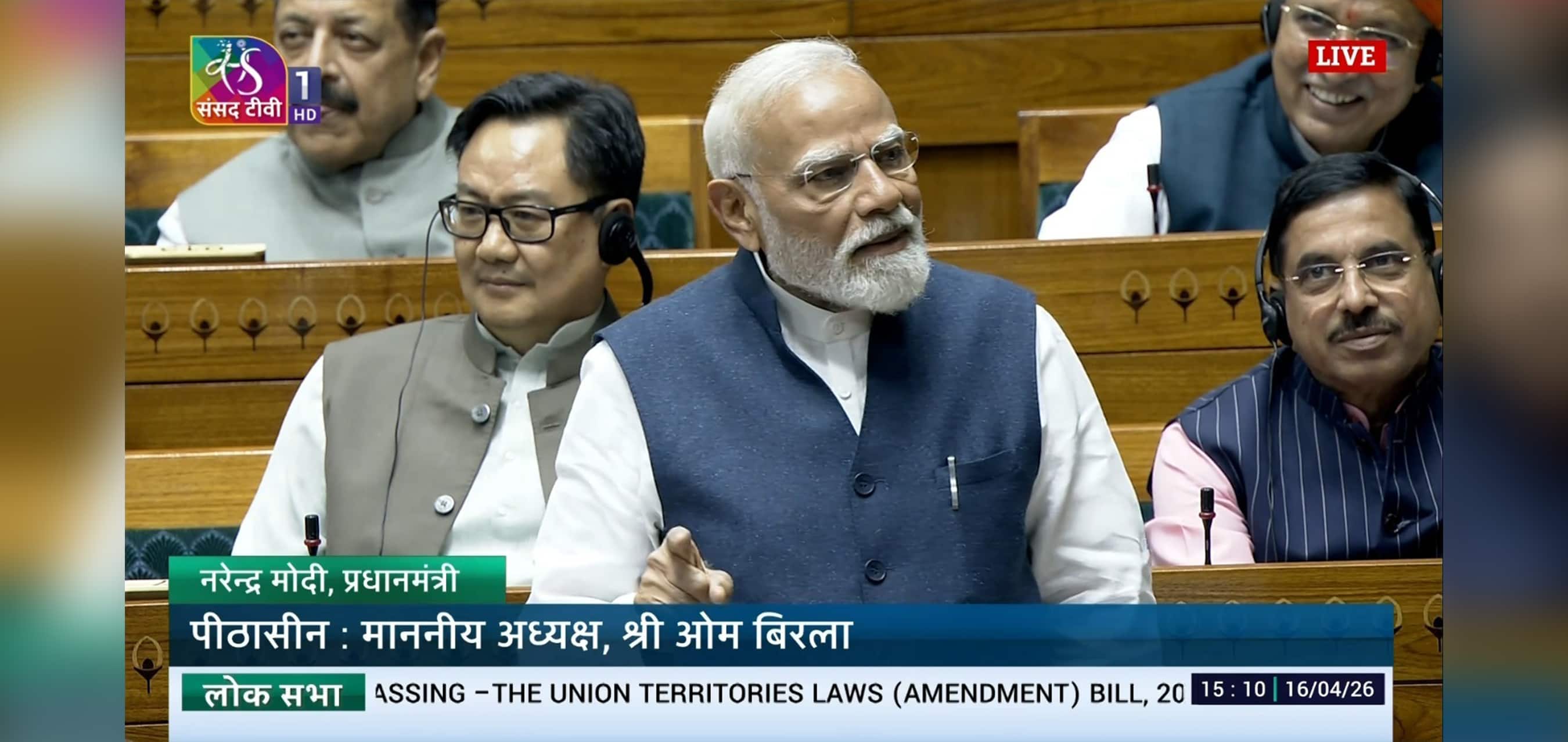


Prime Minister Shri Narendra Modi, today addressed the Lok Sabha. Acknowledging that the discussion on the important bill had commenced early in the morning, PM Modi noted that many colleagues had effectively touched upon crucial issues while relying on facts and logic.
Observing that crucial moments arrive in the life of a nation, the Prime Minister stated that the societal mindset and leadership capability of the time capture such moments to forge a strong national legacy. Affirming that the current juncture represents a similarly historic moment in India's parliamentary democracy, he remarked that this idea should have been fully implemented 25 to 30 years ago to reach maturity by today. Highlighting India's identity as the Mother of Democracy, he pointed out that all House members have received an auspicious opportunity to add a new, reformative dimension to a millennia-old legacy. Reaffirming that making half of the country's population active participants in policy-making is an incredible privilege, the Prime Minister urged all honorable Members of Parliament not to let this vital opportunity slip away. Focusing strictly on the transformative effort underway, he affirmed that all Indians together are preparing to infuse the governance system with deep sensitivity to determine the future condition of the country. "We stand at such a crucial turning point where the nectar emerging from this churning will decide the nation's direction," observed Shri Modi.
Acknowledging the new self-confidence of India in the 21st century, the Prime Minister observed that the entire nation is currently experiencing widespread global acceptance, making it a moment of immense pride tied to the resolution of a developed India. He affirmed that his vision of a developed India transcends superior infrastructure and requires the meaningful integration of the 'Sabka Saath, Sabka Vikas' mantra into policy-making. Emphasizing that making 50 percent of the population a part of policy formulation is an urgent demand, he pointed out that despite past delays, no party opposed the bill in principle during his extensive private consultations. Stating that history proves collective action ultimately favors the nation's democracy rather than individual political entities, he emphasized that the credit belongs to the entire House rather than just the treasury benches or himself. "Therefore, I feel there is absolutely no need to give this a political color, as everyone's true benefit lies in supporting it," affirmed Shri Modi.
Reflecting on his past as an organizational worker outside formal governance, the Prime Minister recalled prevalent corridor discussions questioning the selective ease with which reservations were granted at the Panchayat level. He noted that leaders were comfortable allocating quotas in Panchayats simply because they did not fear losing their own immediate positions or power. Pointing out the deep-seated reluctance of higher officials to implement quotas that threatened their own stakes, Shri Modi observed, “ This protective mindset allowed local reservations to successfully reach 50 percent without affecting the Parliament.”
Warning against underestimating historical shifts, the Prime Minister stated that unlike 25 or 30 years ago, opposition to women's rights today resonates deeply below the political surface. Pointing out that a profound political consciousness has developed, he noted that the millions of women who have won Panchayat elections have evolved from silent observers into highly vocal grassroots opinion makers. Acknowledging that these experienced women have deeply managed public grievances, he observed that they are now highly agitated and demanding inclusion in the primary decision-making processes of the Legislative Assemblies and Parliament. Advising all ambitious politicians to recognize this shift, the Prime Minister emphasized that these millions of female leaders will now heavily influence future electoral outcomes across all constituencies. The Prime Minister urged the House to place complete trust in the understanding of the nation's women. He pointed out that once the 33 percent representation is achieved, female legislators will be perfectly capable of deciding further sub-allocations for different classes and groups without requiring patriarchal oversight. Acknowledging his own roots in an extremely backward community, he emphasized that his paramount constitutional duty is to take every section of society along. The Prime Minister affirmed that the Constitution remains strictly supreme for him, highlighting it as the very force that allowed a marginalized individual to assume such a massive national responsibility. "Why do we doubt their capabilities; let the women come forward and decide," noted Shri Modi.
Observing the phenomenal achievements across all spheres of life, the Prime Minister stated that women power is nowhere behind in elevating the pride and hoisting the flag of the nation. He remarked that mothers, sisters, and daughters are making immense and outstanding contributions that allow the entire country to hold its head high with pride. Questioning the rationale behind expending so much political energy to block such a highly capable demographic, he pointed out that integrating women into legislative bodies will exponentially increase the nation's overall capacity. The Prime Minister explicitly appealed to the lawmakers to evaluate this monumental step based on national interest rather than petty electoral calculus. "I appeal to you not to weigh this on the scales of politics," remarked Shri Modi.
Highlighting the immediate task at hand, the Prime Minister stated that the current opportunity demands unified thinking to secure women's participation in building a Viksit Bharat (developed India) with an open mind. He reiterated that while the entire nation will analyze the final legislative decision, the female electorate will scrutinize the underlying intentions even more closely. Warning the assembly of the consequences of political malice, he observed that any deliberate flaw in their intentions will face severe backlash. "The Nari Shakti of this country will never forgive any flaw in our intentions," stated Shri Modi.
Recalling the unanimous and joyous acceptance of the act in the new Parliament building in 2023, the Prime Minister noted that it successfully generated a positive, non-partisan atmosphere nationwide. Addressing concerns regarding census data and delimitation, PM Modi pointed out that historical timelines and the massive disruptions caused by the COVID-19 pandemic clearly explained the implementation delays. Stating that extensive discussions in 2023 highlighted a widespread urgency to act quickly, he explained that while immediate implementation was impossible before 2024, missing the 2029 opportunity would permanently shatter public trust. The Prime Minister remarked that endless delays would make it impossible to convince the female demographic that the political establishment is truly committed to their empowerment. Noting that comprehensive structural and informal consultations have been held with political parties and activists, he observed that these dialogues are crucial to formulating a viable path forward. "It is the absolute demand of the time that we do not delay this any further," observed Shri Modi.
Issuing a stern reminder of constitutional duties, the Prime Minister stated that no member sitting in the House has the right to view the country in fragmented pieces or make geographically divided decisions. He emphasized that whether it is Kashmir or Kanyakumari, the sacred oaths taken by parliamentarians dictate a fundamental responsibility to act exclusively as one unified nation. Strongly condemning the baseless political whirlwinds created through absolute falsehoods, he stated from the sacred floor of the House that the new delimitation processes will absolutely not discriminate against any state or region. The Prime Minister affirmed that the demographic proportions established during previous governments will be strictly maintained, ensuring that seat increases occur fairly without any detrimental alterations. Asserting his total sincerity, he noted that he is fully prepared to use the strongest words of assurance, including regional terms in Tamil, to eliminate any need for political wordplay. "This decision-making process will absolutely not do injustice to anyone," affirmed Shri Modi.
Addressing the lawmakers, the Prime Minister stated that no one should operate under the arrogant illusion that they are magnanimously 'giving' something to the women of India, as it is their right. He emphasized that the entire political establishment is collectively guilty of withholding this right for decades, making this bill a necessary act of atonement. Pointing out the historical hypocrisy where politicians feigned support while systematically sabotaging the bill with technical caveats, he observed that the era of openly opposing the reservation is long gone. The Prime Minister affirmed that the women of the country can no longer be deceived by complex procedural excuses to delay progress. Urging the members to abandon their blockades, he argued that three decades of obstruction using various technical tangles is more than enough time to reflect on past failures. "You have stopped it for three decades, now you must finally do it," remarked Shri Modi.
Declaring a complete disinterest in claiming personal or party credit, he noted that a unified approach transforms the narrative entirely and neutralizes partisan gains. Elevating the philosophical context of the bill, the Prime Minister stated that women's participation in parliamentary democracy transcends mere statistical adjustments and represents India's profound cultural commitment as the Mother of Democracy. He pointed out that this very commitment successfully established 50 percent reservation in Panchayats across more than 20 states, yielding incredibly positive results. Reflecting on his extensive tenure as a Chief Minister, he shared that his firsthand experience with grassroots women's leadership revealed their highly effective and sensitive approach to problem-solving. The Prime Minister noted that female leaders consistently acted as vital catalysts in accelerating the broader journey of developmental progress through empathetic governance. Affirming that introducing this massive demographic into the House will infuse national policymaking with new strength, he observed that combining lived experience with factual logic multiplies legislative capability exponentially. "Their voices will become a powerful new strength and deeply enrich the House," noted Shri Modi.
The Prime Minister stated that there is an absolute abundance of highly experienced and capable women power in the country ready to serve. He pointed out that placing firm trust in these women will guarantee exceptional and highly beneficial contributions to the nation's governance. Acknowledging the female representatives already serving, he noted that they consistently present well-articulated and profound perspectives whenever given the floor. "They have already enriched the House wonderfully with their capable contributions," asserted Shri Modi.
Providing concrete data to support his stance, the Prime Minister stated that nearly 275 women are currently leading over 650 district panchayats, managing massive responsibilities and budgets that often exceed those of a central Cabinet Minister. He further noted that out of approximately 6,700 block panchayats, more than 2,700 are successfully functioning under the direct and capable leadership of women. Pointing out their urban influence, he observed that women are powerfully directing local bodies, serving as Mayors and standing committee heads in over 900 cities. The Prime Minister affirmed that passing the reservation bill is a critical opportunity for the nation to gratefully acknowledge and repay the profound debt owed to these grassroots leaders for the country's rapid progress. "When this vast administrative experience joins the House, it will multiply our strength immensely," remarked Shri Modi.
Shri Modi observed that the current moment demands breaking free from past limitations to courageously ensure the active participation of women power in national development. Firmly urging the House to advance the legislation with total unanimity, he noted that a collective consensus generates positive pressure on the treasury benches to honor everyone's rights without harm. "We get many exceptional results from collective strength," affirmed Shri Modi.
Concluding his primary arguments, the Prime Minister reiterated that half of the population possesses an undeniable right to sit in the House. Addressing debates regarding seat numbers, he noted that expanding the total seats accommodates the 33 percent quota smoothly without displacing existing members or violating established rights. Shri Modi noted that the new Parliament building was specifically pre-planned to house this additional legislative strength.
Click here to read full text speech
A historic opportunity to empower our Nari Shakti. pic.twitter.com/vmJM8VVHgv
— PMO India (@PMOIndia) April 16, 2026
Including Nari Shakti in decision-making is key to building a Viksit Bharat. pic.twitter.com/RyMAIDB7UF
— PMO India (@PMOIndia) April 16, 2026
More and more women are becoming leaders at the grassroots level. pic.twitter.com/FTvEFdy3w9
— PMO India (@PMOIndia) April 16, 2026
We must not assume we are giving something to the Nari Shakti; this is their right. pic.twitter.com/H4UDhfoHy3
— PMO India (@PMOIndia) April 16, 2026
Women's participation in our parliamentary democracy is not just about numbers, but a commitment to democratic values. pic.twitter.com/LkcNFTraKs
— PMO India (@PMOIndia) April 16, 2026