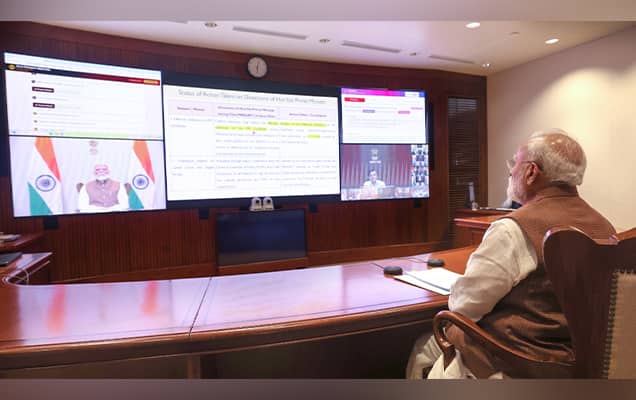
PM Modi addresses the Viksit Krishi Sankalp Abhiyan

Published By : Admin | May 29, 2025 | 18:44 IST
Under this campaign our team of scientists will go from lab to land providing information about modern agriculture to farmers with all the data to help the farmers before the season starts: PM
This campaign resolves to make Indian agriculture the mainstay of Viksit Bharat: PM
India must not only fulfill its own needs but also emerge as a global food supplier: PM
Viksit Krishi Sankalp Abhiyan will open new avenues of progress for farmers driving modernization in agriculture: PM

The Prime Minister Shri Narendra Modi addressed the Viksit Krishi Sankalp Abhiyan via videoconferencing today. Delivering his remarks on the occasion, he remarked that the launch of the Viksit Krishi Sankalp Abhiyan as a significant initiative for farmers and an unique effort to support agricultural development. The Prime Minister highlighted that as the monsoon approaches and preparations for the Kharif season begin, over the next 12 to 15 days, 2000 teams consisting of scientists, experts, officials, and progressive farmers will travel across 700+ districts and reach millions of farmers across villages. He extended his best wishes to all farmers and participants in these teams, acknowledging their dedication to strengthening India's agricultural sector.

Highlighting that agriculture has traditionally been a state subject, with each state formulating policies and taking initiatives for farmers' welfare, Shri Modi emphasised that however with rapidly changing times, India's agricultural sector also requires significant transformation. He remarked that Indian farmers have achieved record production, filling grain reserves, but the market dynamics and consumer preferences are evolving. He asserted that it is imperative to bring modern reforms to agricultural systems in collaboration with states and farmers. Shri Modi noted that under this campaign, scientific teams will transition from lab to land, bringing comprehensive data to farmers and equipping them with advanced agricultural knowledge. He emphasized that these teams will stand ready to assist farmers before the Kharif season begins.

Underlining the significant research advancements made by India's agricultural scientists over the decades, emphasizing their positive impact on farming outcomes, the Prime Minister praised progressive farmers who have successfully experimented with new techniques, achieving impressive yields. Underscoring the importance of ensuring that scientific research and successful farming practices reach the broader farming community, the Prime Minister noted that while efforts have been ongoing, there is now a need to accelerate these initiatives with renewed energy. “Viksit Krishi Sankalp Abhiyan presents a valuable opportunity to bridge this knowledge gap, enabling farmers to benefit from cutting-edge agricultural insights”, the Prime Minister stated.

Shri Modi emphasized that for a Viksit Bharat, India's agriculture must also evolve, highlighting several key focus areas of the central government aimed at transforming the agricultural sector. He outlined critical issues, including ensuring fair prices for farmers' produce, strengthening the agricultural economy, and aligning crop production with national requirements. “India must not only fulfill its own needs but also emerge as a global food supplier”, stated Shri Modi, remarking that tackling climate change challenges, enhancing grain production with minimal water use, protecting soil health from harmful chemicals, modernising the farming techniques and taking science and technology to the fields are essential. He emphasized that over the last 10-11 years, the government has undertaken extensive efforts in these areas. He urged all participants in the campaign to maximize farmer awareness, ensuring they are well-informed about modern agricultural advancements.

Stressing the importance of providing farmers with additional sources of income beyond traditional agriculture, the Prime Minister highlighted key initiatives aimed at expanding opportunities for farmers. He remarked that installing solar panels along field boundaries can generate additional revenue. He noted the impact of the Sweet Revolution, stating that beekeeping is benefiting farmers and must be expanded to involve more participants. The Prime Minister also stressed the need to convert agricultural residues into energy, transforming waste into wealth. He highlighted the significance of identifying suitable areas for cultivating ‘Shri Anna’ and enhancing value addition in agricultural products. Prime Minister further pointed out that even non-milking cattle are now contributing to the economy through the Gobardhan Yojana, which creates income-generating opportunities. He called for widespread farmer awareness about these innovations to ensure maximum participation and benefits.

“India's agriculture must become a cornerstone of a developed India”, emphasised Shri Modi underscoring the magnitude of this mission. He urged farmers to actively engage with visiting scientists, encouraging them to ask questions and seek valuable insights. Shri Modi called upon scientists and officials to recognize the significance of their mission, stating that their commitment must go beyond routine government work and reflect a spirit of national service. He urged them to address farmers' queries comprehensively while also documenting their valuable suggestions. “Viksit Krishi Sankalp Abhiyan will open new avenues of progress for India's farmers, driving modernization in agriculture”, declared Shri Modi and concluded by extending his best wishes to all the stakeholders.

Click here to read full text speech

Explore More
Today, the entire country and entire world is filled with the spirit of Bhagwan Shri Ram: PM Modi at Dhwajarohan Utsav in Ayodhya

Popular Speeches

Today, the entire country and entire world is filled with the spirit of Bhagwan Shri Ram: PM Modi at Dhwajarohan Utsav in Ayodhya
Emerging cities see 42% growth in GCC jobs, outpacing metros: Report

Media Coverage

Emerging cities see 42% growth in GCC jobs, outpacing metros: Report
NM on the go

Nm on the go

Always be the first to hear from the PM. Get the App Now!
...
PM Modi chairs 51st PRAGATI Meeting
May 27, 2026
PM reviews seven critical infrastructure projects across the Railways, Power and Road sectors
Projects reviewed span across 9 States with cumulative investment of around ₹30,000 crore
PM also reviews Ken Betwa Link Project and Swachh Bharat Mission-Urban 2.0
PM says Ken-Betwa River Inter-linking Project should serve as a model for other States to resolve inter-State water issues amicably
PM asks States to expedite the completion of solid waste management-related infrastructure, including waste processing plants and GOBARdhan plants
PM calls for mission-mode rooftop solar coverage in urban areas
Acting upon the advice of PM, system of monthly review of social sector schemes at State level operationalised, starting with review of Swachh Bharat Mission

Prime Minister Shri Narendra Modi chaired the 51st meeting of PRAGATI, the ICT-enabled, multi-modal platform aimed at fostering Pro-Active Governance and Timely Implementation, by seamlessly integrating efforts of the Central and State governments, at Seva Teerth, earlier today.

During the meeting, the Prime Minister reviewed seven critical infrastructure projects across the Railways, Power and Road sectors covering nine States worth around ₹30,000 crore. These projects, pivotal to economic growth and public welfare, were reviewed with a focus on timelines, inter-agency coordination, and timely issue resolution. Prime Minister also reviewed Ken Betwa Link Project and Swachh Bharat Mission-Urban 2.0.

While reviewing power sector projects, Prime Minister emphasized the need to accelerate rooftop solar adoption across urban areas, with a special focus on cities, residential clusters and public institutions. He underlined that rooftop solar should be taken up in mission mode to reduce electricity costs, improve energy security and promote clean energy at the household and community level.

While reviewing road and port connectivity projects, it was emphasised that Vadhavan Port should be developed as a model of port-led, multi-modal development, where every major mode of transport is seamlessly integrated to create a future-ready logistics ecosystem. The project should not be seen merely as a port, but as a national gateway connected through coastal shipping, inland waterways, dedicated freight corridors, high-speed rail connectivity, highways and airport linkages.

Prime Minister emphasised the need for effective implementation of Swachh Bharat Mission 2.0 and underlined that the mission should move beyond infrastructure creation and ensure measurable outcomes through regular monitoring, citizen participation and convergence between various stakeholders. He asked States to expedite the completion of solid waste management-related infrastructure, including waste processing plants and GOBARdhan plants.

While reviewing Ken-Betwa River Inter-linking Project, Prime Minister observed that Ken-Betwa project should serve as a model for other States to resolve inter-State water issues through cooperation, timely clearances, technology-based monitoring and mission-mode execution. States were encouraged to identify similar opportunities where river-linking, water conservation, groundwater recharge and efficient irrigation can be taken up in an integrated manner to ensure long-term water security.

Prime Minister also underlined that the delay in the implementation of public projects leads not only to cost escalation but also deprives citizens of timely access to essential facilities and development benefits. He observed that every delay has a direct impact on people’s lives, regional growth and public resources. He stressed that Ministries, Departments and States must adopt a more proactive and time-bound approach to resolve pending issues, remove bottlenecks and ensure faster execution.

Prime Minister also emphasized that innovative use of canal networks should be explored, including installation of solar panels along canals and over canals for clean electricity generation. This would help optimize land use, reduce evaporation losses, generate renewable energy and create additional economic value from water infrastructure.

At the beginning of the meeting, the Cabinet Secretary informed that, in pursuance of the directions of the Prime Minister, a system of monthly review of social sector schemes at the State level has also been operationalised. This mechanism aims to ensure regular monitoring, faster resolution of implementation issues and greater accountability at the State and district levels. As part of this initiative, Swachh Bharat Mission has been taken up for review at the State level in the first instance.