Launches Dharti Aaba Janjatiya Gram Utkarsh Abhiyan to benefit 63000 tribal villages in about 550 districts
Inaugurates 40 Eklavya Schools and also lays foundation stone for 25 Eklavya Schools
Inaugurates and lays foundation stone for multiple projects under PM-JANMAN
“Today’s projects are proof of the Government’s priority towards tribal society”

The Prime Minister, Shri Narendra Modi inaugurated and laid the foundation stone for various projects worth over Rs 80,000 crore in Hazaribag, Jharkhand today. Shri Modi launched Dharti Aaba Janjatiya Gram Utkarsh Abhiyan, inaugurated 40 Eklavya Model Residential Schools (EMRS) and laid the foundation stone for 25 EMRS, and inaugurated and laid the foundation stone for multiple projects under Pradhan Mantri Janjati Adivasi Nyaya Maha Abhiyan (PM-JANMAN).

Addressing the gathering, the Prime Minister expressed gratitude for becoming a part of Jharkhand’s development journey and recalled visiting Jamshedpur a few days ago to inaugurate development projects worth hundreds of crores. Shri Modi mentioned handing over pucca houses to thousands of poor from Jharkhand under PM Awas Yojna. Referring to today’s projects related to the empowerment and welfare of tribal communities worth more than Rs 80,000 crore, the Prime Minister said that it is proof of the government’s priority towards tribal communities. Prime Minister Modi congratulated the people of Jharkhand and India for the projects of today.

Noting the occasion of Mahatma Gandhiji’s birth anniversary, the Prime Minister said that his vision and ideas towards tribal welfare are India’s capital. Mahatma Gandhi believed, the Prime Minister said, that India can only progress when the tribal societies progress at a fast pace. Shri Modi expressed satisfaction that the present government is paying maximum attention to tribal upliftment and mentioned launching Dharti Aaba Janjati Gram Utkarsh Abhiyan today where 63,000 tribal-dominated villages will be developed in about 550 districts at a cost of about Rs 80,000 crore. Prime Minister Modi informed that work would be done to improve the socio-economic life in these tribal-dominated villages and the benefits would reach more than 5 crore tribal brothers and sisters of the country. “The tribal society of Jharkhand will also benefit greatly from this”, he added.

The Prime Minister expressed happiness that Dharti Aba Janjati Gram Utkarsh Abhiyan was being started from the land of Bhagwan Birsa Munda. PM also recalled that on the birth anniversary of Bhagwan Birsa Munda, PM-Janman Yojana was launched from Jharkhand. He announced that on 15th November 2024, on Janjati Gaurav Diwas, India will celebrate the first anniversary of PM-Janman Yojana. He added that through the PM-Janman Yojana, the fruits of development were reaching those tribal areas of the country which were left behind. Shri Modi highlighted that under PM-Janman Yojana, the foundation stone of development works worth about 1350 crore rupees was laid today. Speaking about the scheme, he underlined that facilities like education, health and roads will be built for a better life in the most backward tribal areas.

Highlighting the multiple achievements of PM-Janman Yojana in Jharkhand in its first year itself, Shri Modi said that the work of providing water to every house in more than 950 very backward villages was completed. He added that 35 Vandhan Vikas Kendras were also approved in the state. The Prime Minister also highlighted the work being done to connect remote tribal areas with mobile connectivity which would help transform the tribal society by providing equal opportunity for progress.

The Prime Minister emphasized that the tribal society will progress when tribal youth get education and opportunities. For this, Shri Modi said, the Government is engaged in a campaign to build Eklavya residential schools in tribal areas. Referring to the inauguration of 40 Eklavya residential schools and laying the foundation of 25 new ones today, the Prime Minister affirmed that Eklavya schools should be equipped with all modern facilities and impart a high standard of education. For this, he added, Government has also almost doubled the budget of every school.

The Prime Minister underlined that positive results are achieved when correct efforts are made. He expressed confidence that the tribal youth would move forward and the country would benefit from their capabilities.

Governor of Jharkhand, Shri Santosh Gangwar and Minister of Tribal Affairs, Shri Jual Oram were present on the occasion among others.

Background

In line with his commitment to ensure comprehensive and holistic development of the tribal communities across the country, the Prime Minister launched Dharti Aaba Janjatiya Gram Utkarsh Abhiyan with a total outlay of over Rs 80,000 crore. The Abhiyan will cover around 63,000 villages benefitting more than 5 crore tribal people in 549 districts and 2,740 blocks across 30 States and UTs. It aims to attain saturation of critical gaps in social infrastructure, health, education and livelihood through 25 interventions implemented by various 17 Ministries and Department of Government of India.

In order to boost the educational infrastructure for the tribal communities, the Prime Minister inaugurated 40 Eklavya Model Residential Schools (EMRS) and laid the foundation stone for 25 EMRS worth over Rs 2,800 crore.

The Prime Minister inaugurated and laid the foundation stone for multiple projects under Pradhan Mantri Janjati Adivasi Nyaya Maha Abhiyan (PM-JANMAN) worth over Rs 1360 crore. It includes more than 1380 km of road, 120 Anganwadis, 250 multi-purpose centers and 10 school hostels. Further, he also unveiled a series of landmark achievements under PM JANMAN, which include electrification of more than 75,800 Particularly Vulnerable Tribal Groups (PVTG) households in around 3,000 Villages, operationalization of 275 Mobile medical units, operationalization of 500 Anganwadi centers, establishment of 250 Van Dhan Vikas Kendras and saturation of more than 5,550 PVTG Villages with ‘Nal se Jal’.

Click here to read full text speech

Explore More
Today, the entire country and entire world is filled with the spirit of Bhagwan Shri Ram: PM Modi at Dhwajarohan Utsav in Ayodhya

Popular Speeches

Today, the entire country and entire world is filled with the spirit of Bhagwan Shri Ram: PM Modi at Dhwajarohan Utsav in Ayodhya
India’s higher education enrolment hits 4.5 crore; women, marginalised groups lead way: AISHE report

Media Coverage

India’s higher education enrolment hits 4.5 crore; women, marginalised groups lead way: AISHE report
NM on the go

Nm on the go

Always be the first to hear from the PM. Get the App Now!
...
India-Australia Roadmap for Sports Collaboration
July 10, 2026

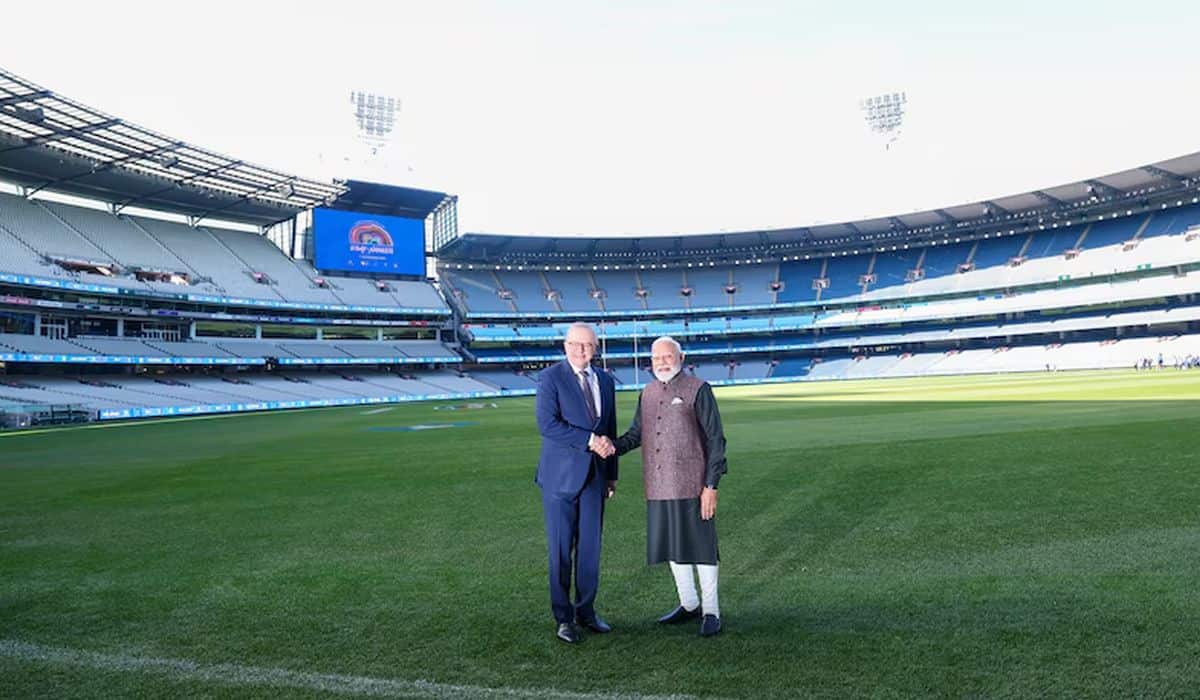
Sports is a powerful bridge between India and Australia, bringing communities together and opening new pathways for collaboration.

Building on the 2023 MoU on Cooperation in Sports, the India-Australia Roadmap for Sports Collaboration sets out practical, future-focused priorities and opportunities to strengthen this cornerstone of our bilateral relationship.

Recognising the decade of opportunity ahead — including the 2030 Commonwealth Games in Ahmedabad, the Brisbane 2032 Olympic and Paralympic Games, and India’s ambition to host a future Olympic and Paralympic Games — this Roadmap identifies targeted areas of cooperation aligned to shared priorities, capabilities and resources.

Respecting differences in the governance of sport and the development of sport ecosystems in Australia and India, and recognising the leadership role of sporting bodies, businesses, state–level governments, universities and community groups in promoting elite and community sports, we are committed to facilitating engagement and supporting collaborative ways of working between relevant institutions, to encourage stronger sports partnerships at all levels that benefits both countries.

Implementation will be pragmatic and outcomes-focused, with activities prioritised in line with available resources and major event timelines.

Cooperation will be delivered through established partnerships, supported by flexible, demand-led arrangements, whereby responsibility for resourcing activities will be negotiated on a case-by-case basis. This approach ensures practical, sustainable and mutually beneficial outcomes.

In this context, the following have been identified as focus areas for collaboration under this Roadmap:

A. Capacity Building:

o Collaborate for sharing best practice in establishing and operating High-Performance Sports Centres in India in priority sports.

o Identify Para sport as a key priority and opportunity for collaboration, including Australian expertise in Para classification, coaching and performance support, with potential links between Indian and Australian universities where appropriate.

o Drawing on Australia’s coach development models, facilitate two-way exchanges that bring Indian coach and coach educators to Australia and Australian coaches and coach educators to India, using a Train the Trainer approach where appropriate.

o A physical education exchange programme between India and Australia may be introduced to facilitate mutual learning, sharing of best practices, and collaboration in areas such as school sports, sports science, and community participation in physical education.

o Recognising the physical and mental health benefits of yoga and the World Yogasana, the federation for yogasana sports based in India, identify opportunities to share knowledge, foster collaboration and encourage participation in yoga in Australia.

o Work with the Australian Sports Commission to build the capability of select Indian coaches as part of the India Australia High Performance Coach Development program.

o Explore opportunities through relevant non-government stakeholders such as sporting organisations and universities to support talented young Indian sportspersons as part of high-performance programs in Australia through student scholarships funded by Government of India.

B. Collaborative Sports Science and Technology Research:

o Encourage joint research and development projects between universities in India and Australia on athlete performance analytics, injury prevention, sports nutrition, wearable performance technology, recovery techniques and Para sport.

o Encourage partnerships between Indian and Australian universities to co-develop sports curriculums.

o Sport Integrity Australia and National Anti-Doping Agency India contribute to international anti-doping efforts by supporting World Anti-Doping Agency (WADA)-led capacity building programs through engagement with the WADA Asia/Oceania Office, and through representation on the UNESCO International Convention against Doping in Sport (Convention) Groups.

C. Major Sporting Events:

o Collaborate with Australian States and Territories, and National Sporting Organisations to exchange best practices for hosting large events.

o Explore opportunities to host exhibition matches and youth events in both countries to promote sports of mutual interest (such as Kabaddi and Kho Kho in Australia, and Australian Football League and basketball in India).

o Leverage the build-up to major sporting events such as Olympic, Paralympic and Commonwealth Games to establish formal, reciprocal arrangements between Indian and Australian sporting bodies for shared facilities, competitions and support networks during and in the build-up to major sporting events.

o Welcoming the inaugural Big Bash League match to be played in India in Chennai in December 2026, encourage Cricket Australia and the Board of Control for Cricket in India to work towards a commitment to host annual BBL matches in India.

D. Sports Industry and Investment Platform:

o Build on the Australia-funded Sports Industry Summit in Mumbai in December 2026 to promote collaboration between Indian and Australian companies on sports equipment manufacturing, sports media and broadcasting, event management, and sports start-ups.

o Facilitate Australian sports sector businesses in the Indian sports market through information sessions and vice-versa.

o Expand India’s export of high quality, competitively priced sports goods to Australia.

o Expand the export of Australian expertise in high performance sports, including coaching, coach development, strength and conditioning, athlete wellbeing, nutrition and psychology.

E. Women in Sports Partnership:

o Launch joint initiatives promoting women’s leadership, health, high performance and participation in sport, including bilateral tournaments for women athletes, drawing on the Australian Sports Commission’s flagship programs, recognising that sport is a powerful pathway for women’s economic empowerment, leadership, health and social inclusion.