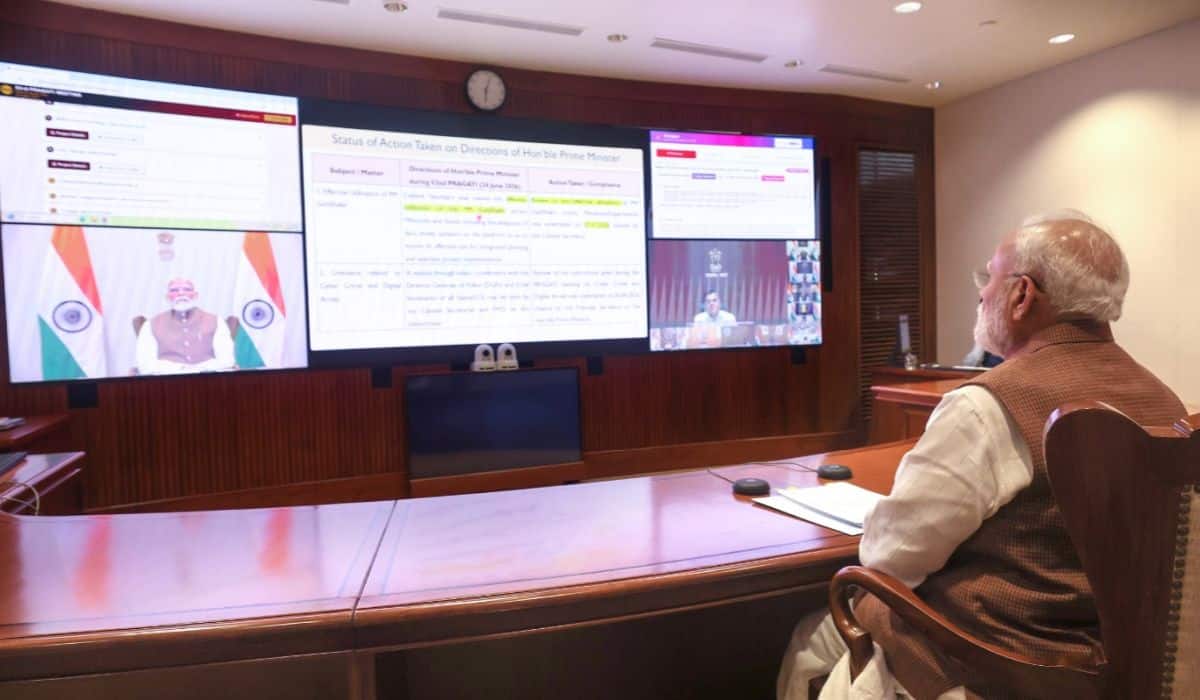
The Prime Minister, Shri Narendra Modi inaugurated and laid the foundation stone of 112 National Highway projects spread across the country worth about Rs. One lakh crore at Gurugram, Haryana today. Lakhs of people connected with the event from all over the country through technology.
Speaking on the occasion, the Prime Minister noted the change from the culture of holding programmes in Delhi to holding big programmes in other parts of the country. He said that today the nation has taken another big and important step towards modern connectivity. Expressing happiness on dedicating the Haryana section of the landmark Dwarka Expressway, PM Modi said that this will change the travel experience between Delhi and Haryana forever and “will shift gear not just in the vehicles but also in the lives of the people of the region”.

Emphasizing the change of speed in implementation of projects, the Prime Minister said that in less than three months of 2024, projects worth more than Rs 10 lakh crore have been either dedicated to the nation or foundation stone has been laid for them. Today’s more than 100 project worth more than Rs one lakh crore include development projects from Karnataka, Kerala and Andhra Pradeshi in South, from the North, Uttar Pradesh and Haryana related development works are there, East is represented by projects from Bengal and Bihar whereas, from West, major projects from Maharashtra, Punjab and Rajasthan are there. Today’s projects include, said the Prime Minister, an increase of 540 kilometer in Amritsar Bhatinda Jamnagar Corridor and development of Bengaluru Ring Road.
Shri Narendra Modi emphasized the transformative impact of infrastructure development, highlighting the shift from problems to possibilities. He underscored the significance of converting challenges into opportunities, a hallmark of his governance.
Prime Minister Modi cited the example of the Dwarka Expressway as a testament to his government's commitment to transforming obstacles into avenues for growth. He reminisced how, in the past, the area where the expressway is now built was considered unsafe, with people avoiding it even after sunset. However, today, it serves as a hub for major corporations, contributing to the rapid development of the National Capital Region (NCR).

The Prime Minister highlighted the strategic importance of the Dwarka Expressway, connecting it to the Indira Gandhi International Airport in Delhi. He emphasized that such infrastructure projects enhance connectivity, leading to accelerated economic activities and improved integration of the NCR.
Further, Prime Minister Modi praised the efforts of the Haryana government, particularly Chief Minister Manohar Lal Khattar, in ensuring the timely completion of infrastructure projects. He commended their dedication to modernizing the state's infrastructure, which is crucial for Viksit Haryana and Viksit Bharat.
The Prime Minister reiterated his government's holistic vision for infrastructure development in the Delhi-NCR region. He emphasized the timely completion of major projects such as the Dwarka Expressway, Peripheral Expressways, and the Delhi-Meerut Expressway. These projects, along with the expansion of metro lines and the construction of international airports, are aimed at easing traffic congestion and reducing pollution in the region. “The 21st Century India is India of big vision and big goals”, the Prime Minister asserted.

Prime Minister Modi emphasized the link between infrastructure development and poverty alleviation, highlighting how improved roads and digital connectivity in rural areas create new opportunities for villagers. He noted the emergence of new possibilities in rural India, driven by digital infrastructure and access to essential services like healthcare and education. “Initiatives like this have helped in pulling 25 crore Indians out of poverty in the last 10 years and India has become the 5th largest global economy” he further added “This rapid infrastructure construction work in the country will make India the third largest economic power in the world.” Prime Minister Narendra Modi reiterated the government's commitment to accelerating infrastructure development across India. He emphasized that such initiatives not only strengthen the country's economy but also create numerous employment opportunities, particularly for the youth.
The Prime Minister mentioned many long pending projects completed by the present government such as Eastern Peripheral Expressway (announced in 2008 completed in 2018), Dwarka Expressway too was stuck for the last 20 years. “Today, whatever work our government lays the foundation stone of, it works equally hard to complete it on time. And then we do not see whether there are elections or not”, he said. Projects like lakhs of kilometres of optic fibers in the villages, airports in small cities, rural roads, are completed irrespective of the election time, he said.

The Prime Minister said “earlier there were delays, now there are deliveries. Earlier there was delay, now there is development.” He said that focus is on to create a 9 thousand KM high speed corridor out of which 4 thousand KM is already constructed. Metro reached 21 cities as compared to 5 cities in 2014. “This work is done with the vision of development. These things happen when the intentions are right. This pace of development will increase manifold in the next 5 years”, the Prime Minister concluded.
Governor of Haryana Shri Bandaru Dattatreya, Chief Minister Shri Manohar Lal, Union Ministers Shri Nitin Gadkari, Shri Rao Inderjit Singh, Shri Krishan Pal, Deputy Chief Minister of Haryana, Shri Dushayant Chautala were among those present on the occasion.

Background
In order to help improve traffic flow and ease congestion between Delhi and Gurugram on NH-48, the Prime Minister inaugurated the Haryana section of the landmark Dwarka Expressway. The 19 km long Haryana section of the 8 lane Dwarka Expressway has been built at a cost of around Rs. 4,100 crore and includes two packages of 10.2 km long Delhi-Haryana Border to Basai Rail-over-Bridge (ROB) and 8.7 km long Basai ROB to Kherki Daula. It will also provide direct connectivity to the IGI Airport in Delhi and Gurugram Bypass.
Other major projects inaugurated by the Prime Minister include the 9.6 km long six lane Urban Extension Road-II (UER-II)- Package 3 from Nangloi - Najafgarh Road to Sector 24 Dwarka section in Delhi; three packages of Lucknow Ring Road developed at cost of about Rs. 4,600 crores in Uttar Pradesh; Anandapuram - Pendurthi - Anakapalli section of NH16 developed at a cost of about Rs. 2,950 crores in the state of Andhra Pradesh; Kiratpur to Nerchowk section of NH-21 (2 packages) worth around Rs. 3,400 crores in Himachal Pradesh; Dobaspet - Heskote section (two packages) worth Rs. 2,750 crores in Karnataka, along with 42 other projects worth Rs. 20,500 crores in different states across the country.

The Prime Minister also laid the foundation stone for various National Highway projects across the country. Major projects for which the foundation stone will be laid include 14 packages of Bengaluru - Kadappa - Vijayawada Expressway worth Rs. 14,000 crores in Andhra Pradesh; six packages of Belgaum - Hungund - Raichur Section of NH-748A worth Rs. 8,000 crores in Karnataka; three packages of Shamli - Ambala Highway worth Rs. 4,900 crores in Haryana; two packages of Amritsar - Bathinda corridor worth Rs. 3,800 crores in Punjab; along with 39 other projects worth Rs. 32,700 crores in different states across the country.
These projects will significantly contribute towards the growth of the National Highway network as well as help in boosting socio-economic growth, enhance job opportunities and promote trade & commerce in regions across the country.
Next-gen infrastructure for 'Viksit Bharat.' pic.twitter.com/htVRhqeC3A
— PMO India (@PMOIndia) March 11, 2024
21वीं सदी का भारत बड़े विजन का भारत है।
— PMO India (@PMOIndia) March 11, 2024
ये बड़े लक्ष्यों का भारत है। pic.twitter.com/VJE6k5dYeD
देश में तेजी से हो रहा इंफ्रास्ट्रक्चर निर्माण का काम, भारत को उतनी ही तेजी से दुनिया की तीसरी सबसे बड़ी आर्थिक ताकत भी बनाएगा। pic.twitter.com/tZONdCcjIo
— PMO India (@PMOIndia) March 11, 2024
Honouring taxpayers. pic.twitter.com/0WkABpNQlO
— PMO India (@PMOIndia) March 11, 2024