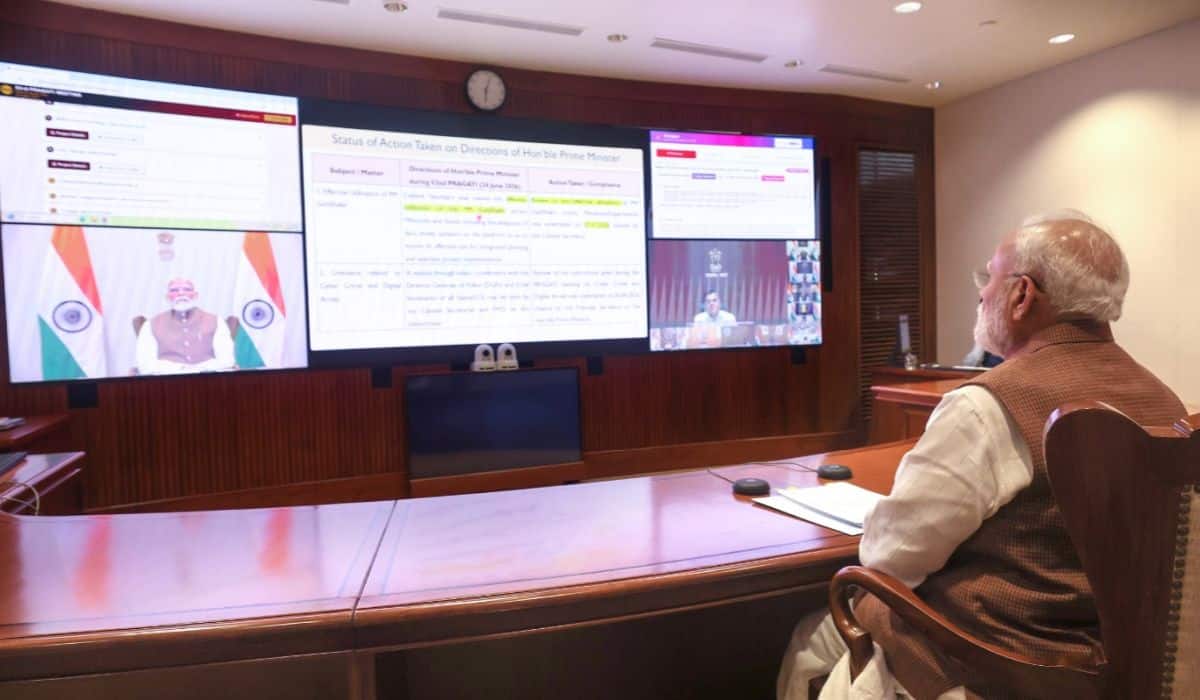
PM chairs a high-level meeting to review the progress of Cooperative sector

Published By : Admin | March 6, 2025 | 17:30 IST
PM emphasizes the need for partnerships with global cooperative organizations to expand the Indian cooperative sector
PM stressed on promoting organic products through cooperative organizations with special focus on export markets
PM recommends the use of Agristack to expand agriculture and related activities in Cooperative Sector
PM highlights the importance of integrating UPI with RuPay KCC cards to facilitate financial transactions
PM proposes introduction of cooperative courses in schools and educational institutions
National Cooperation Policy 2025 draft discussed in the meeting; it realises the vision of 'Sahkar Se Samruddhi'
National Cooperation Policy focuses on accelerating rural economic development, while prioritizing women and youth
PM emphasizes the need for partnerships with global cooperative organizations to expand the Indian cooperative sector
PM stressed on promoting organic products through cooperative organizations with special focus on export markets
PM recommends the use of Agristack to expand agriculture and related activities in Cooperative Sector
PM highlights the importance of integrating UPI with RuPay KCC cards to facilitate financial transactions
PM proposes introduction of cooperative courses in schools and educational institutions
National Cooperation Policy 2025 draft discussed in the meeting; it realises the vision of 'Sahkar Se Samruddhi'
National Cooperation Policy focuses on accelerating rural economic development, while prioritizing women and youth

Prime Minister Shri Narendra Modi chaired a high-level meeting to review the progress of the cooperative sector earlier today at 7 LKM. Discussions were held on promoting "Sahkar Se Samruddhi" bringing transformation through technological advancements in the sector, plans to increase the participation of youth and women in cooperatives, and the various initiatives of the Ministry of Cooperation.

Prime Minister emphasized the need for partnerships with global cooperative organizations to expand the Indian cooperative sector and stressed promoting organic products through cooperative organizations. He also suggested focusing on export markets and developing a soil testing model through cooperatives to improve agricultural practices. Prime Minister highlighted the importance of integrating UPI with RuPay KCC cards to facilitate financial transactions and emphasized the need for healthy competition among cooperative organizations.

Prime Minister also emphasized the importance of documenting the assets of cooperative organizations to ensure transparency. He suggested promoting cooperative farming as a more sustainable agricultural model. He recommended the use of digital public infrastructure (Agristack) to expand agriculture and related activities in Cooperative Sector, providing farmers with better access to services. In the context of education, Prime Minister proposed introducing cooperative courses in schools, colleges, and IIMs, as well as promoting successful cooperative organizations to inspire future generations. He further added that young graduates should be encouraged to contribute, and Cooperative organisations should be ranked based on their performance, so as to promote competition and growth simultaneously.

During the meeting PM was briefed about National Cooperation Policy and key achievements of the Ministry of Cooperation over the past three and a half years. Realising the vision of 'Sahkar Se Samruddhi’, the Ministry has formulated a draft of the National Cooperation Policy 2025 through an extensive consultation process. The objective of National Cooperation Policy 2025 policy is to facilitate the systematic and holistic development of the cooperative sector, with a focus on accelerating rural economic development, while prioritizing women and youth. It aims to promote a cooperative-based economic model and establish a robust legal and institutional framework. Furthermore, the policy endeavours to deepen the grassroots impact of cooperatives and significantly enhance the contribution of the cooperative sector to the overall development of the country.

Since its inception, the Ministry has undertaken 60 initiatives across seven key areas to promote and strengthen the cooperative movement. These initiatives include the digitization of cooperative institutions through the National Cooperative Database and Computerization Projects, as well as the strengthening of Primary Agricultural Credit Societies (PACS). Additionally, the Ministry has focused on enhancing the efficiency and sustainability of cooperative sugar mills.

The Government of India has implemented various schemes for cooperative societies through a "whole of government approach," integrating over 15 schemes from more than 10 ministries at the PACS level. As a result, there has been diversification in cooperative businesses, additional income generation, increased opportunities for cooperatives, and improved accessibility of government schemes in rural areas. Annual targets have also been set for the formation of these cooperatives. To promote cooperative education, training and research and to provide skilled professionals, a Bill to convert IRMA Anand into “Tribhuvan Cooperative University” and make it an Institution of National Importance has been introduced in the Parliament.

Prime Minister was briefed on the growth of cooperatives and their vital role across various sectors. Cooperative sector’s contribution to India’s economy, particularly in agriculture, rural development, and economic inclusion was highlighted. During the meeting it was highlighted that presently, one-fifth of the country's population is associated with the cooperative sector, which includes over 8.2 lakh cooperative institutions spanning more than 30 sectors, with a membership exceeding 30 crore individuals. Cooperatives play a crucial role in several areas of the economy.

The meeting was attended by Home and Cooperation Minister, Shri Amit Shah; Secretary, Ministry of Cooperation, Dr. Ashish Kumar Bhutani; the Principal Secretary to PM, Dr. P.K. Mishra, Principal Secretary-2 to PM Shri Shaktikanta Das; Advisor to PM, Shri Amit Khare and other senior officials.

Explore More
Today, the entire country and entire world is filled with the spirit of Bhagwan Shri Ram: PM Modi at Dhwajarohan Utsav in Ayodhya

Popular Speeches

Today, the entire country and entire world is filled with the spirit of Bhagwan Shri Ram: PM Modi at Dhwajarohan Utsav in Ayodhya
PM Modi completes 12 years in office; BJP, Union ministers hail his leadership

Media Coverage

PM Modi completes 12 years in office; BJP, Union ministers hail his leadership
NM on the go

Nm on the go

Always be the first to hear from the PM. Get the App Now!
...
Cabinet approves integration and continuation of two schemes under umbrella scheme SARTHAK-PDS
May 27, 2026
Centre to spend Rs. 25,530 crore in next 5 years for SARTHAK PDS
Continuation of schemes to ensure last-mile delivery of Food grains with higher FPS Dealers’ commission
Government strive for intelligently optimized PDS operations through advanced technologies to ensure transparency, security and sustainability in PDS operations

The Cabinet Committee on Economic Affairs (CCEA) chaired by the Prime Minister Shri Narendra Modi has approved the continuation of the “Scheme for Assistance in Ration Transport and Handling-Income with Automation in PDS” (SARTHAK PDS) as an umbrella scheme, in the 16th Finance Commission cycle award period, with an outlay of Rs. 25,530 crore as Central share.

The CCEA has also decided to revise the norms of Central assistance for meeting expenditure incurred by States/UTs intra-state movement & handling of foodgrains and FPS dealers’ margin and continuation of the existing funding pattern of Central Assistance.

The Scheme is conceived as an umbrella scheme integrating the ongoing schemes: (i) “Assistance to State Agencies for intra-State movement of foodgrains and FPS dealers’ margin under NFSA” and (ii) “Scheme for Modernization and Reforms through Technology in Public Distribution System (SMART PDS)” to comprehensively strengthen implementation of the National Food Security Act, 2013 (NFSA).

SARTHAK-PDS Scheme aims to provide (a) assured financial support for intra-State movement, handling and FPS dealer’s margin, and (b) a unified, citizen-centric, intelligent and interoperable PDS architecture that ensures last-mile service delivery, minimizes leakages and strengthens the nation’s commitment to food security under NFSA, with the merged scheme to operate up to 31.03.2031.

SARTHAK-PDS Scheme seeks to modernize, integrate and intelligently optimize PDS operations through advanced technologies such as Artificial Intelligence (AI), Machine Learning (ML), Natural Language Processing (NLP) and Blockchain, by creating standardized architectures and unified databases for real-time monitoring, AI-driven grievance and analytics systems, State Command Control Centres for data-driven oversight, and ISO-certified process frameworks to ensure transparency, security and sustainability in PDS operations.

Government of India has a social & legal commitment to the people of the nation - a dignified life by ensuring them access to food and nutritional security through the availability of adequate quantities of quality food grains. The Scheme will work towards fulfilling the Government of India's commitment to 81.35 crore persons covered under NFSA. Building on the statutory and policy framework, SARTHAK-PDS retains and streamlines the financial assistance component while simultaneously embedding it within a modern, technology-driven PDS ecosystem.

Over the past decade, the Government has implemented multiple digitization initiatives such as End-to-End Computerization of TPDS, Integrated Management of PDS (IM-PDS) and SMART PDS, along with citizen-facing applications like Mera Ration, Anna Mitra, Rightful Targeting Dashboard and Anna Sahayata, and since 1st April 2023, the SMART PDS scheme has acted as the cornerstone of technology-led reforms by enabling complete digitization of ration cards, Aadhaar seeding, FPS automation through e-PoS, online allocation and computerized supply-chain management across 36 States/UTs.