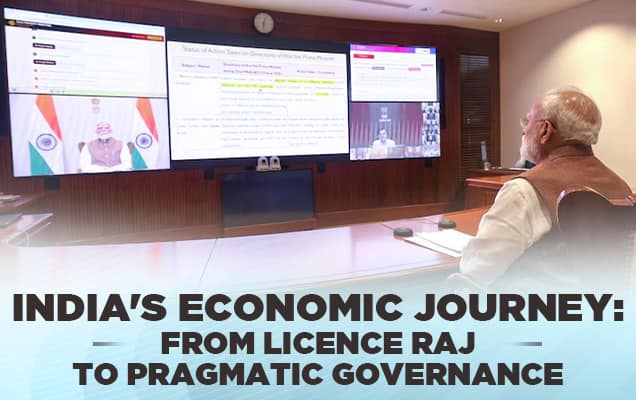
PM addresses 16th Civil Services Day at Vigyan Bhawan in New Delhi

Published By : Admin | April 21, 2023 | 11:00 IST
Confers Prime Minister’s Awards for Excellence in Public Administration to 16 awardees
Releases E-books ‘Viksit Bharat - Empowering Citizens & Reaching the last mile Volume I and II
“For a developed India, the government system should support the aspirations of common people”
“Earlier thinking was that the government will do everything, but now thinking is that the government will work for everyone”
“Motto of the government is ‘Nation First-Citizen First’, today’s government is prioritizing the deprived”
“Today’s aspirational citizens are not willing to wait for long to see changes in the systems”
“As the world is saying that India’s time has arrived, there is no time to be wasted by the bureaucracy of the country”
“Basis of all your decisions should always be the national interest”
“It is the duty of the Bureaucracy to analyze whether a political party is making use of taxpayers’ money for the benefit of their own organization or for the nation”
“Good governance is the key. People-centric governance solves problems and gives better results”
“The century of independence will be the golden century of the country when we will give first priority to our duties. Duty is not an option for us but a resolution”
“The aim of Mission Karmayogi is to utilize the full potential of civil servants”
“You will not be judged by what you have done for yourself, but by what changes have you brought in the lives of the people”
“The power of the citizens of the country has increased in the new India, the power of India has increased”

The Prime Minister, Shri Narendra Modi addressed Civil Servants on the occasion of 16th Civil Services Day, 2023 at Vigyan Bhawan in New Delhi today. The Prime Minister also conferred the Prime Minister’s Awards for Excellence in Public Administration and released the e-books ‘Viksit Bharat - Empowering Citizens & Reaching the last mile Volume I and II.

Addressing the gathering, the Prime Minister congratulated everyone on the occasion of Civil Services Day. The Prime Minister noted that the occasion of Civil Services Day this year becomes much more special as the nation has completed 75 years of its independence and is starting to move forward to achieve the goals and objectives of a developed India. He highlighted the contributions of those Civil Servants who joined the service 15-25 years ago and emphasized the role of young officers who will contribute towards nation-building in the next 25 years of Amrit Kaal. The Prime Minister expressed confidence that the young officers are extremely fortunate to serve the nation in this Amrit Kaal. “The responsibility to accomplish the dreams of every freedom fighter of the nation lies upon every shoulder”, the Prime Minister remarked as he pointed out the paucity of time but the abundance of potential and courage in the country.

The Prime Minister said that the country is prepared for take off due to the work done in the last 9 years. He said that different results are being obtained with the same bureaucracy and personnel. He acknowledged the role of Karamyogis in the growing profile of the country on the global stage, for the growing confidence of the poorest of the poor in ‘Sushasan’ and for a new momentum of development of the country. He mentioned India rising as the 5th largest economy in the world, taking strides in fintech as India is number one in digital transactions, one of the cheapest mobile data countries and the third largest startup ecosystem in the world. He remarked on transformative changes in the rural economy, railways, highways, port capacity augmentation and the number of airports. He said that the awards today reflect the contribution and sense of service of the Karmyogis.

Recalling his address from the ramparts of the Red Fort on 15th August last year when the Prime Minister invoked the ‘Paanch Pran’ namely the development of Viksit Bharat or developed India, breaking the slavery mentality, taking pride in India’s heritage, strengthening the unity and diversity of the country, and keeping one’s duties before anything else, the Prime Minister underlined that the energy emanating from these five resolves will take the nation to its deserved place in the world.

Dwelling on the theme of this year’s Civil Service Day being based on the notion of Viksit Bharat, the Prime Minister said that the concept of Viksit Bharat is not limited to modern infrastructure. “It is important for Viksit Bharat that India’s government system supports the aspirations of every Indian and every government servant helps every citizen in realizing their dreams and the negativity that was associated with the system in the previous years, turns into positivity”, the Prime Minister added.

Throwing light on decades of experience after India’s independence, the Prime Minister stated the importance of last-mile delivery in the implementation of government schemes. He gave examples of results from policies of previous governments and mentioned that there were more than 4 crore fake gas connections, more than 4 crore fake ration cards, and support was provided to 1 crore fictitious women and children by the Ministry of Women and Child Development, fake scholarships were offered to approximately 30 lakh youths by Ministry of Minority Welfare, and lakhs of fake accounts were created under MGNREGA to transfer the benefits of workers who never existed. The Prime Minister highlighted that a corrupt ecosystem had emerged in the country under the pretext of these fake beneficiaries. He credited the civil servants for the transformation that has taken place in the system where roughly 3 lakh crore rupees have been saved from landing in the wrong hands, which is now being used for the welfare of the poor.

The Prime Minister emphasized that when time is limited, it becomes very critical to decide the direction and working style. “Today's challenge is not about efficiency but in figuring out how to find and remove deficiencies”, he said. He recalled the time when in the garb of deficiency even the small aspect was attempted to be controlled. Today, he continued, the same deficiency is being turned into efficiency and removing obstacles in the system. “Earlier, the thinking was that the government will do everything, now the thinking is that the government will work for everyone”, said the Prime Minister highlighting the efficient use of time and resources to serve everyone. “Motto of the government is ‘Nation First-Citizen First’, today’s government’s priority is prioritizing the deprived”, the Prime Minister remarked, informing that the government is going up to Aspirational Districts and up to Aspirational blocks. He said today’s government is treating border villages as the first villages rather than the last villages. He said that for 100 percent saturation, we will need even more hard work and innovative solutions. He gave the example of departments asking for NoCs and information that is available somewhere in the system. He said for ease of living and ease of doing business we will have to find solutions for these.

Giving the example of PM Gatishakti Master Plan, the Prime Minister explained that all data layers related to any infrastructure project can be found on a single platform and stressed the need to utilize it to the maximum for better planning and execution in the social sector. He further added that it will greatly benefit in identifying the needs of citizens, tackling issues related to education that might arise in the future, and enhancing communication between departments, districts and blocks while also helping in the formulation of future strategies.

The Prime Minister stressed that the Amrit Kaal has brought immense challenges along with great opportunities. The Prime Minister elaborated that today’s aspirational citizens are not willing to wait for long to see changes in the systems and this will need our full effort, he said. Taking quick decisions and implementing them with speed has become all the more important as the expectations of the world from India have also risen dramatically. As the world is saying that India’s time has arrived, there is no time to be wasted by the bureaucracy of the country. “The country has put its faith in you, work while maintaining that trust. Basis of all your decisions should always be the national interest”, he insisted.

Highlighting the importance and necessity of political parties with different ideologies in a democracy, the Prime Minister stressed the need for Bureaucracy to assess whether the political party in power is utilizing the taxpayers’ money for the benefit of the nation. “It is the duty of the Bureaucracy to analyze whether a political party is making use of taxpayers’ money for the benefit of their own organization or the nation’s”, the Prime Minister continued, “if it is using the money to create a vote bank or making the lives of the citizens easier; if it is advertising itself with the government treasure or making the people aware; if it is appointing its own party workers in various organizations or creating a transparent process for recruitment.” Recalling the words of Sardar Patel about the Bureaucracy being the steel frame of India, the Prime Minister said that it is time to live up to the expectations and prevent the dreams of the youth from getting crushed along with taxpayers’ money from being destroyed.

The Prime Minister told the government servants that there are two approaches to life, first, getting things done and second letting things happen. The first is an active attitude and the second reflects a passive attitude. People with faith in getting things done take ownership in a proactive manner and become the driving force of their teams. “By this burning desire to bring change in the lives of the people you will be able to leave a memorable legacy. You will not be judged by what you have done for yourself but by what changes have you brought in the lives of the people”, the Prime Minister told the Karmyogis. Therefore, he said “Good governance is the key. People-centric governance solves problems and gives better results”, he said. He gave examples of Aspirational districts that are performing better than other districts on many development parameters due to good governance and the efforts of energetic young officers. By focussing on people’s participation a sense of ownership is created among the people and this people ownership ensures unprecedented results, he said. He illustrated this with examples of Swacch Bharat, Amrit Sarivar and Jal Jeevan Mission.

The Prime Minister referred to the District Visions@100 that are under preparation and said that such visions should be prepared up to Panchayat Level. What sectors should be focussed in the Panchayats, blocks, district and the state, changes for attracting investment and identification of products that can be taken up for exports, a clear vision for all this should be developed, he said. He emphasized linking the chain of MSME and Self-Help Groups to promote local products and said “It is very important for all of you to encourage local talent, promote local entrepreneurship and start-up culture.”

Underlining that he has been the head of the government for more than 20 years now, the Prime Minister expressed delight at getting the opportunity to work with civil servants. He emphasized capacity building and expressed happiness that ‘Mission Karmayogi’ has become a huge campaign among all civil servants. He underlined that the Capacity Building Commission is taking this campaign forward with full force and said, “The aim of Mission Karmayogi is to utilize the full potential of civil servants.” Highlighting the iGOT platform that has been created to ensure the availability of quality training material everywhere, the Prime Minister stressed that training and learning should not remain a formality for a few months. “Now, all the recruits are also being trained on iGOT platform with the orientation module of ‘Karmayogi Prarambh’”, Shri Modi added.

Highlighting the government’s initiative to do away with the protocol of hierarchy, the Prime Minister said that he constantly meets the secretaries, assistant secretaries, and trainee officers. He also gave the example of brainstorming camps to increase everyone's participation within the department for new ideas. He also stated that the issue of officers getting work experience in the Central Government on deputation only after living in the states for the first years has been addressed by filling the gap through the assistant secretary programme where young IAS officers now get a chance to work in the Central Government at the very beginning of their career.

The Prime Minister said that 25 years of Amrit journey is considered a time of duty (Kartavya Kaal). “The century of independence will be the golden century of the country when we will give first priority to our duties. Duty is not an option for us but a resolution”, the Prime Minister stressed. “This is the time of rapid change. Your role will also be determined not by your rights, but by your duties and their performance. The power of the citizens of the country has increased in the new India, the power of India has increased. You have got an opportunity to play an important role in this new emerging India.”, he added.

Concluding the address, the Prime Minister stated that young civil servants have the opportunity to make a mark of prominence in history when the accomplishments of the nation will be evaluated after 100 years of independence. “You can say with pride that I have played a role in creating new systems for the country and also improving it. I am sure all of you will continue to expand your role in nation-building”, Shri Modi concluded.

Union Minister of State for Ministry of Personnel, Public Grievances and Pensions, Dr Jitendra Singh, Principal Secretary to Prime Minister, Shri P K Mishra, Cabinet Secretary, Shri Rajiv Gauba and Secretary, Department of Administrative Reforms & Public Grievances, Shri V Srinivas were present on the occasion.

Background

The Prime Minister has constantly appreciated the contribution of Civil Servants towards nation-building and enthused them to work even harder. The programme served as an apt platform for the Prime Minister to motivate and inspire Civil Servants across the country so that they may keep serving the nation with the same zeal, especially during this crucial phase of Amrit Kaal.

During the event, the Prime Minister also conferred the Prime Minister’s Awards for Excellence in Public Administration as well. These have been instituted with a view to recognize the extraordinary and innovative work done by districts & organizations of the Central and State Governments for the welfare of common citizens.

Awards will be given for exemplary work done in four identified priority programmes: Promoting Swachh Jal through Har Ghar Jal Yojana; Promoting Swasth Bharat through Health & Wellness Centres; Promoting quality education with an equitable and inclusive classroom environment through Samagra Shiksha; Holistic Development through Aspirational District Programme - overall progress with special focus on saturation approach. Eight awards for the above four identified programmes will be given while seven awards shall be given for innovations.

Click here to read full text speech

Explore More
Today, the entire country and entire world is filled with the spirit of Bhagwan Shri Ram: PM Modi at Dhwajarohan Utsav in Ayodhya

Popular Speeches

Today, the entire country and entire world is filled with the spirit of Bhagwan Shri Ram: PM Modi at Dhwajarohan Utsav in Ayodhya
Engineering goods exports up 10.4% in January,2026, crosses $100 billion mark in April-January Period of FY26

Media Coverage

Engineering goods exports up 10.4% in January,2026, crosses $100 billion mark in April-January Period of FY26
NM on the go

Nm on the go

Always be the first to hear from the PM. Get the App Now!
...
Text of PM’s address at the News18 Rising Bharat Summit
February 27, 2026
Developed nations are eager to sign trade deals with India because a confident India is rising beyond doubt and despair: PM
In the last 11 years, a new energy has flowed into the nation's consciousness, India is determined to regain its rightful strength: PM
India's Digital Public Infrastructure has today become a subject of global discussion: PM
Today, every move India makes is closely watched and analysed across the world, the AI Summit is a clear example of this: PM
Nation-building never happens through short-term thinking; It is shaped by a long-term vision, patience and timely decisions: PM

The air of Israel has reached here too.

Namaskar!

All journalists of Network 18, all colleagues overseeing this arrangement, all distinguished guests present here, ladies and gentlemen!

You are all discussing Rising India. And in this, your emphasis is on strength within-in simple words, your focus is on the nation’s own inherent capability. In our scriptures it is said: Tat Tvam Asi!-that which we seek in the Brahman is within us, it is us ourselves. The strength lies within us, and we must recognize it. In the past 11 years, India has recognized that very strength, and today the nation is continuously striving to empower it.

Friends,

Strength in a nation does not suddenly emerge; it is built over generations. It is refined through knowledge, tradition, hard work, and experience. But during a long period of history, through centuries of slavery, the very spirit of being strong was filled with inferiority. Imported ideologies instilled deeply into society the belief that we were uneducated and mere followers. Our scriptures say: Yādṛśī bhāvanā yasya, siddhir bhavati tādṛśī-as is one’s belief, so is the accomplishment. When the belief itself was inferior, the accomplishment was also inferior. We copied foreign technologies, waited for foreign approval-this was slavery not just political or geographical, but mental. Unfortunately, even after independence, India could not free itself from this mentality of slavery. And we are still paying the price for it. A fresh example can be seen in the discussions around trade deals. Some people are surprised-how did this happen, why are developed nations so eager to make trade deals with India? The answer lies in a confident India, emerging out of despair and hopelessness. If the country were still stuck in the pre-2014 gloom, counted among the “Fragile Five,” trapped in policy paralysis-who would have made trade deals with us, who would have even looked at us?

But friends,

In the past 11 years, new energy has flowed into the nation’s consciousness. India is now striving to regain its lost strength. Once upon a time, when India had the greatest dominance in the global economy, what was our strength? India’s manufacturing, the quality of Indian products, India’s economic policies. Today’s India is once again focusing on these aspects. That is why we worked on manufacturing, emphasized Make in India, strengthened our banking system, controlled inflation that was running in double digits, and made India the growth engine of the world. It is this strength of India that has developed nations themselves coming forward to make trade deals with us.

Friends,

When the hidden power of a nation awakens, it achieves new milestones. Let me give you some more examples. Whenever I meet heads of government from other countries, they are eager to hear about the immense power of Jan Dhan, Aadhaar, and Mobile. In a country where ATMs arrived much later compared to developed nations, how did India achieve global leadership in digital payments? Where leakage in government aid was accepted as bitter truth, how did India, through DBT, transfer 24 lakh crore rupees-twenty-four trillion rupees-to beneficiaries? India’s digital public infrastructure has today become a subject of global discussion.

Friends,

The world is astonished-how India where until 2014 nearly 30 million families lived in darkness, became one of the top countries in solar power capacity? How did India whose cities had no hope of improved public transport, become the third-largest metro network country in the world? How did India whose railways were known only for delays and slow speed achieve semi-high-speed connectivity with Vande Bharat and Namo Bharat?

Friends,

There was a time when India was only a consumer of new technology. Today, India is also a creator of new technology and is setting new standards. And this has happened because we recognized our own strength-the very strength within you are discussing is an example of this.

Friends,

When we move forward with pride, the way the world looks at us also changes. Remember, just a few years ago, how little global media discussed India’s events. Events in India were not given much importance. And today, see how every action of India is analyzed globally. The AI Summit is an example-it was held right here in this building. More than 100 countries participated. Whether Global North or Global South, all sat together at one table. From large corporations to small startups, all gathered together.

Friends,

In all the industrial revolutions so far, India and the entire Global South were only followers. But in this era of Artificial Intelligence, India is not only a participant in decisions but is also shaping them. Today we have our own AI startup ecosystem, the strength to invest in data centers, and we are working rapidly on the power most needed to store and process AI data. The reforms we have made in the nuclear power sector will also help strengthen India’s AI ecosystem.

Friends,

The organization of the AI Summit was a moment of pride for the whole of India. But unfortunately, the country’s oldest party tried to tarnish this celebration. In front of foreign guests, Congress did not just strip off clothes, but also exposed its ideological bankruptcy. When failure breeds despair and arrogance takes over, such thinking emerges that seeks to defame the nation. Clearly, Congress’s actions have angered the country. To justify its sin, they brought Mahatma Gandhi forward. Congress always does this-when it wants to hide its sins, it puts Bapu forward; when it wants to glorify itself, it gives all credit to one family.

Friends,

Congress has now reduced itself to a mere toolkit of opposition in the name of ideology. This mentality of blind opposition has grown so much that they do not miss any chance to belittle the nation on every stage, every platform. Whatever good happens for the country, whatever auspicious occurs, Congress only knows how to oppose.

Friends,

I have a long list-the new Parliament building was constructed, they opposed it. The lions of the Ashoka pillar atop Parliament-they opposed it. Those whose lions once ran away after eating ordinary citizens’ shoes, were frightened by the teeth of the Parliament’s lions. The Kartavya Path was built, they opposed it. The armed forces carried out surgical strikes, they opposed it. The Balakot air strike happened, they opposed it. Operation Sindoor was conducted, they opposed it. In short, for every achievement of the nation, Congress’s toolkit produces only one thing-opposition.

Friends,

The nation brought down the wall of Article 370, the country rejoiced. But Congress opposed it. We enacted the CAA law-they opposed it. We introduced the Women’s Reservation Bill-they opposed it. We brought a law against triple talaq-they opposed it. We launched UPI-they opposed it. We initiated the Swachh Bharat Mission-they opposed it. The country developed its own COVID vaccine, and even that they opposed.

Friends,

In a democracy, opposition does not mean blind resistance. In democracy, opposition means presenting an alternative vision. That is why the enlightened citizens of the country have been teaching Congress a lesson-not just today, but continuously for the past four decades. What I am about to say, I urge my media colleagues to analyze as well. You will see that Congress’s votes are not being stolen; rather, the people of the country no longer consider Congress worthy of their vote. And this decline began after 1984. In 1984, Congress received 39 percent of the vote and more than 400 seats. In subsequent elections, Congress’s vote share kept declining. And today, Congress’s condition is such that only four states remain where Congress has more than 50 legislators. Over the past 40 years, the number of young voters has increased, and Congress has steadily disappeared. Congress has become a club of people enslaved to one family. That is why first the millennials taught Congress a lesson, and now Gen Z is also ready.

Friends,

Congress and its allies have such a narrow mindset that they have even made long-term vision a crime. Today, when we talk about a developed India by 2047, some people ask-“Why talk about something so far ahead now?” Some even say, “Modi won’t be alive till then.” The truth is that nation-building never happens through short-term thinking. It happens through a grand vision, patience, and timely decisions. Let me present some facts before Network 18’s viewers. Every year, India spends more than 6 lakh crore rupees on freight through foreign ships. On fertilizer imports, we spend 2.25 lakh crore rupees annually. On petroleum imports, we spend 11 lakh crore rupees annually. That means, every year, trillions of rupees are flowing out of the country. If this investment had been directed towards self-reliance 20–25 years ago, today this capital would have been strengthening India’s infrastructure, research, industry, farmers, and youth. Today, our government is working with this very vision. To avoid paying 6 lakh crore rupees to foreign ships, Indian shipping and port infrastructure is being strengthened. To increase domestic fertilizer production, new plants are being set up, and nano-urea is being promoted. To reduce dependence on petroleum, ethanol blending, the Green Hydrogen Mission, solar energy, and electric mobility are being prioritized.

And friends,

We must take decisions today while keeping the future in mind. That is why India is building a semiconductor ecosystem. In defense production, mobile manufacturing, drone technology, the critical minerals sector, and investments therein-we are laying the foundation for economic security in the coming decades. The 2047 goal is not a political slogan. It is also a resolve to correct the historical mistakes where Congress governments failed to invest in time. Today, if we build indigenous ships, produce our own energy, and develop new technologies ourselves, then future generations will not discuss the burden of imports, but the capacity for exports. The progress of a nation is determined not by “today’s convenience” but by “tomorrow’s preparation.” And the hard work done with foresight is the foundation of a self-reliant, strong, and prosperous India in 2047. And no matter how many clothes Congress tears in protest, we will continue to work tirelessly.

Friends,

One very important condition of nation-building is sincerity of intent. Congress and its allies have failed even here. They have never worked with sincerity. They have no concern for the suffering of the poor. For example, in Bengal, the Ayushman Bharat scheme has still not been implemented. If there were sincerity, would they have blocked a scheme that provides free treatment up to 5 lakh rupees for the poor? No. You also know that under the PM Awas Yojana, permanent houses are being built for the poor. Let me give another figure to Network 18’s viewers. In Tamil Nadu, about 9.5 lakh permanent houses have been allocated for poor families-9.5 lakh. But construction of 3 lakh of these houses has stalled. Why? Because the DMK government is not showing interest in building these homes for the poor. And the reason is clear-their intent is not sincere.

Friends,

Let me also give you an example from the agriculture sector. During Congress’s time, farming was left to its fate. Small farmers were ignored, crop insurance was in shambles, the Swaminathan Committee’s report on MSP was buried in files. Congress made announcements in the budget, but nothing happened on the ground-because they lacked sincerity. We began working sincerely for the farmers of the country, and today the world is witnessing the results. Today, India is becoming one of the major agricultural exporters in the world. We have created a safety net for farmers at every level. Through the PM Kisan Samman Nidhi, more than 4 lakh crore rupees have been deposited directly into farmers’ accounts. We set MSP at 1.5 times the cost and made record purchases. Let me give you just one figure-pulses. The UPA government, in 10 years, purchased only 6 lakh metric tons of pulses at MSP-6 lakh metric tons. Our government has already purchased about 170 lakh metric tons of pulses at MSP-nearly 30 times more. Now you decide who truly works for the farmers.

Friends,

The UPA government was also stingy in providing help to farmers through the Kisan Credit Card. In its 10 years, the UPA government gave 7 lakh crore rupees in agricultural loans-7 lakh crore rupees. Whereas our government has given four times more-28 lakh crore rupees. During UPA’s time, only 5 crore farmers benefited from this. Today, the number has more than doubled, reaching nearly 12 crore farmers. That means, for the first time, even small farmers have received help. Our government has also given farmers the protective shield of the PM Fasal Bima Yojana. Under this, about 2 lakh crore rupees have already been provided to farmers in times of crisis. Because we are working with sincerity, the confidence of India’s farmers is rising, their productivity is increasing, and their incomes are growing.

Friends,

A quarter of the 21st century has already passed. The next phase is the decisive period of India’s development. The decisions taken today will determine the direction of the future. We must move forward by recognizing and enhancing our strength. Every individual must aim for excellence in their field, every institution must make excellence its culture. We should not just produce products, but produce best-quality products. We should not just do routine work, but world-class work. We must convert capability into performance. As I said from the Red Fort-this is the time, the right time. This is the time to take India to new heights. Once again, my heartfelt congratulations and thanks to all of you. Namaskar.