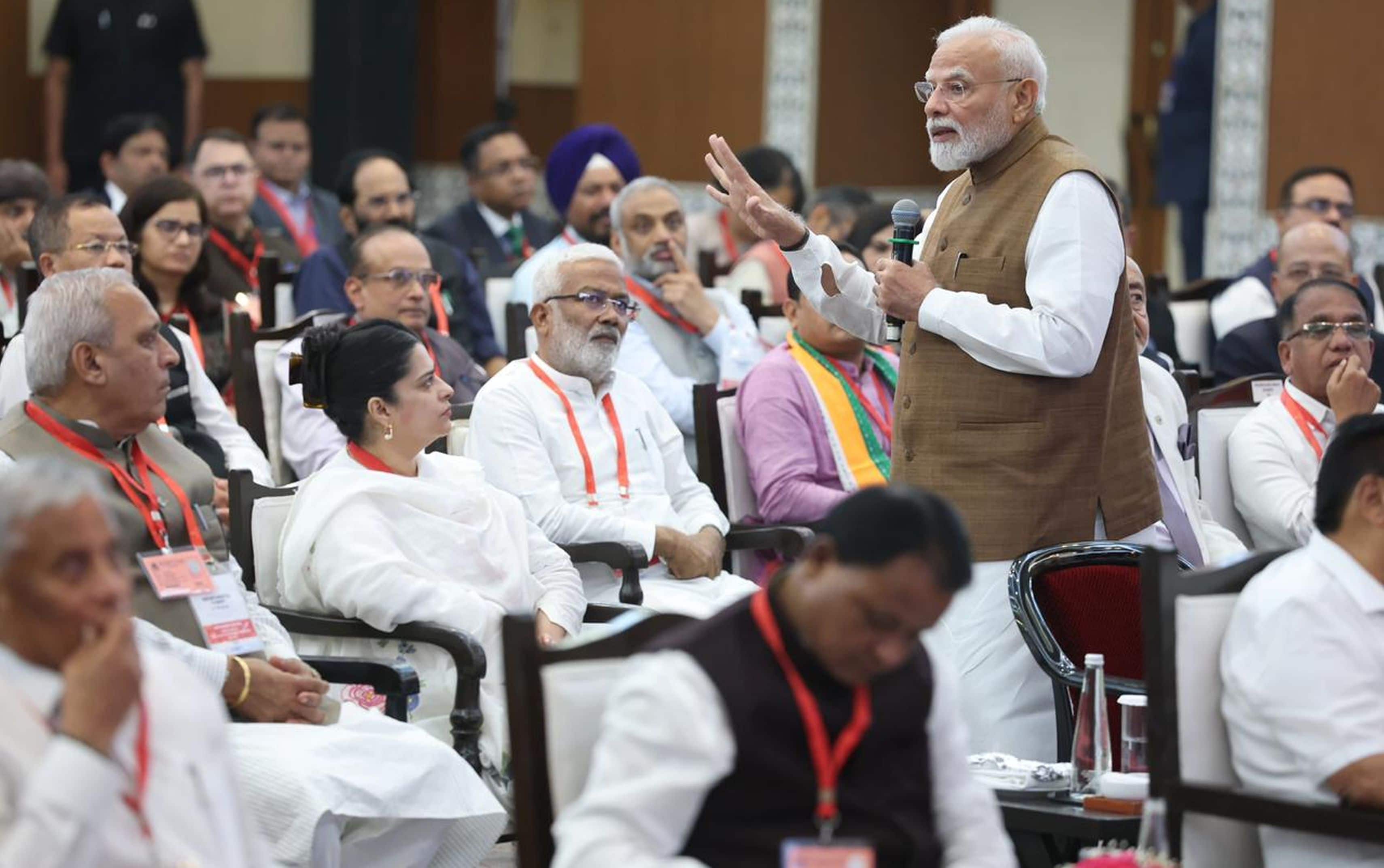
Prime Minister today addressed the 25th Foundation Day of the Rajiv Gandhi University of Health Sciences at Bengaluru via video conferencing.
Prime Minister appreciated the efforts of the Karnataka Government in handling the COVID-19 situation.
Shri Modi said the World is facing one of the biggest crisis since the two World Wars. Like the world changed pre and post-World Wars, the same way the pre and post Covid world will be different, he said.
Shri Modi said at the root of India's brave fight against Covid-19 is the hard-work of the medical community and our Corona warriors. He likened the doctors and medical workers as soldiers but without the soldiers’ uniform.
Prime Minister said the virus may be invisible enemy but our corona warriors are invincible and in the battle against the invisible vs invincible our med workers are sure to win.
Prime Minister expressed concern at violent incidents, owing to mob mentality, against the front-line workers and said several steps have been taken by the Government to curb them. He said that the Government also provided an insurance cover of Rs. 50 Lakhs to those on the front-line.

Prime Minister called for a focus on human centric aspects of development instead of debates on economic issues in the era of globalisation.
He said, advancements nations make in the health sector will matter more than ever before and that the Government had taken many initiativesin health-care and medical education, in the last 6 years.
Prime Minister called for a four pillared strategy to improve the health care, its infrastructure and its access to one and all.
He said the first pillar would be Preventive Health Carewhere in the emphasis would be importance of Yoga, Ayurveda and General Fitness. He said more than 40,000 Wellness Centres were opened with a key focus on controlling life style related diseases. The success of Swachch Bharat mission is another key area of preventive health care.
The second pillar is - Affordable Healthcare. Prime Minister highlighted the success of Ayushman Bharat- the world's largest healthcare scheme and how in less than two years, One crore people have benefitted from it, especially women and those living in rural areas.

The third pillar is- Improvements on the supply side. Prime Minister said that a nation like Indai has to have proper medical infrastructure and medical education infrastructure.
He said, Work is under-way to ensure a medical college or post-graduate medical institute in every district of the country. Prime Minister underlined the fact that the country has seen rapid progress in setting up 22 more AIIMS.
He said over the last five years, we have been able to add over 30,000 seats in MBBSand 15,000 seats in post-graduation. This has been the largest increase in the five year term of any government since independence.
Prime Minister also spoke of the setting up of National Medical Commission to replace The Medical Council of India through an Act of the Parliament.
The fourth pillar, he said would be Mission mode implementation of all the schemes and that it is very crucial for the success of a good idea.
He cited how the implementation of National Nutrition Mission is helping youngsters and mothers and also how India is determined to eliminate Tuberculosis by 2025, which is 5 years ahead of the global target of 2030.
He also spoke of Mission Indradhanush where the annual rise in vaccination coverage has increased by four times.
Prime Minister said that the Central Government has recently approved the introduction of a new law for expanding education of more than 50 different allied and healthcare professionals, which will address the shortage of shortage of para-medical personnel in the country.
He urged the gathering to discuss and ideate on three issues namely how to make advances in Tele-Medicine; how to make gains in health sector through ‘Make In India” and how to bring about more of IT related services into health care.
He was appreciative of how the initial gains in the area of Make in India where the domestic manufacturers started production of PPEs and N-95 Masks and already supplied over 1 Crore of PPEs and 1.5 Crore of Masks.
Prime Minister also appreciated how the ArogyaSetu App is helping in the fight against Corona virus.
25 years means this University. is in the prime of its youth.
— PMO India (@PMOIndia) June 1, 2020
This is the age to think even bigger and do even better.
I am confident that the University will continue to scale new heights of excellence in the times to come: PM @narendramodi
In normal times, the celebrations would have surely been bigger.
— PMO India (@PMOIndia) June 1, 2020
Had it not been for the global pandemic, I would have loved to be with you all in Bengaluru to mark this special day: PM @narendramodi
At such a time, the world is looking up to our doctors, nurses, medical staff and scientific community with hope and gratitude.
— PMO India (@PMOIndia) June 1, 2020
The world seeks both ‘care’ and ‘cure’ from you: PM @narendramodi
At the root of India’s brave fight against COVID-19 is the hardwork of the medical community and our CORONA warriors.
— PMO India (@PMOIndia) June 1, 2020
In fact, doctors and medical workers are like soldiers, but without the soldiers’ uniform: PM @narendramodi
The virus may be an invisible enemy.
— PMO India (@PMOIndia) June 1, 2020
But our warriors, medical workers are invincible.
In the battle of Invisible vs Invincible, our medical workers are sure to win: PM @narendramodi
During the last six years, we in India have given top-most priority to reforms in health and medical education. We are broadly working on four pillars: PM @narendramodi
— PMO India (@PMOIndia) June 1, 2020
Ayushman Bharat- the world’s largest healthcare scheme belongs to India.
— PMO India (@PMOIndia) June 1, 2020
In less than 2 years, 1 crore people have benefitted from this scheme.
Women and those staying in villages are among the major beneficiaries of this scheme: PM @narendramodi
A nation like ours has to have proper medical infrastructure and medical education infrastructure.
— PMO India (@PMOIndia) June 1, 2020
Work is underway to ensure a medical college or post-graduate medical institute in every district of the country: PM @narendramodi
The country has seen rapid progress in setting up 22 more AIIMS.
— PMO India (@PMOIndia) June 1, 2020
Over the last five years, we have been able to add over 30,000 seats in MBBS and 15,000 seats in post-graduation: PM @narendramodi
The fourth pillar is- Mission mode implementation.
— PMO India (@PMOIndia) June 1, 2020
A well-thought of idea on paper makes it a good idea.
And, a good idea well implemented makes it a great one: PM @narendramodi
I would like to highlight the success of India’s National Nutrition Mission that is helping youngsters and their Mothers.
— PMO India (@PMOIndia) June 1, 2020
India is working twenty four by seven to eliminate TB by 2025.
This is five years ahead of the global target of 2030: PM @narendramodi
There are three things on which I would urge maximum discussion and participation.
— PMO India (@PMOIndia) June 1, 2020
One is - advances in tele-medicine.
Can we think of new models that make tele-medicine popular on a larger scale: PM @narendramodi
The other is related to ‘Make in India’ in the health sector.
— PMO India (@PMOIndia) June 1, 2020
The initial gains in this make me optimistic.
Our domestic manufacturers have started production of PPEs and have supplied about 1 crore PPEs to Covid warriors: PM @narendramodi
Third is- IT related tools for healthier societies.
— PMO India (@PMOIndia) June 1, 2020
I am sure you have heard of “ArogyaSetu.”
12 crore health-conscious people have downloaded it. This has been very helpful in the fight against Coronavirus: PM @narendramodi
I want to state it clearly- violence, abuse and rude behaviour against front-line workers is not acceptable: PM @narendramodi
— PMO India (@PMOIndia) June 1, 2020