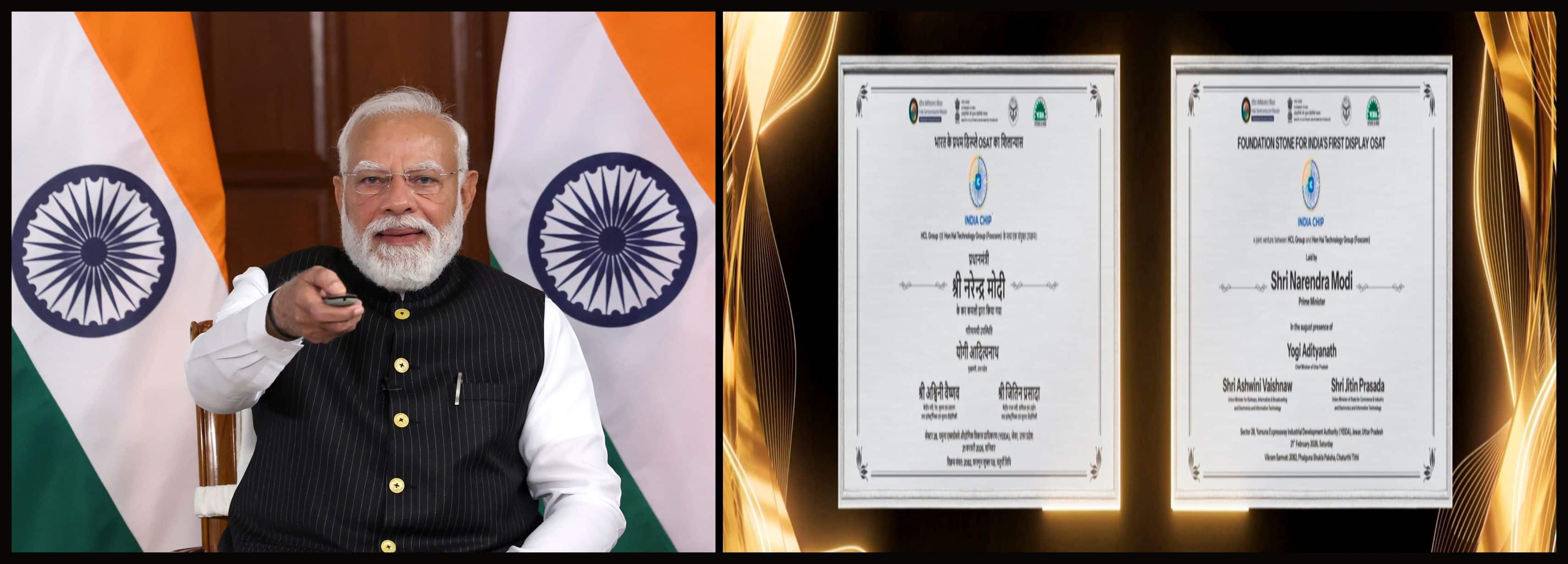
The establishment of the HCL-Foxconn semiconductor facility in Uttar Pradesh is a step towards technological self-reliance, will boost India’s presence in the global chip ecosystem: PM
India is advancing simultaneously in both Software and Hardware; Uttar Pradesh is set to emerge as a major hub for the nation’s Semiconductor Ecosystem: PM
This new factory of HCL and Foxconn will further strengthen UP’s new identity as a technology powerhouse: PM
This decade is India’s Techade; India’s technological strides today will form the foundation of our strength in the 21st Century: PM
India aims for self-reliance in chip manufacturing; focus remains on building a robust domestic Semiconductor Ecosystem: PM
Democratic India is a trusted global partner; our participation increases the resilience of global value chains: PM
Today the world is looking at India as the centre of the tech future: PM

Chief Minister of Uttar Pradesh Yogi Adityanath ji, my colleague in the Union Cabinet Ashwini Vaishnaw ji, Jitin Prasada ji, all ministers of the Uttar Pradesh government, President of Foxconn's Semiconductor Business Group Bob Chen, Chairperson of HCL Technologies Roshni Nadar ji, industry leaders present in the program, other dignitaries, ladies and gentlemen!

​Today India is working at a very fast pace on the goal of becoming developed. And I have also said from the Red Fort that India does not have time to stop or pause. From the beginning of the year 2026 itself, India has further increased its pace. On January 12, lakhs of youth of the country joined the Viksit Bharat Young Leaders Dialogue; on January 16, we celebrated National Startup Day, giving new energy to India's startup revolution; in January itself, at the India Energy Summit, India attracted the world's attention with its potential. Then came the budget giving new momentum to Viksit Bharat, and now this week is also proving to be historic for India. At the Global AI Impact Summit, heads of state from many countries of the world, stalwarts of the technology world, all gathered in Delhi. In this summit, the world saw India's AI potential, understood and appreciated our vision
​Friends,

​This summit ended only yesterday, and now we are becoming a part of such a big program related to India's semiconductor ecosystem here.

​Friends,

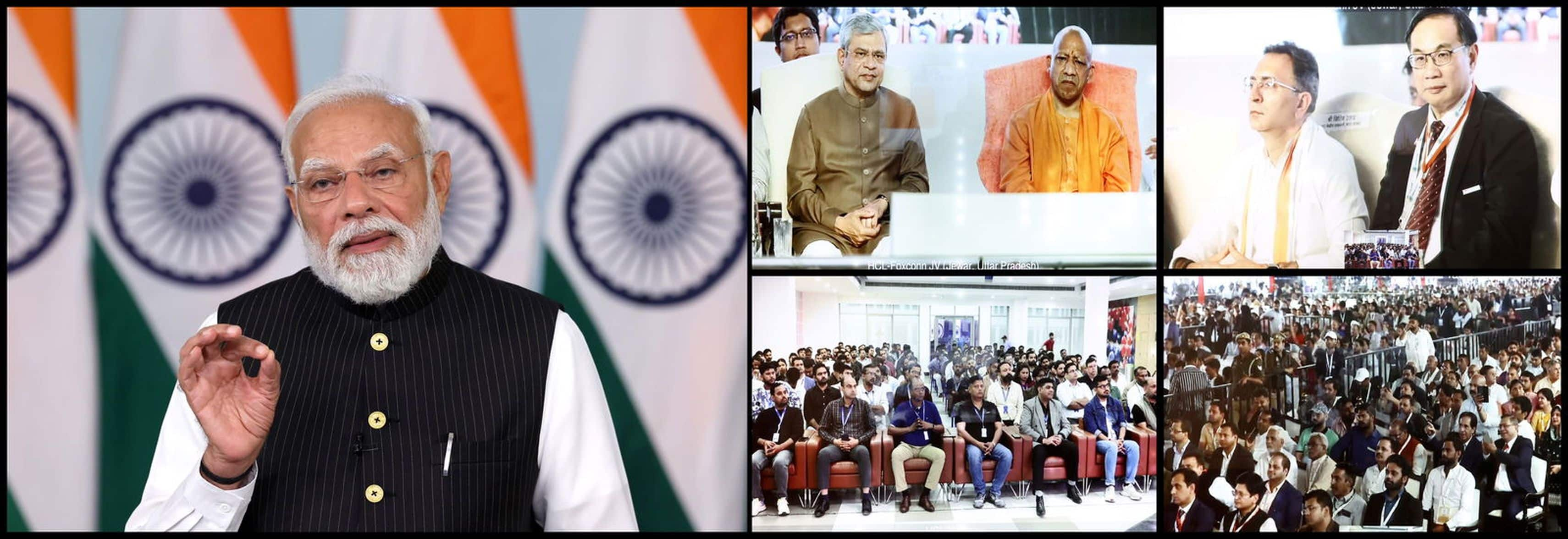
​In the processing power needed to run the modern world, India is now trying to come along with the top countries of the world. That is, India is working on both aspects, software and hardware, simultaneously. And it is a matter of pride for all of us that Uttar Pradesh is also going to become a big center of India's semiconductor ecosystem. This new factory of HCL and Foxconn will further strengthen the new identity of UP as a technology power-house. As a Member of Parliament from Uttar Pradesh too, this is a moment of great pride for me. Because of this semiconductor factory, the youth of Uttar Pradesh and the youth of the country will get employment in large numbers. Because where a semiconductor unit comes, design houses come there, R&D centers come, startup ecosystems are formed. And all this is now going to happen in UP as well. I congratulate the Chief Minister Yogi Adityanath ji and his entire team, and the people of UP very much.

​Friends,

​I often say one thing, that this decade is India's Techade. Whatever India is doing in the field of technology in this decade will become the foundation of our potential in the twenty-first century. Whether it is green energy, whether it is space tech, whether it is digital technology, whether it is manufacturing technology, or artificial intelligence, India today is making unprecedented investments in every technology that determines the future of humanity. The development of a strong semiconductor ecosystem in India is also an excellent example of this. Although India may have started its journey in the semiconductor sector late, today we are moving forward at a very fast pace. Under its Semiconductor Mission, India has so far approved 10 semiconductor fabrication and packaging projects. Out of these, four units are going to start their production very soon.

​Friends,

​You all know, in the twentieth century, the country that had oil gained both prosperity and power. In the twenty first century, this same power lies with a small chip, and in the skill and material associated with it. During the Corona pandemic, we have seen how weak the supply chain of a small chip has been. During that time, as soon as the brake was applied to the supply of chips, factories in the world stopped, and economies began to crumble. India also learned from that crisis and started the effort to turn it into an opportunity. We decided that India has to be made self-reliant in chip manufacturing. For this, a semiconductor ecosystem has to be built in India. Today's program is a reflection of this very vision.
​Friends,

​The creation of Viksit Bharat will happen only when India is self reliant. And for this, it is very important to have a Made in India chip. Because when India's chip is Made in India, we will not have to look towards others for the manufacturing of our modern equipment. Digital India, AI, 5G-6G, Electric Vehicles, Defence, today the soul of every necessary item is the semiconductor, the chip. When we have our own chip, India's speed in every sector will continue without interruption.

​Friends,

​Today, the coming of giant companies like Foxconn to India and cooperating in chip manufacturing also carries a global message. A democratic country like India is a reliable partner of the world. India's increasing participation in any value chain will also increase the resilience of that value chain. Therefore, India's identity as the factory of the world is like a win-win situation for India and other countries of the world.

​Friends,

​Today the world is looking at India as the center of the tech future. A big reason for this is also India's talent. India is not only expanding its pool of chip designing talent but is also giving great emphasis on other skills related to semiconductors. The Government of India has started the Chip to Startup program. Its objective is to prepare more than 85 thousand industry-ready professionals in semiconductor design. In this year's budget, the second phase of the India Semiconductor Mission has also been announced. That is, a complete support system is being developed in India itself for all types of Fabs, advanced packaging, and R&D. Rare earth minerals are also very essential for semiconductor and battery manufacturing. India is taking big steps for self-reliance in this as well. It has been announced in this year's budget that Rare Earth Corridors will be built in the country. This is also a huge encouragement for the semiconductor sector.

​Friends,

​In the past 11 years, India has shown repeatedly that whatever we resolve to do, we achieve it. A few years ago, when the country took the resolution of Make in India, some people had expressed doubts and apprehensions. But today, Make in India has emerged as a strong brand. In the last 11 years, electronics manufacturing in India has increased about six times. Electronics exports have also reached about eight times. In this too, mobile manufacturing has increased more than twenty-eight times. And in our mobile phone exports, there has been an increase of more than a hundred times.
​Friends,

​I have the satisfaction that UP is emerging as a strong pillar in India's manufacturing success. If I talk about mobile phone manufacturing itself, more than half of the country's mobile phones are being made in Uttar Pradesh today. In the coming time, this potential of UP is going to increase further. Because here, along with the semiconductor ecosystem, electronic components, i.e., small parts, are also going to be made here. This will also create new employment opportunities in very large numbers here.

​Friends,

​Today Uttar Pradesh is being discussed for manufacturing. Uttar Pradesh is in the news for the investment of thousands of crores of rupees coming here, and for the new factories being set up here. But until about a decade ago, the name of Uttar Pradesh was being tossed around for the wrong things. Migration and scarcity, lack of facilities and crime - it seemed as if this had become the misfortune of the largest state in the country. I am very proud that the trust the people of UP placed in the double-engine government and the blessings they gave repeatedly, their results are constantly visible. Today, Uttar Pradesh has become a state of Expressways. UP is discussed for the Defence Corridor. People of the country and the world are making Uttar Pradesh a favorite tourism destination today.

​Friends,

​Investors from all over the world are coming to UP today because they know that a grand return on their investment in UP is certain. Modern connectivity like the Dedicated Freight Corridor and Jewar International Airport is taking this entire region to new heights of development. And tomorrow itself, coming tomorrow Sunday, I am going to inaugurate the Delhi-Meerut Namo Bharat train corridor. Where such excellent work is happening, that Uttar Pradesh will certainly become developed. I once again express my gratitude to HCL and Foxconn. I am confident that this semiconductor unit will further accelerate the pace of development of Uttar Pradesh.

​My best wishes to all of you again.

​Thank you very much.

Explore More
ଶ୍ରୀରାମ ଜନ୍ମଭୂମି ମନ୍ଦିର ଧ୍ଵଜାରୋହଣ ସମାରୋହରେ ପ୍ରଧାନମନ୍ତ୍ରୀଙ୍କ ଅଭିଭାଷଣ

ଲୋକପ୍ରିୟ ଅଭିଭାଷଣ

ଶ୍ରୀରାମ ଜନ୍ମଭୂମି ମନ୍ଦିର ଧ୍ଵଜାରୋହଣ ସମାରୋହରେ ପ୍ରଧାନମନ୍ତ୍ରୀଙ୍କ ଅଭିଭାଷଣ
PM Modi's gifts: Muga silk stole for Italy PM, Ladakhi stole for Sweden PM, Kesar mangoes for UAE prez

Media Coverage

PM Modi's gifts: Muga silk stole for Italy PM, Ladakhi stole for Sweden PM, Kesar mangoes for UAE prez
NM on the go

Nm on the go

Always be the first to hear from the PM. Get the App Now!
...
Joint Statement on the State Visit of the President of the Republic of Cyprus
May 22, 2026

The President of the Republic of Cyprus, Mr. Nikos Christodoulides, paid a State Visit to India from 20-23 May 2026, at the invitation of the Prime Minister of the Republic of India, Shri Narendra Modi. The visit holds particular significance as it is taking place during the Cyprus’ Presidency of the Council of the European Union.

This visit builds upon the historic momentum generated by Prime Minister Shri Narendra Modi’s visit to Cyprus in June 2025, which laid the foundation for a strategic partnership, and marks the transition of India-Cyprus relations into a results-oriented and implementation-driven phase.

The two Leaders welcomed the substantial progress achieved in implementing the Joint Declaration issued in 2025, including the advancement of political dialogue, increased business engagement, enhanced defence contacts, and the initiation of cooperation in innovation and technology. Recognizing the evolving geopolitical landscape and the deepening of the India-Cyprus partnership, the Leaders agreed to elevate the bilateral Comprehensive Partnership to a Strategic Partnership, to reflect new realities and opportunities.

President Christodoulides was warmly welcomed by the Hon’ble President of India, H.E. Smt. Droupadi Murmu at Rashtrapati Bhavan on 22 May 2026. He paid homage to Mahatma Gandhi, father of the Indian nation, at Rajghat. Hon’ble President also hosted a State Banquet in honour of the visiting dignitary.

During the visit, Prime Minister Modi and President Christodoulides held bilateral talks in New Delhi on 22 May 2026. The two Leaders held wide-ranging discussions on bilateral relations and expressed satisfaction at the renewed momentum in bilateral engagement across different sectors. They reaffirmed the close and trusted partnership between India and Cyprus, based on shared democratic values, rule of law and mutual respect. They also exchanged views on India-EU relations, as well as regional and global issues of mutual interest.

The two Leaders welcomed the regular contact at the high political level as an important aspect of the India-Cyprus Comprehensive Partnership. They welcomed the significant progress made in the implementation of the India-Cyprus Joint Action Plan 2025-2029 announced during the visit of Prime Minister Modi in 2025. Both sides also agreed to commemorate the 65th anniversary of establishment of diplomatic relations between the two countries in 2027 through the organization of special events.

President Christodoulides congratulated Prime Minister Modi on the successful hosting of the AI Impact Summit 2026. Cyprus was represented by the Deputy Minister for Research, Innovation and Digital Policy, and endorsed the Summit Declaration. Both Leaders shared their views on working towards safe, trustworthy, and inclusive development of AI.

Shared Values and Multilateral Cooperation

The two Leaders underscored their shared commitment to peace, democracy, the rule of law, effective multilateralism, and sustainable development. They reaffirmed their support for a rules-based international order, grounded in the UN Charter and international law, placing particular emphasis on the United Nations Convention on the Law of the Sea (UNCLOS), with regard to freedom of navigation and overflight, unimpeded commerce and sovereign maritime rights.

Both Leaders reiterated their call for addressing pressing global challenges and to prepare the world for emerging developments through reformed and effective multilateralism. In this context, they expressed their intention to strengthen coordination within international organizations, including within the United Nations and the Commonwealth.

The two Leaders stressed the urgent need for the reform of the United Nations Security Council, including ways to make it more effective, efficient, and representative of the contemporary geopolitical challenges. They agreed to coordinate closely in multilateral fora, including on UNSC matters, and to continue supporting efforts to conclude inter-governmental negotiations on the reform of the United Nations Security Council. Cyprus reiterated its firm support for India’s permanent membership of a reformed United Nations Security Council. Both sides also agreed to engage in close cooperation and support each other at the United Nations and other multilateral fora including each other’s candidacies.

Support for Sovereignty and Peace

Cyprus and India expressed their strong commitment to the resumption of negotiations to achieve a comprehensive, just and lasting settlement of the Cyprus Question on the basis of a bizonal, bicommunal federation with political equality, in accordance with the agreed UN framework and the relevant United Nations Security Council resolutions. They underlined the important role of the United Nations Peacekeeping Force in Cyprus (UNFICYP) and their full support for its mandate. President Christodoulides expressed his appreciation for India’s valuable contribution to UNFICYP.

India reiterated its unwavering and consistent support for the independence, sovereignty, territorial integrity, and unity of the Republic of Cyprus. Both sides emphasized the need for full respect of the relevant United Nations resolutions and International Law, so as not to undermine efforts towards a negotiated peaceful solution.

Security, Defence and Counter-Terrorism

Both Leaders categorically and unequivocally condemned terrorism in all its forms and manifestations, including cross-border terrorism. Cyprus expressed solidarity and unwavering support to India in its fight against cross-border terrorism.

The two Leaders condemned in the strongest terms the terrorist attack in Pahalgam, Jammu and Kashmir on 22 April 2025 and the terror incident near Red Fort, New Delhi on 10 November 2025. They emphasized that those responsible for the attacks should be held accountable. Both Leaders called for decisive and concerted international efforts to combat terrorism in a comprehensive and sustained manner and in accordance with international law.

Emphasizing the need for a comprehensive, coordinated, and sustained approach to combating terrorism across borders, they underscored the importance of working collaboratively, both bilaterally and within the multilateral system.

In this context, the Leaders called for strengthening multilateral efforts to combat terrorism and the expeditious finalization and adoption of the Comprehensive Convention on International Terrorism within the UN framework. They urged for strong and concerted action against all UN- and EU-designated terrorists and terrorist entities, including those under 1267 UNSC Sanctions Committee, their associated proxy groups, facilitators, sponsors, financiers and backers.

They underlined the need for cooperation to counter violent extremism and radicalization, financing of terrorism and money-laundering as well as to prevent exploitation of new and emerging technologies for terrorist purposes and to tackle terrorist recruitment. Both sides also called for eliminating terrorist safe havens and infrastructure as well as disrupting terrorist networks and combating the financing of terrorism, at the United Nations and the Financial Action Task Force (FATF).

They reiterated their zero-tolerance approach to terrorism, rejecting double standards, state sponsored terrorism and any justification for such acts, under any circumstances. The Leaders welcomed the signing of an MoU on establishing a Joint Working Group (JWG) on Counter Terrorism, which will provide a framework to enhance bilateral cooperation in counter-terrorism through information and knowledge sharing and capacity building and agreed to hold the first meeting of the JWG as early as possible.

The two Leaders noted the ongoing close cooperation between relevant agencies of both countries, especially to address new and emerging threats in the cyberspace. In this context, the Leaders welcomed the establishment of Cybersecurity Dialogue between the two countries.

They agreed to deepen defence and security cooperation, including through collaboration between their respective defence industries, with a special focus on cybersecurity and emerging technologies. In this context, the Leaders welcomed the signing of the MoU between Cyprus Defence & Space Industries Cluster (CyDSIC) and Society of Indian Defence Manufacturers (SIDM).

Welcoming the India-Cyprus Bilateral Defence Cooperation Programme signed in February 2026, the two Leaders underscored the potential for significant cooperation in the defence sector. They also welcomed the signing of the Technical Arrangement for the establishment of Official Coordination and Cooperation on Search and Rescue (SAR) matters. These will provide an institutional framework for promoting defence industrial cooperation and technology partnership, building on the momentum of the India-EU Defence and Security Partnership signed on 27 January 2026, as well as facilitate exchanges, training and capacity building. The Leaders welcomed the conclusion of the Roadmap for Bilateral Defence Cooperation between the Ministries of Defence of the two countries for the period 2026-2031.

India and Cyprus being maritime nations with deep-rooted naval traditions, both Leaders encouraged expanding cooperation in the maritime domain, including regular port calls by Indian naval vessels and exploring opportunities for joint maritime training and exercises to enhance maritime domain awareness and regional security.

Trade, Investment and Innovation

Both Leaders emphasized that significant potential exists for further expanding bilateral trade, investment and technology partnerships. They agreed to enhance cooperation on building trusted, reliable and resilient supply chains, as well as safeguarding their economic security.

The Leaders welcomed the sustained growth of investments from Cyprus into India, making Cyprus an important source of investments into India. They reaffirmed their commitment to fully realizing the untapped economic potential, including through startups, digitalization, AI and innovation-driven enterprises. They encouraged the business community in both countries to actively explore trade and investment opportunities in priority sectors including, inter alia, financial services, maritime, connectivity, logistics, clean and green energy, waste management, space, science & technology, and research and innovation. The Leaders also highlighted the opportunities that will arise through the implementation of the historic India-EU Free Trade Agreement (FTA) concluded earlier this year.

Through Fintech connectivity, not only cross border transactions but also cross border connections will be strengthened. The Leaders noted the deepening of economic engagement in the financial sector, including the MoU signed between NIPL and Eurobank Cyprus in 2025. They also welcomed the establishment of a framework for interoperability of India’s Unified Payments Interface (UPI) with Target Instant Payment Settlement System (TIPS System) of the European Central Bank (ECB), which will facilitate seamless cross-border transactions, benefiting both tourists and businesses of both the countries.

The two Leaders also welcomed the growing momentum in trilateral and bilateral economic cooperation. In this context, they appreciated the establishment of the India-Greece-Cyprus (IGC) Business and Investment Council as an important platform for strengthening business-to-business linkages, promoting investment flows, and fostering collaboration among the three countries.

Building upon the momentum generated by the India-Cyprus investors roundtable held in Limassol in June 2025, an India-Cyprus Business Forum was organised in Mumbai during the visit which aimed at further strengthening the bilateral economic and commercial partnership as well as fostering new avenues of collaboration. The Leaders welcomed the signing of B2B MoUs on the sidelines of the Business Forum in Mumbai.

The Leaders welcomed continued collaboration between the startups, unicorns, innovation ecosystems and venture capital networks of the two countries. In this context, they welcomed the signing of an MoU on Innovation & Technology which would provide a framework for exchanges between startups, incubators, accelerators and the innovation agencies of both countries.

The Leaders noted the importance of maritime and shipping cooperation in strengthening trade and connectivity between the two countries, and for connecting the Indo-Pacific to Europe through trusted maritime partnerships. Recognizing Cyprus’ role as a gateway to Europe and the potential to serve as a regional hub for transshipment, storage, distribution, and logistics, they encouraged strengthening of maritime cooperation through joint ventures involving Cyprus-based and Indian maritime service providers for mutual benefit. In this context, both Leaders agreed to take forward the positive momentum in maritime cooperation under the existing Bilateral Agreement on Merchant Shipping.

Considering the strong complementarities between Cyprus’ globally recognized maritime services ecosystem and India’s rapidly expanding maritime and port infrastructure capabilities, the two Leaders agreed to strengthen cooperation in the maritime sector as a strategic pillar of the bilateral partnership.

In this context, they acknowledged the potential of Cyprus to serve as a European maritime gateway and operational base for Indian shipping interests and welcomed closer engagement between Indian maritime stakeholders and Cyprus’ shipping and ship management community. The two sides agreed to promote cooperation in maritime services, port connectivity, logistics, maritime training and skills development, as well as green shipping and regulatory compliance, with a view to generating practical and mutually beneficial outcomes in the near term.

The Leaders noted that cooperation in disaster resilience and infrastructure is an area of growing importance to both countries, particularly in the context of increasing climate-related challenges. In this context, Prime Minister Modi welcomed Cyprus’ expression of interest in joining the Coalition for Disaster Resilient Infrastructure (CDRI), and both the Leaders underscored CDRI’s role as a global platform for advancing technical cooperation, capacity building and knowledge sharing, as well as promoting investments in disaster-resilient infrastructure systems.

Science & Technology

Acknowledging the transformative potential of new and emerging technologies, the Leaders noted that the MoU on Innovation and Technology, will promote collaboration among research centers, startups, and academic institutions, as well as joint research and innovation projects in emerging and sustainable technologies, including ethical and responsible AI.

Recognizing the importance of space sector as a critical infrastructure underpinning global economic progress, security, innovation, and technological advancement, both sides expressed interest in partnerships in addressing global challenges. Prime Minister Modi informed that India’s Space Policy 2023 provides an enabling and dynamic framework for non-governmental entities to undertake end-to-end activities in the space domain. Both sides welcomed the ongoing efforts to enhance collaboration for mutual benefit. In this context, the Leaders welcomed the ongoing engagement between ERATOSTHENES Centre of Excellence (ECoE) and Indian National Space Promotion and Authorization Centre (IN-SPACe).

Education, Mobility and Skills Development

The Leaders welcomed growing exchanges at the academic level including students and researchers. In this context, they welcomed the signing of an MoU in the field of Higher Education and Research, which they noted would provide a strong foundation for higher education institutions and research organizations in both countries to strengthen engagement, enhance exchanges, and explore opportunities for collaboration, including through joint research initiatives, faculty and student mobility, and institutional partnerships.

The Leaders welcomed the signing of an MoU on Diplomatic Training between the Sushma Swaraj Institute of Foreign Service (SSIFS) and the Diplomatic Academy, MoFA, Cyprus which will strengthen bilateral ties by cooperation in the training of diplomats.

The Leaders committed to continuing negotiations with a view to concluding a Migration and Mobility Partnership Agreement, which will provide a framework to facilitate collaboration on safe, regular and orderly migration, and support sustainable workforce mobility of highly skilled workers, students, and researchers. Both Leaders also agreed on the commencement of negotiations for a Social Security Agreement at the earliest.

In this context, the Leaders also welcomed the signing of the MoU between the Institute of Chartered Accountants of India (ICAI) and the Institute of Certified Public Accountants of Cyprus (ICPAC) which would provide a good opportunity for young accountants to contribute to developing professional and regulatory standards, exchanging best practices in accounting and auditing, and enhancing mutual recognition and employability in the fields of finance and business services.

Cultural Cooperation and People-to-People ties

The Leaders highlighted the need to expand cultural exchanges between India and Cyprus. They welcomed the signing of an MoU on Cultural Cooperation, which is expected to facilitate exchanges in the fields of visual arts, performing arts, educational programs for the arts, heritage conservation, and creative industries. The Leaders encouraged closer collaboration between museums, academic institutions, and cultural bodies to promote joint initiatives, exhibitions, and capacity-building efforts, and appreciated the growing interest in Yoga, Ayurveda and Indian culture in Cyprus.

The Leaders recognized the potential for further growth in two-way tourism which would contribute to fostering greater understanding between the people of both countries. Both sides agreed to work to expand tourist flow in both directions by collaboration between tourism stakeholders.

The Leaders noted that cooperation on consular matters remained an area of continued interest to both countries, given the growing movement of people and expanding people-to-people ties. In this context, they welcomed the launch of a Consular Dialogue, noting that it would provide a structured framework for addressing consular issues and strengthening cooperation.

India–EU Relations

The two Leaders welcomed the conclusion of the India-EU Free Trade Agreement during the India-EU Summit on 27 January 2026. Both sides also endorsed the Joint India–EU Comprehensive Strategic Agenda for 2030, aimed at further reinforcing the strategic partnership by broadening, deepening and better coordinating EU-India cooperation to deliver mutually beneficial, concrete and transformative outcomes for both partners and for the wider world.

Hailing the India-EU Free Trade Agreement as a historic milestone in the strategic partnership, the Leaders called for its early signing and timely implementation for realizing the true potential for trade and investment collaboration through diversifying critical value chains and opening new markets.

The Leaders agreed to further enhance the work of the India-EU Trade and Technology Council (TTC) to address key trade, technology, and economic security issues, and looked forward to the results of the TTC Ministerial meeting in July.

The signing of the India-EU Security and Defence Partnership will deepen cooperation in areas of shared interests, including maritime security, defence industry and technology, cyber and hybrid threats, space and counter terrorism. The two Leaders also called for early conclusion of the India-EU Security of Information Agreement in this regard.

Welcoming the signing of the MoU on Comprehensive Framework of Cooperation on Mobility and the launch of a pilot European Union Legal Gateway Office in India, the Leaders noted its role in promoting legal pathways for movement of professionals, skilled workforce and students and strengthening people-to-people ties between India and the EU.

Indo-Pacific, Connectivity and Regional & Global Issues

The Leaders reiterated their shared commitment to promoting a free, open, peaceful, prosperous and rules-based Indo-Pacific, in accordance with international law, including the UNCLOS. Prime Minister Modi appreciated Cyprus for joining the Indo-Pacific Oceans Initiative, underscoring its potential to deepen cooperation in maritime security as well as the sustainable use of marine resources.

Both Leaders recognized the India–Middle East–Europe Economic Corridor’s (IMEEC) transformational potential in reshaping and promoting global trade, connectivity and prosperity. They reiterated their shared commitment to promoting stability in the Eastern Mediterranean and the wider Middle East and emphasized the importance of fostering deeper engagement and corridors of interconnection from India through the wider Middle East to Europe. They discussed the establishment of a Bilateral Connectivity Dialogue.

The Leaders expressed their support for the early resolution of the conflict in Ukraine through dialogue, diplomacy and constructive engagement between the key stakeholders, in order to achieve a comprehensive, just and lasting peace in Ukraine, in accordance with international law and the principles of the UN Charter.

On the recent developments in West Asia, both the Leaders underscored the importance of dialogue and diplomacy to resolve the underlying issues in a peaceful manner, including safe and unimpeded passage of maritime shipping.

The two Leaders also discussed the importance of upholding the global non-proliferation architecture, recognizing the value of India joining the Nuclear Suppliers Group.

Conclusion

Both Leaders expressed satisfaction at the deepening of India–Cyprus relations and in order to take forward the cooperation under the India-Cyprus Strategic Partnership, they directed both sides to work for the timely implementation of the India-Cyprus Joint Action Plan 2025-2029. The Leaders agreed to maintain regular interaction building upon the shared spirit of mutual respect and collaboration.

The President of Cyprus thanked the Prime Minister of India for the excellent arrangements during his State Visit extended by the Government and the people of India.

The Leaders reaffirmed their shared vision of Cyprus and India as strategic partners and vital connectors between Europe, the Mediterranean, and the Indo-Pacific, committed to advancing peace, stability, connectivity, and prosperity.

They reaffirmed their commitment to delivering tangible outcomes under the India-Cyprus Joint Action Plan 2025-2029 and to further strengthening India-Cyprus cooperation as a dynamic pillar of the broader India-EU strategic partnership.

The Leaders agreed that the present visit marks a decisive step in transforming a historically strong relationship into a new stage in bilateral relations, elevating the partnership into a more ambitious, modern, strategic, and future-oriented framework of cooperation.