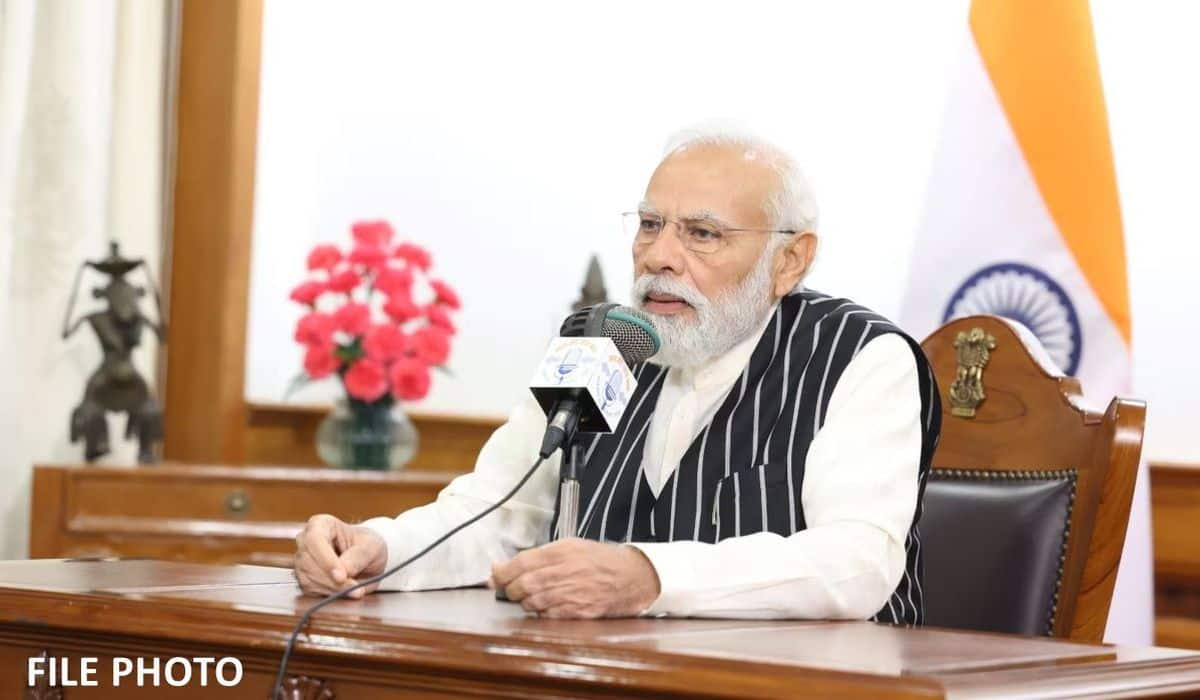
PM’s speech at book release on former PM Chandra Shekhar

Published By : Admin | July 24, 2019 | 17:18 IST
It has been 12 years since he passed away but the thoughts of Chandra Shekhar Ji continue to guide us: PM Modi
These days, even if a small leader does a 10-12 km Padyatra, it is covered on TV. But, why did we not honour the historic Padyatra of Chandra Shekhar Ji: PM
There will be a museum for all former Prime Ministers who have served our nation. I invite their families to share aspects of the lives of former PMs be it Charan Singh Ji, Deve Gowda Ji, IK Gujral Ji and Dr. Manmohan Singh Ji: PM

The Hon'ble Vice President; the Speaker of the Lok Sabha, Om Birla ji; Ghulam Nabi ji; in a way the focus of today's programme, Shri Harivansh ji, all the family members of Chandrashekhar ji and all his fellow companions who share his ideas.

It is very difficult to survive even for two years, after taking leave from the political scene in today's time. People forget; companions also forget, and such a personality perhaps is lost in some corner of history.

We must remember this fact that around 12 years after his departure, Chandrasekhar Ji remains alive in the same form among us even today. I want to congratulate Harivansh ji for not only accomplishing this task but also to have the courage to do the same. I used the word 'courage' because in the past few years, such an environment has been created in our country where political gameplay has turned more intense. Harivanshji, who has come from the world of journalism has been a neutral personality and is the Deputy Chairman in the Rajya Sabha. However, after the release of the book, I am afraid a particular label may be attributed to him.

I didn't get the opportunity to work with Chandrashekhar ji. Once I had got the opportunity to meet him in the year 1977. I would like to share a few incidents. Once I and Bhairon Singh Shekhawat ji were going for a party work and were at the Delhi Airport. Chandrashekhar ji too was going for some personal work. We saw Chandrashekhar ji coming towards us from a distance. So, Bhairon Singh ji pulled me aside and put all the things he had in his pocket in my pocket. Everything happened so fast that by the time I could ask the reason for putting those things inside my pockets, Chandrashekhar ji had arrived. The first thing that Chandrashekhar ji did was to put his hands inside Bhairon Singh ji's pockets. Then I understood. Bhairon Singh ji used to have things like Pan Parag and tobacco whereas Chandrashekhar ji was totally opposed to the same. Whenever Bhairon Singh ji used to meet Chandrashekhar ji, he used to take those things away and throw them in the dustbin. Thus, to avoid that, Bhairon Singh ji had put his things into my pockets.

On one hand was the Jan Sangh, Bharatiya Janta Party and its ideology while on the other hand was Chandrashekhar ji and his ideology. There was a fellow-feeling and openness. Chandrashekhar ji was always concerned about Bhairon Singh ji's health. This is a great thing in itself. Chandrashekhar ji, both at personal and public level, used to address Atal ji as 'Guru ji". And before saying anything, even in the House, he used to say - "Guru ji, kindly forgive me; I am going to criticize you". If you see the old records, you will find that such were his values and these reflected his dignity.

After all, at a time when Congress party's stars were shining, what was that element or that source of inspiration that motivated this person to choose the path of rebellion? Probably the values of Bagi Ballia, the soil of Bagi Ballia had inspired him. I consider two major historic events to be the most significant ones - Jaiprakash Narayan ji- Bihar and Mahatma Gandhi- Gujarat. After independence when it came to choose the Prime Minister for the country, a Gujarati chose a non-Gujarati. Similarly, after winning the fight for democracy, when it came to choosing the Prime Minister, he chose a Gujarati instead of a Bihari.

At that time, there was a dicey situation and one had to choose either Chandrashekhar ji or Morarji Bhai. Of the few colleagues of Chandrashekhar ji, I was in good contact with Mohan Dharia ji and George Fernandez. And their words always reflected Chandrashekhar ji's conduct and ideas. Those used to be full of respect. There could be several others, but I was not in contact with them.

Chandrashekhar ji was ill for some time. I got a telephone call from him a few months before his death. I was the Chief Minister of Gujarat at that time. He said - "Brother, when are you coming to Delhi?" I asked him what the matter was. He said - "I was wondering if you could come to my home. We could meet. I would have come if I were in good health." I said- "It is a great privilege that you thought of me and called me". So, I visited him. I was surprised that despite his poor health he talked to me for so long and tried to know about Gujarat. He tried to know whatever was going on in Gujarat at the government level. But then he talked about his ideas on the issues in the country and the ways to deal with it. He said -" you are young, you should deal with it". He became extremely sentimental. That was my last meeting with him. But even today, his indelible image, his clarity of thoughts, his commitment to the general public, devotion to democratic systems are visible in his every word.

This book on Chandrasekhar ji, written by Harivansh ji, will give us a chance to understand Chandrasekharji; but a lot of things in this book are opposite to what we have been told about the events of that era so far. Therefore, probably, some section might analyze that book with that perspective. And there is a fashion in our country. Some people have certain rights to analyze things.

Today even if a non-descript leader carries out 10-12 km Padyatra, TV channels will show it for 24 hours and the news will make headlines on the front page of the newspapers. But Chandrashekhar ji did Padyatra not in view of elections but keeping in mind the villages and poor farmers. But we failed to give him the honour that the nation should have given. This is really painful and unfortunate.

There could be a difference of opinion on his ideas even today. That is the special feature of a democracy. But, deliberately, with a planned strategy, Chandrasekhar ji's visit was described as a motive to collect donations, capitalists’ money and corruption etc. Such gross injustice lies in public life. I do not know whether Harivansh ji has taken it in his book or not but I have tried to study that matter closely.

There is one more thing in our nation. If the new generation is asked about the total number of Prime Ministers in our country so far, probably no one is aware of that. Who were the Prime Ministers? Very few people would know that. They were made to forget. In such a scenario Harivanshji, you have done a courageous job! I congratulate you. Everyone is a party to it but forgive me, there is one particular group that tried to create a negative image of Baba Saheb Ambedkar ji and Sardar Vallabh Bhai Patel - that they didn't understand anything etc.

If Lal Bahadur Shastri ji was alive today, that group would have presented him in a similar way. Lal Bahadur Shastri was saved because his martyrdom became supreme.

After that discussions had started about what Morarji Bhai drank, or about some Prime Minister who slept through the meetings or some Prime Minister who back stabbed. That is, such titles were given to everyone so that the world would forget them.

But with your blessings, I have decided to set up a modern museum in Delhi with all the former Prime Ministers. It is my request to the family members and friends of all the former Prime Ministers to compile and keep the things ready so that future generations are able to know about them. Chandrashekhar ji was our Prime Minister and those were his contributions or those were the specialties and contribution of Charan Singh ji or the contributions of Deve Gowda ji, I.K Gujral ji or Dr. Manmohan Singh ji. Everything should be detached from politics.

We need a new political culture within the country and we are trying to do the same. Chandrashekhar ji can inspire people even today if we present him in the right perspective before the people. Even today, with his thoughts, the minds of the youngsters can be enriched with democratic values. There will be no need to adopt an undemocratic way.

I remember clearly when he had to resign from the Prime Minister’s post, one IB's policeman created a flutter in Delhi. The world noted that a government could fall due to a policeman.

That day I was in Nagpur. There was a programme of Atal ji and Advani ji. But they were supposed to reach later. I reached there early. I received a phone call from Chandrashekhar ji at my place there. He asked me - "where is Guruji?" I said - "his plane has not reached yet. Probably it would take an hour". He said - "I am waiting. I want to talk to him as soon as possible. Tell him that I have decided to resign. But I want to talk to him." At that time Atal ji was to come to Nagpur and I had reached there to check the arrangements. But Chandrashekhar ji was desperate to talk to him, whom he called Guruji, before his final decision.

He had many such characteristics. We are commemorating him once again in the same place where he had spent 40 years of his life as an MP for the welfare of the nation and for the welfare of the oppressed, deprived classes and the poor. Seeking inspiration from him, if we could do something for the common man of the country, it would be a tribute to him in the true sense.

Once again, congratulating Harivanshji and the family members, I end my speech.

Thank you!

Explore More
ଶ୍ରୀରାମ ଜନ୍ମଭୂମି ମନ୍ଦିର ଧ୍ଵଜାରୋହଣ ସମାରୋହରେ ପ୍ରଧାନମନ୍ତ୍ରୀଙ୍କ ଅଭିଭାଷଣ

ଲୋକପ୍ରିୟ ଅଭିଭାଷଣ

ଶ୍ରୀରାମ ଜନ୍ମଭୂମି ମନ୍ଦିର ଧ୍ଵଜାରୋହଣ ସମାରୋହରେ ପ୍ରଧାନମନ୍ତ୍ରୀଙ୍କ ଅଭିଭାଷଣ
 PLI schemes attract over Rs 2.16 lakh crore investment, generate 14.39 lakh jobs

Media Coverage

PLI schemes attract over Rs 2.16 lakh crore investment, generate 14.39 lakh jobs
NM on the go

Nm on the go

Always be the first to hear from the PM. Get the App Now!
...
PM Modi inaugurates Phase I of Noida International Airport, developed with an investment of around ₹11,200 crore
March 28, 2026
The inauguration of Phase-I of Noida International Airport marks a major step in Uttar Pradesh’s growth story and India’s aviation future: PM
UP has now emerged as one of the states with the highest number of international airports in India: PM
Airports are not just basic facilities in any country, they give wings to progress: PM
Our government is making unprecedented investments in modern infrastructure to build a Viksit Bharat: PM

The Prime Minister, Shri Narendra Modi, today inaugurated the Noida International Airport at Jewar in Uttar Pradesh. Expressing his pride and joy on the occasion, the Prime Minister said that today marks a new chapter in the Viksit UP, Viksit Bharat Abhiyan. He noted that India's largest state has now become one of the states with the highest number of international airports. PM Modi shared that he felt doubly proud , first, for having laid the foundation stone of this airport and now inaugurating it, and second, because the name of this grand airport is linked to Uttar Pradesh. "This is the state that chose me as its representative and made me a Member of Parliament, and its identity is now associated with this magnificent airport," remarked Shri Modi.

Highlighting the far-reaching impact of the new airport, the Prime Minister said that the Noida airport will benefit a vast region encompassing Agra, Mathura, Aligarh, Ghaziabad, Meerut, Etawah, Bulandshahr, and Faridabad. He emphasised that the airport will bring numerous new opportunities for the farmers, small and medium enterprises, and the youth of western Uttar Pradesh. "Aircraft will fly from here to the world, and this airport will also become a symbol of a developed Uttar Pradesh taking flight," said Shri Modi, extending his heartfelt congratulations to the people of the state, especially western UP.

Speaking about the current global situation, the Prime Minister observed that the entire world is deeply concerned today, with a war raging in West Asia for over a month, creating crises of essential commodities including food, petrol, diesel, gas, and fertilizers in many countries. He noted that India imports a very large quantity of crude oil and gas from the conflict-affected region. "The Government is taking every possible step to ensure that the burden of this crisis does not fall on ordinary families and farmers," affirmed Shri Modi.

Underscoring India's continued momentum of rapid development even during times of global crisis, the Prime Minister noted that in Western Uttar Pradesh alone, this is the fourth major project to be either inaugurated or have its foundation stone laid in recent weeks. "During this period, the foundation stone of a major semiconductor factory in Noida was laid, the country's first Delhi-Meerut Namo Bharat train gained speed, the Meerut Metro was expanded, and today the Noida International Airport is being inaugurated," highlighted PM Modi.

The Prime Minister credited the current Government for these remarkable achievements in UP's development. He noted that the semiconductor factory is making India self-reliant in technology, the Meerut Metro and Namo Bharat Rail are providing fast and smart connectivity, and the Jewar Airport is connecting entire North India to the world. " Today under the current government, the same Noida is becoming a powerful engine of UP's development," asserted Shri Modi.

Elaborating on the history of the airport project, The Prime Minister recalled that the Jewar Airport was approved by Atal ji as early as 2003. And as soon as the current government was formed here, the foundation was laid, construction happened, and now it has started operations," said Shri Modi.

Drawing attention to the region's emerging role as a logistics hub, the Prime Minister pointed out that this area is becoming the hub of two major freight corridors , special railway tracks laid for goods trains, which have enhanced North India's connectivity with the seas of Bengal and Gujarat. He noted that Dadri is the strategic point where both these corridors converge, meaning whatever farmers grow and industries produce here can now reach every corner of the world swiftly, by land and by air. "This kind of multi-modal connectivity is making UP a major attraction for investors worldwide," explained PM Modi.

Addressing the transformation of the region's image, the Prime Minister said. "Today, Noida is ready to welcome the entire world. This whole area is strengthening the resolve of Aatmanirbhar Bharat”.

The Prime Minister expressed his gratitude to the farmers who gave up their lands to make this project a reality, noting that agriculture and farming hold great importance in the region's economy. Shri Modi noted that the expansion of modern connectivity will further boost food processing prospects in Western UP, adding, "The agricultural produce from here will now reach global markets more efficiently."

Acknowledging the contribution of sugarcane farmers to reducing India's dependence on crude oil, the Prime Minister highlighted the significant role of ethanol produced from sugarcane. PM Modi highlighted that without the increase in ethanol production and its blending with petrol, India would have had to import an additional four and a half crore barrels,approximately 700 crore litres of crude oil annually, adding, "The hard work of our farmers has given the country this enormous relief during the time of crisis."

The Prime Minister further elaborated that ethanol has not only benefited the nation but has also greatly benefited farmers, with approximately Rs 1.5 lakh crore worth of foreign exchange being saved. He recalled the earlier days when sugarcane farmers had to wait for years for their dues. "Today, thanks to the efforts of the current Government, the condition of sugarcane farmers has improved significantly," affirmed Shri Modi.

Emphasizing that airports are not merely amenities but catalysts for progress, the Prime Minister pointed out the remarkable expansion of India's aviation infrastructure. Highlighting that today, there are more than 160 airports, PM Modi remarked that the Air connectivity is now reaching not just metropolitan cities but also smaller towns. “ The current government has made air travel accessible for the common Indian," asserted Shri Modi, adding that the number of airports in Uttar Pradesh has been increased to seventeen.

Highlighting the impact of the UDAN scheme, the Prime Minister said that the government has consistently strived to ensure that while airports are built, airfares remain within the reach of ordinary families. Noting that more than one crore sixty lakh citizens have travelled by air at affordable rates by booking tickets under the UDAN scheme, Shri Modi remarked, “ Recently, the Central Government has further expanded the UDAN scheme with an approval of approximately Rs 29,000 crore, under which 100 new airports and 200 new helipads will be built in smaller cities in the coming years. UP will also benefit immensely from this."

Speaking about India's rapidly growing aviation sector, the Prime Minister noted that as new airports are being built, the demand for new aircraft is also rising, with various airlines placing orders for hundreds of new planes. Shri Modi observed that this creates tremendous opportunities for the youth, including pilots, cabin crew, and maintenance professionals, adding that "our government is also expanding training facilities in the aviation sector" to meet this growing demand.

Addressing a critical gap in India's aviation ecosystem, the Prime Minister drew attention to the Maintenance, Repair, and Overhaul (MRO) sector, noting that 85 per cent of Indian aircraft still have to go abroad for MRO services. PM Modi noted that the government has resolved to make India self-reliant in the MRO sector as well and highlighted that today, the foundation stone of an MRO facility has been laid here at Jewar. “When ready, it will serve aircraft from India and abroad , generating revenue for the country, keeping our money within India, and creating numerous jobs for the youth," announced Shri Modi.

Underlining the government's priority of ensuring citizen convenience and saving their time and money, the Prime Minister spoke about the expansion of modern rail services such as Metro and Vande Bharat. "The Delhi-Meerut Namo Bharat Rail has already been used by over two and a half crore passengers. The journey between Delhi and Meerut that used to take hours is now completed in minutes," said PM Modi.

Underscoring the unprecedented investment in modern infrastructure for a Viksit Bharat, the Prime Minister shared that over the past eleven years, the infrastructure budget has been increased more than six-fold, with Rs 17 lakh crore spent on highways and expressways and over one lakh kilometres of highways constructed. He noted that railway electrification has expanded from 20,000 kilometres before 2014 to over 40,000 kilometres since then, with nearly 100 per cent of the broad-gauge network now electrified. The Prime Minister highlighted that for the first time, the Kashmir Valley and the capitals of the North-East are being connected to the rail network, while port capacity has more than doubled in the past decade and the number of inland waterways continues to grow. "India is working at a rapid pace in every sector necessary for building a Viksit Bharat," stated Shri Modi.

Calling for collective effort and national unity in the face of global challenges, the Prime Minister said he had spoken at length in Parliament and held detailed discussions with Chief Ministers about tackling the crisis arising from the ongoing conflict. He appealed to the people to face this crisis with a calm mind and patience, calling it the greatest strength of Indians. PM Modi reiterated that what is in the interest of Indians and in the interest of India, that alone is the policy and strategy of the Government of India." I am fully confident that all political parties will lend strength to the country's united efforts”, concluded Shri Modi.