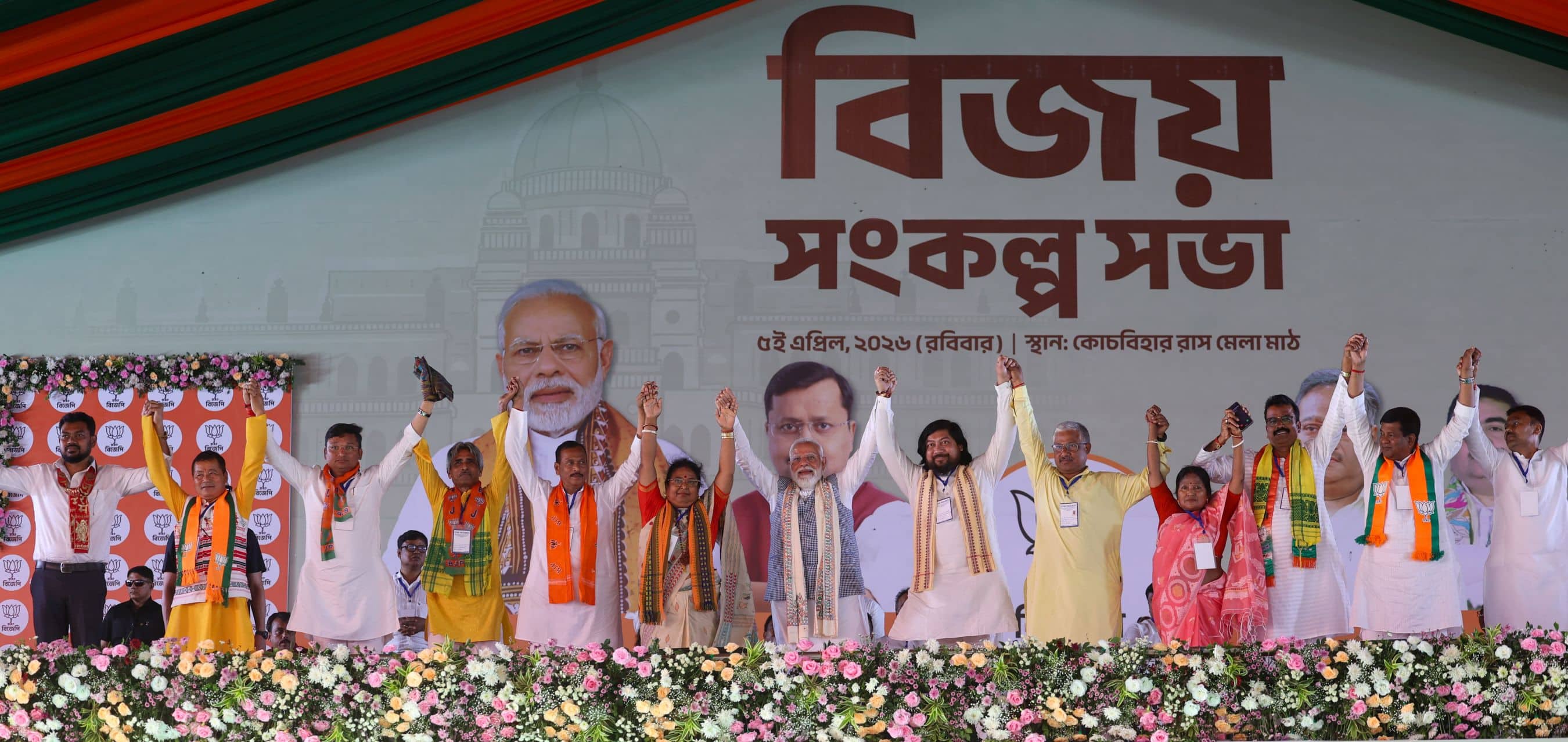
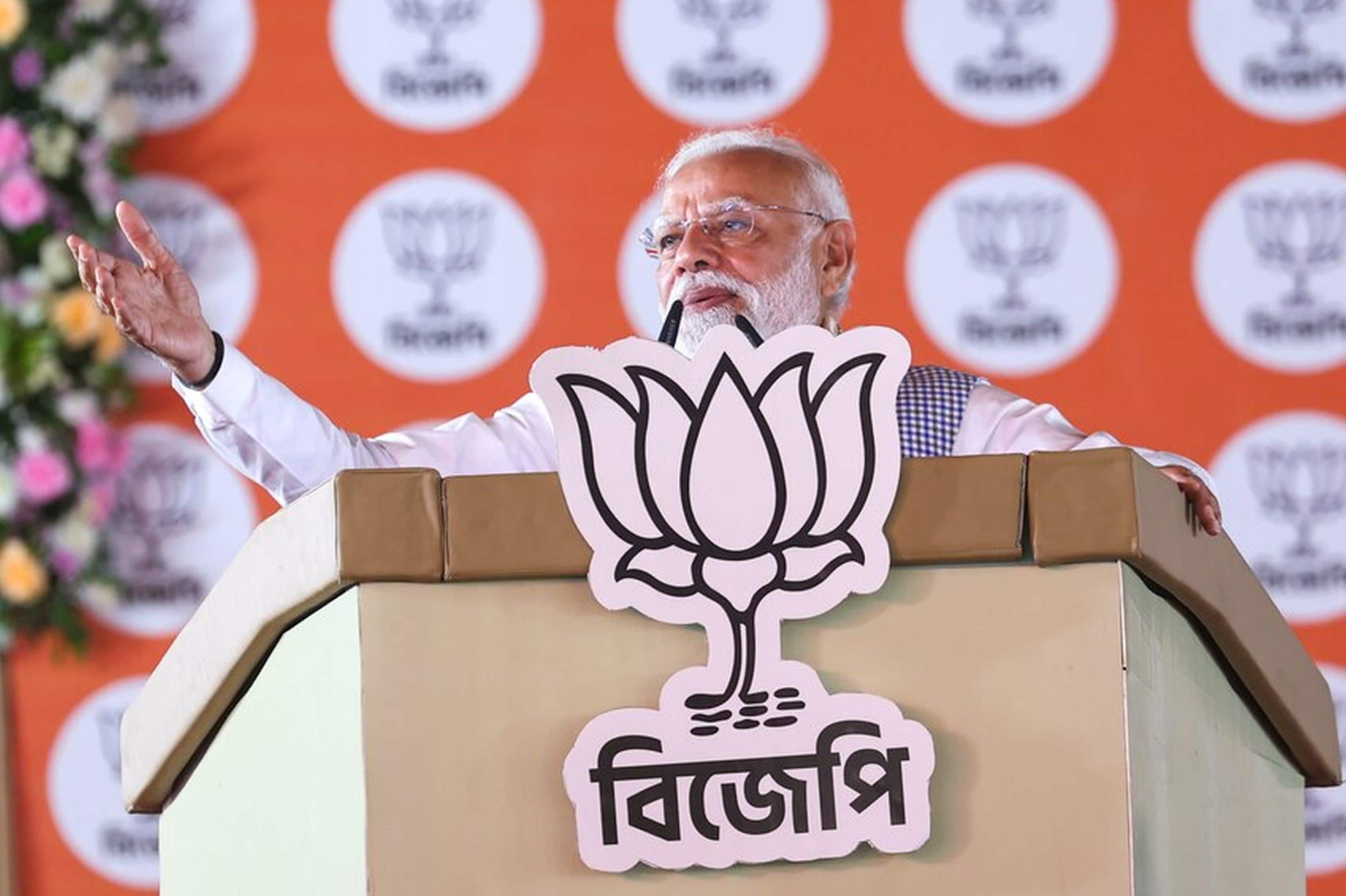
PM Modi addresses a massive public rally in Cooch Behar, West Bengal

Published By : Admin | April 5, 2026 | 16:20 IST
The people of Bengal are today faced with a clear choice between TMC’s fear and BJP’s trust: PM Modi in Cooch Behar rally
A double-engine government will ensure better infrastructure and fair opportunities for farmers: PM Modi’s promise in Bengal
The people of Bengal have resolved to defeat those attempting to alter the state’s identity: PM Modi
Bengal, once among India’s most developed states, has suffered due to successive phases of misgovernance under Congress, Left and now TMC: PM expressed grief in Bengal rally

PM Modi addressed a massive public rally in Cooch Behar, stating that the people of West Bengal are today faced with a clear choice between TMC’s fear and BJP’s trust. He said that while TMC represents cut-money, corruption, infiltration and syndicate raj, BJP stands for rapid development, security, dignity and rightful ownership of land and homes.

Highlighting the deteriorating law and order situation, PM Modi said that democracy is under constant attack in West Bengal. He referred to recent incidents in Malda, where judicial officials were held hostage, and said such events reflect the collapse of governance under TMC. He added that even the Supreme Court has had to intervene, exposing the extent of lawlessness and “Maha Jungle Raj” in the state.
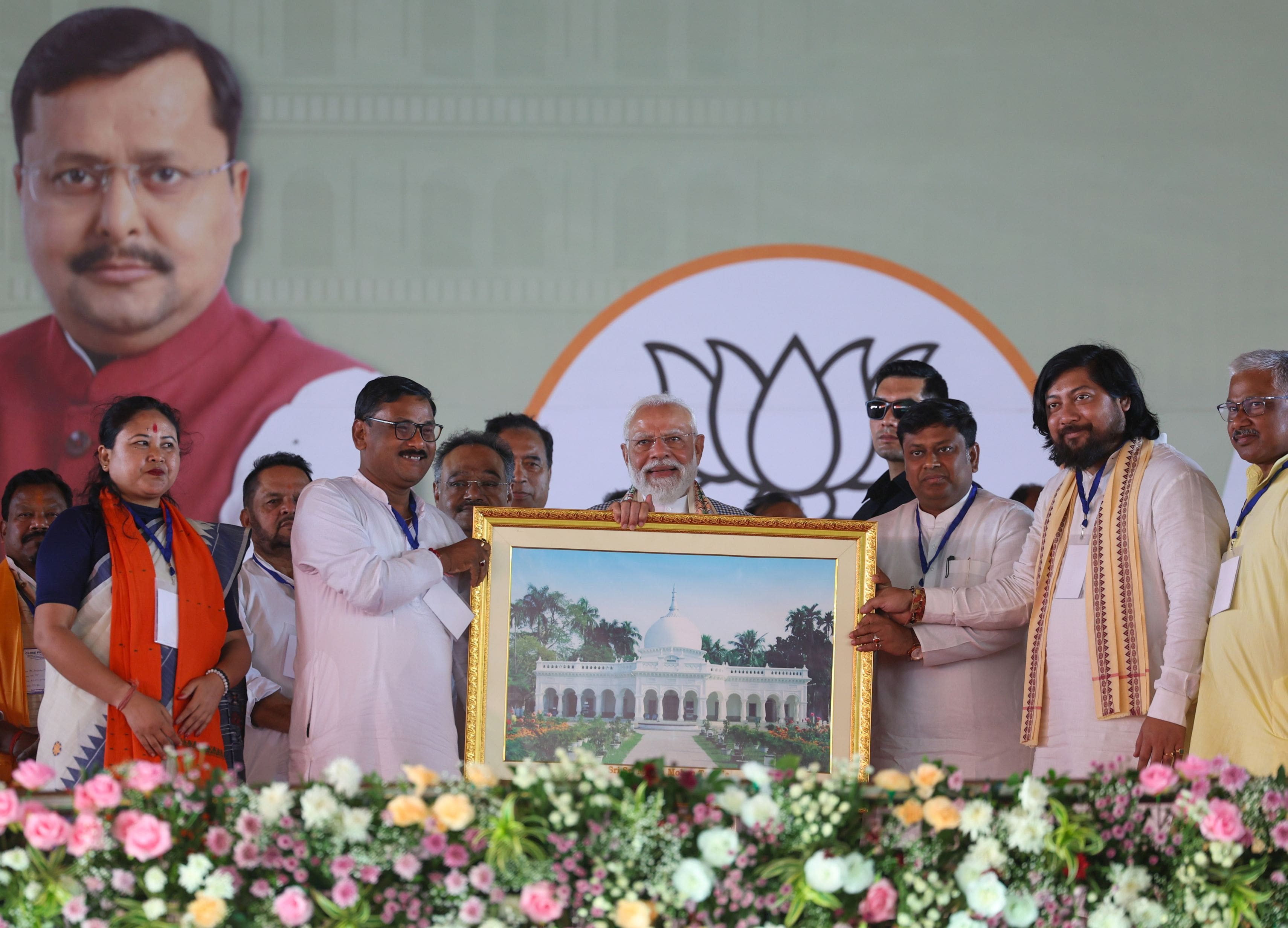
Emphasising BJP’s commitment to women empowerment, the Prime Minister said Bengal is the land of Shakti worship and assured that BJP will open new avenues for women’s dignity and prosperity. He highlighted that over 3 crore women have become Lakhpati Didis under central schemes.

PM Modi said Bengal, once among India’s most developed states, has suffered due to successive phases of misgovernance under Congress, Left and now TMC. He also highlighted the SSC teacher recruitment scam and said corruption and syndicate control have damaged the future of Bengal’s youth.
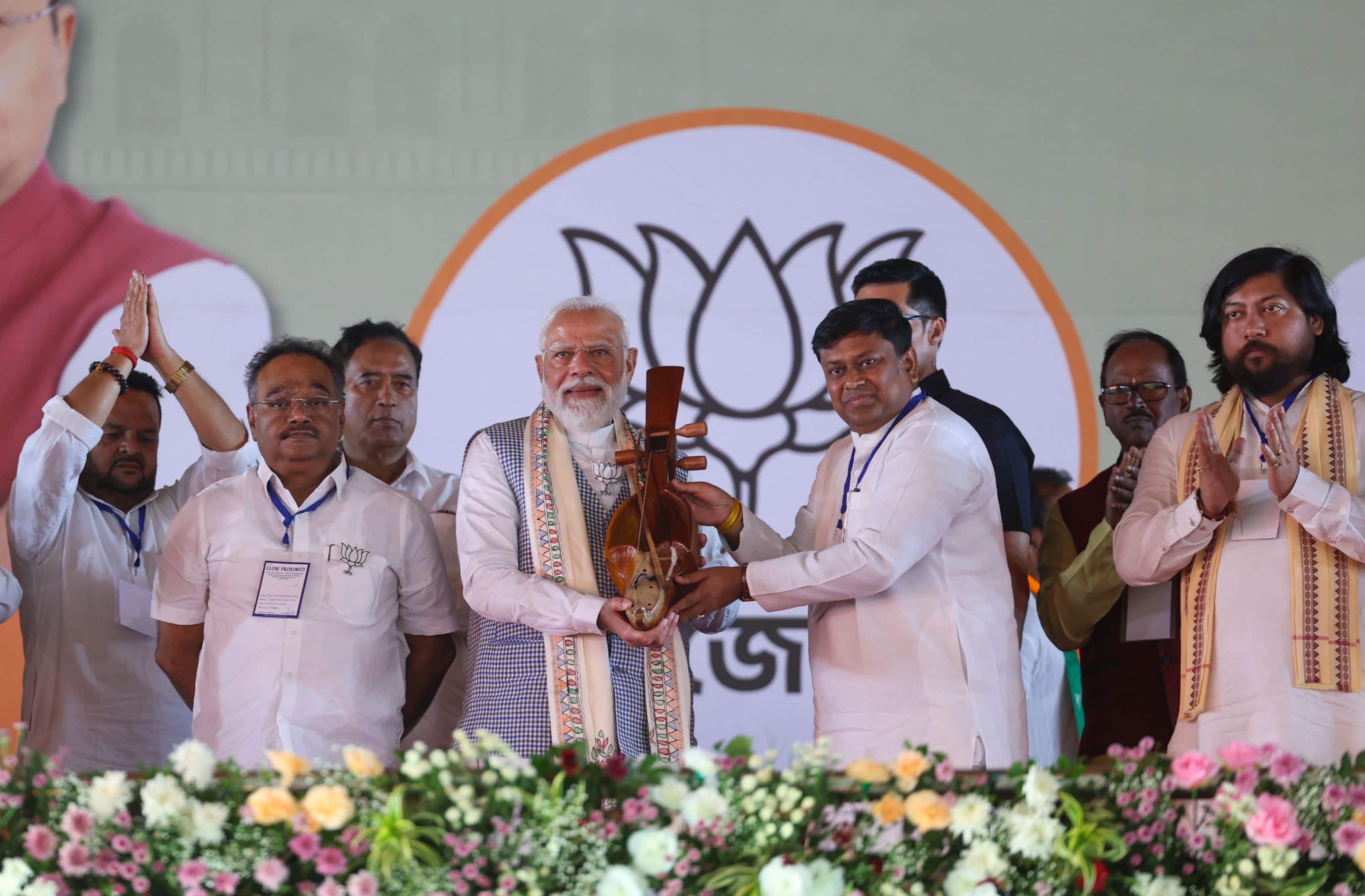
Speaking on regional imbalance, the PM said North Bengal has faced severe neglect under TMC. He listed stalled infrastructure projects such as Malda, Balurghat and Hashimara airports, lack of medical colleges in several districts, and obstruction of central schemes.

Referring specifically to Cooch Behar, PM Modi said repeated promises of industrial development have remained unfulfilled. He noted that even after five years, the proposed industrial park in Mekhliganj has not materialised.
Addressing farmers’ concerns, he said Cooch Behar’s farmers, especially potato growers, are forced to sell their produce at low prices due to lack of cold storage and processing industries. He assured that a double-engine government will ensure better infrastructure and fair opportunities for farmers.

On national security, PM Modi accused the TMC government of protecting infiltrators and endangering the state’s demographic balance and security. He said the Centre is working to identify and remove illegal infiltrators, while TMC is opposing measures like SIR and threatening to roll back CAA for political gains.
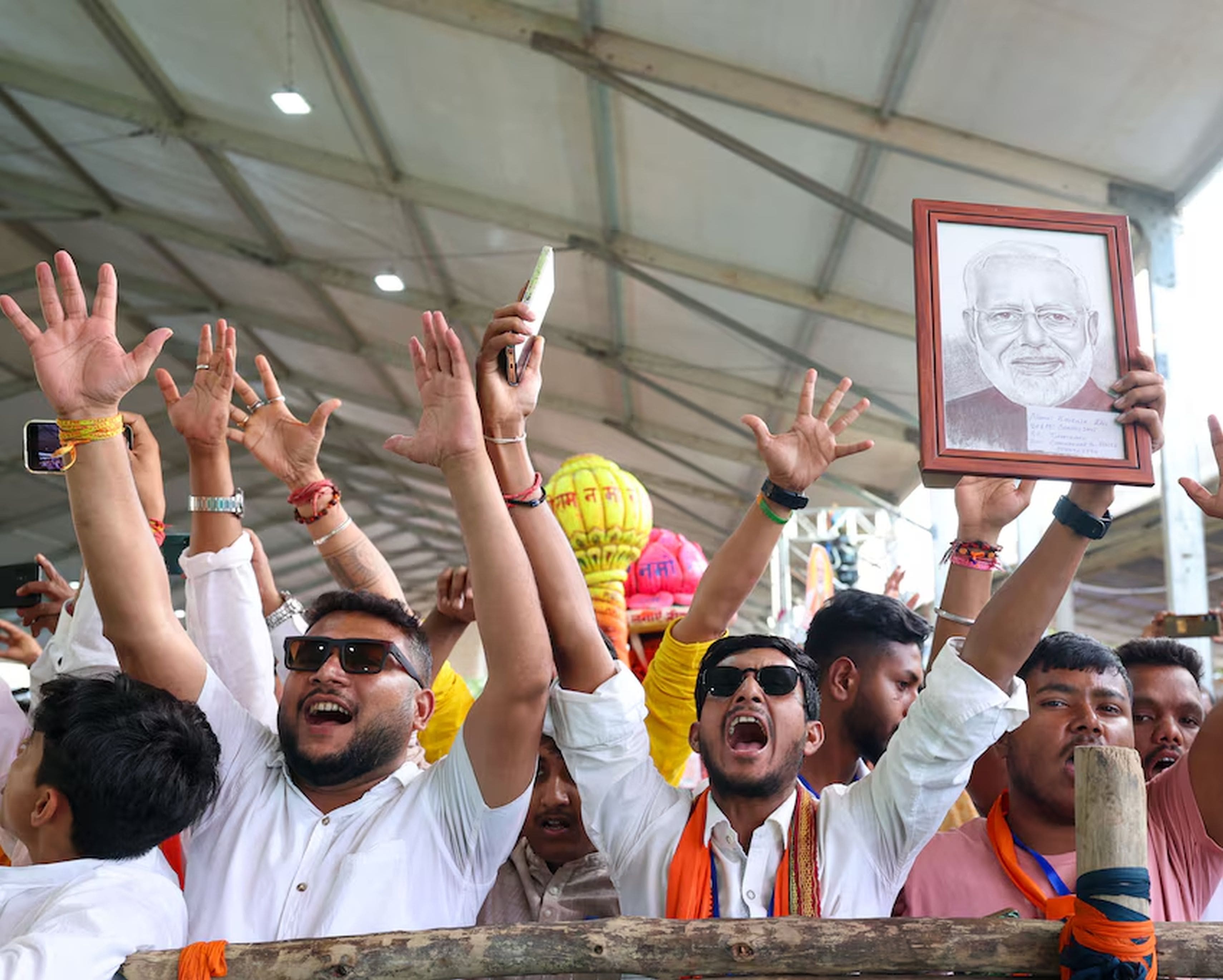
Calling for decisive change in conclusion, he said the people of Bengal have resolved to defeat those attempting to alter the state’s identity. He concluded with a strong call: “Ei bar Banglar porichoy bodlanor cheshta je korche, tar bidai hobe (This time, whoever is trying to change the identity of Bengal will be dismissed).”

Click here to read full text speech

Explore More
अयोध्येत श्री राम जन्मभूमी मंदिर ध्वजारोहण उत्सवात पंतप्रधानांनी केलेले भाषण

लोकप्रिय भाषण

अयोध्येत श्री राम जन्मभूमी मंदिर ध्वजारोहण उत्सवात पंतप्रधानांनी केलेले भाषण
Centre launches Bhavya scheme to set up 100 industrial parks across country

Media Coverage

Centre launches Bhavya scheme to set up 100 industrial parks across country
NM on the go

Nm on the go

Always be the first to hear from the PM. Get the App Now!
...
How India is changing the approach from reactive treatment to proactive detection
May 24, 2026

India’s health system is undergoing a stable and decisive transformation under Prime Minister Narendra Modi. For decades, the system was built largely around treatment after illness had already advanced.
Today, it is increasingly structured around prevention, early detection, and timely intervention. This shift matters because India’s heaviest disease burden such as Tuberculiosis, anaemia and other communicable and non communicable diseases , has always fallen on those least able to absorb it, that is, the poor, the undernourished, and those who reach care too late.
Through large-scale screening programmes, nutrition support, and more accessible treatment pathways, the government is ensuring that the disease is detected earlier, treated sooner, and prevented from becoming a greater social and economic burden.

Holistic approach to TB

In 2014, India accounted for more TB cases and deaths than any other country in the world, with an incidence rate of 237 per lakh, with an estimated 15 lakh patients missing entirely from the system. By 2024, that rate had fallen to 187 per lakh.
According to the WHO’s Global Tuberculosis Report 2025, this represents a 21% decline, the steepest among high-burden countries, and nearly double the global average reduction of 12%, with treatment coverage rising from 53% to 92% in the same decade.
What drove this was not only better medicines but mass detection. Under TB Mukt Bharat Abhiyan (2024), 20 crore people were screened, 28 lakh active TB patients were identified, and 9 lakh asymptomatic cases were found who were carrying the disease without knowing it, undetected and untreated. The act of finding them was itself a public health intervention.
This identification led to a better intervention. The BPaLM regimen further reduced drug-resistant TB treatment from 20 months to 6 months, with treatment success rates among MDR-TB patients reaching 87%, as documented in a 2025 Science Direct study on India’s TB Elimination Programme.
Yet the clinical evidence is emphatic about one point: medicines alone are not sufficient. A 2025 study published in PLOS Global Public Health by Cornell University found that TB patients carry a “metabolic scar” with disrupted metabolic patterns persisting after the infection clears and that nutritional care must be integral to TB management, not supplementary.
Under PM Modi’s initiative, Ni-Kshay Poshan Yojana operationalises this challenge directly. The government doubled the monthly nutritional support for TB patients from Rs. 500 to Rs. 1,000, disbursing nearly Rs. 4,500 crores to 1.38 crore patients through Direct Benefit Transfer since 2018.
These interventions resulted in over 46 thousand Gram Panchayats being certified TB-free, a community-level confirmation that a combined medical and nutritional approach is producing results beyond facility walls.

Anaemia

Anaemia presents a different scale of burden. NFHS-5 (2019-21) data show that 57% of women aged 15-49, 67% of children under five, 52.2% of pregnant women, and 59.1% of adolescent girls are anaemic.
Its consequences extend far beyond fatigue, presenting as developmental impairment in children, poor pregnancy outcomes, and long-term reductions in cognitive and physical productivity, which are all well-documented downstream effects.
To address this disease burden, the PM Modi government started the Anaemia Mukt Bharat (AMB) programme, which includes deworming and iron-folic acid (IFA) supplements as interventions. And under Pradhan Mantri Poshan Shakti Nirman, fortified rice has been mandated through the PDS, midday meal programmes, and ICDS.
This has shown a profound impact on anaemia reduction. A landmark study published in The Lancet Global Health, conducted across India, found that IFA supplementation cured approximately 85% of children with mild anaemia and 75% with moderate anaemia within 90 days, making combined IFA the most efficient single intervention for India’s profile.
Adding rice fortification addresses what supplementation programmes alone cannot reach, where populations that will not consistently attend health facilities.
A 2024 GiveWell meta-analysis in India, drawing on six controlled trials, found that iron-fortified rice reduced the prevalence of anaemia by 29%.
Together, these measures have shown that sustained intervention against anaemia, focusing on prevention, nutrition, and delivery systems that reach people before the condition becomes severe.

Screening: Prevention as Policy

Non-communicable diseases (NCD) share TB and anaemia’s central problem: they cause the most harm before producing symptoms. In 2025, the Ministry of Health launched an Intensified NCD Screening Campaign to achieve 100% coverage for all individuals aged 30 and above, delivered through nearly 1.85 lakh Ayushman Arogya Mandirs (AAM).
Cumulatively, more than 55.50 crore people have been screened for hypertension, and 48.5 for diabetes, 57.74 crore screened for oral cancer, breast cancer and cervical cancer in AAM reducing the burden of NCDs through early management, reaching nearly 90% of its target by the end of 2025.
Taken together, these initiatives show how, under Prime Minister Modi, India is becoming a healthier nation through a balanced mix of preventive, diagnostic, and curative solutions.
The significance lies not only in the scale of the programmes but also in the way they reach citizens at the community level and change health outcomes before disease becomes irreversible.
The same community infrastructure, through grassroots intervention by ASHA workers, Ayushman Arogya Mandirs, the Ni-Kshay platform, is simultaneously addressing TB, anaemia, and other chronic diseases.
This is the larger reform of the public health system, moving from isolated interventions to a more integrated model of care, steadily strengthening the nation’s health map.