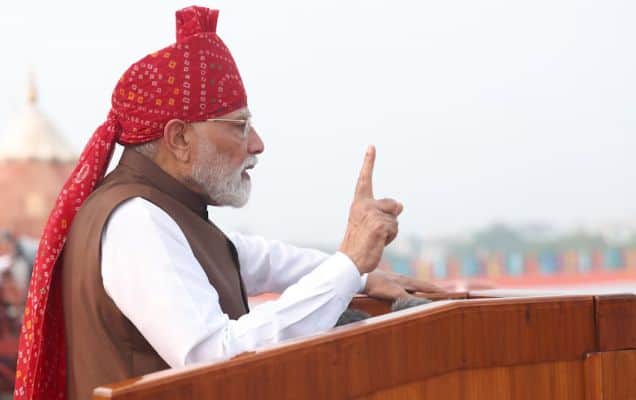
PM Modi addresses public rally in Mirzapur, Uttar Pradesh

Published By : Admin | March 3, 2017 | 14:25 IST
Elections in Uttar Pradesh has turned into an 'Utsav' of freeing the state from misrule of SP, BSP, Congress: PM
UP elections are about giving opportunities to the state's youth: PM
Uttar Pradesh has the potential to take the whole country forward says PM Modi
Our aim is to double farmers' income by 2022 when India celebrates her 75th year of independence: PM
Uttar Pradesh has so much scope of tourism. The Vindhyachal region can draw people from around the country: PM

Prime Minister Narendra Modi addressed huge public meeting in Mirzapur, Uttar Pradesh today. During his address Shri Modi thanked the people of Uttar Pradesh for their support during elections. “Elections in Uttar Pradesh has turned into an 'Utsav' of freeing the state from misrule of SP, BSP, Congress,” he said.

PM Modi emphasized that this election in Uttar Pradesh is a fight for the rights of the poor, fight to provide equal opportunities to the youth. “UP elections are about giving opportunities to the state's youth, ensuring safety of people, all round progress of poor,” he said. Uttar Pradesh has the potential to take the whole country forward he further added.

PM Modi attacked the Samajwadi Government and said that they started various projects but could not finish them. “When Mulayam Singh ji was the Chief Minister of UP, he promised opening up of two new bridges, but why is it that they aren't made yet,” he said. He further said that there are wires laid but no electricity in UP and the Government is aware of this, what kind of development is this?

PM took a dig at the BSP party and said, “BSP leader took away stones from Mirazapur for building statues but later when questioned, the leader shied away and said it came from Rajasthan.”

PM further said that the Brass industry is destroyed by SP-BSP governments in the state which destroyed opportunities for youth and lead to exodus. He said, “UP government never paid attention to development works in the state. Brass industry in UP have been shut.”

PM took a dig at the corruption level in the state and said, “From lodging FIRs to jobs, from pension schemes to ration card, termite of corruption has badly gripped Uttar Pradesh.” He also said that election is the best way of defeating corruption and the political parties that encourage it.  He also said that the state lacks progress.

He said that Uttar Pradesh has so much potential but the present Samajwadi Government is not interested in development at all. “Uttar Pradesh has so much scope of tourism. The Vindhyachal region being close to Kashi can draw people from around the country,” added the PM. He also said that in order to take the country forward, Eastern UP must develop.

Shri Modi opined that we want to work for the empowerment of poor and said that his government want rural India to be smoke-free. We want them to have access to clean fuel. “We have provided 1.8 cr LPG connections so far,” he said.

Prime Minister Modi mentioned that his government is committed towards the welfare of farmers.  He said, “Our aim is to double farmers' income by 2022 when India celebrates her 75th year of independence.”

PM Modi pointed out several steps taken by the Union Government for benefiting the farmers. He spoke about, soil health card scheme, drip irrigation, neem-coating of urea and Pradhan Mantri Fasal Bima Yojana and said these are aimed at benefiting farmers. He further said that his BJP government is continuously undertaking welfare measures for farmers. “We'd waive off their loans, if we come to power,” he added.

He attacked opposition and said that the Government at the state is not giving benefits of schemes to the people. He asked why is it that only 14% farmers gets benefit of the crop insurance scheme while about 60% farmers gets benefitted by it in the BJP ruled states?

Shri Modi said that the BJP was committed to work for welfare of the poor. The Prime Minister noted that the Centre had reduced stent prices which would directly benefit people as cost of treatment would come down.

PM Modi highlighted that he has started a fight against corruption and black money and he will continue to fight it. “SP, BSP, Congress all came together. They attacked us when we took decision to demonetise high value currency to fight corruption,” he added.

Shri Modi urged people to Vote for BJP and change the government for inclusive development of Uttar Pradesh

Several party karyakartas were also present at the public meeting.

 Click here to read full text speech

Explore More
अयोध्येत श्री राम जन्मभूमी मंदिर ध्वजारोहण उत्सवात पंतप्रधानांनी केलेले भाषण

लोकप्रिय भाषण

अयोध्येत श्री राम जन्मभूमी मंदिर ध्वजारोहण उत्सवात पंतप्रधानांनी केलेले भाषण
India's high-flying ambitions: How policy overhaul doubled nation's MRO footprint from 96 to 166

Media Coverage

India's high-flying ambitions: How policy overhaul doubled nation's MRO footprint from 96 to 166
NM on the go

Nm on the go

Always be the first to hear from the PM. Get the App Now!
...
Roadmap of India-Netherlands Strategic Partnership [2026-2030]
May 17, 2026

Prime Minister of India Shri Narendra Modi and Prime Minister of the Netherlands Mr Rob Jetten during their meeting at the Hague on 16 May 2026 agreed to elevate the India-Netherlands bilateral relationship to a Strategic Partnership by following focused, time bound initiatives and joint plans of action. To this end, India and the Netherlands adopted the Roadmap of India-Netherlands Strategic Partnership for the next 5 years (2026-2030).

Both sides agreed to:

I. Political Dialogue

a. Maintain meetings and reciprocal visits, on a regular basis, between Heads of Government / State, Ministers of Foreign Affairs and other Cabinet Ministers including on the sidelines of multilateral events.

b. Institute a mechanism at the level of Foreign Ministers which will hold annual meetings to take stock of the progress of the Roadmap of this Strategic Partnership and give strategic guidance for future action.

c. Intensify meetings and interactions between the heads of relevant Ministries, to deepen cooperation in all sectors of common interest.

II. Economic Cooperation and Investments

a. Leverage annual meetings of the overarching Joint Trade and Investment Committee (JTIC), to increase bilateral trade, market access and investment, especially in sectors with high potential such as renewable energy, telecommunications, maritime, infrastructure and urban development, innovation, electronics, semicon, agriculture, pharmaceuticals and medical technology, organic chemicals textiles, iron & steel, aluminium, including through joint ventures, industrial partnerships and technological collaboration between companies of the two sides with the aim of enhancing supply chain resilience.

b. Promote the participation in each other’s trade fairs and holding of business fora, with the involvement of industrial and economic associations and chambers of commerce.

c. Periodically review the work of the bilateral Fast Track Mechanism for investment facilitation and resolution of issues, if any.

d. Scope and facilitate a bilateral strategic joint partnership across the Critical Raw Materials value chain for supply chain diversification, under the Memorandum of Understanding on cooperation in the field of critical minerals, exploration, research and innovation, integration of value chains, supply chain resilience, circularity and ESG standards and related assessments.

e. Promote identified two-way investments between India and the Netherlands in priority sectors such as renewable energy, sustainable agriculture, maritime, infrastructure, pharmaceuticals, medtech and high-tech and innovation. To this end, both sides will facilitate business-to-business matchmaking, support joint ventures and public-private partnerships, and encourage collaboration between knowledge institutions and industry. Focus will be placed on enabling SME participation, enhancing investment facilitation, and strengthening innovation ecosystems to drive sustainable growth, job creation, and resilient value chains.

III. Water, Agriculture and Health

a. Express the shared ambition to renew the Strategic Partnership on Water signed in March 2022 and running until March 2027; and review its progress through the Ministerial Joint Working Group on Water.

b. Enhance collaboration in integrated water resources management, integrated coastal zone management, urban water management, flood resilience, river basin management and sustainable water quality & availability in the Ganga Basin.

c. Leverage the Centre of Excellence on Water with National Mission for Clean Ganga, to support its ongoing work by exchanging knowledge and expertise, building capacity and promoting start-ups.

d. Support the creation of Urban River Management Plans for the agreed cities in India by promoting and integrating the Urban River Management Planning and ‘Water as Leverage’ approach in its framework and stimulate application through projects, thereby fulfilling the Water Action Agenda joint commitment.

e. Support the development and enhancement of disaster-resilient urban water infrastructure in India and globally through capacity building initiatives led by the India-led Coalition for Disaster Resilient Infrastructure (CDRI).

f. Continue the Joint Agriculture Working Group to strengthen and promote bilateral cooperation in the field of agriculture and animal husbandry, including but not limited to reviewing the progress of India-Netherlands Centres of Excellence, on phytosanitary and veterinary market access, joint support for climate resilient agriculture, responsible value chains and global food security.

g. Promote exchanges on Ag-Tech and biotechnology, knowledge sharing and skill development, and support co-development of new agricultural technologies like for the creation of Clean Plant Centres and inter alia through support to startups.

h. Combat global public health risks by facilitating bilateral cooperation under the Memorandum of Understanding on Healthcare & Public Health and its Joint Working Group, with a focus on priority areas such as cross-border infectious diseases and anti-microbial resistance (AMR), non-communicable diseases (NCD), digital health (including AI and cybersecurity), the interlinkages between climate change & health, and capacity building. This cooperation will be further strengthened through the recently signed Letter of Intent between the Dutch National Institute for Public Health and the Environment (RIVM) and the Indian Council of Medical Research (ICMR). Focus areas include infectious diseases, vector borne diseases, One Health and disease surveillance.

i. Promote bilateral cooperation in pharmaceuticals and medical devices to support resilient global supply chains and to strengthen research and innovation, in line with the Memorandum of Understanding signed in June 2025 and through regular meetings of the Joint Working Group set up under the Memorandum of Understanding. This includes, amongst others, academic cooperation, regulatory cooperation, engagement between businesses, and knowledge exchange on market access.

j. Exchange knowledge through interactions between food safety authorities on international standards, notification and cooperation mechanisms and the use of electronic (certification) systems as outlined in the recently signed Memorandum of Understanding between Netherlands Food and Consumer Product Safety Authority (NVWA) and Food Safety and Standards Authority of India (FSSAI).

IV. Emerging Technologies, Innovation, Science and Education

a. Taking into account India and the Netherlands’ national research priorities, enhance innovation and research collaborations, with special emphasis on key enabling technologies such as semiconductors, AI, cybersecurity, energy materials and biomolecular and cell technologies, involving governments, academia and industries, through the existing Joint Working Group on Science, Technology and Innovation collaboration.

b. Leverage the Memorandum of Understanding on the India-Netherlands Partnership on Semiconductors and Related Emerging Technologies to:

i. Explore new avenues of cooperation to build trusted and resilient supply chains through collaboration between the semiconductor industry of both India and the Netherlands.

ii. Expand cooperation on research and development in emerging technologies, forging technology value chains partnerships in both countries, in sectors such as artificial intelligence, photonics, quantum, and cyber-security.

iii. Connecting the Dutch Semicon Competence Centre to the Indian Semiconductor Mission, to support and strengthen the semiconductor sector, specifically industries, startups, scale-ups, SMEs, and their suppliers, through collaboration, technology- and talent development.

c. Support the Memorandum of Cooperation between Eindhoven University of Technology and University of Twente and six Indian leading Technical Institutes (IISc Bangalore, IIT Bombay, IIT Delhi, IIT Gandhinagar, IIT Guwahati and IIT Madras) for a brain bridge in semiconductors and related technologies, supported by NXP, ASML, TATA and CG Semi.

d. Implement the Memorandum of Understanding on the Netherlands-India collaboration on Higher Education and hold regular interactions to establish and execute a joint working plan to foster further collaboration between knowledge institutions.

e. Increase and strengthen educational and research engagements, such as in the STEM domain, and explore a platform for institutional partnerships.

f. Acknowledging the ongoing space partnership between India and the Netherlands, further collaboration can be explored at a government, industry and academic level, including using space-based applications in addressing societal challenges including climate change, water issues, food security as well as air quality.

V. Energy Transition, Sustainable Development and Maritime Development

a. Set up a Joint Working Group on Renewable Energy and hold regular meetings to share best practices and experiences, promote knowledge of each other's industrial ecosystems and facilitate industrial partnerships cooperation in green hydrogen, bioenergy, bio-chemicals or circular feedstocks, renewables and battery storage.

b. Collaborate to draft an action plan for joint activities in the field of renewable hydrogen, including a green corridor between India and the Netherlands.

c. Explore avenues for robust cooperation on environment by establishing a Joint Working Group to deepen bilateral relations on climate; share best practices, knowledge and technology on climate adaptation and mitigation.

d. Work together to strengthen bilateral partnerships on biofuels, circular economy and waste to energy through initiatives like the Global Biofuels Alliance, Integrated Biorefineries Mission, International Solar Alliance and the Combitrack on Sustainable Waste Management.

e. In order to contribute to a safe, secure and sustainable maritime sector, promote innovative green energy solutions in ports, inland waterways and shipping as well as further develop cooperation in the context of the recently renewed Memorandum of Understanding on Maritime Cooperation and the agreed Letter of Intent on a ‘Green and Digital Sea Corridor’ between India and the Netherlands. This would also promote India’s green hydrogen exports by integrating domestic production capacities with the European markets.

f. Within the framework of the Joint Working Group on Maritime Cooperation, both countries will explore a comprehensive ‘Roadmap on a Green and Digital Sea Corridor’, which aims at working towards an environmentally sustainable, digitally integrated and economically efficient future-ready maritime corridor between India and the Netherlands.

g. Work together to deliver capacity building, knowledge exchange on Sustainable Urban Development through a Joint Working Group under the Memorandum of Understanding on spatial planning and urban development. Identify niche areas of cooperation under the themes of Solid Waste & Water Management, Circular Economy, Urban Active Mobility, Zero Emission Transportation and Charging Infrastructure and Urban Sustainability and Governance.

VI. Defence Cooperation

a. Plan structured Joint Tri-services interaction between respective Ministries of Defence of the Directorates of International Military Cooperation to coordinate bilateral military cooperation including cooperation between Defence Industry and Research Centres.

b. Enhance maritime cooperation, through mutual participation in naval exercises and tailored involvement in the IFC-IOR.

c. Promote interactions between respective Armed Forces in the framework of Netherlands’ growing interest in the Indo-Pacific Region, aimed at increasing cooperation in the context of the Indo-Pacific Oceans Initiative (IPOI) and the Indian Ocean Naval Symposium (IONS).

d. Explore avenues on technology collaboration of platforms and equipment between respective Ministries of Defence.

e. Work towards a Defence Industrial Roadmap between the two Ministries of Defence in order to promote cooperation between Defence Industry and Research Centre through respective sectoral organisations, the Society of Indian Defence Manufacturers (SIDM) and the Netherlands Industry for Defence and Security (NIDV).

f. Examine feasibility of institutionalizing logistic support to military units/formation during training exercises through signing of Mutual Logistic Support Agreement.

VII. Security Cooperation

a. Enhance cooperation through regular exchanges on traditional and non-traditional security issues, including defence, maritime security, economic security, knowledge security, counterterrorism, critical and emerging technologies, cyber security, and other mutually agreed matters of international security.

b. Strengthen bilateral cyber dialogue engagements to support the implementation of the Letter of Intent on enhanced cyber cooperation in areas of mutual interest, including closer coordination in multilateral fora and joint efforts to counter cyber threats and cybercrime through capacity building and knowledge exchange.

c. Strengthen cooperation in the fight against terrorism at the bilateral, regional and international forums through information-sharing with respect to threat assessments and best practices as well as working together for the adoption of the Comprehensive Convention on International Terrorism at the UN.

d. Continue to work together to conclude a Mutual Legal Assistance Treaty and a new Extradition Treaty.

e. Increase cooperation in the context of the Netherlands membership to the Indo-Pacific Ocean’s Initiative (IPOI).

VIII. Migration, Mobility and Consular Matters

a. Recognising the long-standing and historical bonds of friendship between India and the Netherlands, and wishing to give a new impetus to the same.

b. Resolved to facilitate fair migration and mobility to each other’s countries.

c. Determined to jointly take appropriate steps to prevent and counter irregular migration.

d. Cooperate to facilitate fair mobility of students, academics, doctoral students, researchers, and highly skilled professionals, including young professionals.

e. Implement the Memorandum of Understanding on Mobility and Migration.

f. Hold regular exchanges on pending consular matters through the India-Netherlands Consular Dialogue.

IX. Culture and People-to-People Exchanges

a. Enhance bilateral cultural cooperation through continuous dialogue, exchange programs, and joint initiatives, including knowledge exchange on preservation and restoration of heritage sites and buildings.

b. Welcome the ongoing efforts for implementation of Memorandum of Understanding on cultural cooperation with the focus on strengthening collaboration in design, visual arts, cultural heritage, performing arts and museum sectors.

c. Continue to cooperate in the handling of the request for the return and restitution of cultural artifacts.

d. Encourage exhibitions and cultural initiatives to deepen mutual knowledge, also through the establishment of partnerships between museums.

e. Foster connections and tourist flows in both directions.

f. Acknowledge the contributions of the vibrant Indian and Dutch communities, as well as significant Indian Diaspora in the Netherlands, in promoting bilateral and cultural ties and long-standing bonds of friendship.