Institutionalising Honesty

Published By : Admin | March 14, 2019 | 14:33 IST

For a country used to the usual ‘chalta hai’ attitude when it came to graft in public life, the last few years have seen a virtual onslaught against corruption never seen before in India. On the one hand, discretion in the process of allocation of resources has been done away with, while on the other, a distribution system, marred by the middlemen, too has been replaced with a direct, transparent and efficient process.

JAM as the Tool to Empower Masses

Without doubt, the Jan Dhan Yojana-Aadhar-Mobile or the JAM trinity has facilitated government’s objective of increasing transparency with Direct Benefit Transfer (DBT). The biggest step towards financial inclusion, the Jan Dhan Yojana has helped create a potent system of distribution that curbs leakages in the process. The Jan Dhan – Aadhar – Mobile (JAM) trinity has been instrumental in minimizing the role of middlemen.  With unique identification associated with every account, in the form of account number, there is no scope for duplication of accounts or ghost beneficiaries. As of Februrary 2019, 439 schemes across 55 ministries fall under the purview of DBT.

Imagine if there was no JAM, the historic PM-Kisan Samman Nidhi Yojana with the aim of providing Rs. 6,000 of yearly income to 12 crore marginal farmers would have been lost in the maze of graft-ridden delivery systems.

License-Inspector Raj a ‘real’ thing of the past

Although the 1991 reforms had sought to end the license-inspector raj, in reality things hadn’t changed so effectively on the ground. But now in addition to the path-breaking GST regime, leveraging technology to the fullest, the government has simply ‘shut down the shutters’ of the license inspector raj. No more can any government official harass a law-abiding businessman or a tax-paying citizen. For instance, the advent of GST has while brought down the effective tax rates on goods and services benefiting the end-consumers to a great extent, through GSTN’s uniform interface for the tax payer and a common and shared IT infrastructure between the Centre and States, the possible role of any real person compromising the system has been completely ruled out. The creation of Government e Marketplace (GeM) as a digital e-commerce portal to facilitate online procurement of common use Goods & Services required by various Government Departments/Organisations/PSUs is another landmark step with the aim of enhancing transparency, efficiency and speed in public procurement. 

Discretion-free allocation process

The government has taken all possible steps to enhance transparency in its day to day functioning. The non-transparent and discretionary allocation of public resources such as coal and spectrum of the earlier years has seen a complete reversal. Now, the government has outlined a clean and transparent system of allocation through public auction where every player, both private and public, gets a fair chance.

Discretion-free appointment process

The abolishing of interviews for all group C and D, and non-gazetted group B posts by the government has been another huge measure aimed at dealing with corruption.

It must be remembered that the last five years have not only seen a frontal assault on corruption of all kinds, there has even been an attempt to create a constructive discourse around the virtue of honesty itself. With technology, financial inclusion and a strong political will, the Modi government at the highest level has done everything possible to institutionalise and reward honesty.


Explore More
अयोध्येत श्री राम जन्मभूमी मंदिर ध्वजारोहण उत्सवात पंतप्रधानांनी केलेले भाषण

लोकप्रिय भाषण

अयोध्येत श्री राम जन्मभूमी मंदिर ध्वजारोहण उत्सवात पंतप्रधानांनी केलेले भाषण
Make in India Electronics: Cos create 1.33 million job as PLI scheme boosts smartphone manufacturing & exports

Media Coverage

Make in India Electronics: Cos create 1.33 million job as PLI scheme boosts smartphone manufacturing & exports
NM on the go

Nm on the go

Always be the first to hear from the PM. Get the App Now!
...
6 Years of Jal Jeevan Mission: Transforming Lives, One Tap at a Time
August 14, 2025
Jal Jeevan Mission has become a major development parameter to provide water to every household.” - PM Narendra Modi

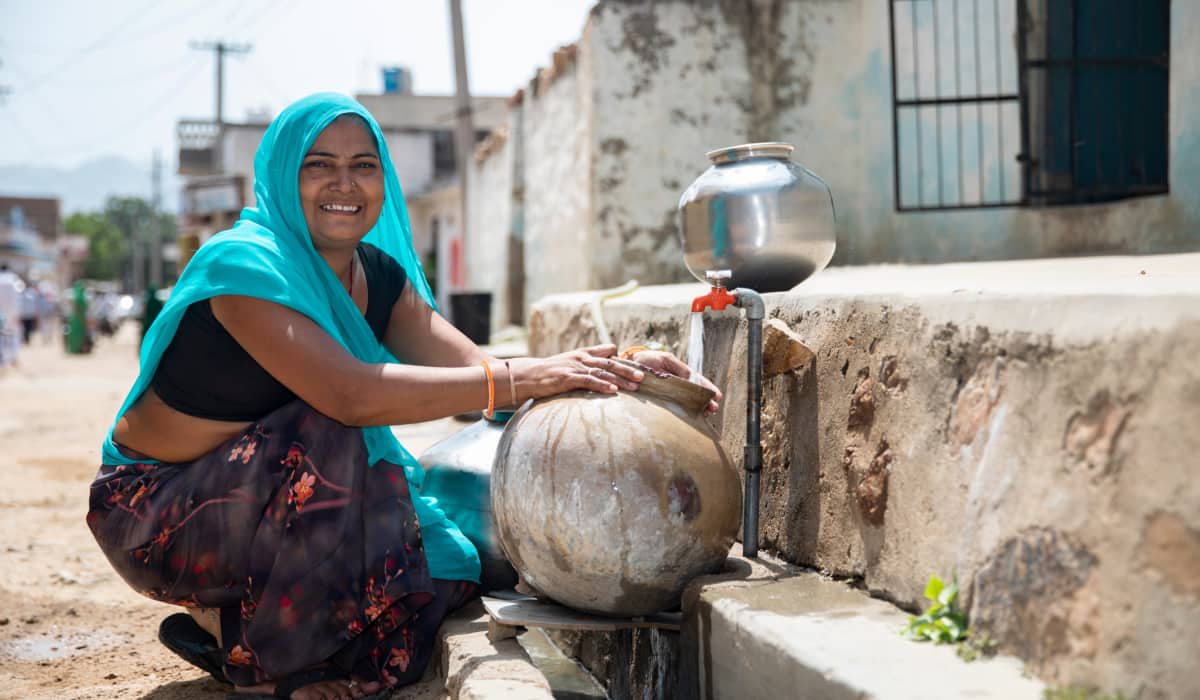
For generations, the sight of women carrying pots of water on their heads was an everyday scene in rural India. It was more than a chore, it was a necessity that was an integral part of their everyday life. The water was brought back, often just one or two pots which had to be stretched for drinking, cooking, cleaning, and washing. It was a routine that left little time for rest, education, or income-generating work, and the burden fell most heavily on women.

Before 2014 water scarcity, one of India’s most pressing problems, was met with little urgency or vision. Access to safe drinking water was fragmented, villages relied on distant sources, and nationwide household tap connections were seen as unrealistic.

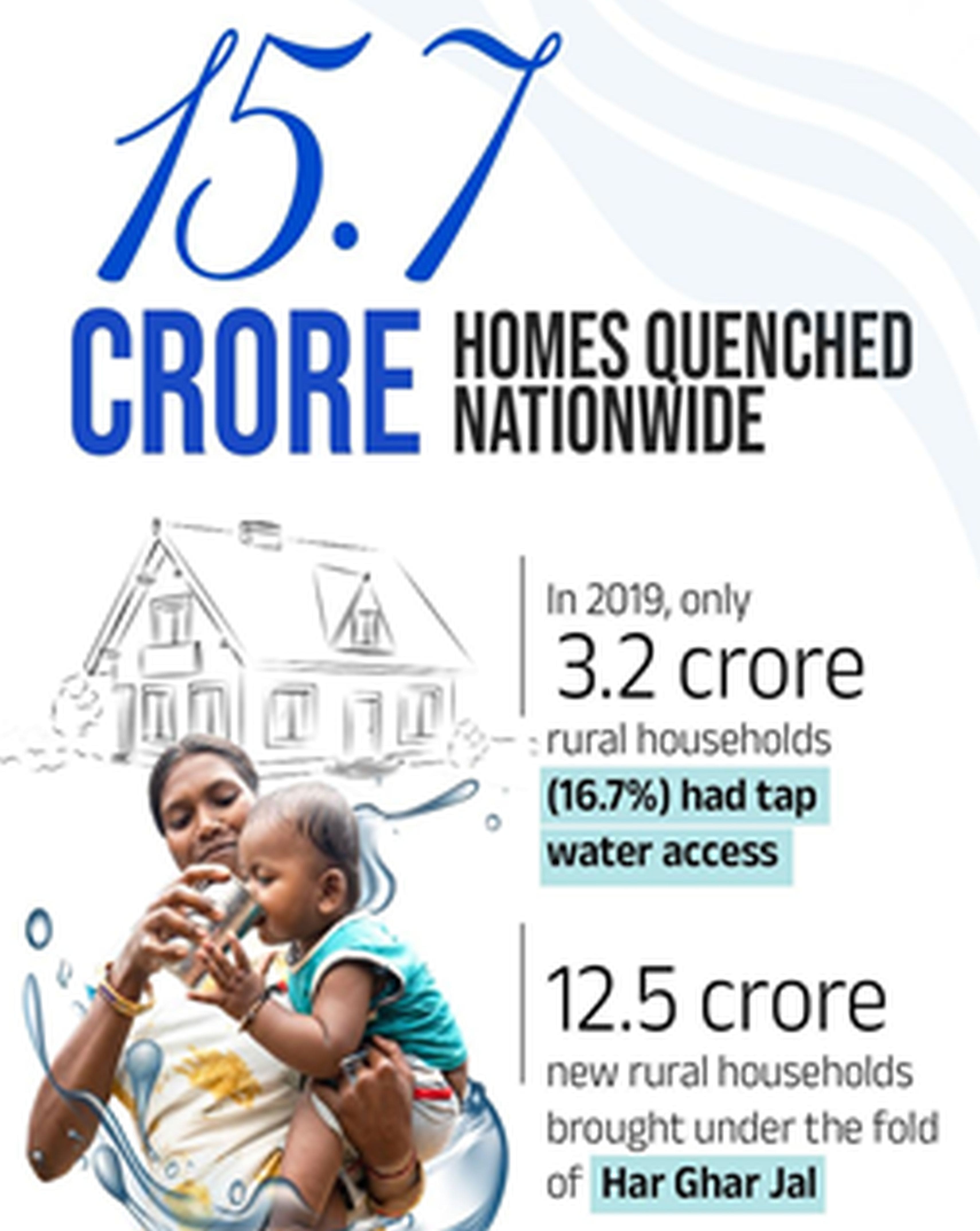
This reality began to shift in 2019, when the Government of India launched the Jal Jeevan Mission (JJM). A centrally sponsored initiative which aims at providing a Functional Household Tap Connection (FHTC) to every rural household. At that time, only 3.2 crore rural households, a modest 16.7% of the total, had tap water. The rest still depended on community sources, often far from home.

As of July 2025, the progress under the Har Ghar Jal program has been exceptional, with 12.5 crore additional rural households connected, bringing the total to over 15.7 crore. The program has achieved 100% tap water coverage in 200 districts and over 2.6 lakh villages, with 8 states and 3 union territories now fully covered. For millions, this means not just access to water at home, but saved time, improved health, and restored dignity. Nearly 80% of tap water coverage has been achieved in 112 aspirational districts, a significant rise from less than 8%. Additionally, 59 lakh households in LWE districts have gained tap water connections, ensuring development reaches every corner. Acknowledging both the significant progress and the road ahead, the Union Budget 2025–26 announced the program’s extension until 2028 with an increased budget.

The Jal Jeevan Mission, launched nationally in 2019, traces its origins to Gujarat, where Narendra Modi, as Chief Minister, tackled water scarcity in the arid state through the Sujalam Sufalam initiative. This effort formed a blueprint for a mission that would one day aim to provide tap water to every rural household in India.

Though drinking water is a State subject, the Government of India has taken on the role of a committed partner, providing technical and financial support while empowering States to plan and implement local solutions. To keep the Mission on track, a strong monitoring system links Aadhaar for targeting, geo-tags assets, conducts third-party inspections, and uses IoT devices to track village water flow.

The Jal Jeevan Mission’s objectives are as much about people as they are about pipes. By prioritizing underserved and water-stressed areas, ensuring that schools, Anganwadi centres, and health facilities have running water, and encouraging local communities to take ownership through contributions or shramdaan, the Mission aims to make safe water everyone’s responsibility..

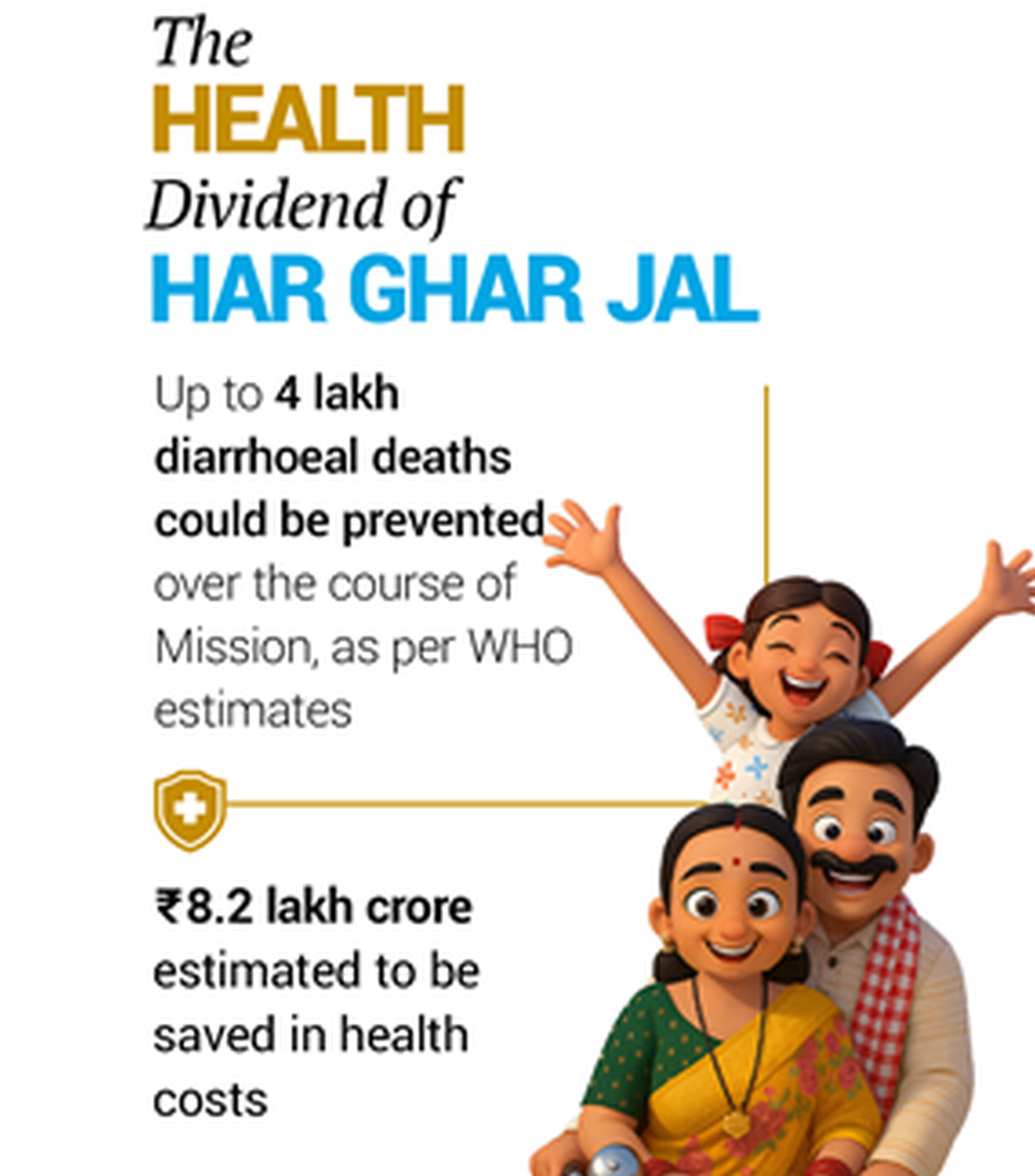
The impact reaches far beyond convenience. The World Health Organization estimates that achieving JJM’s targets could save over 5.5 crore hours each day, time that can now be spent on education, work, or family. 9 crore women no longer need to fetch water from outside. WHO also projects that safe water for all could prevent nearly 4 lakh deaths from diarrhoeal disease and save Rs. 8.2 lakh crores in health costs. Additionally, according to IIM Bangalore and the International Labour Organization, JJM has generated nearly 3 crore person-years of employment during its build-out, with nearly 25 lakh women are trained to use Field testing Kits.

From the quiet relief of a mother filling a glass of clean water in her kitchen, to the confidence of a school where children can drink without worry, the Jal Jeevan Mission is changing what it means to live in rural India.