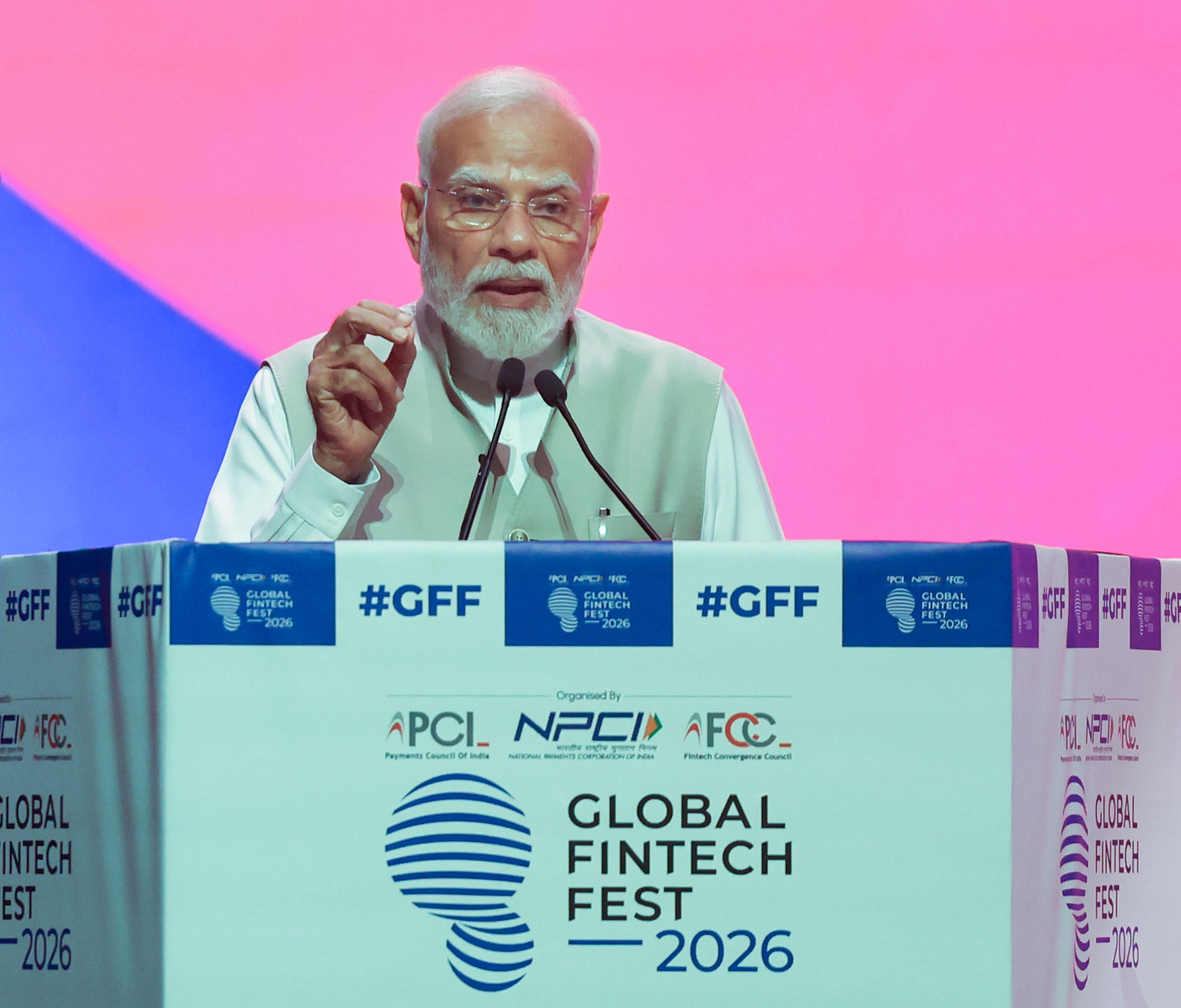
PM Modi delivers key note address at the Economic Times Global Summit
True reforms are those which result in transformation in the lives of citizens: PM
We should create new opportunities for citizens to progress and also give them a choice of opportunities: PM
I am confident that despite the challenges, we can successfully go forward in a way to benefit the common people: PM
Entrepreneurship is one of India's traditional strengths, it was sad to see it neglected in the last few years but we have changed that: PM
I believe in the politics of empowerment. I believe in empowering the people to improve their own lives: PM
We have taken India to the top of global league tables of foreign investment and growth in less than 2 years: PM
When the power of the people is with us, hard challenges become huge opportunities: PM
I believe in the politics of empowerment. I believe in empowering the people to improve their own lives: PM

Shri Vineet Jain Distinguished Guests Ladies and Gentlemen

I am very happy to be here today. The global economy is going through a period of uncertainty. At a time like this I am glad that so many participants not only from India, but also from abroad have taken the time to come here. I am sure all of us in India will benefit from the experience of other countries. I will take this opportunity to present to you some of my thoughts on the progress of the Indian economy and on the business environment.

Some of you may recall what I have said before - that true reforms are those which result in transformation in the lives of citizens. As I have said before, my goal is “reform to transform”. Let me start with the basics. What should be the basic guiding principles of economic policy in any country, particularly for the developing countries? 


Firstly, we have to improve the use of our natural and human resources, to increase the value addition we can get from them. This means increasing the efficiency in allocation of resources. It means greater managerial efficiency. It means removing unnecessary controls and distortions.

Secondly, we should create new opportunities for citizens to progress and also give them a choice of opportunities. Opportunity is like oxygen to the aspirational citizen and we are keen that this is never in short supply. In simple terms, it means Sabka Saath, Sabka Vikas.

Thirdly, we have to increase the quality of life of the common citizen and even more so, the quality of life of the poor. Quality of life may have an economic aspect, but it is not economics alone. If a government is progressive, and runs an honest and efficient administration, the biggest beneficiaries are the poor. I know from my experience, that poor governance hurts the poor more than it hurts others. Therefore, improved governance is as important as economic reform.

We live in a globally connected world. Actions of one country affect another. Such actions are not only based on trade and investment but also in matters of pollution and environment. A poet had said that no man is an island. Today it can be said that no country can live alone. It is often said that all politics is local. To me, all economics is global. Indeed the distinction between domestic affairs and foreign affairs is increasingly losing relevance. For a country in the modern day, it is not sufficient that its economic policies should only address its domestic priorities. To me, India’s policies must be such that they make a positive contribution to the rest of the world.

Many of you are aware of the contribution India can make to the global economy at a time of economic stagnation in many parts. For the last four quarters, India has been the fastest growing large economy in the world. In 2014-15, India contributed 7.4% of global GDP in purchasing power terms. But it contributed 12.5% of global growth. Thus its contribution to growth is 68% higher than its share of the global economy. FDI in India has increased by 39% in the last 18 months, at a time when global FDI has fallen.

But a country’s contribution goes beyond economics. Protecting our planet from climate change is one of the most important tasks for this generation. If one country reduces its environmental footprint, it creates benefits for all others. It is for this reason that in the COP 21 Summit, India made far reaching commitments towards the larger welfare of the planet. In history, every country that has grown has increased its per capita emissions footprint. We are committed to re-writing that history. We are committed to reducing the emission intensity of our GDP by 33% by 2030 even while growing at a fast pace. For a country which is already at a very low base of per capita emission, this is a very ambitious target. We have committed that by 2030, 40% of our electric power capacity will be from non-fossil fuel. We have also committed to building an additional carbon sink of over 2.5 billion tonnes of carbon dioxide equivalent. This will be done by creating additional forest cover by 2030. This commitment is from a country with a very low per capita land availability. We have taken the lead in launching an international solar alliance, involving 121 countries falling between the Tropic of Cancer and the Tropic of Capricorn. This initiative will help many developing countries, from Africa to South America, to take advantage of developments in renewable energy around the world.

Let me now return to the three policy objectives I mentioned. I will start with the performance of Indian economy. Economists talk about GDP growth, inflation, investment, and the fiscal deficit as key economic parameters. Since this Government took office, growth has increased and inflation has decreased. Foreign investment has increased and the fiscal deficit has decreased. And despite a slow-down in global trade, the balance of payments deficit has also decreased.

Yet, such broad statistics give only a partial picture of what we are attempting, and what we are achieving. It is often said “the devil is in the detail”. But I believe that God is in the proper execution of many so-called details. It is these so-called details which, when done well, add up to a big picture.

You may be interested to know that • India’s highest ever urea fertiliser production was achieved in 2015.

• India’s highest ever production of ethanol as blended fuel, benefiting sugar cane farmers, was in 2015.

• The highest number of new cooking gas connections to the rural poor was achieved in 2015.

• India’s highest ever output of coal was achieved in 2015.

• India’s highest ever generation of electricity was achieved in 2015

• India’s highest ever quantity of cargo handled by major ports was in 2015.

• India’s fastest average turnaround time in ports was in 2015. • India’s highest ever increase in railway capital expenditure was achieved in 2015.

• India’s highest ever number of new highway kilometres awarded was in 2015.

• India’s highest ever production of motor vehicles was achieved in 2015

• India’s highest ever software exports were achieved in 2015.

• India’s highest ever rank in World Bank Doing Business indicators, was achieved in 2015.

• India’s highest ever foreign exchange reserves were achieved in 2015.

When I give these figures, it is important to remember that in the preceding years, many of these indicators were moving in the opposite direction. Not only have many indicators improved, but they have improved by large margins. For example, in 2013-14, the total number of National Highway kilometres awarded was about 3500. This more than doubled in the first year of this Government to nearly 8000 kilometres, an all-time high. This year we are planning to award 10,000 kilometres.

Let me give you more examples of quantum leaps. The Shipping Corporation of India which made a loss of Rs. 275 crores in 2013-14 made a profit of Rs. 201 crores in 2014-15. This is a turnaround of Rs. 475 crores in one single year.

In 2013-14, India accounted for just 0.1% of global demand for energy efficient LED lighting. In 2015-16, it is 12%. Indian LED bulbs are now the cheapest and most competitive in the world, costing less than a dollar versus a global average of 3 dollars. In 2013-14, India commissioned 947 megawatts of solar power plants. In 2015-16, this will rise to over 2500 megawatts. It is expected to reach 12,000 megawatts in 2016-17. India’s share of the global solar energy market will rise from 2.5% in 2014 to 18% in 2016. India’s contribution here is not merely in increasing the share of clean energy. Its other contribution is that the huge increase in scale has enabled producers to cut prices benefitting the whole world. In 2013-14, 16,800 kilometres of transmission lines were added. In 2014-15 this rose to over 22,000, an increase of 32%. In the power sector as a whole, the cost of power has declined by over 30%.

Let me turn to the second aspect — improving opportunities. I believe in the politics of empowerment. I believe in empowering the people to improve their own lives. We undertook the world’s largest and most successful financial inclusion programme. It has brought over two hundred million unbanked people into the banking system. In the early days of this programme, sceptics felt that these accounts would have no balances. You will be surprised to know that today these accounts have a balance exceeding Rs. thirty thousand crores or over four billion dollars. We have also issued a record number of debit cards to them. India is now one of the few countries where the market share of an indigenous credit card brand exceeds 33%.

We have introduced a new and comprehensive program of crop insurance. This empowers farmers to give their best, with the State providing cover against risks beyond the farmer’s control.

We have introduced soil health cards to empower our farmers. The card will tell every farmer the exact character of his soil. This will enable him to increase crop yield, reduce over-use of chemical inputs and fertilizer and restore soil health.

Entrepreneurship is one of India's traditional strengths. It was sad to see it neglected in the last few years. “Business” and “profits” had become bad words. We have changed that. We need to value enterprise and hard work, not wealth. Our programs ranging from MUDRA to Start Up India and Stand-Up India provide opportunity to the hard working and to the enterprising. In so doing, we have placed special emphasis on Scheduled Castes, Scheduled Tribes, Other Backward Classes and women. We are empowering them to become masters of their own destinies.

Creating opportunities for cities and towns to grow is very crucial. Urban areas are an engine of growth. A key initiative for urban transformation is the Smart City Mission. The Mission has several ‘firsts’. It is the first time that certain areas in cities will be comprehensively developed in a systematic and qualitative way. These areas will act as ‘light houses’ which will eventually influence the rest of the city. It is the first time that there has been such extensive citizen consultation. Nearly 2.5 million people participated through contests, discussions, polls, blogs and talks on the MyGov platform. This is a major break from the top-down approach to urban planning. It is the first time that allocation of funds in a government scheme is done not by decisions of Ministers or officers but on the basis of competition. This is a good example of competitive and cooperative federalism.

As I mentioned earlier, the role of a Government does not end with the economy alone. There are many non-economic dimensions which are vital for ensuring the welfare of the citizens. Good governance is crucial. We have taken numerous steps which have transformative potential. We have ended the era of high level corruption. This is a fact acknowledged by Indians and foreigners, and by critics and supporters of this Government. This is not an easy achievement. We have ended political interference and crony capitalism in nationalized banks. We have for the first time appointed several heads of public sector banks from the private sector. Transparent auctions have cleaned up the natural resources sector which was riddled with scandals.

Many experts have commented on the need to reduce subsidies. The new universal access to banking through the Jan Dhan Yojana, has enabled plugging of huge leakages in subsidies. In developing countries, fuel subsidies are generally very difficult to tackle. We have successfully decontrolled cooking gas prices. We are now operating the world’s largest direct benefit transfer scheme for cooking gas. Subsidies are transferred to the bank account of households. Through electronic verification, multiple and bogus connections are eliminated. This enables genuine beneficiaries to get what they deserve while eliminating those who are not eligible. This has substantially reduced the subsidy.

Another subsidized fuel is kerosene, used by the poor for cooking and lighting, and distributed by state governments. There is clear evidence that a large quantity of subsidized kerosene is misused and diverted. We have begun a pilot in thirty three districts where kerosene will be sold at market prices. The difference between market price and the subsidized price will be transferred directly to bank accounts of those who are poor. The poor will be properly identified through bank accounts and biometric identification through Aadhaar. This will eliminate duplicate, non-eligible and bogus consumers. This elimination will reduce the total subsidy. We have decided that 75% of the savings from this will be passed on to the states. Thereby, we have encouraged state governments to implement this in all districts.

The experience of Chandigarh, shows that this is possible. In April 2014, there were 68,000 beneficiaries of subsidized kerosene in Chandigarh. A campaign was launched to issue gas connections to all eligible families. 10,500 new gas connections were issued. Kerosene quotas were stopped for 42,000 families who already had gas connections. By 31st March, 2016, Chandigarh will be declared kerosene-free. Believe it or not, till date, the saving achieved in kerosene consumption through this initiative is 73%!

Two days ago at a meeting with Chief Secretaries of the States, I was reviewing implementation of various pension schemes. I was pleasantly surprised to see that there had been noteworthy reduction in leakage, simply by eliminating those who were double counted and who were ineligible. In some states, a reduction of 12% in subsidies has been achieved without any harm to the poor.

Another major subsidy is on fertilizer. A substantial quantity of subsidized urea is diverted illegally to use in the production of chemicals. We have introduced a simple but effective technical solution: neem-coating of urea. The organic neem coating makes the fertilizer unsuitable for diversion. We have now achieved 100% neem coating in both domestic and imported urea. A significant side benefit has also happened. The collection of neem leaves for urea has become a new income earning opportunity for rural women.

I know that several of you are economists. Economists generally believe that human beings are rational. They believe people will not give up a benefit for which they are entitled. Last year, I gave a call to citizens. I asked them to give up their cooking gas subsidies, if they felt they were not poor enough to get it. We also made a promise. Every connection given up, would be used to give a new gas connection to a poor family. Poor women in rural India use firewood or biomass and suffer greatly because of smoke. This scheme is entirely voluntary. You may be surprised to learn that nearly 6.5 million people in India have responded to my call. It warms my heart, to see that so many of them have come forward, with no compulsion to benefit the poor and give up their subsidies. Already, over 5 million new connections have been given to the poor. It is a sign of the public spirit and the self-respect which prevails among Indians and shows the potential of citizen action. Another example where citizens have responded is in the case of Khadi. In October 2014, I had appealed to all Indians to buy at least one Khadi garment. In response, Khadi sales have increased substantially.

We have taken a creative approach to tackling the problem of loss making power distribution companies. Under the UDAY programme, short term debt relief is given by state governments taking over bank loans. But this is accompanied by strong long term conditions to hold both the distribution companies and the states. This will create the conditions for rolling out 24x7 power supply.

Our country suffers from an excess of old and unnecessary laws which obstruct people and businesses. We began the exercise of identifying unnecessary laws and repealing them. 1,827 Central laws have been identified for repeal. Out of these, 125 have already been repealed. Bills for repealing another 758 have been passed by the Lok Sabha and are awaiting the approval of the Upper House.

I have given just a few examples of the potential of improved governance. The benefits of improved governance and reduced corruption are lasting and profound. If our policies are studied closely, you will find that many are popular, but none are populist. Every one of the changes we have made is in the direction of good governance and rationality.

I have been referring to cooking gas, fertilizer and kerosene subsidies. I must confess that I am surprised by the way words are used by experts on this matter. When a benefit is given to farmers or to the poor, experts and government officers normally call it a subsidy. However, I find that if a benefit is given to industry or commerce, it is usually called an “incentive” or a “subvention”. We must ask ourselves whether this difference in language also reflects a difference in our attitude? Why is it that subsidies going to the well-off are portrayed in a positive manner? Let me give you an example. The total revenue loss from incentives to corporate tax payers was over Rs. 62,000 crores. Dividends and long term capital gains on shares traded in stock exchanges are totally exempt from income tax even though it is not the poor who earn them. Since it is exempt, it is not even counted in the Rs. 62,000 crores. Double Taxation avoidance treaties have in some cases resulted in double non-taxation. This also is not counted in the Rs. 62,000 crores. Yet these are rarely referred to by those who seek reduction of subsidies. Perhaps these are seen as incentives for investment. I wonder whether, if the fertiliser subsidy is re-named as “incentive for agricultural production”, some experts will view it differently.

I am not arguing that all subsidies are good. My point is that there cannot be any ideological position on such matters. We have to be pragmatic. We have to eliminate bad subsidies, whether or not they are called subsidies. But some subsidies may be necessary to protect the poor and the needy and give them a fair chance to succeed. Hence my aim is not to eliminate subsidies but to rationalize and target them.

In 19 months, much has been achieved. Much more is expected of us. And there are challenges ahead. Yet, I am now confident • that we can successfully go forward, • that we can successfully go faster, • and that we can do so in a way that will benefit the common people.

When the people of a nation make up their minds to go forward and when the power of the people is with us, hard challenges become huge opportunities. This confidence of mine is not formed in a vacuum, but founded on my experience over the last 19 months.

We inherited a struggling economy, just recovering from a currency crisis. In less than two years, we have taken India to the top of global league tables of foreign investment and growth. Friends, we have a long way to go but I feel ours is a journey well begun. Like all long journeys, there may be obstacles on the way, but I am confident we will reach our destination. We have created a platform for a new future and for a new India:

An India where every child is born safely and maternal and infant mortality are below world averages,

An India where no person is houseless,

An India where every town and every village, every school and every train, every street and every house, are clean and sanitary,

An India where every citizen has access to good health care,

An India where every village has 24x7 electricity,

An India where every city is vibrant and livable,

An India where girls are educated and empowered,

An India where every boy and every girl is skilled and ready for productive employment,

An India where agriculture, industry and services provide well-paying jobs to all who need them,

An India where farmers know the nature of their soil, have the best inputs and reach global levels of productivity,

An India where enterprises, large and small, have access to capital and credit,

An India where start-ups and other businesses provide innovative solutions,

An India which is at the forefront of a global digital economy,

An India which leads the world in clean energy,

An India where every citizen has basic social security and a pension in old age,

An India where citizens trust Government and are trusted by Government.

And above all, a transformed India where all citizens have the opportunity to reach their full potential.

Thank you.

Explore More
প্রধান মন্ত্রীনা শ্রী রাম জন্মভুমি মন্দির দ্বাজরোহন উৎসবতা পীখিবা ৱারোলগী মৈতৈলোন্দা হন্দোকপা

Popular Speeches

প্রধান মন্ত্রীনা শ্রী রাম জন্মভুমি মন্দির দ্বাজরোহন উৎসবতা পীখিবা ৱারোলগী মৈতৈলোন্দা হন্দোকপা
PLI schemes attract ₹2 lakh crore investment till September, lift output and jobs across sectors

Media Coverage

PLI schemes attract ₹2 lakh crore investment till September, lift output and jobs across sectors
NM on the go

Nm on the go

Always be the first to hear from the PM. Get the App Now!
...
'Vande Mataram' rekindled an idea deeply rooted in India for thousands of years: PM Modi in Lok Sabha
December 08, 2025
Vande Mataram energised our freedom movement: PM
It is a matter of pride for all of us that we are witnessing 150 years of Vande Mataram: PM
Vande Mataram is the force that drives us to achieve the dreams our freedom fighters envisioned: PM
Vande Mataram rekindled an idea deeply rooted in India for thousands of years: PM
Vande Mataram also contained the cultural energy of thousands of years, it also had the fervor for freedom and the vision of an independent India: PM
The deep connection of Vande Mataram with the people reflects the journey of our freedom movement: PM
Vande Mataram gave strength and direction to our freedom movement: PM
Vande Mataram was the all-encompassing mantra that inspired freedom, sacrifice, strength, purity, dedication, and resilience: PM

Honourable Speaker Sir,

I express my heartfelt gratitude to you and to all the distinguished Members of this House for choosing the path of a collective discussion on this significant occasion. To recall with reverence that mantra, that clarion call, which infused the nation’s freedom movement with energy, inspiration, and the spirit of sacrifice and austerity- to commemorate Vande Mataram within this House is a matter of immense privilege for all of us. It is a matter of great pride that we stand witness to the historic occasion marking 150 years of Vande Mataram. This period brings before us countless events from the expanse of history. This discussion will certainly reflect the commitment of this House, but if we collectively utilise this moment well, it may also serve as a source of learning for the generations to come, for every successive generation.

Honourable Speaker Sir,

This is a period in which many inspiring chapters of history have once again come alive before us. Only recently we celebrated, with great pride, 75 years of our Constitution. Today, the nation is also celebrating the 150th birth anniversary of Sardar Vallabhbhai Patel and Bhagwan Birsa Munda, and we have just commemorated the 350th martyrdom anniversary of Guru Tegh Bahadur Ji. Today, we stand here attempting to experience the collective energy of this House on the occasion of 150 years of Vande Mataram. The journey of these 150 years has passed through many phases.

But, Honourable Speaker Sir,

When Vande Mataram completed 50 years, the country was compelled to live under the shackles of slavery. When it completed 100 years, the nation was trapped in the shackles of the Emergency. At the time when the centenary of Vande Mataram should have been celebrated as a grand occasion, the throat of the Constitution of India was being strangled. When Vande Mataram turned 100, those who lived and died for patriotism were thrown behind prison bars. The very song that had infused the nation with the energy to fight for freedom — when it reached its centenary, a dark chapter unfolded in our history. We were trapped in (unclear).

Honourable Speaker Sir,

The 150th year gives us the opportunity to re-establish the greatness of that chapter, that glory, and I believe that neither this House nor the nation should let such an opportunity pass. It is Vande Mataram that ultimately led the country to freedom in 1947.The emotional leadership of the freedom struggle was embodied in the triumphant chant of ‘Vande Mataram’.

Honourable Speaker Sir,

As I stand before you today to initiate this discussion on the occasion of Vande Mataram 150, there is no ruling side or opposition here, because for all of us seated here, this is truly an occasion to acknowledge a profound debt. It is because of Vande Mataram that determined individuals fought the freedom movement, and its outcome is that today we are all seated here. Therefore, for all Members of Parliament and for all public representatives, this is a sacred moment to acknowledge the debt we owe to Vande Mataram. And drawing inspiration from it, we must once again revive the spirit through which Vande Mataram united the nation’s freedom struggle- North, South, East, and West- the entire country marched forward with one voice. Once again, the moment calls upon us to walk together, to carry the nation with us. The dreams cherished by the passionate freedom fighters- Vande Mataram 150 must become our inspiration, our energy, compelling us to make Bharat self-reliant, and to transform India into a developed nation by 2047. This occasion of Vande Mataram gives us a great opportunity to reiterate that pledge.

Honourable Speaker Sir,

Dada, are you feeling well? No, no, at times such things happen at this age.

Honourable Speaker Sir,

The journey of Vande Mataram began when Bankim Chandra Ji composed it in 1875, at a time when, after the 1857 uprising, the British Empire was deeply shaken. They were exerting various forms of pressure upon Bharat, inflicting countless atrocities, and subjecting the people of this land to coercion. During that time, there was a conspiracy to propagate their national anthem, God Save the Queen, into every household in Bharat. It was in such a time that Bankim Da rose to the challenge, responding with strength greater than what he was confronted with, and Vande Mataram was born. A few years later, in 1882, when he wrote Anandamath, he incorporated this song into it.

Honourable Speaker Sir,

Vande Mataram revived that idea which had been embedded in the veins of Bharat for thousands of years. He gifted us that same feeling, that same set of values, that same culture and tradition, through profound and elevated words. Vande Mataram was not merely a mantra for political freedom- not merely a call for the departure of the British so that we could stand independently upon our own path. It inspired far beyond that. The freedom struggle itself was a sacred mission to liberate this motherland. It was a holy battle to free Mother Bharati from her chains. And when we examine the cultural foundation of Vande Mataram, its lineage of values traces back to the Vedic age. When we utter Vande Mataram, the thought that arises is the same as that from the Vedic period: “माता भूमिः पुत्रोऽहं पृथिव्याः”- “The earth is my mother, and I am her son.”

Honourable Speaker Sir,

This is the very sentiment that even Lord Shri Ram expressed when he rejected the splendour of Lanka, proclaiming, “जननी जन्मभूमिश्च स्वर्गादपि गरीयसी”- “The mother and the motherland are greater even than heaven.” Vande Mataram is the modern embodiment of this sublime cultural tradition.

Honourable Speaker Sir,

When Bankim Da composed Vande Mataram, it naturally became the voice of the freedom movement. From East to West, North to South, Vande Mataram became the resolve of every Indian. In praise of Vande Mataram, these lines were written:

“मातृभूमि स्वतंत्रता की वेदिका पर मोदमय, मातृभूमि स्वतंत्रता की वेदिका पर मोदमय, स्वार्थ का बलिदान है, ये शब्द हैं वंदेमातरम, है सजीवन मंत्र भी, यह विश्व विजयी मंत्र भी, शक्ति का आह्वान है, यह शब्द वंदे मातरम। उष्ण शोणित से लिखो, वक्‍तस्‍थलि को चीरकर वीर का अभिमान है, यह शब्द वंदे मातरम।”

(On the altar of the motherland’s freedom, there is joyous sacrifice of self-interest- these are the words Vande Mataram.
This is a life-giving mantra, a world-conquering mantra; it is an invocation of strength- these words Vande Mataram.
Write with warm blood, tear open the chest- this is the pride of the brave- these words Vande Mataram.)

Honourable Speaker Sir,

A few days ago, when the Vande Mataram 150 celebrations began, I had said at that event that Vande Mataram symbolised thousands of years of cultural energy. It embodied the spirit of freedom as well as the vision of a free Bharat. During the British period, it had become fashionable to portray Bharat as weak, useless, lazy, and indolent- to demean Bharat in every possible way. Those who had been shaped under that British influence also adopted that same language. To shake the nation free of that inferiority complex and to reveal Bharat's strength, Bankim Da, through his powerful hymn, wrote:

“त्वं हि दुर्गा दशप्रहरणधारिणी, कमला कमलदलविहारिणी, वाणी विद्यादायिनी। नमामि त्वां नमामि कमलाम्, अमलाम् अतुलां सुजलां सुफलां मातरम्॥ वन्दे मातरम्॥”

Meaning that Maa Bharati is the goddess of knowledge and prosperity, and also the fierce warrior Durga, who stands with her weapons before her enemies.

Honourable Speaker Sir,

These words, this emotion, this inspiration uplifted the Indians who were sinking into despair under colonial rule. These lines made crores of countrymen realise that this battle was not for a piece of land, not merely for a seat of power, but for liberating the nation from the shackles of slavery and for giving rebirth to its ancient traditions, its great culture, and its glorious history.

Honourable Speaker Sir,

The deep connection of Vande Mataram with the masses is expressed through the long saga of our freedom struggle.

Honourable Speaker Sir,

Whenever a river is spoken of- whether the Sindhu, Saraswati, Kaveri, Godavari, Ganga or Yamuna- alongside it also flows a cultural stream, a developmental journey, a chronicle of human life. But has anyone ever thought that every phase of Bharat's freedom struggle flowed through the emotions of Vande Mataram? It blossomed along its banks. Such a poetic sentiment may scarcely be found anywhere else in the world.

Honourable Speaker Sir,

The British understood that after 1857 it would be difficult for them to remain in Bharat for long. They realised that unless they divided Bharat, unless they fragmented its people and made them fight amongst themselves, their rule could not survive. They adopted the policy of “divide and rule”, making Bengal their laboratory, for they too knew that Bengal’s intellectual strength once provided direction, power, and inspiration to the entire nation. Hence the British wished to weaken that strength, believing that if Bengal were divided, the entire country would fall apart, and they would rule as long as they wanted to. In 1905, they partitioned Bengal. But when they committed that sin in 1905, Vande Mataram stood firm like a rock. It became the voice of every street, every corner, echoing for the unity of Bengal. That slogan became the people’s inspiration. With Bengal’s partition, the British intensified their efforts to weaken Bharat further, but Vande Mataram, as one voice and one thread, became an ever-growing challenge for them and a rock of strength for the nation.

Honourable Speaker Sir,

The partition of Bengal did indeed take place, yet an immense Swadeshi movement rose in its wake, and at that time Vande Mataram resounded everywhere. The British had realised that something extraordinary had emerged from the soil of Bengal- this emotional mantra of Bankim Da… ...All right, thank you, thank you, thank you, I respect your sentiments. Bankim Babu… Bankim Babu- thank you, Dada, thank you. May I call you Dada? Otherwise you may object to that as well. The emotional universe that Bankim Babu had created through this stirring hymn shook the British to their core. And look at the extent of their weakness, and the strength of this song - the British were compelled to impose a legal ban upon it. One could be punished for singing it, punished for printing it, and not only that, even uttering the words Vande Mataram invited punishment. Such harsh laws were enforced. Hundreds of women led the freedom movement of our nation, and countless women contributed with great determination. I wish to recall one incident. In Barisal, the gravest atrocities were committed for singing Vande Mataram. That Barisal is no longer a part of Bharat today. At that time, our mothers, sisters, and children of Barisal took to the streets; they stepped onto the battlefield for the honour of Vande Mataram, in defiance of this ban. And then emerged this valiant woman of Barisal- Smt Sarojini Ghosh. Behold the spirit of that era- she had declared that until the ban on Vande Mataram was lifted, she would remove the bangles she wore. In Bharat, in those days, removing one’s bangles was considered a momentous act in a woman’s life. Yet, for her, Vande Mataram was an emotion above all else. She removed her gold bangles and vowed that until the ban on Vande Mataram was withdrawn, she would not adorn them again. Such was the great vow she undertook. The little children of our country were not left behind either. They were flogged; at such tender ages they were thrown into prison. And in those days, especially in the lanes of Bengal, morning processions chanting Vande Mataram would take place unfailingly. They had become a constant thorn in the side of the British. At that time, a song echoed through Bengal:

“Jaaye jaabe jeebono choley, jaaye jaabe jeebono choley, jogoto maajhe tomar kandhe Vande Mataram bole.” (in Bengali)

Meaning: O Mother, if life passes while serving you and chanting Vande Mataram, then even such a life is blessed. This is what the children in the lanes of Bengal were proclaiming. That song was the voice of the courage of those children, and their courage gave strength to the nation. The voice that emerged from the alleys of Bengal became the voice of the entire country. In 1905, in a village in Haritpur, very young children were shouting the slogan Vande Mataram when the British mercilessly flogged them. They were forced to fight a battle between life and death itself. Such was the brutality inflicted upon them. In 1906, similar atrocities were committed by the British upon the children of Neel City High School in Nagpur. Their only “crime” had been standing together and raising one united cry: Vande Mataram. Through their strength, they sought to demonstrate the sacred power of this mantra. Our brave revolutionaries embraced the gallows without fear, and until their final breath, their resounding proclamation remained: Vande Mataram, Vande Mataram, Vande Mataram. Khudiram Bose, Madan Lal Dhingra, Ram Prasad Bismil, Ashfaqulla Khan, Roshan Singh, Rajendranath Lahiri, Ramkrishna Biswas- countless others embraced the noose while chanting Vande Mataram. This happened in different jails, in different regions. The faces of the persecutors differed, the people being tortured differed, their languages differed — but the mantra of 'Ek Bharat Sreshtha Bharat', was the same for all: Vande Mataram. The youth of Chittagong who challenged the British in the Swadeshi revolution are also radiant names in our history. Hargopal Kaul, Pulin Bikash Ghosh, and Tripura Sen — all sacrificed themselves for the nation. When Master Surya Sen was hanged in 1934, he wrote a letter to his comrades, and that letter echoed with only one word- Vande Mataram.

Honourable Speaker Sir,

We Indians should be proud. In the history of the world, there can be no poem, no inspirational song that can motivate millions of people for centuries toward one single goal, that can inspire them to dedicate their lives. There can be no such emotional song anywhere in the world except Vande Mataram. The whole world should know that even during the era of slavery, such extraordinary people were born in our country who could create a song of this nature. This is a wonder for the world. We should say this with pride, and then the world will also begin to honour it. It was the mantra of our freedom, the mantra of sacrifice, the mantra of energy, the mantra of purity, the mantra of dedication, the mantra of renunciation and penance, the mantra that gave the strength to endure hardships and that mantra was Vande Mataram. And that is why Gurudev Rabindranath Tagore had written: एक कार्ये सोंपियाछि सहस्र जीवन—वन्दे मातरम् (in Bengali), meaning “Thousands of hearts bound in a single thread, thousands of lives dedicated to one mission: Vande Mataram”. This is what Rabindranath Tagore wrote.

Honourable Speaker Sir,

During the same period, recordings of Vande Mataram reached different parts of the world. London had become a kind of sacred land for revolutionaries, and in that London India House, Veer Savarkar sang Vande Mataram, and the song echoed there time and again. It was a great source of inspiration for those ready to live and die for the nation. At that time, Bipin Chandra Pal and Maharshi Aurobindo Ghosh started a newspaper and they named it Vande Mataram. In fact, Vande Mataram was enough to disturb the sleep of the British at every step, and that is why they chose this name. When the British banned newspapers, Madam Bhikaji Cama started a newspaper in Paris and named it Vande Mataram.

Honourable Speaker Sir,

Vande Mataram also showed Bharat the path of self-reliance. At that time, from matchboxes to large ships, a tradition began of writing Vande Mataram on them. It became a means of challenging foreign companies, a mantra of Swadeshi. The mantra of freedom began expanding like the mantra of Swadeshi.

Honourable Speaker Sir,

I would also like to mention another incident. In 1907, when V. O. Chidambaram Pillai built a Swadeshi company’s ship, Vande Mataram was written on it. The national poet Subramania Bharati translated Vande Mataram into Tamil and composed hymns of praise. In many of his Tamil patriotic songs, one can clearly see the devotion towards Vande Mataram. Perhaps people from Tamil Nadu may know this, but others may not. Bharat’s flag song was written by V. Subramania Bharati himself. The description of that flag song was based on the flag on which Vande Mataram was written. The title of this song in Tamil was: Thayin manikodi pareer, thazhndu paninthu Pukazhnthida Vareer! (in Tamil). Meaning “O lovers of the motherland, come, behold, bow in reverence, and praise the divine flag of my mother.”

Honourable Speaker Sir,

Today, I also want to present Mahatma Gandhi’s feelings about Vande Mataram in this House. A weekly newspaper published from South Africa, Indian Opinion, carried what Mahatma Gandhi wrote on 2nd December 1905. I am quoting it. Gandhi wrote: “The song Vande Mataram, composed by Bankim Chandra, has become extremely popular throughout Bengal. During the Swadeshi movement, massive gatherings were held in Bengal where hundreds of thousands assembled and sang this song of Bankim.” Gandhiji further writes and this is very important and he wrote this in 1905: “This song has become so popular that it has become like our national anthem. Its emotions are noble and it is sweeter than the songs of other nations. Its sole purpose is to awaken the spirit of patriotism within us. It regards Bharat as a mother and offers praises to her.”

Speaker Sir,

The Vande Mataram that Mahatma Gandhi viewed as a national anthem in 1905 and the song that lived in every corner of the country, in the life of every person who lived and breathed for the nation held enormous power for all who awakened for the cause of Bharat. Vande Mataram was so great, its spirit so noble, then why was such grave injustice done to it in the last century? Why was there betrayal against Vande Mataram? Why did this injustice happen? What was that force whose will became more powerful than even the sentiments of revered Bapu himself? Who dragged such a sacred emotion as Vande Mataram into controversy? I believe that as we celebrate 150 years of Vande Mataram today, it is our responsibility to tell our new generations about the circumstances that led to this betrayal. The Muslim League’s politics of opposition to Vande Mataram was intensifying. On 15th October 1937, Muhammad Ali Jinnah raised a strong slogan against Vande Mataram from Lucknow. The then Congress President Jawaharlal Nehru saw his political ground shaking. Instead of strongly countering the baseless statements of the Muslim League, condemning them, and expressing his and the Congress Party’s loyalty to Vande Mataram, the opposite happened. Why he acted so is neither asked nor known, but he began scrutinising Vande Mataram itself. Five days after Jinnah’s opposition, Nehru wrote a letter to Netaji Subhas Bose on 20th October. Echoing Jinnah’s sentiment, he agreed in that letter that the Anandamath background of Vande Mataram might irritate Muslims. I will read Nehru ji’s quote. Nehru ji says: “I have studied the background of the song Vande Mataram.” Nehru ji then writes: “I feel that Muslims may be provoked because of this background.”

Friends,

Following this, a statement came from the Congress that the Congress Working Committee would meet in Kolkata from 26th October onward to review the use of Vande Mataram. Bankim Babu’s Bengal, Bankim Babu’s Calcutta was chosen for this review. The whole country was shocked, the whole nation astonished. Across the country, patriots organized morning marches, singing Vande Mataram in protest. But unfortunately, on 26th October, the Congress compromised on Vande Mataram. They decided to break Vande Mataram into parts. They wore the mask, the robe of “social harmony” behind this decision, but history stands witness that Congress kneeled before the Muslim League. Congress accepted this under the pressure of the Muslim League. It was a way to pursue their politics of appeasement.

Honourable Speaker Sir,

Congress bowed for dividing Vande Mataram under the pressure of appeasement politics. That is why Congress had to bow for the partition of Bharat. It seems Congress outsourced its decision-making. Unfortunately, Congress’ policies remain the same. And not only this the INC has gradually turned into an MMC. Even today, Congress and its allies, all those associated with Congress, still try to create controversy around Vande Mataram.

Honourable Speaker Sir,

The character of any nation is revealed not in its best times, but in times of challenge and crisis. True strength is tested only when the test comes how firm, powerful, and capable we are. After independence in 1947, the country’s challenges changed, the priorities changed, but the nation’s character and resilience remained the same, drawing inspiration from the same spirit. Whenever Bharat faced crises, the country always moved forward with the spirit of Vande Mataram. Let it be whatever may have happened in the middle years. But even today, on 15th August and 26th January, or during “Har Ghar Tiranga,” that same emotion is visible everywhere. Tricolours wave proudly. There was a time when the country faced a food crisis and it was the spirit of Vande Mataram that filled our granaries through the efforts of our farmers. When attempts were made to crush Bharat’s freedom, when the Constitution itself was attacked, when Emergency was imposed, it was the strength of Vande Mataram that made the nation rise and defeat it. Whenever wars were imposed on the country, whenever we were pushed into conflict, it was the spirit of Vande Mataram that made our soldiers stand firm at the borders, waving the flag of Maa Bharati in victory. When a global crisis like Corona struck, it was with the same spirit that the nation stood together, overcame it, and moved ahead.

Honourable Speaker Sir,

This is the strength of the nation, a powerful current of energy that connects the nation with deep emotion. It is a stream of consciousness, a reflection of our unbroken cultural flow, its expression. Vande Mataram is not merely something for us to remember; it should become a time for drawing new energy, new inspiration, and dedicating ourselves to it. As I said earlier, we are indebted to Vande Mataram. It is Vande Mataram that created the path on which we have reached where we stand today and therefore, we owe it a debt. Bharat has the strength to overcome every challenge and this strength comes from the spirit of Vande Mataram. Vande Mataram is not just a song or an inspirational hymn; it is a force that awakens us to our duties towards the nation. This is why we must continue to embrace it. We are moving forward with the dream of ‘Aatmanirbhar Bharat’ (a self-reliant India), and we must fulfil it. Vande Mataram is our inspiration. We want to strengthen the Swadeshi movement. Times may have changed, forms may have changed, but the spirit expressed by revered Gandhi still exists today, and Vande Mataram continues to unite us. The dream of our great leaders was an independent Bharat; the dream of today’s generation is a prosperous Bharat. The spirit of Vande Bharat nurtured the dream of an independent Bharat; the spirit of Vande Mataram will nurture the dream of a prosperous Bharat. It is with these emotions that we must move forward. We must build ‘Aatmanirbhar Bharat’. By 2047, the country must become ‘Viksit Bharat’ (Developed India). If 50 years before independence someone could dream of a free Bharat, then 25 years before 2047, we too can dream of a prosperous, ‘Viksit Bharat’ and we can dedicate ourselves to realizing this dream. With this mantra and resolve, may Vande Mataram continue to inspire us. Let us acknowledge our debt to Vande Mataram. Let us carry its spirit forward, take along the people of the nation, walk together, and fulfil this dream. With this thought, this discussion begins today. I am confident that this will become a reason to ignite that spirit within the country, to inspire the nation, to energize our new generation in both Houses of Parliament. With these words, I express my deep gratitude to you for giving me this opportunity. Thank you very much!

Vande Mataram!

Vande Mataram!

Vande Mataram!