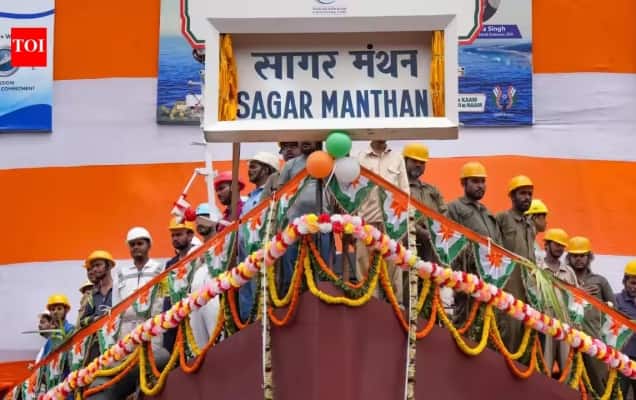
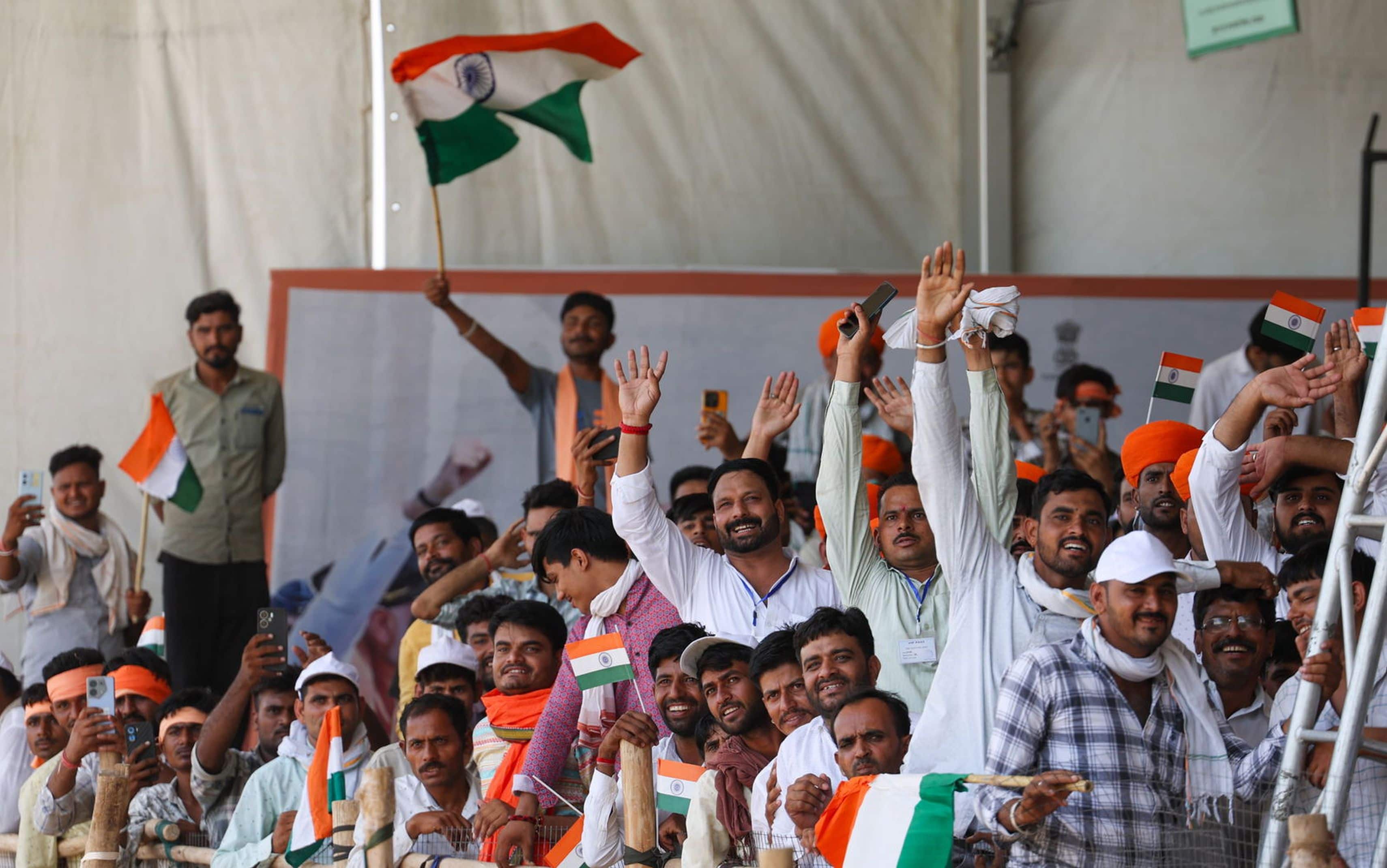
The Prime Minister Shri Narendra Modi inaugurated, laid the foundation stone and dedicated to the nation multiple development projects worth Rs 26,000 crore in Bikaner, Rajasthan today. Addressing the occasion, he welcomed the large gathering at the event, acknowledging the significant participation of people from 18 states and union territories who joined online. He highlighted the presence of several governors, chief ministers, lieutenant governors, and other public representatives. The Prime Minister extended his greetings to all esteemed dignitaries and citizens connected from across the country.
Shri Modi stated that he arrived at the event after seeking the blessings of Karni Mata, emphasizing that these blessings further strengthen the nation's resolve to build a developed India. Mentioning the inauguration and foundation stone laying of development projects worth ₹26,000 crore, he underscored their significance in advancing the country's growth. He extended his congratulations to the citizens for these transformative initiatives.

Highlighting the ongoing transformation of India's infrastructure, emphasizing the nation's commitment to modernization, the Prime Minister pointed to the rapid advancements in roads, airports, railways, and railway stations over the past 11 years. “India is now investing six times more in infrastructure development compared to previous years, a progress that has captured global attention”, remarked the Prime Minister, pointing out iconic infrastructure projects across the country, citing the remarkable Chenab Bridge in the north, the Sela Tunnel in Arunachal Pradesh, and the Bogibeel Bridge in Assam in the east. In western India, he noted the Atal Setu in Mumbai, while in the south, he highlighted the Pamban Bridge, India's first of its kind.
Emphasising India's continuous efforts to modernize its railway network, Shri Modi underlined the introduction of Vande Bharat, Amrit Bharat, and Namo Bharat trains as symbols of the country's new speed and progress. He remarked that nearly 70 routes now operate Vande Bharat trains, bringing modern rail connectivity to remote regions. He further pointed out the significant infrastructure advancements over the past 11 years, including the construction of hundreds of road overbridges and underbridges, as well as the laying of over 34,000 kilometers of new railway tracks. He noted that unmanned level crossings on broad gauge lines have been eliminated, enhancing safety. Shri Modi also highlighted the swift development of dedicated freight corridors to streamline cargo transportation and the ongoing construction of India’s first bullet train project. Alongside these efforts, the modernization of more than 1,300 railway stations is being carried out to improve passenger experience.
Prime Minister stressed that the modernized railway stations have been named Amrit Bharat Stations and that over 100 such stations have been completed. He noted that social media users have witnessed the striking transformation of these stations, which serve as showcases of local art and history. He pointed out significant examples, including Rajasthan’s Mandalgarh station, reflecting the grandeur of Rajput traditions, and Bihar’s Thawe station, depicting the sacred presence of Maa Thawewali along with Madhubani artwork. The Orchha railway station in Madhya Pradesh exudes the divine essence of Lord Ram, while the design of Srirangam station draws inspiration from the Sri Ranganatha Swamy temple. Gujarat’s Dakor station pays homage to Ranchhodrai ji, Tiruvannamalai station follows Dravidian architectural principles, and Begumpet station embodies the architectural legacy of the Kakatiya dynasty. The Prime Minister underscored that these Amrit Bharat Stations not only preserve India’s thousands-of-years-old heritage but also serve as catalysts for tourism growth across states, creating new employment opportunities for youth. He urged the people to ensure the cleanliness and safety of the stations as they were the true owners of these infrastructure.

Underlining that government investments in infrastructure not only drive development but also create employment opportunities and boost business activities, Shri Modi emphasized that the thousands of crores being spent are directly benefiting workers, shopkeepers, factory employees, and those involved in transport sectors such as truck and tempo operators. He noted that once infrastructure projects are completed, the benefits multiply. Farmers can transport their produce to markets at lower costs, reducing wastage. Well-developed roads and expanded railway networks attract new industries and significantly boost tourism. He underscored that infrastructure spending ultimately benefits every household, with young people gaining the most from emerging economic opportunities.
Shri Modi highlighted the substantial benefits Rajasthan is gaining from ongoing infrastructure development. He noted that high-quality roads are being constructed across villages and even in border areas. Over the past 11 years, approximately ₹70,000 crore has been invested in Rajasthan’s road infrastructure alone. He stated that the central government is set to spend nearly ₹10,000 crore on railway development in the state this year, marking a 15-fold increase compared to pre-2014 levels. He remarked on the flagging-off of a new train connecting Bikaner to Mumbai, further enhancing connectivity. Additionally, he emphasized the launch and foundation stone laying of various health, water, and electricity projects in multiple regions. These initiatives aim to accelerate the progress of both urban and rural areas of Rajasthan, ensuring that young people find promising opportunities within their own cities and towns.
Underlining the accelerated industrial development in Rajasthan under the Union and State governments, the Prime Minister noted that Chief Minister Shri Bhajanlal Sharma’s administration has introduced new industrial policies across various sectors, which will benefit regions like Bikaner. He emphasized that Bikaneri Bhujia and Bikaneri Rasgullas will expand their global recognition, further strengthening the state’s food processing industry. The Prime Minister remarked that Rajasthan’s refinery project is in its final stages, positioning the state as a key hub for petroleum-based industries. He also underscored the significance of the six-lane economic corridor from Amritsar to Jamnagar, passing through Shri Ganganagar, Hanumangarh, Bikaner, Jodhpur, Barmer, and Jalore. Additionally, he highlighted the near-completion of the Delhi-Mumbai Expressway in Rajasthan, stating that these connectivity projects will elevate the state’s industrial growth to new heights.
Shri Modi highlighted the rapid progress of the PM Surya Ghar Muft Bijli Yojana in Rajasthan, noting that over 40,000 people in the state have already benefited from this initiative, which has eliminated their electricity bills and provided them an opportunity to generate income through solar power. He remarked on the inauguration and foundation stone laying of several power-related projects, emphasizing that these developments will further enhance Rajasthan’s electricity supply. He underscored that the increasing power generation in the state is playing a crucial role in accelerating industrial growth.

Underlining the historical significance of Rajasthan’s land, Shri Modi recalled the visionary efforts of Maharaja Ganga Singh in transforming desert terrain into fertile landscapes. He highlighted the critical importance of water for the region and its role in advancing the development of areas such as Bikaner, Shri Ganganagar, Hanumangarh, and western Rajasthan. He stated that the government is actively working on completing irrigation projects while simultaneously implementing river-linking initiatives. He underscored the impact of the Parvati-Kalisindh-Chambal Link Project, which will benefit multiple districts across Rajasthan, ensuring better agricultural prospects for farmers and enhancing the region’s sustainability.
Emphasising the unwavering spirit of Rajasthan, stating that nothing is greater than the country and its people, the Prime Minister condemned the terrorist attack on April 22, where assailants targeted innocent lives based on their faith. He remarked that while the bullets were fired in Pahalgam, they wounded the hearts of 140 crore Indians, uniting the nation in resolve against terrorism. He highlighted the decisive response by India's armed forces, stating that they were given full operational freedom. He noted that in a meticulously executed operation, the three forces collaborated to dismantle Pakistan’s defenses, forcing them into submission. He revealed that in response to the April 22 attack, India struck back within 22 minutes, destroying nine major terrorist hideouts. “This action demonstrated the nation's strength, proving that when the sacred sindoor turns into firepower, the outcome is definitive”, exclaimed the Prime Minister. He also pointed out a significant coincidence—five years ago, after the Balakot air strike, his first public rally was in Rajasthan. Similarly, following the recent Operation Sindoor, his first rally is again in Rajasthan, in Bikaner, reaffirming the land’s deep-rooted valor and patriotism.
Shri Modi recalled his statement in Churu, reaffirming his commitment to the nation: "Swear by this soil, I will not let the country fall, I will not let the country bow." He declared from Rajasthan that those who attempted to erase the sacred sindoor have been reduced to dust, and those who spilled India’s blood have now paid the price in full. The Prime Minister stated that those who assumed India would remain silent are now in hiding, while those who boasted about their weapons now lie buried beneath rubble. Emphasizing that Operation Sindoor was not an act of revenge, but a new form of justice, he remarked that it was not just an expression of outrage but a display of India's unwavering strength and determination. He asserted that the nation has adopted a bold approach, striking the enemy directly and decisively. “Crushing terrorism is not just a strategy but a principle, this is India, this is the new India”, stressed Shri Modi.

Outlining the three key principles established through Operation Sindoor in India’s fight against terrorism, the Prime Minister stated the first principle - any terrorist attack on India would be met with a decisive response, with the timing, method, and terms determined solely by India’s armed forces. Second, he asserted that India would not be intimidated by nuclear threats. Third, he emphasized that India would no longer differentiate between terrorist masterminds and the governments that support them, rejecting Pakistan’s distinction between state and non-state actors. Highlighting ongoing global efforts to expose Pakistan’s role in fostering terrorism, seven distinct groups, comprising leaders from various political parties and foreign policy experts, are actively working to present Pakistan’s true face to the world, he added.
Shri Modi asserted that Pakistan can never win a direct confrontation with India, recalling its repeated failures in past conflicts. He emphasized that, unable to succeed in open battles, Pakistan has long used terrorism as a weapon against India, resorting to violence and creating an atmosphere of fear. He declared that Pakistan had underestimated India’s resolve, stating that under his leadership, the nation stands strong and unwavering. “Any terrorist attack on India would result in severe consequences, with Pakistan paying a heavy price—borne by its military and its economy”, stated Shri Modi.
Prime Minister stated that upon arriving in Bikaner, he landed at Nal Airport, which Pakistan had attempted to target but failed to inflict any damage. He highlighted that across the border, Pakistan’s Rahim Yar Khan Airbase has been forced to shut down for several days due to India’s precise military strikes, which severely impacted its operations. The Prime Minister firmly declared that there would be neither trade nor talks with Pakistan. He asserted that any discussions would solely revolve around Pakistan-occupied Kashmir. He warned that if Pakistan continued exporting terrorists, it would face economic ruin. He reiterated that India would not allow Pakistan access to its rightful share of water and that playing with Indian blood would come at a steep cost. “This resolve is India's commitment, one that no force in the world can shake”, he stressed.

“Both security and prosperity are essential for building a developed India”, emphasised Shri Modi, asserting that this vision can only be realized when every corner of the country is strengthened. He stated that the event serves as an exemplary demonstration of India’s balanced and accelerated growth. Concluding his address, he extended his congratulations from the land of valor to all present.
The Governor of Rajasthan, Shri Haribhau Kisanrao Bagade, Chief Minister of Rajasthan, Shri Bhajanlal Sharma, Union Ministers Shri Ashwini Vaishnaw, Shri Arjun Ram Meghwal were present among other dignitaries at the event.
Background
In line with his commitment to constantly improve and enhance the rail infrastructure in the country, Prime Minister inaugurated 103 redeveloped Amrit Stations in 86 districts across 18 States and Union Territories of India developed at a cost of over Rs 1,100 crore. Over 1,300 stations are being redeveloped with modern facilities, designed to reflect regional architecture and enhance passenger amenities under the Amrit Bharat Station Scheme. Deshnoke railway station, serving pilgrims and tourists visiting the Karni Mata Temple among others, is inspired with temple architecture and arch and column theme. Begumpet railway station in Telangana is inspired by the architecture of the Kakatiya empire. Thawe station in Bihar incorporates various murals and art works representing Maa Thawewali, one of the 52 Shakti Peethas and depicting Madhubani paintings. Dakor station in Gujarat is inspired by Ranchhodrai Ji Maharaj. The redeveloped Amrit stations across India integrate modern infrastructure with cultural heritage, passenger-centric amenities including those for Divyangjan and sustainable practices to enhance the travel experience.
Indian Railway is marching towards 100% electrification of its network, making railway operations more efficient and environment friendly. In line with this, Prime Minister laid the foundation stone of Churu-Sadulpur rail line (58 km) and dedicated to the Nation Suratgarh-Phalodi (336 km); Phulera-Degana (109 km); Udaipur-Himmatnagar (210 km); Phalodi-Jaisalmer (157 km) and Samdari-Barmer (129 km) rail line electrification.
In a major boost to road infrastructure in the state, Prime Minister laid the foundation stone for construction of 3 Vehicle Underpasses, widening and strengthening of National highways. He will also dedicate 7 roadways projects in Rajasthan. The roadways projects, worth over Rs 4850 crore, will facilitate smoother movement of goods and people. The highways extend up to the Indo-Pak border, enhancing accessibility for security forces and strengthening India's defence infrastructure.
Furthering the vision of electricity for all and green and clean energy, Prime Minister laid the foundation stone of power projects including Solar projects at Bikaner and Nawa in Didwana Kuchaman, and Transmission Systems for Evacuation of Power Part B PowerGrid Sirohi Transmission Ltd and Part E PowerGrid Mewar Transmission Ltd. He will also inaugurate power projects including Solar project at Bikaner, Transmission system for Evacuation of PowerGrid Neemuch and from Bikaner Complex, Augmentation of transformation capacity at Fatehgarh-II Power Station which will provide clean energy and reduce carbon emission.
Prime Minister also laid the foundation stone, inaugurated and dedicated 25 important state government projects across Rajasthan to enhance infrastructure, connectivity, power supply, health services, and water availability in the state. These include laying of foundation stone and dedication to the nation of projects for upgrading and maintaining 12 State Highways covering a total length of over 750 km worth over Rs 3,240 crore; further expansion under the program includes an additional 900 km of new highways. Prime Minister inaugurated power projects at Bikaner and Udaipur. He also inaugurated Nursing Colleges in Rajsamand, Pratapgarh, Bhilwara, Dholpur which will play a key role in enhancing health infrastructure in the state. He also laid the foundation stone and dedicated to the nation various water infrastructure projects in the region including Rural Water Supply and Fluorosis Mitigation Project in Jhunjhunu District, Restructuring of Urban Water Supply Schemes in 7 Towns of Pali District under AMRUT 2.0, among others.
Click here to read full text speech
हमारे देश की सड़कें आधुनिक हों... हमारे देश के एयरपोर्ट आधुनिक हों... हमारे यहां रेल और रेलवे स्टेशन...आधुनिक हों...
— PMO India (@PMOIndia) May 22, 2025
इसके लिए पिछले 11 साल में अभूतपूर्व गति से काम किया गया है: PM @narendramodi pic.twitter.com/fa3XkyRii0
आधुनिक हो रहे इन रेलवे स्टेशनों को देश ने अमृत भारत स्टेशन का नाम दिया है।
— PMO India (@PMOIndia) May 22, 2025
आज इनमें से 100 से अधिक अमृत भारत स्टेशन बनकर तैयार हैं: PM @narendramodi pic.twitter.com/nDu8ial1Ag
एक तरफ हम सिंचाई परियोजनाओं को पूरा कर रहे हैं और साथ ही नदियों को जोड़ रहे हैं: PM @narendramodi pic.twitter.com/mvESBzE56V
— PMO India (@PMOIndia) May 22, 2025
हमारी सरकार ने तीनों सेनाओं को खुली छूट दी... तीनों सेनाओं ने मिलकर ऐसा चक्रव्यूह रचा कि पाकिस्तान को घुटने टेकने के लिए मजबूर कर दिया: PM @narendramodi pic.twitter.com/LxczNcKg1X
— PMO India (@PMOIndia) May 22, 2025
दुनिया ने और देश के दुश्मनों ने भी देख लिया कि जब सिंदूर...बारूद बन जाता है...तो नतीजा क्या होता है: PM @narendramodi pic.twitter.com/0d0vNtbGqX
— PMO India (@PMOIndia) May 22, 2025
ऑपरेशन सिंदूर ने आतंकवाद से निपटने के तीन सूत्र तय कर दिए हैं: PM @narendramodi pic.twitter.com/j0ehKVVspw
— PMO India (@PMOIndia) May 22, 2025
अब भारत ने दो टूक साफ कर दिया है... हर आतंकी हमले की पाकिस्तान को भारी कीमत चुकानी पड़ेगी।
— PMO India (@PMOIndia) May 22, 2025
और ये कीमत...पाकिस्तान की सेना चुकाएगी... पाकिस्तान की अर्थव्यवस्था चुकाएगी: PM @narendramodi pic.twitter.com/FCdt1v0z4k
भारतीयों के खून से खेलना...पाकिस्तान को अब महंगा पड़ेगा: PM @narendramodi pic.twitter.com/0qj5rOOAgB
— PMO India (@PMOIndia) May 22, 2025