



Premier Li Keqiang
President of CPAFFC Madame Li Xiaolin
Hon’ble Chief Ministers, Governors and Mayors
This is a historic moment in the relationship between India and China.
Today, we are launching a new vehicle for advancing cooperation between our two countries.
In times to come, this will become one of the most important instruments for deepening our economic partnership and contact between our people.
As someone who has been Chief Minister for thirteen years and Prime Minister for one, this forum has a special place in my heart.
But, it is not just my sentiments that lead me to give such importance to this new institution.
It comes from a serious conviction, born from my experience, that states have a vital role to play in the national development.
This is especially true for large and populous countries, with a high degree of geographical, social and economic diversity.
It becomes even more relevant, when the constitutional and political systems are federal in structure.
These attributes exist in both India and China, the world's two most populous nations.
In India's Constitution, state governments have predominant role in economic and social development.
The Central Government creates the macro-economic environment. It can set the broad social and economic agenda and directions for the nation.
It can launch development policies and schemes. It can manage resources.
But, in the end, the state governments have an important role in their implementation.
But, as I saw in my own experience, state governments can take innumerable initiatives for the development of the states.
That is the level of autonomy and responsibility that they enjoy under our Constitution.
In the same national environment, states are performing at different levels.
For business investors, too, whether they are Indian or foreign, their journey may begin in Delhi, but their success ultimately depends on state capitals.
Many of the critical requirements for success – infrastructure, land, utilities, skilled human resources and many approvals –ultimately depend on the state governments.
But, for me, the involvement of states in our national effort is not just because of their constitutional and legal responsibilities.
It is also stems from a basic management principle. The chances of success are higher when we create a sense of participation for everyone; when we give everyone a stake in success.
That is why I speak of Team India. That is why I believe that the foundation for India's development will not be the single pillar of the Central Government, but 30 pillars comprising the Central Government and all our States.
It follows from the simple logic of science that this foundation will be stronger and more stable. It can support a much taller structure of development.
That is why I speak of Cooperative Federalism, when the Centre and the States are partners. I also speak of cooperative and competitive federalism, in which states compete with each other to attract investments and jobs.
We have moved quickly in the past year to give shape to this vision.
When we replaced the old Planning Commission with the institution called Niti Ayog, we gave a formal place and role for state governments in an institution of this nature for the first time in India.
We have radically increased the amount of resources that the Central Government must transfer to the state governments.
And, when we began to raise large revenues from the auction of our coal, it also filled the coffers of the states where the mines are located.
I am asking my ministries to move conferences out of Delhi to state capitals and other cities, so that they do get the benefits that come from hosting such events.
More than anything else, we deal with the state governments in a spirit of partnership and with sensitivity to their concerns.
And, in doing so, we do not look at the symbol of the political party that is in power in the state.
Which is why, when I invited state governments to participate in this event, I did considered the linkages of their states with China, but also broader political representation.
Every nation needs strong international partnerships for its progress. The linkage has deepened in an integrated world.
As international partnerships in trade, investments, innovation, technology, tourism, education, skills and health grow, state governments have a stake in them and responsibility for their success.
I have found, both through outbound and inbound state delegations, that state level interactions can be often more focused and productive.
A number of decisions can be taken quickly by the state governments.
These interactions also make the state governments more sensitive and aware of the international dynamics and requirements.
Therefore, I attach great significance to this forum.
It is the first that India has with any country.
And, it is appropriate that it has started with China.
We are two of the world's largest economies and among its fastest growing major economies. We have enormous economic synergies.
We also face similar challenges. We have some similar experiences.
We have both seen differences in the pace of development in different parts of our countries.
Our economic relations are growing rapidly.
During President Xi's visit last year, we set for ourselves an ambitious plan to take our economic relations to a new level.
We agreed on China setting up two industrial parks in India – in Maharashtra and Gujarat. We are pleased that both Chief Ministers are here. We have agreed on cooperation in the upgrading of India's railway sector.
I have invited Chinese companies to invest in India's manufacturing sector. President Xi spoke of 20 billion dollars of Chinese investments over the next five years. Some of the business agreements will take shape in Shanghai tomorrow.
I believe it will be much easier to translate our vision into reality, if provincial and state governments come into closer contacts.
It will also serve our other interests – especially promoting greater people-to-people contacts, which is at the heart of all relationships.
Between India and China, we already have sister-state relationships between Gujarat and Guangdong. We also have a number of sister-city relations.
During this visit, we will see the launch of Karnataka Sichuan relations and four sister-city relationships.
It is also consistent with this spirit that President Xi began his visit to India in Ahmedabad and I started this visit in Xian.
These are welcome developments. We are truly taking our relationship outside our national capitals to state capitals and cities.
So, it is a great pleasure for me to join Premier Li in launching this forum. It will have our full support. And, I wish it all success.
Thank you.
Published By : Admin |
May 15, 2015 | 12:43 IST
-
Share
-

-

-


Login or Register to add your comment
Explore More

Popular Speeches
প্রধান মন্ত্রীনা শ্রী রাম জন্মভুমি মন্দির দ্বাজরোহন উৎসবতা পীখিবা ৱারোলগী মৈতৈলোন্দা হন্দোকপা


Nm on the go
Always be the first to hear from the PM. Get the App Now!

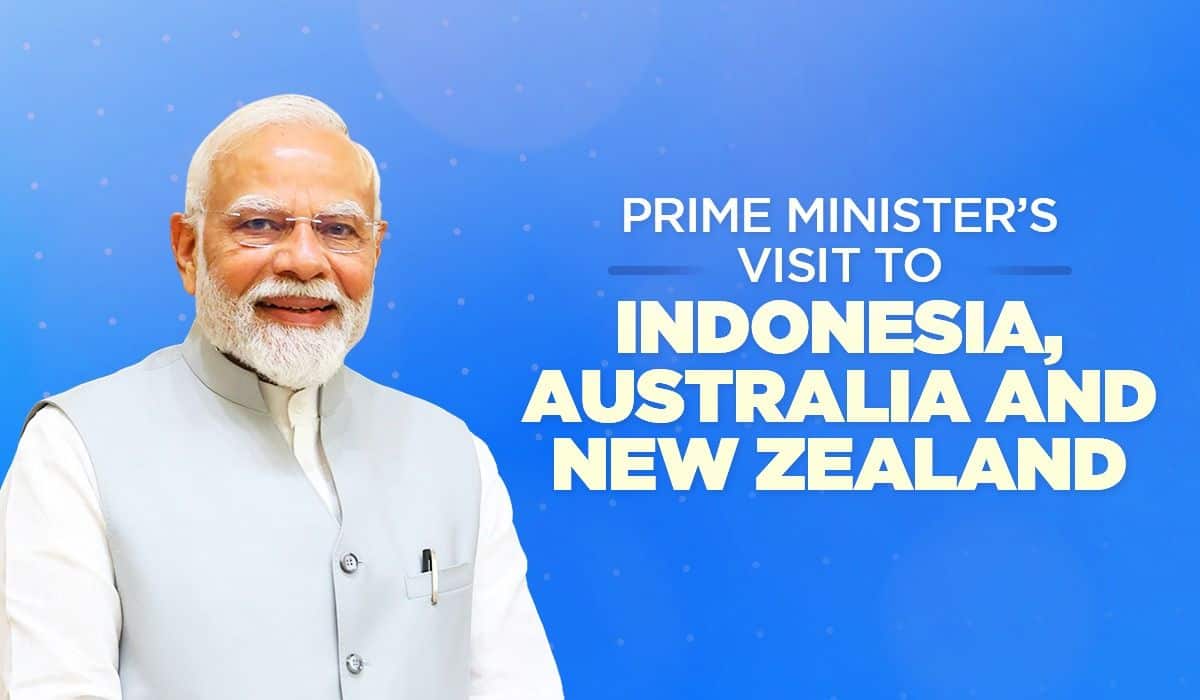
Prime Minister’s visit to Indonesia, Australia and New Zealand
July 03, 2026
-
Share
-
-
-
At the invitation of the President of the Republic of Indonesia, H.E. Mr. Prabowo Subianto, Prime Minister Shri Narendra Modi will pay a visit to Indonesia from 6-8 July, 2026. This will be Prime Minister’s fourth visit to Indonesia and his first bilateral visit since the elevation of India-Indonesia ties to the level of Comprehensive Strategic Partnership in May 2018. During the visit, Prime Minister will hold bilateral discussions with President Prabowo and review the progress made in the partnership. In Jakarta, Prime Minister will address a large gathering of the Indian Diaspora. India and Indonesia share historical and warm people-to-people ties. In keeping with these special bonds, Prime Minister will visit the Prambanan Temple complex at Yogyakarta, a prominent UNESCO world heritage site in Indonesia.
From Indonesia, at the invitation of the Prime Minister of Australia, the Honourable Anthony Albanese MP, Prime Minister will travel to Melbourne from 8-10 July, 2026. In Melbourne, Prime Minister will hold bilateral discussions with Prime Minister Albanese. He will also call on the Governor General of Australia, the Honourable Ms Sam Mostyn AC. During his visit, Prime Minister will also participate in the India-Australia CEOs Forum, where he will address a gathering of top business leaders from both countries. Prime Minister will also address a large gathering of the Indian Diaspora, who constitute a strong pillar of the India-Australia relationship.
From Melbourne, at the invitation of the Prime Minister of New Zealand, Rt Honourable Christopher Luxon, Prime Minister will travel to Auckland for a state visit from 10-11 July, 2026. This will be the first state visit of an Indian Prime Minister to New Zealand in four decades. In Auckland, Prime Minister will hold bilateral discussions with Prime Minister Luxon and review the entire gamut of the bilateral relationship, which has seen significant progress in the last two years, especially in the areas of trade and commerce and defence. While in Auckland, Prime Minister will also interact with prominent business and sports personalities. In a reflection of the strong people-to-people ties that exist between India and New Zealand, Prime Minister will address a large gathering of the Indian Diaspora during the visit.


Posted via www.narendramodi.in