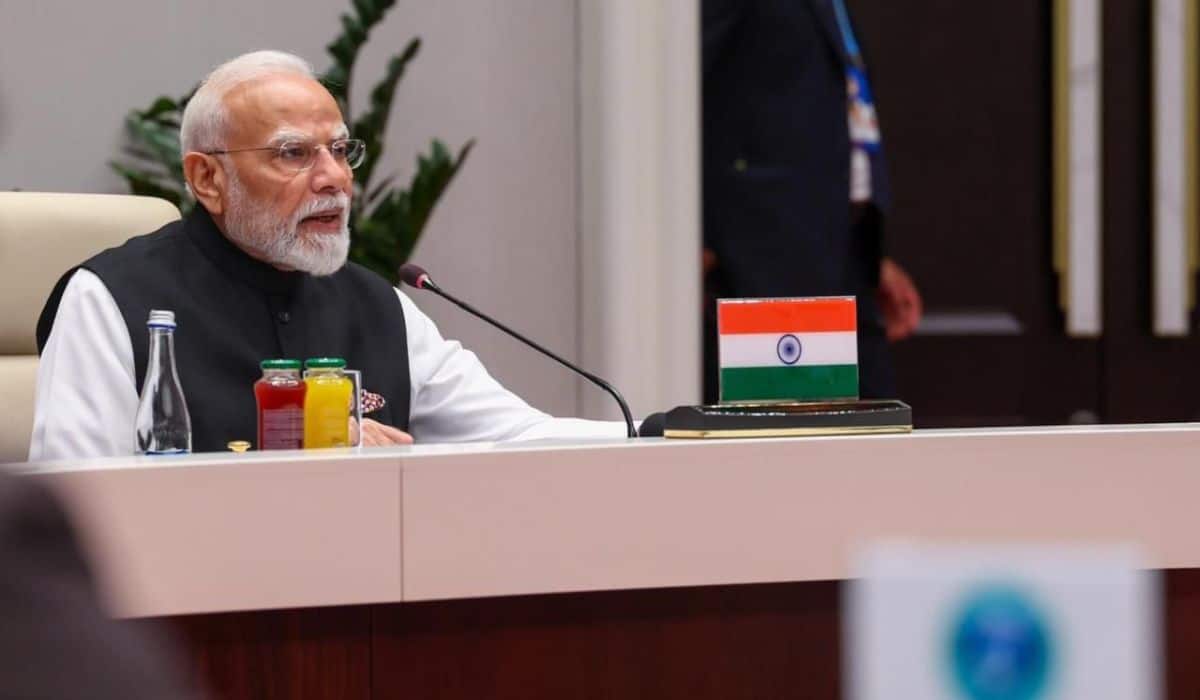
At the invitation of the President of the Kyrgyz Republic H.E. Mr. Almazbek Atambaev, Prime Minister of India, H.E. Mr. Narendra Modi, paid an Official Visit to the Kyrgyz Republic on 11- 12 July 2015.
Prime Minister Narendra Modi and President Almazbek Atambaev held profound exchange of views on strengthening bilateral relations as well as regional and international issues of mutual interest, in warm and friendly atmosphere.

Kyrgyz Republic and Republic of India (further named as "The Sides”) highly appreciated significant achievements in different areas of cooperation over the past 24 years since the establishment of diplomatic relations between the two countries. The Sides expressed satisfaction at the steady development of political, trade-economic relations, cultural-humanitarian cooperation, and agreed to elevate the bilateral partnership to a higher trajectory in the days ahead.
Guided by the common aspiration to improve the level of Kyrgyz-Indian relations and further increase of their multi-faceted cooperation and confirming that Kyrgyzstan and India are partners, sharing common fundamental values, such as freedom, democracy, human rights, and rule of law,

The Sides declared the following:
1. Political cooperation
The Sides noted that the relations between India and the Kyrgyz Republic are based on historical ties spanning several centuries.
The Indian side recognizes the achievements of the Kyrgyz Republic in providing political freedom for its citizens.
The Sides decided to enhance contacts at different levels, including regular high-level visits and official exchanges to facilitate closer consultations on bilateral, international and regional issues of mutual interest.
India expressed deep appreciation at the continued institutionalization of parliamentary democracy in the Kyrgyz Republic.
Both Sides would foster regular Parliamentary exchanges. Kyrgyz side expressed interest in studying the Indian experience of parliamentary system. In this regard, the Sides agreed that Kyrgyz parliamentarians would utilize courses conducted by Bureau of Parliamentary Studies and Training of India.
The Sides welcomed the signing of a Memorandum of Understanding on cooperation in the field of elections between Central Commission on Elections and Conducting Referendum in Kyrgyz Republic and the Election Commission of India.
2. Cooperation at regional and global level
Noting common positions on many current international issues, the Sides stressed the importance of deepening interaction between the two countries in the international arena including in the framework of United Nations Organization and reaffirmed the need to strengthen the role of UN. The Sides called for UN reforms, with a view to maintain its leading role in adequately dealing with contemporary challenges and the threats to global peace and stability.
Noting the contribution of India in maintaining peace in the world, the Kyrgyz side reaffirmed its support to the rightful claim of India for permanent membership in an expanded UN Security Council.
The Indian side reaffirmed support of the candidacy of the Kyrgyz Republic for the UN Human Rights Council for 2016-2018.
The Sides expressed satisfaction at their cooperation on regional issues, including in the framework of the Conference on Interaction and Confidence Building Measures in Asia (CICA) and the Shanghai Cooperation Organization (SCO).
Kyrgyz Side welcomed the commencement of the process of accession of India as a full member of the SCO, as decided by the Council of Heads of State-members of the SCO on 10 July 2015 in Ufa, Russia. The Kyrgyz side noted that full membership of India in SCO will be a significant step in increasing the political prestige of SCO and its role in international and regional affairs.
The Sides expressed grave concern at the rising trend of extremism, radicalism and terrorism in the region and whole world. The Indian side highly appreciated the steps taken by the Kyrgyz Government in counteracting terrorism and in retaining the secular character of Kyrgyz society.
The Sides agreed to expeditiously consider signing an agreement on "combating international terrorism and other crimes”.
3. Defence cooperation
The Sides expressed satisfaction at development of defence ties, which reflect a high level of mutual trust between them. The Sides welcomed exchange of visits at Defence Minister level and the major initiatives that have been taken as well as their ongoing programme of cooperation. Both Sides appreciated the signing of an Agreement between the Government of the Kyrygz Republic and the government of the Republic of India on Cooperation in the Defence Sector.
The Sides expressed satisfaction on the second round of joint exercises "Khanjar 2015” between the Special Forces of the Armed Forces of two countries held in Kyrgyzstan in March 2015, which reflected continuity in exercises held in India in 2011. It was decided to hold joint exercises on an annual basis.
The Indian side welcomed the endeavor of Kyrgyzstan to participate in UN peacekeeping operations and expressed full support of India in this regard. The Kyrgyz side expressed its appreciation to the Government of India for training Kyrgyz military officers for conducting various UN Peacekeeping Courses, including by Centre for UN Peacekeeping in New Delhi, as well as for exchange of experience with Kyrgyz Armed Forces on the Level II UN Field Hospital of the General Staff of the Armed Forces of the Kyrgyz Republic.
The Kyrgyz side expressed its gratitude to the Government of India for providing medical equipment for their Level II Field Hospital and for support of India in establishing an Information Technology Centre at the Military Academy of the Armed Forces of the Kyrgyz Republic named after Lieutenant General K. Usenbekov.
Both Sides appreciated the joint expedition between the Armed Forces of two countries, including Indian-Kyrgyz expedition in September 2011 to scale mount Stock Kangri in Ladakh, India and expedition in August 2013 to Lenin Peak in Kyrgyzstan, and called for continuation of such exchanges.
4. Economic cooperation
Noting that the current level of economic, trade and investment linkages between India and Kyrgyzstan are below potential, the Sides underlined the need for concerted efforts to enhance the economic content of the bilateral partnership.
Prime Minister Narendra Modi congratulated President Almazbek Atambaev on Kyrgyzstan's joining the Eurasia Economic Union. The Sides exchanged opinions on integration process in the Eurasian space. Both Sides agreed to work together for early conclusion of a Free Trade Agreement between the Member States of Eurasia Economic Union and the Republic of India.
Attaching great importance to further enhancing economic cooperation, the Kyrgyz side invited Indian business to invest actively in the Kyrgyz economy and expressed its willingness to render assistance to the Indian investors in their investment activities in the Kyrgyz Republic. The Kyrgyz side welcomed the interest of Indian companies to invest in mining and pharmaceutical sectors in Kyrgyzstan.
The Sides noted the importance of implementation of their bilateral agreements, including the Protocol of the VII session of the Bilateral Inter-governmental Joint Commission on Trade, Economic, Scientific-Technical Cooperation in New Delhi on 16-17 March 2015, as well as the MoUs on cooperation in the fields of Textiles and Energy.
The Sides expressed satisfaction with cooperation in the Joint Business Council between Federation of Indian Chambers of Commerce and Industry (FICCI) and Kyrgyz Chambers of Commerce and Industry (KCCI), which held its meeting in New Delhi on 2 December 2014. The Sides agreed to take necessary actions for implementation of the mutually agreed outcomes.
The Sides welcomed the commencement of direct flights between Bishkek and Delhi and agreed to encourage greater connectivity in order to enhance trade and tourism between the two countries.
The Sides called to facilitate the establishment of direct business contacts, and positively noted events in the field of pharmaceutical, agriculture, trade and investment, including a specialized pharmaceuticals exhibition by PHARMEXCIL of India with participation of more than 40 Indian companies in Bishkek in March 2015 as well as the participation of representatives of Agrarian Platform from Kyrgyzstan in Aahar 2015 trade fair in New Delhi in March 2015.
Underlining the fact that more than sixty percent of the population in India and the Kyrgyz Republic works in the agriculture sector, the Sides reaffirmed the importance of meaningful collaboration in the agriculture sector. The Indian side offered to share experience in agro-processing, greenhouse technology, water conservation, and agricultural research in order to enhance productivity and add value to agricultural produce. The Sides welcomed the round table to be held shortly in Bishkek on strengthening cooperation in the Agriculture sector to identify avenues and concrete projects for cooperation in this sector.
The Kyrgyz Side expressed its appreciation to the Indian side for its willingness to consider financing important socio-economic projects of the Kyrgyz Republic on mutually beneficial and acceptable terms. The Sides agreed to determine the conditions of financing in accordance with the National Sustainable Development Strategy of the Kyrgyz Republic in the period of 2013-2017 and the Mid-term Management Strategy of the State debt of the Kyrgyz Republic for 2015-2017 as well as relevant Indian regulations.
5. Scientific and Technical Cooperation
Reiterating that, as fellow democracies, both their countries place people at the heart of all developmental activity, the Sides expressed satisfaction over their developing cooperation in sectors such as education and health.
The Sides noted that Kyrgyzstan remains one of the popular destinations for the Indian medical students. Students from Kyrgyzstan study in India as well and over 1000 working professionals from a cross section of the Kyrgyz society have utilized the Indian Technical and Economic Cooperation (ITEC) programme. The Kyrgyz side welcomed the decision of the Government of India to increase the number of ITEC slots for Kyrgyz nationals from 85 to 100 this year.
The Sides expressed satisfaction at the successful functioning of the India-Kyrgyz Centre for IT established in the Kyrgyz State University of Construction, Transport and Architecture named after N. Isanov in Bishkek (KSUCTA), agreed to work towards upgrading the Centre and consider setting up of similar Centres in other major cities in Kyrgyzstan under Indian grant assistance.
The Sides expressed satisfaction over growing links in the health sector, including regular visits by doctors from super-specialty hospitals in India to Kyrgyzstan, visits of patients from Kyrgyzstan to India for medical treatment and complex surgery at affordable cost and international standards, and the gifting of a Computed Tomography Machine to the National Center for Cardiology and Internal Medicine (NCCIM) by the Government of India in September 2014.
The Sides welcomed the launch of project to establish Tele-medicine links, with the support of Government of India, between highly specialized hospitals of India and six Medical Establishments of Kyrgyzstan: (National Centre of Maternity and Childhood Care; National Center of Cardiology and Internal Medicine (NCCIM); National Centre of Surgery; Osh Inter-Regional Clinical Hospital; Talas Regional Hospital; and Issyk-Kul Regional Hospital), which was inaugurated by Prime Minister Narendra Modi at the National Center for Cardiology and Internal Medicine in Bishkek during his visit.
Indian side highly appreciated the support extended by the Kyrgyz Republic to the Kyrgyz-India Mountain Bio-medical Research Center. The Sides agreed to continue the research activity and welcomed commencement of the second phase during the visit of Prime Minister Narendra Modi.
Indian side thanked the Kyrgyz side for co-sponsoring the resolution in the UN General Assembly about celebration of 21st June as International Yoga Day, which was suggested by Prime Minister Narendra Modi in the UN General Assembly. Kyrgyzstan welcomed the offer of the Indian side to establish an AYUSH (Ayurveda, Yoga and Naturopathy, Unani, Siddha and Homeopathy) Center in Kyrgyz Republic to share India's knowledge in traditional medicine.
6. Cultural and humanitarian cooperation
The Sides intend to enhance cultural and humanitarian cooperation, including exchange of students. The Sides also intend to strengthen scientific-technical cooperation between researchers and students in Universities, research and analytical centers and private sector.
The Sides welcomed the signing of Agreement on Cultural Cooperation during the visit and stressed the need to enhance cooperation between the peoples of the two countries in different forms of art, music, dance, theatre, cinema and other cultural manifestations.
The Sides expressed satisfaction over continuing cultural exchanges between the two countries. The Sides stressed importance of organizing further mutual cultural events in Kyrgyzstan and India and expressed interest in joint study of common historical and cultural heritage.
Keeping in view the geographical proximity of the two countries and the potential of increasing tourism, the Sides expressed satisfaction at activities on tourism promotion organized by the Indian Ministry of Tourism in Bishkek in 2014 and the road show organized by the Kyrgyz Ministry of Culture, Information and Tourism in New Delhi in 2015. The Sides called for similar events in future.
The Sides instructed relevant departments to put in place a liberal visa regime for a few categories of citizens to promote business and tourism between the two countries.
Prime Minister Narendra Modi appreciated the decision of the Kyrgyz side to install a statue of Mahatma Gandhi in Bishkek city, which was ceremoniously unveiled by the Prime Minister during his visit.
Looking Ahead
Keeping in view the shared cultural and historical linkages as well as the deep trust and mutual confidence between India and the Kyrgyz Republic, the Sides felt that the visit of Prime Minister Narendra Modi marks a new beginning towards qualitatively enhancing the relationship between India and the Kyrgyz Republic and to strengthen friendship and comprehensive cooperation between the two countries.
The Sides expressed confidence that the decisions reached during the visit will give an additional impetus for further progressive development across the entire spectrum of their cooperation.
At the conclusion of his visit, Prime Minister Narendra Modi expressed his deep gratitude to President Almazbek Atambaev, the Government and the people of the Kyrgyz Republic for the warm welcome and gracious hospitality extended during his visit. Prime Minister Narendra Modi invited President Almazbek Atambaev to visit India. The invitation was accepted with gratitude.