Garib Kalyan Mela puts tools of development in hands of poor

Published By : Admin | August 7, 2010 | 12:55 IST

The ongoing Seva-Yagna, Garib Kalyan Mela (GKM) Abhiyan, have inspired so much visceral enthusiasm, especially among the poor beneficiaries by putting the tools of development in to their hands. The GKM held at Jamnagar distributed welfare assistance worth Rs. 161 Lacs among eight thousand beneficiaries.

Shri Divyesh Kanzariya was enthused to receive the subsidy-amount's cheque, which has planted a dream in Divyesh to become an entrepreneur. Not only that his loan papers were processed by District Industries Officer and on its recommendation his loan has been sanctioned for purchasing a Xerox-machine, he received a cheque of Rs. 30,000.

It has been a moment of triumph for Shri Hajibhai Osmanbhai Sodha, he was too proud to acknowledge that he would be more comfortable with the assistance-a fishing-net and a cycle. These are the tools, which have infused confidence in Hajibhai; he also can start his independent work. The new trend adopted by State Government has motivated the officials that they must approach the beneficiary, not the beneficiary should take rounds of Government offices, has served the purpose.

Shri Samir Arvindbhai is doing business of clothes. He has received Loan cum Aid of Rs. 1.50 Lac at the Garib Kalyan Mela, for starting his own Bandhni-Unit. He is much more confident to get settled and to earn more income.

Bukhari Mominben Rajabbhai got a certificate and tool-kit for beauty-parlor, Jayshri Pithdiya got tool-kit for Bandhni business. The beneficiaries have expressed their gratitude towards State Government and to admit that the principal and proactive approach to help the poor has realised the vision and ideals of welfare-state.

Explore More
প্রধান মন্ত্রীনা শ্রী রাম জন্মভুমি মন্দির দ্বাজরোহন উৎসবতা পীখিবা ৱারোলগী মৈতৈলোন্দা হন্দোকপা

Popular Speeches

প্রধান মন্ত্রীনা শ্রী রাম জন্মভুমি মন্দির দ্বাজরোহন উৎসবতা পীখিবা ৱারোলগী মৈতৈলোন্দা হন্দোকপা
UPI — an eventful journey

Media Coverage

UPI — an eventful journey
NM on the go

Nm on the go

Always be the first to hear from the PM. Get the App Now!
...
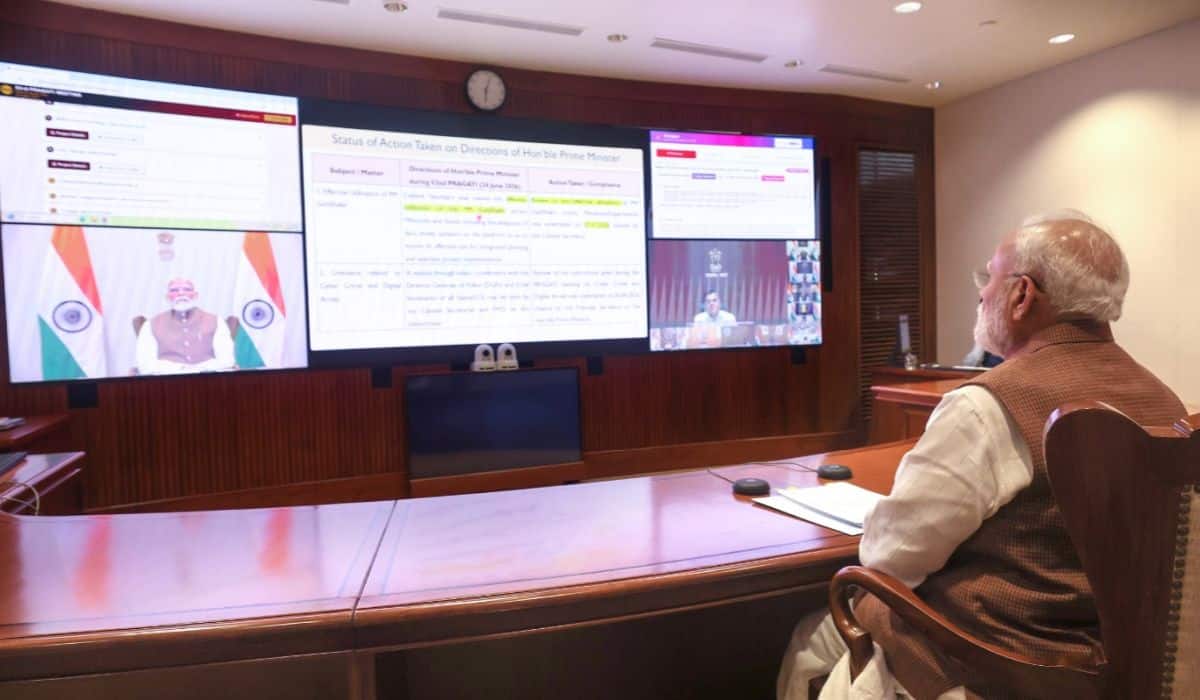
PM chairs 53rd PRAGATI Meeting
August 25, 2026
PM reviews six key infrastructure projects across the Railway, Road and Power sectors
Projects reviewed span across 9 States with cumulative investment of more than ₹30,000 crore
PM says Infrastructure projects should be viewed as an integrated whole, rather than as individual sections or packages
PM calls for continuous reforms across all stages of project implementation and a proactive work culture across Ministries and States
PM says Speed must go hand-in-hand with quality
While reviewing AgriStack, PM emphasises the need to leverage the latest digital technologies including AI to derive greater value from agricultural data
On cyber fraud and ‘digital arrest’, PM stresses training, public awareness, cyber-safety education and coordinated action

Prime Minister Shri Narendra Modi chaired the 53rd meeting of PRAGATI, the ICT-enabled, multi-modal platform for Pro-Active Governance and Timely Implementation, at Seva Teerth earlier today.

During the meeting, Prime Minister reviewed six key infrastructure projects across the Railway, Road and Power sectors, spanning nine States with a cumulative cost of more than ₹30,000 crore. The projects, significant for strengthening connectivity, supporting industrial and economic activity and improving public services, were reviewed with particular emphasis on adherence to timelines, inter-agency coordination, resolution of pending issues and expeditious completion.

Prime Minister emphasised that delays in infrastructure projects have consequences beyond cost escalation, as they also postpone the benefits intended for citizens, businesses and the economy. He said that infrastructure projects should be viewed and monitored as an integrated whole, rather than as isolated sections, stretches or packages. He noted that progress in individual packages should ultimately translate into timely completion and operationalisation of the entire project. Ministries and States were therefore asked to adopt an end-to-end approach, and address critical gaps that could delay the overall commissioning and delivery of benefits. He called for fostering a proactive work culture across Ministries and State Governments, with greater ownership at every level of project implementation.

Prime Minister stressed the need to explore common utility corridors for infrastructure services, wherever feasible, particularly while planning major transport and infrastructure projects. He called upon Ministries and States to examine such integrated approaches at the planning stage itself, keeping in view their technical and economic feasibility.

Prime Minister said that speed of execution must be accompanied by uncompromising quality. He called upon Ministries, States and implementing agencies to adopt modern technologies and strengthen quality assurance and supervision at every stage.

While reviewing AgriStack under the Digital Agriculture Mission, Prime Minister emphasised the need to leverage the latest digital technologies, including Artificial Intelligence, to derive greater value from agricultural data. He stressed that the data ecosystem should be effectively utilised across the agricultural value chain, from input planning to processing, enabling more informed interventions, better targeting and data-driven decision-making. He appreciated the efforts of the States and the Central Government in building the AgriStack ecosystem and called for further strengthening its use for delivering better outcomes for farmers.

During the review of cyber fraud cases, including incidents of digital arrest, Prime Minister said that prevention must be strengthened through a sustained focus on training, awareness and education. He stressed the need for continuous and targeted public-awareness campaigns, particularly for senior citizens, youth and other vulnerable sections, to familiarise them with common fraud techniques, warning signs and safe digital practices. He also called for regular capacity-building of personnel involved so that emerging modes of cyber fraud are identified and acted upon swiftly.