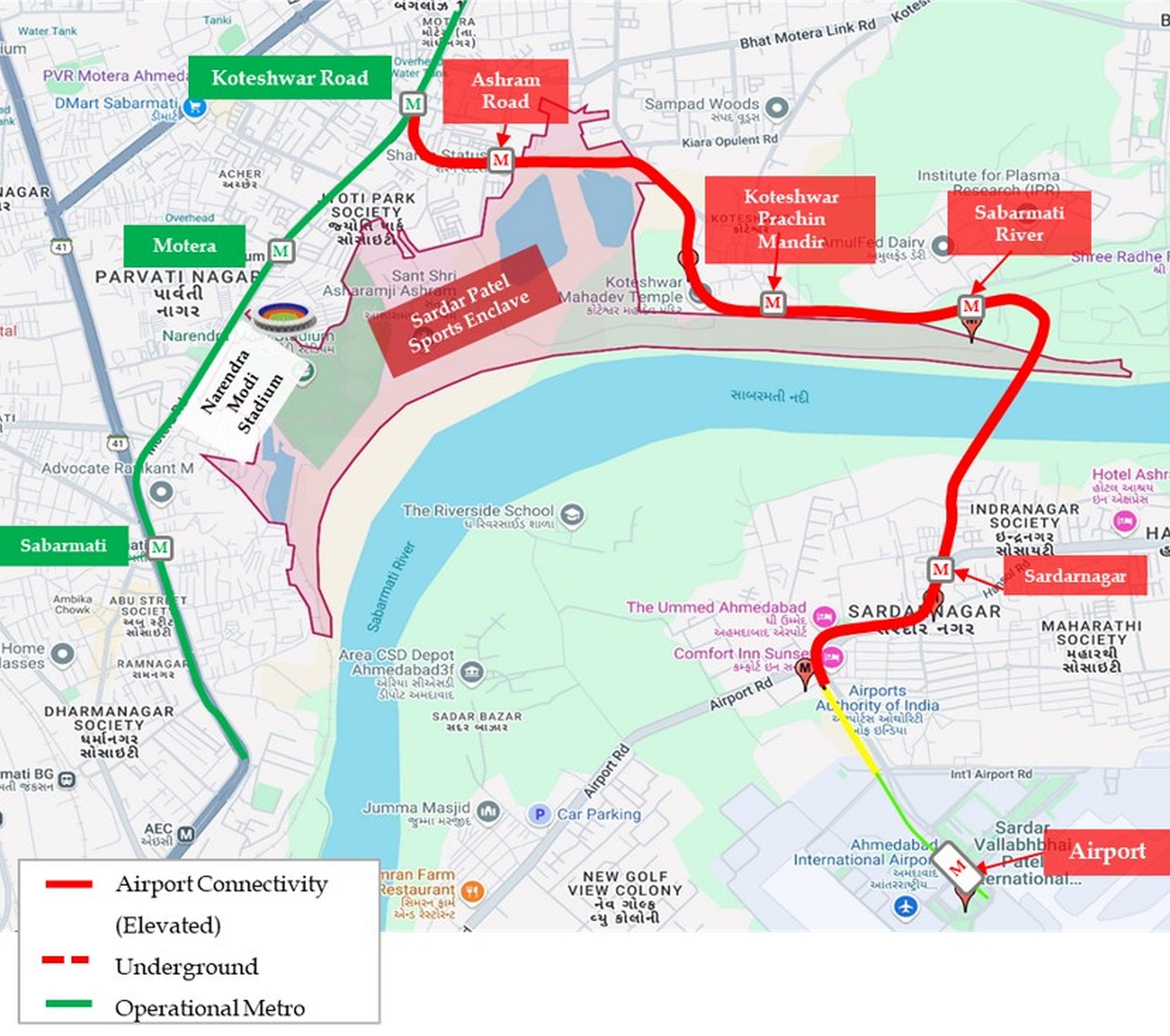
The Union Cabinet chaired by the Prime Minister Shri Narendra Modi has approved Phase 2(A) of Ahmedabad Metro Rail Project with corridor for a length of 6.032 Km with 05 stations (04 Elevated and 01 underground). On operationalisation of Phase 2(A), Ahmedabad-Gandhinagar will have 77.63 Km of active Metro Rail Network. The names of stations in the Phase 2(A) Corridor are- Ashram Road, Koteshwar Prachin Mandir, Sabarmati River, Sardar Nagar and Airport.

The total completion cost including IDC (Interest during Construction) for the project will be Rs.2,169.04 crore.

Benefits and Bolstering Growth:

The Phase 2(A) of Ahmedabad Metro Rail Project represents a significant advancement in the city’s infrastructure development. Phase 2(A) acts as a major expansion of the Metro Rail Network in the city.

Enhanced Connectivity:

Phase 2(A) of the Ahmedabad Metro Project envisages the development of approximately 6.032 km of new metro corridor, aimed at substantially enhancing public transportation by providing seamless connectivity to the airport and linking key residential and commercial areas that presently lack efficient transit access.

This phase aims to seamlessly integrate key zones, including residential & Commercial hubs with existing Ahmedabad-Gandhinagar corridor. Further, likelihood of sports facilities also being developed in the vicinity for the World Police Games 2029 and Commonwealth Games 2030.

By bridging these vital areas with the metro network, Phase 2(A) will not only enhance connectivity but also stimulate economic activity, tourism, and ease urban mobility for both residents and visitors.

Reduction in Traffic Congestion: Metro Rail as an efficient alternate road transport and with Phase 2(A) as an extension of the Metro Rail network to the Airport, will be particularly impactful inside Ahmedabad. Reduction in road traffic can lead to smoother movement of vehicles, reduction in travel time, increasing overall road safety etc.

Environmental Benefits: With the addition of Phase 2(A) of Ahmedabad Metro Rail Project and increase in overall Metro Rail Network in Ahmedabad & Gandhinagar cities, can significantly reduce carbon emissions compared to traditional fossil fuel-based transport.

Economic Growth: Reduced travel times and improved access to different parts of the city such as Airport, Railway Stations and Bus Depots can enhance productivity by allowing individuals to reach their workplaces and destinations more efficiently. Also, the enhanced connectivity can stimulate local businesses, especially in areas near new metro stations which can also attract investment and development in previously less accessible regions.

Social Impact: The expansion of Phase 2(A) Metro Rail network in Ahmedabad will provide more equitable access to public transport, benefiting diverse socio-economic groups and reducing transport disparities which will contribute to a higher quality of life by reducing commute times and improving access to essential services.
The Phase 2(A) of Ahmedabad Metro Rail Project is set to be a transformative development for the city. It promises to deliver enhanced connectivity, reduced traffic congestion, environmental benefits, economic growth, and improved quality of life. By addressing key urban challenges and providing a foundation for future expansion, Phase 2(A) will play a crucial role in shaping the city's development trajectory and sustainability.

The Ahmedabad Metro Phase 2A will generate employment of around 2,000 persons during the peak period of construction activity and 500 persons are likely to work during Operation & Maintenance of the system.

Route Map:
Explore More
প্রধান মন্ত্রীনা শ্রী রাম জন্মভুমি মন্দির দ্বাজরোহন উৎসবতা পীখিবা ৱারোলগী মৈতৈলোন্দা হন্দোকপা

Popular Speeches

প্রধান মন্ত্রীনা শ্রী রাম জন্মভুমি মন্দির দ্বাজরোহন উৎসবতা পীখিবা ৱারোলগী মৈতৈলোন্দা হন্দোকপা
India's Shanti Act

Media Coverage

India's Shanti Act "Very Positive": Global Nuclear Watchdog Chief
NM on the go

Nm on the go

Always be the first to hear from the PM. Get the App Now!
...
Cabinet approves construction of the General Pool Residential Accommodation (GPRA) in Amaravati, Andhra Pradesh
June 10, 2026

The Cabinet Committee on Economic Affairs, chaired by the Prime Minister Shri Narendra Modi, today has approved the construction of the General Pool Residential Accommodation (GPRA) at New Capital City, Amaravati, Andhra Pradesh. This marks the first GPRA project in the capital city of Amaravati, as well as within the State of Andhra Pradesh.

The objective of the proposal is to alleviate the financial burden on Central Government employees by providing adequate residential accommodation, thereby enhancing their morale, promoting integrity, and contributing to their overall well-being. Further, by enabling staff to reside in close proximity to their workplaces, the project will support efficient government functioning and ensure that employees remain readily available to discharge their official duties effectively.

The General Pool Residential Accommodation (GPRA) Campus in the New Capital City of Amaravati, Andhra Pradesh, is planned over an area of 17 acres. The development comprises 11 residential towers with a total of 1,504 dwelling units, ranging from Type II to Type VI, including refuge areas. The project provides basement parking facilities accommodating 1,972 Equivalent Car Spaces (ECS). The total built-up area of the project is 31.30 lakh sqft. (2,90,762 sqm), including a basement area of 9.10 lakh sqft. (84,394 sqm).

Across the globe, there is a growing emphasis on adopting environmentally friendly and sustainable construction practices. In line with this objective, the proposed General Pool Residential Accommodation (GPRA) Campus in the New Capital City of Amaravati, Andhra Pradesh, envisages that all buildings will be planned and designed in strict compliance with the best green building standards prevailing in India, with a strong focus on minimizing environmental impact through sustainable site planning, enhanced energy efficiency, water conservation, usage of locally available materials, and improved occupant health and comfort.

The campus will be designed, constructed, and registered to achieve a minimum GRIHA 4-Star Rating, in compliance with the latest provisions of the Energy Conservation and Sustainable Building Code (ECSBC) 2024 and requirements of Eco-Niwas Samhita (ENS) 2024.

The General Pool Residential Accommodation (GPRA) Campus in the New Capital City of Amaravati, Andhra Pradesh, will be equipped with essential civic and community amenities, including a bank and ATM, post office, crèche, community hall with dining facilities, food court, shopping complex, service centre, and guest house. The campus will incorporate a barrier-free built environment to ensure accessibility and convenience for Divyangjan (Persons with Disabilities), in compliance with applicable accessibility standards.

The project is expected to generate significant direct and indirect employment opportunities for skilled, semi-skilled, and unskilled workers. It is estimated to create approximately 7.00 lakh man-days of employment per annum during the construction phase, followed by the sustained generation of around 50,000 man-days of employment per annum during the operational phase.

PROJECT COST & FUNDING

The estimated cost of the project is ₹1,234.91 crores, which will be funded by the Government of India through budgetary support under the Head of Account: 4216 – Capital Outlay on Housing (Residential Buildings) – Voted.

PRE-PROJECT ACTIVITIES

The project will be executed by the Ministry of Housing & Urban Affairs through the Central Public Works Department (CPWD). Pre-bid activities have already commenced, and the preparation of tender documents is presently in progress.

PROPOSED GENERAL POOL RESIDENTIAL ACCOMMODATION (GPRA)CAMPUS AT NEW CAPITAL CITY, AMARAVATI, ANDHRA PRADESH