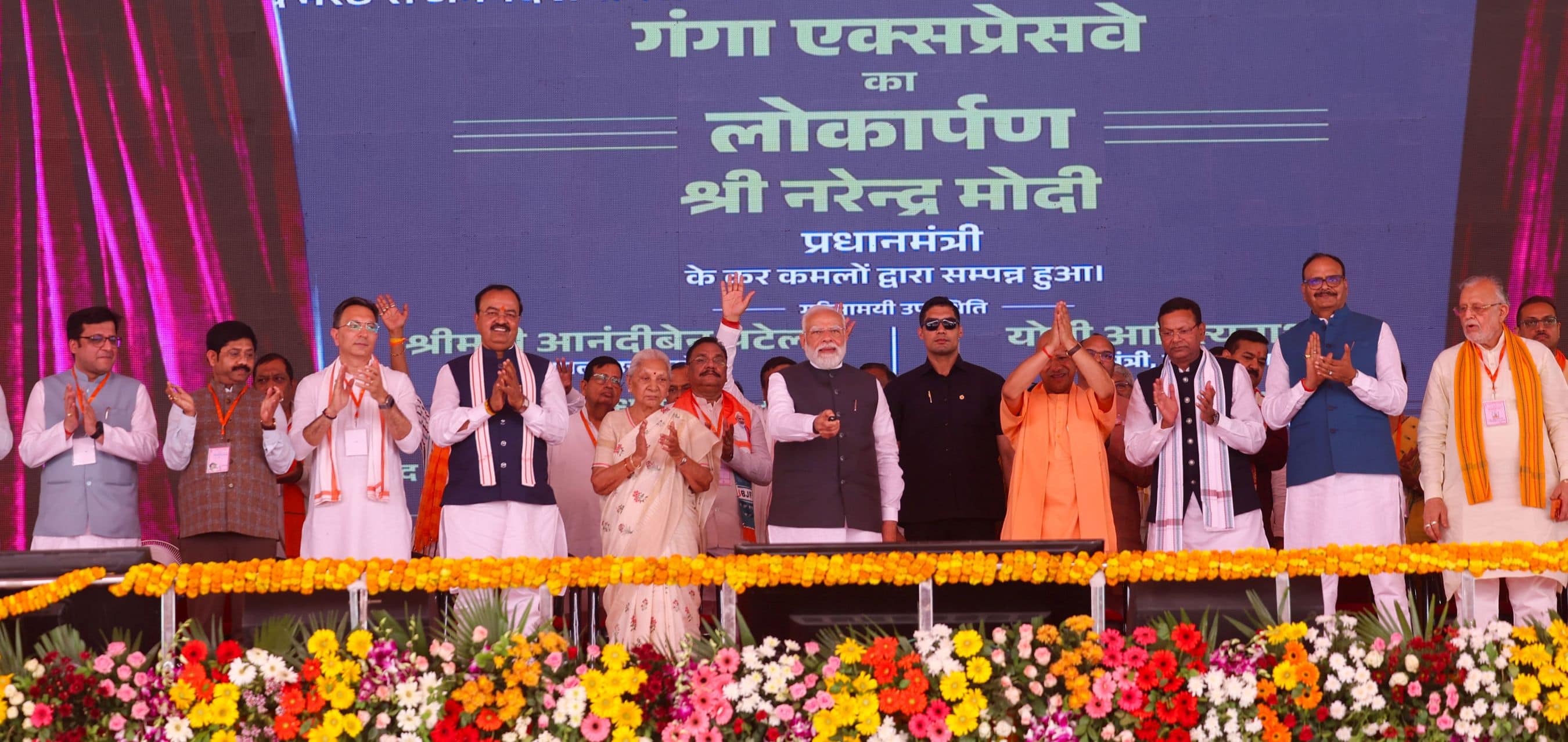


Prime Minister Shri Narendra Modi today inaugurated 594-km long Access-Controlled Greenfield Ganga Expressway in Hardoi, Uttar Pradesh. Commencing his address by reverencing the sacred land of Lord Narasimha and the divine presence of Maa Ganga flowing just kilometers away, the Prime Minister stressed that the entire region stands as a pilgrimage site blessed by the river's spiritual and nurturing grace. "The boon of expressways to Uttar Pradesh is also a blessing from Maa Ganga herself," Shri Modi asserted, highlighting how the expressway will transform travel to sacred destinations within hours.

Drawing a parallel between the timeless significance of Maa Ganga and modern infrastructure, the Prime Minister emphasized the expressway's transformative role in the state's development journey. Noting that these newly constructed highways represent the lifelines of a developing India, Shri Modi remarked, "These modern lifelines are today proclaiming the bright future of India."
Reflecting on his recent spiritual engagements, the Prime Minister observed that his presence near Maa Ganga over the preceding days, from Bengal on April 24 to Kashi yesterday and again this morning, constituted a remarkable convergence of faith and infrastructure development. Expressing his delight at the state government's decision to name the expressway after Maa Ganga, Shri Modi noted, "This reflects our vision of development and offers glimpses of our heritage."
Emphasizing the government's accelerated pace of infrastructure construction, the Prime Minister noted the completion of the Ganga Expressway, the country's longest green corridor expressway, in less than five years. Asserting his vision for rapid modernization, he remarked, "This is the speed of the current government's work! This is the way the current government works!"

Elaborating on the expressway's strategic significance, the Prime Minister outlined its 600-kilometer span connecting western UP's commercial centers through central UP's agricultural heartland to eastern UP's cultural sites, directly impacting crores of citizens across twelve districts. "The Ganga Expressway is not merely a high-speed road. It is a gateway to new possibilities, new dreams, and new opportunities," asserted Shri Modi.
Addressing the chronic challenges faced by agricultural communities, the Prime Minister observed that farmers in these fertile regions historically struggled to access major markets due to inadequate logistics infrastructure and cold storage facilities. Affirming the transformative potential of improved connectivity, he asserted, "This will increase our farmers' income."
Highlighting the expressway's connectivity benefits, the Prime Minister noted, “while it connects one end of UP to the other, it will also bring closer the immense possibilities of the National Capital Region, with new industrial opportunities developing along its sides as vehicles run on it.”

Highlighting the emergence of industrial opportunities alongside the expressway, the Prime Minister noted that industrial corridors are being strategically developed in districts like Hardoi to attract manufacturing clusters across pharmaceuticals, textiles, handlooms, leather goods, and handicrafts, and create new employment opportunities for youth. Praising the entrepreneurial spirit of the state's youth empowered by schemes like Mudra Yojana and ODOP (One District One Product), the Prime Minister noted that small industries and MSMEs are getting a boost, and better connectivity will open new paths for them. "All these will reach domestic and international markets on a large scale. This will increase the income of millions of families," observed Shri Modi.
Highlighting the remarkable transformation of Uttar Pradesh, the Prime Minister recalled that the state once labeled backward and BIMARU is today moving forward to become a 1 trillion dollar economy, a very big goal backed by equally big preparation owing to the state's immense capacity and the potential of the country's large young population. Outlining the strategy to harness this demographic dividend, PM Modi explained that this strength is being used to make UP a manufacturing hub, where new industries and factories will be established, large-scale investment will arrive, economic progress will accelerate, and employment opportunities will be created for youth. Highlighting India's achievement as the world's second-largest mobile manufacturer with half of production occurring in UP, Shri Modi remarked, "UP has made a significant contribution to this."
Underscoring the state's emerging role in cutting-edge technology sectors, the Prime Minister observed UP's advancement in semiconductor manufacturing following the recent groundbreaking in Noida. "Vast areas full of unlimited opportunities are opening for UP's people in the future," Shri Modi noted, positioning the state as a leader in the AI-driven economy.

Positioning UP's industrial development as a strategic asset for national security, the Prime Minister observed that one of India's two defense corridors operates within the state, with major defense manufacturers establishing operations there. Noting the manufacture of globally-respected systems like BrahMos missiles in UP, Shri Modi remarked, "UP's industrial development is today becoming a strategic strength for India."
Emphasizing the comprehensive modernization of UP's connectivity infrastructure, the Prime Minister noted the expansion of the airport network from minimal presence to 21 operational airports, including 5 international facilities, with the newly inaugurated Noida International Airport positioned just hours from the Ganga Expressway corridor.
Juxtaposing UP's current trajectory with its troubled past, the Prime Minister observed the stark contrast between an earlier era when the state was associated with crime and lawlessness, and today's reality where law and order have become exemplary. "Now, UP's law and order is cited as an example throughout the country," remarked Shri Modi.
Positioning UP's development within India's broader civilizational and economic ambitions, the Prime Minister asserted that the state's transformation embodies the nation's core resolve. "Today, the entire country is moving forward with one resolve,the resolve for a Viksit Bharat! UP has a major role to play in fulfilling this resolve," stated Shri Modi.
Acknowledging global instability and external opposition to India's ascendancy, the Prime Minister affirmed the nation's unwavering commitment to development despite external threats. " We are not only secure but are also creating new milestones of development. We are advancing the Atmanirbhar Bharat campaign. We are constructing the most modern infrastructure," asserted Shri Modi.

Concluding his remarks by positioning the Ganga Expressway as emblematic of this broader development paradigm, the Prime Minister affirmed his confidence in the people of UP to transform emerging opportunities into tangible prosperity. "I am confident that the possibilities the Ganga Expressway will bring to our doorstep, the people of UP will realize through their hard work and talent," remarked Shri Modi.
Click here to read full text speech
जैसे मां गंगा हजारों वर्षों से यूपी की और इस देश की जीवनरेखा रहीं हैं... वैसे ही, आधुनिक प्रगति के इस दौर में उनके समीप से गुजरता ये एक्स्प्रेसवे... ये यूपी के विकास की नई lifeline बनेगा: PM @narendramodi during inauguration of the Ganga Expressway in Hardoi
— PMO India (@PMOIndia) April 29, 2026
कुछ ही दिन पहले मुझे दिल्ली-देहरादून एक्सप्रेसवे के लोकार्पण का अवसर मिला था।
— PMO India (@PMOIndia) April 29, 2026
तब मैंने कहा था कि ये नए बनते एक्सप्रेसवे... विकसित होते भारत की हस्तरेखाएं हैं... और ये आधुनिक हस्तरेखाएं... आज भारत के उज्ज्वल भविष्य का जयघोष कर रही हैं: PM @narendramodi
गंगा एक्सप्रेसवे यूपी के एक छोर को दूसरे छोर से तो जोड़ता ही है।
— PMO India (@PMOIndia) April 29, 2026
ये NCR की असीम संभावनाओं को भी करीब लाएगा: PM @narendramodi