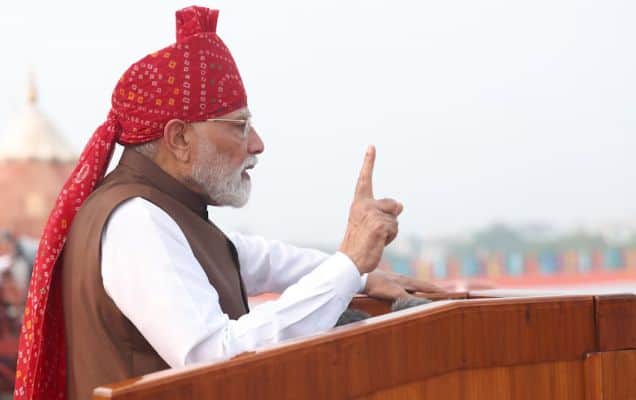
The Prime Minister, Shri. Narendra Modi, today, inaugurated the Global Mobility Summit in New Delhi.
Addressing the summit, Prime Minister said that India is on the move, in terms of its economy, infrastructure, youth and many other areas. He said that mobility is a key driver of the economy; it can boost economic growth and create employment opportunities.
Prime Minister also outlined the vision for the future of mobility in India based on 7 C’s. The 7 C’s are Common, Connected, Convenient, Congestion-free, Charged, Clean and Cutting-edge.

Following is the full text of PM’s address:
“Excellencies,
Distinguished Delegates from across the World,
Ladies and Gentlemen.
I welcome you all to the Global Mobility Summit.
Move - The name of this Summit captures the spirit of India today. Indeed, India is on the Move:
Our economy is on the Move. We are the world’s fastest growing major economy.
Our cities and towns are on the Move. We are building one hundred smart cities.
Our infrastructure is on the Move. We are building roads, airports, rail lines and ports at a quick pace.
Our goods are on the Move. The Goods and Services Tax has helped us rationalize supply chains and warehouse networks.
Our reforms are on the Move. We have made India an easier place to do business.
Our lives are on the Move. Families are getting homes, toilets, smoke-free LPG cylinders, bank accounts and loans.
Our youth are on the Move. We are fast emerging as the start-up hub of the world. India is moving ahead with new energy, urgency and purpose

Friends,
We all know that, mobility has been key to the progress of humanity.
The world is now in the middle of a new mobility revolution. It is, therefore, important to understand mobility as a wider construct.
Mobility is a key driver of the economy. Better mobility reduces the burden of travel and transportation and can boost economic growth. It is already a major employer and can create the next generation of jobs.
Mobility is central to urbanization. Motorized personal vehicles require ever-growing road, parking, and traffic infrastructure.
Mobility is a key element of ‘ease of living’. It occupies the minds of virtually every person: in time spent to get to school and work, in frustration with traffic, in the cost of visiting family or moving goods, in access to public transport, in the quality of air our children breathe in concerns around the safety of travel.
Mobility is critical to preserving our planet. Road transport accounts for one fifth of global Carbon dioxide emissions. This threatens to choke cities and raise global temperatures.
Creating a mobility eco-system that is in sync with nature is the need of the hour.
Mobility is the next frontier in our fight against Climate Change. Better mobility can provide for better jobs, smarter infrastructure, and improve the quality of life. It can also reduce costs, expand economic activity and protect the planet. Thus, the mobility sector impacts larger public outcomes.
Mobility, especially the digitization of mobility, is disruptive. It has big potential for innovation and it has been setting a searing pace!
Already, people are calling taxis on their phones, sharing bicycles in cities; buses are running on clean energy, cars are going electric.
In India, we have been laying emphasis on mobility. We have doubled our pace of construction of highways.
We have re-energized our rural road-building programme. We are promoting fuel efficient and cleaner fuel vehicles. We have developed low-cost air connectivity in under-served regions. We are also starting operations on hundreds of new air routes.
We are pushing waterways in addition to traditional modes like rail and road.
We are reducing travel distances in our cities by efficient location of homes, schools and offices.
We have also started data-driven interventions such as intelligent traffic management systems.
However, we also need to encourage pedestrians and cycling by taking steps ensure their safety and priority.

Friends,
In a rapidly transforming mobility paradigm, India has some inherent strengths and comparative advantages. Our starting point is fresh. We have little of the legacy of resource-blind mobility.
We have fewer vehicles per capita than other major economies. Thus, we do not carry much of the baggage of other economies that were built on the back of private car ownership! This gives us the window of opportunity to create an all-new, seamless mobility eco-system.
On the technology front, our strengths lie in information technology, big data, digital payments, and the internet-enabled shared economy. These elements are increasingly becoming the drivers of the global future of mobility.
Our unique identity program, Aadhaar, and its India-stack eco-system, has laid down a comprehensive public digital infrastructure. It has digitally empowered 850 million of our citizens. India can demonstrate how such digital infrastructure can be combined with new mobility business models.
Our renewable energy push will ensure that the environmental benefits of electric mobility can be fully realized. We plan to draw 175 GigaWatts of energy from renewables by 2022. We are already the fifth largest producer of solar energy in the world. We are also the sixth largest producer of renewable energy. We have also championed the cause of solar energy globally through the International Solar Alliance.
We have a fast growing manufacturing base, especially in the automotive sector.
We also have a large, digitally literate, young population. This provides millions of educated minds, skilled hands and aspirational dreams for powering the future.

Therefore, I am convinced that India is best placed globally, to be an early mover in the ‘Mobility Economy’.
My vision for the future of mobility in India is based on 7 C’s – Common, Connected, Convenient, Congestion-free, Charged, Clean and Cutting-edge.
1. Common: Public Transport must be the cornerstone of our mobility initiatives. New business models driven by digitization, are re-inventing the current paradigm. Big Data is enabling smarter decision-making by better understanding our patterns and needs.
Our focus must also go beyond cars, to other vehicles such as scooters and rickshaws. Large segments of the developing world depend on these vehicles for mobility.
2. Connected mobility implies integration of geographies as well as modes of transport. The internet-enabled Connected Sharing Economy is emerging as the fulcrum of mobility.
We must leverage the full potential for vehicle pooling and other innovative technical solutions to improve private vehicle utilization. People from villages should be able to bring their produce to the cities with ease and efficiency.
3. Convenient mobility means safe, affordable and accessible for all sections of the society. This includes the elderly, the women and the specially abled. We need to ensure that public transport is preferred to private modes of travel.
4. Congestion free mobility is critical to check the economic and environment costs of congestion. Hence, there should be emphasis on ending bottlenecks of networks. This would result in fewer traffic jams and lower levels of stress for people travelling. It would also lead to greater efficiency in logistics and freight.
5. Charged mobility is the way forward. We want to drive investments across the value chain from batteries to smart charging to Electric Vehicle manufacturing. India’s business leaders and manufacturers are now poised to develop and deploy break-through battery technology.
The India Space Research Organization uses one of the best battery systems to run satellites in space. Other institutions can partner with ISRO to develop cost effective and efficient battery systems for electric cars. We want to build India as a driver in Electric Vehicles.
We will soon put in place a stable policy-regime around electric and other alternative fuel vehicles. Policies will be designed as a win-win for all, and enable huge opportunities in the automotive sector.
6. Clean Mobility powered by Clean Energy is our most powerful weapon in our fight against Climate Change! This means a pollution-free clean drive, leading to clean air and better living standards for our people.
We should champion the idea of ‘clean kilometres’. This could be achieved through bio-fuels electric or solar charging. Electric Vehicles in particular can complement our investments in renewable energy.
We will do whatever it takes, because this is our commitment to our heritage, and our promise to future generations.
7. Cutting-edge: Mobility is like the Internet in its early days. It is Cutting-edge. It is the next big innovation sector. The ‘Move Hack’ and ‘Pitch to Move’ events organized over the past week show how young minds are coming up with creative solutions.
Entrepreneurs should see mobility as a sector with immense opportunity for innovation and growth. It is a sector where innovation can help solve problems for public good.

Friends,
I am convinced that the ‘Mobility Revolution’ is an enabler of our growth and development. When India transforms mobility, it benefits one fifth of mankind. It also becomes a scaled success story, for others to replicate.
Let us build a template, for the world to adopt.
In conclusion, let me particularly appeal to the youth of India.

My young, dynamic friends, this is your opportunity to lead a new era of innovation. This is the future. This is the sector that will absorb everything from those with doctors to engineers to drivers to mechanics. We should embrace this revolution early, and leverage our strengths to lead the mobility innovation ecosystem both for ourselves and for others.
The Talent and Technology assembled here today, has the capability of making a transformative mobility shift for India and the World.

This shift will be based on ‘Caring for our World’, and ‘Sharing with Others’.
To quote from our ancient scriptures:
ॐ सह नाववतु
सह नौ भुनक्तु
सह वीर्यं करवावहै
तेजस्वि ना वधीतमस्तु मा विद्विषावहै
Which means:
May we all be Protected.
May we all be Nourished
May we work together with great energy
May our intellect be Sharpened
Friends!
I look forward to see what we can do together.
This summit is just the beginning. Let us Move ahead.
Thank you.
Thank You Very Much!
Indeed, India is on the MOVE:
— PMO India (@PMOIndia) September 7, 2018
Our economy is on the MOVE. We are the world’s fastest growing major economy
Our cities and towns are on the MOVE. We are building 100 smart cities
Our infrastructure is on the MOVE. We are speedily building roads, airports, rail lines & ports: PM
Our goods are on the MOVE. GST has helped us rationalize supply chains & warehouse networks.
— PMO India (@PMOIndia) September 7, 2018
Our reforms are on the MOVE. We have made India an easier place to do business.
Our lives are on the MOVE. Families are getting homes, toilets, LPG cylinders, bank accounts & loans: PM
Our youth are on the MOVE. We are fast emerging as the start-up hub of the world.
— PMO India (@PMOIndia) September 7, 2018
India is MOVING ahead with new energy, urgency and purpose: PM
Mobility is a key driver of the economy.
— PMO India (@PMOIndia) September 7, 2018
Better mobility reduces the burden of travel and transportation, and can boost economic growth.
It is already a major employer and can create the next generation of jobs: PM
We have doubled our pace of construction of highways.
— PMO India (@PMOIndia) September 7, 2018
We have re-energized our rural road building programme.
We are promoting fuel efficient and cleaner fuel vehicles.
We have developed low-cost air connectivity in under-served regions: PM
My vision for the future of mobility in India is based on 7 C’s:
— PMO India (@PMOIndia) September 7, 2018
Common,
Connected,
Convenient,
Congestion-free,
Charged,
Clean,
Cutting-edge: PM
Common Public Transport must be the cornerstone of our mobility initiatives.
— PMO India (@PMOIndia) September 7, 2018
New business models driven by digitization, are reinventing the existing paradigm.
Our focus must also go beyond cars, to other vehicles such as scooters and rickshaws: PM
Connected mobility implies integration of geographies as well as modes of transport.
— PMO India (@PMOIndia) September 7, 2018
The Internet-enabled Connected Sharing Economy is emerging as the fulcrum of mobility.
We must leverage the full potential for vehicle pooling to improve private vehicle utilization: PM
Convenient mobility means safe, affordable and accessible for all sections of the society.
— PMO India (@PMOIndia) September 7, 2018
This includes the elderly, the women and the specially abled.
We need to ensure that public transport is preferred to private modes of travel: PM
Congestion free mobility is critical to check the economic and environmental costs of congestion.
— PMO India (@PMOIndia) September 7, 2018
Hence, there should be emphasis on de-bottlenecking of networks.
This would result in fewer traffic jams and lower levels of stress for commuters: PM
Charged mobility is the way forward.
— PMO India (@PMOIndia) September 7, 2018
We want to drive investments across the value chain from batteries to smart charging to Electric Vehicle manufacturing.
India’s entrepreneurs & manufacturers are now poised to develop and deploy break-through battery technology: PM
Clean Mobility powered by Clean Energy is our most powerful weapon in our fight against Climate Change.
— PMO India (@PMOIndia) September 7, 2018
This means a pollution-free clean drive, leading to clean air and better living standards for our people.
We should champion the idea of ‘clean kilometres’: PM