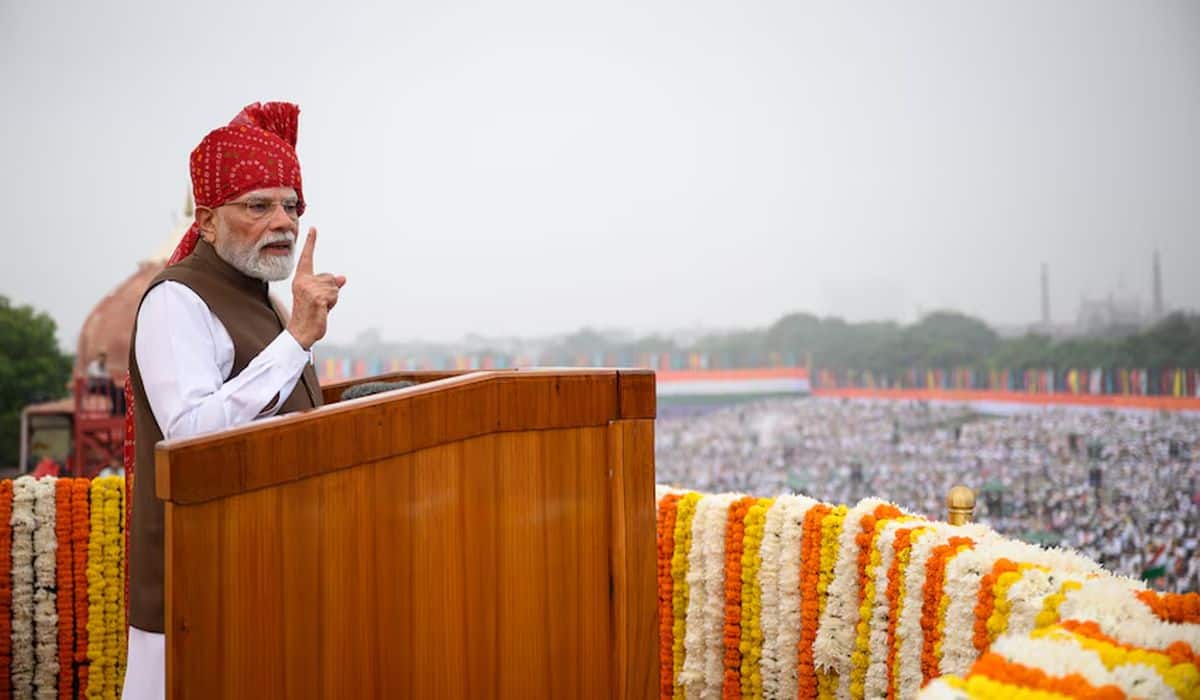
भारत में हमारे पास एक मजबूत और सक्षम वैज्ञानिक समुदाय है। हमारे पास अच्छे वैज्ञानिक संस्थान भी हैं। कोविड-19 से लड़ते हुए वे विशेष रूप से पिछले कुछ महीनों के दौरान देश की बड़ी संपत्ति रहे हैं: पीएम
देश में कोरोना संक्रमण के मामले प्रति दिन घट रहे हैं और इसकी वृद्धि की दर में भी कमी आई है। भारत में आज ठीक होने की दर भी 88 प्रतिशत हो गई है: पीएम मोदी
"भविष्य को उन समाजों द्वारा आकार दिया जाएगा, जो विज्ञान तथा नवाचार में निवेश करते हैं" : प्रधानमंत्री मोदी

Namaste!

Melinda and Bill Gates, Union Minister in my Cabinet, Dr Harsh Vardhan, Delegates from across the world, Scientists, Innovators, Researchers, Students, Friends, I am happy to be with all of you, for this sixteenth Grand Challenges Annual Meeting.

This meeting was to be held physically in India. But, in changed circumstances it is being held virtually. Such is the power of technology that a global pandemic did not keep us apart. This programme has continued as per schedule. This shows the commitment of the grand challenges community. It shows a commitment to adapt and innovate.

Friends,

The future will be shaped by societies that invest in science and innovation. But, this cannot be done in a short-sighted manner. One has to invest in science and innovation well in advance. That is when we can reap benefits at the right time. Similarly, the journey to these innovations must be shaped by collaboration and public participation. Science will never prosper in silos. The Grand Challenges Programme has understood this ethos well. The scale of this programme is commendable .

In 15 years, you have engaged with several nations globally. The nature of issues addressed is diverse. You have combined bright global talent to address problems such as: Antimicrobial Resistance, Maternal and Child Health, Agriculture, Nutrition, WaSH - water, sanitation and hygiene. And many others are welcome initiatives.

Friends,

It has taken a global pandemic to make us realise yet again the importance of teamwork. Afterall, diseases do not have geographic boundaries. Diseases do not discriminate on the grounds of faith, race, gender or colour. And, by diseases I am not only talking about the current pandemic situation. There are several communicable and non-communicable diseases that are impacting people, specially, bright youngsters.

Friends,

In India, we have a strong and vibrant scientific community. We also have very good scientific institutions. They have been India’s greatest assets, specially during the last several months, while fighting COVID-19. From containment to capacity building, they have achieved wonders.

Friends,

India’s size, scale and diversity has always made the global community curious. Our nation is almost four times the size of the USA's population. Many of our states are as populated as European nations. Yet, thanks to a people powered and people driven approach, India kept its COVID-19 death rate very low. Today, we are seeing a decline in the number of cases per day and the growth rate of cases. India has one of the highest recovery rates of 88 percent. This happened because: India was one of the first countries to adopt a flexible lockdown when the total cases were just a few hundred. India was one of the first to encourage the usage of masks. India actively began to work on effective contact-tracing. India was one of the earliest to deploy the rapid antigen tests. India has also innovated CRISPR gene editing technology.

Friends,

India is now at the forefront of vaccine development for COVID. More than 30 indigenous vaccines are being developed in our country, Three of them are in an advanced stage. We are not stopping here. India is already working on putting a well-established Vaccine delivery system in place. This digitised network along with digital health ID will be used to ensure immunisation of our citizens.

Friends,

Beyond Covid too, India is known for its proven capacity to produce quality medicines and vaccines at low cost. More than 60 percent of the Vaccines for Global Immunisation are being manufactured in India. We included Indigenous Rotavirus Vaccine in our Indradhanush Immunisation programme. This is a successful example of a strong partnership/ for long lasting results. The Gates Foundation has also been a part of this particular effort. With India’s experience and research talent, we will be at the centre of global healthcare efforts. We want to help other nations enhance their capacities in these sectors.

Friends,

In the last 6 years we have made many interventions which are contributing to a better healthcare system. Take a subject such as sanitation. Improved cleanliness. More toilet coverage. Who does this help the most? It helps the poor and under-privileged. It leads to a reduction in diseases. It also helps women the most.

Friends,

Now, we are ensuring that each household gets piped drinking water. This will further ensure disease reduction. We are setting up more medical colleges, especially in rural areas. This ensures more opportunities for the youth. It brings better healthcare to our villages. We are running the world’s largest health insurance scheme and ensuring access to everyone.

Friends,

May we keep using our collaborative spirit for individual empowerment and collective well-being. The Gates Foundation, and several other organisations are doing wonderful work. I wish you all fruitful and productive deliberations over the next 3 days. I hope to see many exciting and encouraging new solutions coming out from this Grand Challenges platform. May these efforts further a human centric approach to development. May they also give our youth the opportunities to be thought leaders for a brighter future. Once again, I thank the organisers for inviting me.

Thank you.

Thank you very much.

Explore More
आज सम्पूर्ण भारत, सम्पूर्ण विश्व राममय है: अयोध्या में ध्वजारोहण उत्सव में पीएम मोदी

लोकप्रिय भाषण

आज सम्पूर्ण भारत, सम्पूर्ण विश्व राममय है: अयोध्या में ध्वजारोहण उत्सव में पीएम मोदी
‘Have to isolate dimaagi Naxals’: PM Modi in Independence Day speech from Red Fort

Media Coverage

‘Have to isolate dimaagi Naxals’: PM Modi in Independence Day speech from Red Fort
NM on the go

Nm on the go

Always be the first to hear from the PM. Get the App Now!
...
12 Years of Transformation: PM Modi Highlights India’s Progress in Independence Day Address
August 15, 2026

In his Independence Day address, Prime Minister Shri Narendra Modi highlighted India’s transformation over the last 12 years, outlining the progress made across manufacturing, digital infrastructure, basic amenities, energy security, youth empowerment, innovation, social security and other key sectors.

Key highlights from the Prime Minister’s address include:

1. Manufacturing: Scale and Self-Reliance

Over the last 12 years:

  • Defence production has increased nearly 4 times.
  • Khadi and Village Industries production has increased nearly 5 times.
  • Electronics manufacturing has increased nearly 7 times.
  • Modern railway coach production has increased 21 times.
  • Mobile phone production has increased 35 times.

2. Digital India and Innovation

The Prime Minister highlighted the rapid expansion of India’s digital and innovation ecosystem:

  • Internet consumers have increased nearly 4 times.
  • Patent grants have increased 4 times.
  • Digital transactions have increased around 100 times.
  • India has built a significantly larger digital and innovation ecosystem.

3. Faster Delivery of Basic Amenities

The Prime Minister highlighted the faster pace at which basic facilities are reaching ordinary citizens:

  • Tap-water connections have been provided at an average annual pace nearly 15 times faster.
  • LPG connections have been provided at an annual pace nearly 6 times faster.
  • Toilets for the poor have been constructed at an annual pace nearly 4 times faster.
  • Pucca houses for the poor have been provided at an annual pace nearly 3 times faster.
  • Hundreds of obsolete laws have been abolished.
  • Modern public transport, including metro systems, has reached several more cities.

4. Building the Semiconductor Ecosystem

The Prime Minister highlighted India’s progress in building domestic semiconductor capabilities:

  • India earlier had no major semiconductor manufacturing plant.
  • A complete semiconductor ecosystem is now being built in India.
  • Three semiconductor plants have been initiated.
  • India has also started exporting chips.

5. Securing Critical Minerals

Highlighting the importance of critical minerals for emerging technologies, the Prime Minister referred to the steps being taken to strengthen India’s capabilities in this sector:

  • National Critical Mineral Mission has been launched.
  • Critical Mineral Corridor has been announced in the Budget.
  • Agreements have been signed with several countries for critical mineral supplies.

6. Strengthening Energy Security

The Prime Minister underlined that energy security is an essential condition for building a developed India, particularly as technologies such as chips, AI and data centres require huge quantities of electricity.

Underlining the role of nuclear energy, the Prime Minister highlighted:

  • The SHANTI Act as a major reform in the nuclear energy sector.
  • India crossing an important milestone in Fast Breeder Nuclear Technology.
  • The potential of the technology to play a major role in making India self-reliant in nuclear fuel.

7. Expanding Oil and Gas Exploration

The Prime Minister highlighted the change in India’s approach towards offshore exploration:

  • Nearly 99% of India’s offshore area was earlier classified as a No-Go Area.
  • The approach has now changed from No-Go Area to Go Ahead Area.
  • Previously restricted areas have been opened for exploration.
  • This has created possibilities for discovering new oil and gas reserves.

8. Energy Diversification

The Prime Minister highlighted the rapid expansion in different sources of energy.

City Gas Distribution

  • 2014: Available in fewer than 70 cities.
  • Today: Available in around 700 cities.

Piped Cooking Gas


  • 2014: Around 20–22 lakh households.
  • Today: Nearly 1.75 crore households.

Solar Energy


  • 2014: Around 2 GW.
  • Today: Around 160 GW.

PM Surya Ghar Muft Bijli Yojana


  • The scheme has crossed 50 lakh households.
  • Lakhs of families are benefiting through lower or zero electricity bills.
  • Families can also sell surplus electricity and earn.
  • Assistance of up to around ₹80,000 per household is available.

9. Railways: Electrification and Future Fuels

The Prime Minister highlighted the transformation of Indian Railways:

  • In 2014, after nearly 90 years, only around 30% of the railway network had been electrified.
  • Today, Indian Railways has moved towards near-complete electrification.
  • India has started work on its first Made-in-India hydrogen train.
  • It is being developed as the world’s longest and most powerful hydrogen train.

10. India’s Resilience During Global Crises

The Prime Minister said that the capabilities built over the last 10–12 years were tested during:

  • COVID-19 pandemic.
  • Russia-Ukraine war.
  • Conflicts in West Asia.

11. Affordable Fertiliser for Farmers

Highlighting the Government’s efforts to protect farmers from high global fertiliser prices, the Prime Minister stated:

  • Urea: Around ₹3,000 per bag internationally; Indian farmers get it for less than ₹300.
  • DAP: More than ₹5,000 internationally; Indian farmers get it for ₹1,350.

12. Trade and Export Opportunities

The Prime Minister highlighted the new opportunities being created for Indian producers and exporters:

  • Since 2014, India has entered into FTAs with around 40 countries.
  • New opportunities have opened for agriculture, fisheries, MSMEs, textiles and other export sectors.

13. Youth at the Centre of Viksit Bharat

The Prime Minister said that India’s youth have a major role in building Viksit Bharat and highlighted the new pathways opened up for them:

  • Startup India: New avenues for innovation and entrepreneurship.
  • ₹1 lakh crore Research Fund: New opportunities for young researchers.
  • Digital India: Empowerment through affordable data.
  • Skill India: National skills ecosystem.
  • Space Sector: Opened for private participation.
  • National Drone Policy: New opportunities for young entrepreneurs and innovators.
  • Khelo India: Strengthened sports ecosystem.

14. Education and Innovation

The Prime Minister highlighted the expansion of educational and innovation opportunities:

  • National Education Policy 2020: Introduced after a gap of 35 years.
  • Universities: Fewer than 350 during 2004–2014; around 650 new universities added in the following decade.
  • Medical Colleges: Fewer than 400 before 2014; around 850 today.
  • More than 10,000 Atal Tinkering Labs have been established in schools.
  • Focus has been placed on developing a technology and innovation mindset from an early age.

15. Startups, Space and AI

The Prime Minister highlighted India’s growing startup and innovation ecosystem:

  • An Indian space startup has launched a Made-in-India rocket.
  • India now has around 2.5 lakh registered startups.
  • AI is creating new opportunities for young Indians.
  • India hosted the AI Impact Summit this year.

16. New Sectors and New Opportunities

Bioeconomy

  • 2014: Around ₹60,000 crore.
  • Today: Nearly ₹20 lakh crore.
  • The expansion is creating new jobs and entrepreneurial opportunities.

Electric Vehicles


  • Towards the end of the previous decade: Around 1.5 lakh EVs sold annually.
  • Last year: Around 25 lakh EVs sold.

Aviation


  • New airports and routes are creating employment.
  • MRO is opening new opportunities.
  • India is moving towards Made-in-India aircraft manufacturing.
  • The Made-in-India C-295 defence transport aircraft has successfully completed its flight.

17. Rural Empowerment through SVAMITVA

The Prime Minister highlighted the impact of the SVAMITVA initiative:

  • Around 3.25 crore families have received property cards.
  • Around ₹140 lakh crore of economic potential has been unlocked in rural areas.
  • Property records are enabling villagers to access bank loans against their property.
  • New avenues for rural employment, self-employment and entrepreneurship have opened up.

18. Growth in Defence Exports

The Prime Minister highlighted the expansion of India’s defence exports:

  • Defence exports have increased more than 50 times.
  • Indian defence equipment is now exported to around 100 countries.

19. Women-Led Development: Lakhpati Didi

Highlighting the growing role of women in India’s development:

  • The target of 3 crore Lakhpati Didis has been achieved.
  • Women from general, Dalit, backward and tribal families have become Lakhpati Didis.

20. Expanding Social Security

The Prime Minister highlighted the expansion of social security coverage:

  • Before 2014, around 25 crore people were covered by social security.
  • Today, around 100 crore Indians are covered by one or another social security scheme.

21. Ayushman Bharat

The Prime Minister highlighted the financial relief provided to families through Ayushman Bharat:

  • Beneficiary families have avoided an estimated ₹2 lakh crore in medical expenditure.