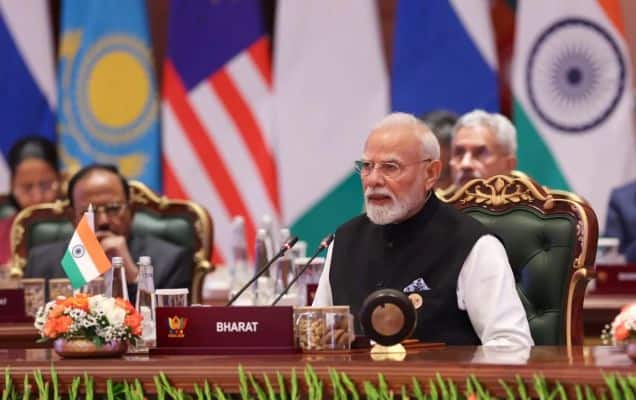
BRICS has developed a robust framework for cooperation and it contributed stability and growth in a world drifting towards uncertainty: PM
India is in a mission mode to eradicate poverty, ensure better healthcare, food security, sanitation, energy and education for all: PM
Affordable, reliable & sustainable access to energy is crucial for development of our nations: PM Modi at BRICS Summit

PM Modi today said that BRICS had developed a robust framework for cooperation and it contributed stability and growth in a world drifting towards uncertainty. He stressed on furthering collaboration in sectors like agriculture, energy, sports, environment, ICT and culture.

PM Modi remarked that India was in a mission mode to eradicate poverty, ensure better healthcare, food security, sanitation, energy and education for all. He added that the women empowerment programmes were productivity multipliers which brought women in the mainstream of nation development.

The Prime Minister urged for an early creation of BRICS rating agency to cater to needs of sovereign and corporate entities of developing countries. “Our Central Banks must further strengthen their capabilities & promote co-operation between the Contingent Reserve Arrangement & the IMF”, he added.

Stressing on vitality of renewable energy, PM Modi said, “Affordable, reliable & sustainable access to energy is crucial for development of our nations.” He urged BRICS nations to work closely on International Solar Alliance.

Speaking about tapping the potential of youth, PM Modi said, “We need to mainstream our youth in our joint initiatives, scale up cooperation in skill development and exchange of best practices.”

Continuing dialogue at 8th BRICS Summit in Goa, PM Modi emphazised need to accelerate track of cooperation in smart cities, urbanization and disaster management.

The PM further said that a strong BRICS partnership on innovation and digital economy could spur growth, promote transparency and support the SDGs. The PM also welcomed cooperation for capacity building between BRICS & African countries in area of skills, health, infrastructure, manufacturing and connectivity. 

Following is the Text of PM's intervention:

Your Excellencies

President Xi Jinping,

President Jacob Zuma,

President Michel Temer,

President Vladimir Putin,

Let me begin by sincerely thanking President Xi again for his warm reception and the excellent organisation of this Summit. Our interaction during the restricted session was constructive. It enriched our mutual understanding and perspectives. After more than a decade of existence, BRICS has developed a robust framework for cooperation. We contribute stability and growth in a world drifting towards uncertainty. While trade and economy have been the foundation of our cooperation, our endeavours today touch diverse areas of technology, tradition, culture, agriculture, environment, energy, sports, and ICT. The New Development Bank has started disbursing loans in pursuit of its mandate to mobilize resources for infrastructure and sustainable development in BRICS countries. At the same time, our Central Banks have taken steps to make the Contingent Reserve Arrangement fully operational. These are milestones of progress we can build upon. Looking ahead, it is important that our people remain at the centre of our journey. I am happy to note that China has taken forward the people-to-people thrust of our exchanges from last year. Such inter-mingling will consolidate our links and deepen our understanding.

Excellencies,

India’s own far-reaching journey of transformation gives pride of place to our people. We are in mission-mode to eradicate poverty; to ensure health, sanitation, skills, food security, gender equality, energy, education and innovation. National programmes of Clean Ganga, Renewable Energy, Digital India, Smart Cities, Housing for All and Skill India are laying the basis for clean, green and inclusive development. They are also tapping the creative energy of our 800 million youth. Our women’s empowerment programmes are productivity multipliers that mainstream women in nation building. We have also stepped up the fight against black money and corruption. Moving forward, using the springboard of our national experiences, BRICS countries can deepen partnership for win-win results. Some thoughts come to mind for upgrading mutual cooperation. First, last year we discussed pooling our efforts to create a BRICS rating agency. An Expert Group has since been studying the viability of such an agency. I would urge that the roadmap for its creation should be finalized at the earliest. Second, our Central Banks must further strengthen their capabilities and promote co-operation between the Contingent Reserve Arrangement and the IMF. Third, affordable, reliable, and sustainable access to energy is crucial for the development of our nations. Climate resilient development calls upon us to utilise all available resource streams. Renewable energy is particularly important on multiple counts. Recognizing this, India, together with France, launched a major international initiative - the International Solar Alliance (ISA) - in November 2015. It will bring together a coalition of 121 countries for mutual gains through enhanced solar energy utilisation. BRICS countries can work closely with ISA to strengthen the solar energy agenda. Our five countries have complementary skills and strengths to promote use of renewable and solar energy. The NDB can also establish an effective link with ISA to support such cooperation. We would wish to see more clean energy funding, particularly in solar energy, from the NDB. Fourth, we are nations with large youth populations. We need to mainstream our youth in our joint initiatives as far as possible. Scaled up cooperation in skill development and exchange of best practices will be a valuable instrument. Fifth, at the Goa Summit last year we had exchanged thoughts on smart-cities, urbanization, and disaster-management in the context of cooperation between our cities. We need to further accelerate this track. Sixth, Technology and innovation are the foundations of the next generation of global growth and transformation. India has also found that technology and digital resources are powerful tools in fighting poverty and corruption. A strong BRICS partnership on innovation and digital economy can help spur growth, promote transparency and support the Sustainable Development Goals. I would suggest considering a collaborative pilot project under the BRICS framework, including private entrepreneurship. Finally, India would be happy to work towards more focused capacity building engagement between BRICS and African countries in areas of skills, health, infrastructure, manufacturing and connectivity.

Excellencies,

In the last decade, two generations of leader of our countries contributed to the emergence and establishment of BRICS. We acquired credibility, wielded influence and spurred growth. Now, the next decade is crucial. In an environment where we seek stability, sustainable development and prosperity. BRICS leadership will be crucial in driving this transformation. If we as BRICS can set the agenda in these areas, the world will call this its Golden Decade. In our outreach segment with emerging markets tomorrow. I will share some of our ideas in this regard. I am confident that it will help the BRICS in our shared journey to scale new heights of partnership. I thank you.

Explore More
શ્રી રામ જન્મભૂમિ મંદિર ધ્વજારોહણ ઉત્સવ દરમિયાન પ્રધાનમંત્રીના સંબોધનનો મૂળપાઠ

લોકપ્રિય ભાષણો

શ્રી રામ જન્મભૂમિ મંદિર ધ્વજારોહણ ઉત્સવ દરમિયાન પ્રધાનમંત્રીના સંબોધનનો મૂળપાઠ
Indian youth are at the forefront of tech-led growth, innovation: PM Modi

Media Coverage

Indian youth are at the forefront of tech-led growth, innovation: PM Modi
NM on the go

Nm on the go

Always be the first to hear from the PM. Get the App Now!
...
India-France Innovation Roadmap 2030
June 15, 2026

On 17 February 2026, Prime Minister Narendra Modi and President Emmanuel Macron elevated the bilateral relationship to a “Special Global Strategic Partnership” and jointly inaugurated the India-France Year of Innovation 2026, calling for expanded and diversified cooperation in areas such as artificial intelligence, innovation, research, technology, digital technology and cyber space, health, culture, economy, educational links and people-to-people ties.

Building upon the Horizon 2047 Roadmap and the shared innovation journey of the two countries, India and France recognize innovation as a central driver of economic resilience, sustainable development, strategic autonomy, and technological and industrial sovereignty. Both sides agree that a strengthened innovation partnership will help unlock the full innovation potential of the two countries and contribute to solutions for global challenges.

The two sides recognize that India’s vision of Viksit Bharat 2047 and France’s ambition under France 2030 provide strong convergences for building a future-oriented innovation partnership, paving the way for new investment opportunities in disruptive innovations. India and France are therefore adopting the India-France Innovation Roadmap 2030 as a framework to guide their collaborative efforts towards advancing co-development in critical and emerging technologies, strengthening trusted technology ecosystems, deepening academic and research mobility, and delivering concrete outcomes for people, the planet and shared prosperity.

This Roadmap consists of the following key elements:

I. Partnership for 'Trusted AI' a central pillar of innovation partnership: Building on the India–France Declaration on Artificial Intelligence of February 2025 and the AI Action and Impact Summits hosted by France and India in 2025 and 2026 respectively, both countries agree to make 'trusted AI' a central pillar of their innovation partnership.

● Safe, secure and trustworthy AI systems: Both sides will work together to promote safe, secure and trustworthy AI systems that are aligned with democratic values and human rights, prevent discrimination and the dissemination of misinformation, and support the 2030 Agenda for Sustainable Development. They will encourage cooperation between regulators, standards bodies, and technical experts to advance interoperable, risk-based approaches to AI governance, including for frontier and generative models, while ensuring that innovation and national development are not stifled.

● Cooperation on child safety online as a priority of their AI partnership: Recognizing the acute risks that AI-enabled services pose to vulnerable sections particularly children in the digital environment, India and France agree to deepen their cooperation on child safety online as a priority of their AI partnership. Building on the Expert Engagement Group on AI and Child Safety convened at the AI Impact Summit 2026 and India’s emerging techno-legal framework on child safety online, the two sides will develop concrete synergies between their ongoing initiatives, including privacy-preserving age assurance, safety-by-design architectures, and outcome-based safety standards for AI systems that materially interact with children.

● Centrality of privacy-preserving data sharing frameworks: India and France recognize the centrality of privacy-preserving data sharing frameworks to unlock the full potential of AI and data-driven innovation while safeguarding fundamental rights. India’s Data Empowerment and Protection Architecture (DEPA) and France’s own work on trusted data spaces and health data platforms offer complementary strengths that can support secure, consent-based data flows for research, healthcare, and public services.

II. Partnership for enhanced people-to-people cooperation via academic mobility: In accordance with the shared objectives under the Horizon 2047 framework, both sides recognize that investment in STEM education, research partnerships, mobility of talent, and institutional collaboration will play a critical role in preparing future generations to address global challenges. In this regard, both sides acknowledge the importance of France’s objective of welcoming 30,000 Indian students by 2030 and reaffirm their commitment to strengthening people-to-people ties as a foundation of the bilateral partnership. In this context, both sides welcome the following initiatives:

● Mutual Recognition of Qualifications (MRQ): Recognizing the central role of mobility and academic integration in sustaining long-term innovation partnerships, both sides reaffirm the importance of strengthening mutual recognition frameworks for higher education and professional qualifications. Recalling that France became the first country to conclude a Mutual Recognition of Qualifications (MRQ) agreement with India in 2018, both sides express their intention to work towards an expanded and updated framework encompassing a broader range of academic disciplines, regulated professions, and emerging technology domains. Such cooperation would support greater academic mobility, facilitate dual-degree programmes and doctoral co-supervision arrangements, and contribute significantly towards strengthening the long-term talent and knowledge partnership between India and France.

● Further, several institutions from India and France have agreed to collaborate on academic mobility through student exchanges and research collaboration [List of MoUs in annexure].

III. Partnership for technological sovereignty and innovation led growth through industry-academia linkages: Both countries recognize that closer collaboration between governments, industries, startups, universities, research institutions will be essential for fostering innovation-led growth, and building resilient and trusted supply chains in strategic sectors. In this context, both sides recognize:

● the centrality of the Indo-French Centre for the Promotion of Advanced Research (CEFIPRA), a flagship instrument of bilateral scientific cooperation, with an enhanced focus on innovation and the co-development and scaling of strategically relevant technologies.

● the importance of the India-France Innovation Network (IFIN), as a key achievement of the India-France Year of Innovation, and a powerful tool to connect the two countries’ innovation ecosystems. Both countries are committed to contributing to its long-term vitality including through the possible establishment of a joint Indo-French steering committee to ensure the governance of the IFIN.

● the relevance of the Franco-Indian Campus in Life Sciences for Health (FIC-LSH) as an existing platform supporting cooperation in biomedical sciences and health innovation, and express interest in continuing discussions on ways to strengthen its contribution to bilateral research, academic collaboration, and innovation partnerships in the health sector.

Through reciprocal access to research laboratories, the CEFIPRA, the Joint Science and Technology Committee, start-up collaboration at Station-F, FRIND-X and the launch of the India-France Innovation Network, both countries are committed to securing their technological sovereignty and ensuring that the next generation of researchers and entrepreneurs can independently address global challenges.

Further, both sides agreed to the following initiatives:

● Franco-Indian Campus for Aeronautics Training and Careers: France and India will establish an aeronautical training campus in Kanpur in partnership with MSDE, in order to develop and share their training offerings in this prominent and strategic sector.

● India–France InnoXchange Bridge: Both sides acknowledge the potential of the India-France InnoXchange Bridge as a bilateral startup and innovation exchange initiative aimed at establishing a dedicated research and entrepreneurship corridor between the two countries. Building on existing bilateral initiatives, the InnoXchange Bridge could provide structured and reciprocal access to research laboratories, technology platforms, innovation clusters, investors and start-up ecosystems in both countries, enabling start-ups and innovators to undertake research residencies, collaborative innovation immersion and collaboration programmes as well as soft landings across both jurisdictions.

● Acknowledging the vital role of small and medium enterprises in driving innovation, employment and inclusive economic growth, both sides intend to explore ways for further interactions between SME ecosystems.

● France and India remain committed to strengthening the existing strong partnership between the two countries in space at an institutional level as well as between the French and Indian private space ecosystems. India and France will host two international space events during the same week: the Bengaluru Space Expo (BSX) on 7-9 September in Bengaluru, and the International Space Summit on 9-10 September in Paris. These major events will contribute to lay the foundations for a structured common ambition to deepen our bilateral space cooperation in the fields of Earth observation and human exploration including joint activities related to French Zero-G capabilities and expertise and to Indian future space station in Low Earth Orbit and to bring together the French and Indian eco-systems.

IV. Partnership for building AI and research-based solutions for global challenges in health

● Consent based data sharing: Building on ongoing collaborations such as the pilot project involving India's ICMR and France’s Health Data Hub (HDH), the two sides will work on consent-based architectures, in compliance with national legal frameworks, for secure data sharing that can be scaled, adapted to additional sectors and shared with interested partners, including in the Global South. India and France will encourage joint work between their data intermediaries, technical standard bodies and regulators to advance interoperable, rights-protecting data infrastructures that underpin AI innovation and public-interest research.

India and France will pursue this Roadmap as a partnership guided by mutual trust, shared democratic values, strategic autonomy, and a common commitment to trusted, open, inclusive and human-centric innovation.

ANNEX TO INDIA FRANCE INNOVATION ROADMAP 2030


Agreements

1. 

Amendment to existing Memorandum of Understanding to add cooperation in translation, incubation and acceleration between IIT Bombay and Institut Polytechnique de Paris (IPP), France

2. 

Amendment to existing Memorandum of Understanding to add cooperation in translation, incubation and acceleration between IIT Bombay and Paris-Saclay university, France.

3. 

Cooperation between faculty, administrative staff, departments and research institutions between IIT Bombay and Université Côte d’Azur, Nice, France.

4 .

Academic and scientific exchange and collaboration in education and research between IIT Delhi and Institut Mines-Télécom, France

5. 

Innovation and entrepreneurship partnership, especially Energy, Sustainability and Climate Change between IIT Delhi and Foundation for Innovation and Technology Transfer (FITT) and Racines de France, France.

6. 

Innovation and entrepreneurship partnership, focused on Energy, Sustainability and Climate Change between IIT Delhi and Foundation for Innovation and Technology Transfer (FITT) and DDI (Descartes Développement & Innovation) incubator

7. 

Innovation and entrepreneurship partnership to address global challenges and accelerate research into market-ready products and solutions between IIT Delhi and Foundation for Innovation and G2i Venture Management Private Limited  (Represented by its French entity SC Conseil)

8. 

Expression of Interest to explore academic, innovation, entrepreneurship and research collaboration in mobility, AI, digital platforms, sustainability, smart transportation systems and innovation ecosystems between IIT Gandhinagar and Comuto SA / BlaBlaCar, France

9. 

Strategic academia-industry partnership in Positioning, Navigation and Timing (PNT), with focus on building a national ecosystem in India between IIT Tirupati and Safran Electronics & Defense, France

10. 

Declaration of Intention between the IITs, IISC and UDICE networks to promote academic, scientific and research collaboration in areas of mutual interest

11. 

Memorandum of Understanding for collaboration on 3D computing systems between IIT Hyderabad and Crimson Energy Experts and Dassault Systeme

12. 

Memorandum of Understanding between CYRAN AI and Safran Aircraft Engines

13. 

Renewal of the Student Exchange Agreement between IIT Madras and Université de Limoges (UNILIM)

14. 

Student Exchange Agreement between IIT Madras and ESCP Business School

15. 

Student Exchange Agreement between IIT Madras and Clermont Auvergne Institut National Polytechnique (Clermont Auvergne INP)

16. 

Student Exchange Agreement between IIT Madras and Université de Technologie de Compiégne (UTC)

17. 

Renewal of the Student Exchange Agreement between IIT Madras and CentraleSupélec Univesrsité Paris-Saclay

18. 

Memorandum of understanding between Université Grenoble Alpes (UGA), France and Indian Institute of Science, Bengaluru (IISc), India

19. 

Academic Collaboration and Student Exchange Agreement between IIT Madras and Ecole Nationale Supérieure des Mines de Saint-Etienne