Place :New Delhi

Speech Date :18-03-2011

  • A holistic view of human life and the surroundings is essential for our sustainable development and India presents a premier model in a situation like this .
  • To balance between development and economic growth, we have to look towards Mahatma Gandhi.
  • Even in the midst of robustness, there may be small devices and structures which are closer to the nature. Even amidst the mega creations, there may be small mechanisms which can empower and take care of the last person.
  • Gujarat's model of development is an amazing mix of the big and small; robust and inclusive; fast and yet sustainable.
  • India has the power of new energy in the form of its youth.
  • India has the strength of its tradition in the form of its caring culture.
  • India has the warmth of participation in the form of its democracy.

“Leadership in an Emerging Nation: Balancing Development and Economic Growth”

 Mr. Birthe Foster, the Chairperson of EBG, Excellencies, Leaders of the European and Indian corporate world, Ladies and Gentlemen!

At the very outset, I wish to compliment the organizers for choosing this topic. It is not only relevant for the economy but also for the humanity. It is also a matter very close to my heart. Such deliberations help us a lot in learning from each other. I have been a firm believer in noble intentions in every human being. We all want to do good. And the collective wisdom does give us the way forward. In fact, the term leadership has a wider meaning. There are leaders in every walk of life. The real work of a true leader is to unleash that creativity of the people around him. If we encourage leaders in all fields, there would be automatic balance in the society and economy. We have to work on this collective strength of the people.

Friends! I think after the world wars, this is the most critical moment in human history. Established theories are getting diluted. Our beliefs are getting tested. Our structures are still looking for the capacity to withstand the nature. Our safety nets are not safe enough. Our systems are not strong to safeguard us before human and natural adventures. Employment and livelihood is not secure for all time. Infrastructure and amenities are not sustainable. But we have to live and have to live in a better way. For this, we have to make this world a better place to live. Not only for ourselves, but also for the coming generations. The option is not to escape from the reality. The option is also not to disappear from this planet. There is a common belief that if you are living at a particular place, you are better off. But recent economic crisis and natural disasters have shown that it is not so. So WHERE do we live is not an important question. To my mind, the important question is HOW do we live?

Friends! To say conclusively as to how do we live is not easy. Unfortunately, there are very few models left on which we can rely. All philosophies have been tested. All technologies have been tried. The industrial revolution gave us the confidence that we can make anything. The world wars gave the confidence that we can destroy anything. But when it comes to development of all, no theory, philosophy or strategy has proved to be enough. There have been elections, civil unrest and wars in the name of equality and justice. But we all know where we stand. What is the reason for this situation? The answer, to my mind, is within us. We have to look within. The biggest problem of the present model of development is that it is based on exploitation. Exploitation of nature and its resources. Exploitation of the poor by the rich. Exploitation of one part of the world by another part. Exploitation of the feelings of the common man through dreams of consumerism. It will not work for a long time.

The answer is not in exploitation. The answer is in nurturing. We have to find and exchange technologies which ensure maximum productivity from minimum usage of natural resources. The ‘throw away' culture is not sustainable. This is leading to a mad rush of consumerism. By the time we get used to one particular model of an instrument, there is a newer version. What we need is satisfaction and value for the consumer. Only the satisfaction of the producer is not enough. Moreover, we have to use our resources in a manner that the same is available in equal or greater measure for the posterity. Unfortunately, the term ‘development' has become a limited concept. It is understood as relating only to economic development and physical wellbeing. Moreover, it attempts to meet only the present demands. While nurturing takes a holistic view of the situation. It combines the people, resources and amenities. It combines the past, the present and the future . A holistic view of human life and the surroundings is essential for our sustainable development . I can say that such models are available in many emerging nations . I have the humility to say that India presents a premier model in a situation like this .

India has been a society and culture of nurturing and nourishment . We have been told to thank and seek forgiveness from the mother earth as soon as we get up in the morning . We have been told not only to plant trees but to preserve and worship them . We have been told to raise cattle, feed them and pray for their well being if we want our good fortunes . We have been told to treat the entire universe as one family . These thoughts are embedded in our culture and scriptures . Since ancient times, our society has practiced them . However, it was Mahatma Gandhi who showed us that these ideals work even in the modern age . Friends! In this light, I can answer your topic in one line. And the answer is that we have to look towards Mahatma Gandhi. There can not be a better guide to balance the conflicting demands of present day. The conflicts are there for economic growth, disaster management and ecological conservation. The challenge is to ensure smooth, equitable and sustainable development .

Thus, living in harmony with the nature; living with compassion for others is the only way to live happily . I have not read anything more profound than what Gandhi has told for the people like us sitting here . And this is relevant for the entire topic of today. He said, “If you are in a dilemma, just remember the face of the last person who is going to be affected by your decision”. So, ‘UNTO THE LAST' is the best guiding principle for balancing the economic growth and development. However, we have misinterpreted it to mean just ‘trickle down' of wealth and development . This is not enough .

Just distribution is not enough . It will not reach till the last person . It will not reach to him at the time when he needs it . It will not be available in the manner he needs it . What we need is the models of development where people are not just beneficiaries . Rather they are made equal partners in the process of development . People should be in the beginning of the development cycle, not at the end . Someone had said ‘Small is Beautiful' . But, unfortunately, small became a synonym of poverty . Actually, it is not so . Even in the midst of robustness, there may be small devices and structures which are closer to the nature . Even amidst the mega creations, there may be small mechanisms which empower and take care of the last person . This is essential . The ‘Big' will not be sustainable unless its foundation lies in the small . Small devices, small mechanisms, and above all, the feelings of the small man .

Friends! You must be aware that Gujarat is the birth place of Gandhi . And then who else will follow what he said, if we don't . I must admit that our eyes are always on robust and faster economic growth . I always say ‘Gujarat's growth is needed for India's growth' . We are committed to contribute immensely to India's faster growth . However, Gujarat's growth model is very different . It is a very unique model .

  • Our Growth is with active participation of people
  • Our Growth is a mass movement
  • Our growth is both robust and pervasive
  • Our growth is both quantitative and qualitative
Friends! ‘India Has Emerged' is the buzz word all around the world today . However, to make India's emergence steady and sustainable, we in the States have to put up strong foundations . I am happy to say that Gujarat represents the elements of such a strong foundation . Its fundamentals are strong . They are strong not in a particular sector but all across the economic sectors . Its vibrancy can be felt not only in economic activities but also in social life . Its richness can be seen not only in its infrastructure but also in its flora and fauna.
  • Gujarat is a place where rural development has kept pace with urban Growth
  • Gujarat is a place where agriculture has kept pace with industry
  • Gujarat is a place where wellbeing of workers has kept pace with industrialization
Friends! Gujarat has emerged as the Growth Engine of India not only because it contributes immensely in its economic growth . Actually, the bigger success is that it has an amazing mix of the big and small; robust and inclusive; fast and yet sustainable . It has done wonderfully well on both the Macro and the Micro indicators . Our growth rate of GDP has been in double digits for a decade . At the same time, the per capita income of the people has also grown at the fastest rate of 13.8% . Not only the multinationals and big companies have done well, but a large number of SMEs have also prospered . Not only the industry has grown at 13% but agriculture has also grown at 9.6% . We have not only created world's largest multi-purpose dam but also several hundred thousands of small water harvesting structures . We have not only added Megawatts to our electric generation, but have also taken to the remotest households giving them power on a 24X7 basis (Jyotigram scheme) . We have not only created world class roads and ports, but also rooms and toilets in all our schools . We have not only created world class institutions, but have also ensured 100% enrollment in elementary education .

Gujarat's growth is sufficiently uniform and inclusive . However, our present emphasis is on better Human Development Index . On the one hand, we have created world class hospitals . At the same time, we have made the poor people get easy access to the medical facilities (Chiranjeevi Yojna) . On the one hand, we export quality industrial products of the country and on the other, our farmers supply important agri and dairy produce in the foreign countries . There is a long list of the things in Gujarat which are innovative, modern and progressive . And yet they are humanitarian solutions to our problems . This is the reason that Gujarat's multi-faceted growth and excellence has been recognized not only in the country but in the entire world . This is because we work with people . We work holistically and strengthen the entire value chain .

To give a few examples:

  • In water: From harvesting to its economic use leading to high agri-productivity
  • In agriculture: from farm to factory, from factory to fashion from fashion to foreign .
  • In energy: from generation to management and its conservation and saving
  • In forestry: from conservation to social forestry to creation of forests based on the planets and stars
Gujarat represents an enterprising spirit . It has a development friendly environment . Gujarat is a place where democratization has gone to the next level of innovation . We have created participatory institutions of new age which will be reckoned as models in the years to come . Our Panchayati Raj and Co-operative institutions have taken deep roots . To add to that, we have launched several long-lasting initiatives . One of them is a technology enabled State wide Grievance Redressal System called SWAGAT . The United Nations has given Public Service Award to my office for this programme . Similarly, in our attempt to take the Government closer to the people, we have reorganized our sub-district level administration . Our efforts in Good Governance have been applauded the world over . We have received more than 200 national and international awards in the last eight years . We are getting such awards on a weekly basis . They are in recognition of excellence in various fields . However, we treat these awards as just milestones in our journey . They are only indicators that we are in the right direction . We are constantly improving our standards . Alongwith many offices of the State, my own office is an ISO certified office .

Friends! To sum up, I must reiterate that if you want sustainability in development, the whole world has to be viewed as one organic unit . We have seen that in bad times of the Global economy, it was the emerging nations who sustained the pace of economy . They did it through creation of demand for the products and thus creation of jobs . It was they who helped in sustaining global recovery during the recession . However, even when the time is good, the whole world treats them just as markets . I will give you only one example . We all know that thermal energy is too expensive from the viewpoint of its carbon footprint . We have seen recently that even Nuclear energy can be very expensive for human lives . Their adverse impacts are felt for several generations . The developed world wants renewable and eco-friendly sources of energy to be exploited . This is indeed the need of the hour . But then we are not getting the technology at cheaper prices . We all know that given the high input prices, we can not do it with the desired momentum . We, in Gujarat, have started harnessing the wind and solar energy in a big way . I am personally committed for it and we are going ahead . I firmly believe that we must tackle the issues impacting the climate . We can not ignore it any longer . In fact, in order to give focus and to work in organised manner on the climate change issues, we have created a full fledged department for Climate Change . We have taken a lot of measures in this direction . Some of these measures have been listed in my recent book ‘Convenient Action' .

So, if we want the world to be a better place to live, we have to treat it as one unit. If we want economic growth to be pervasive, we have to make people its partners . If we want the process of development to be sustainable, we have to work with the environment. If we want our coming generations to enjoy the fruits of development, we have to nurture the nature . Even at the cost of repetition, I would say that India is an excellent model in this regard . India has the power of new energy in the form of its youth. India has the strength of its tradition in the form of its caring culture. India has the warmth of participation in the form of its democracy. The whole world has seen during the recession that India has its inherent strength to withstand a crisis. A strength, which is rooted in its universal thinking and interdependence .

And friends ! Gujarat always represents the best of what is India

Thank You!

Explore More
શ્રી રામ જન્મભૂમિ મંદિર ધ્વજારોહણ ઉત્સવ દરમિયાન પ્રધાનમંત્રીના સંબોધનનો મૂળપાઠ

લોકપ્રિય ભાષણો

શ્રી રામ જન્મભૂમિ મંદિર ધ્વજારોહણ ઉત્સવ દરમિયાન પ્રધાનમંત્રીના સંબોધનનો મૂળપાઠ
India's strong growth outlook intact despite global volatility: Govt

Media Coverage

India's strong growth outlook intact despite global volatility: Govt
NM on the go

Nm on the go

Always be the first to hear from the PM. Get the App Now!
...
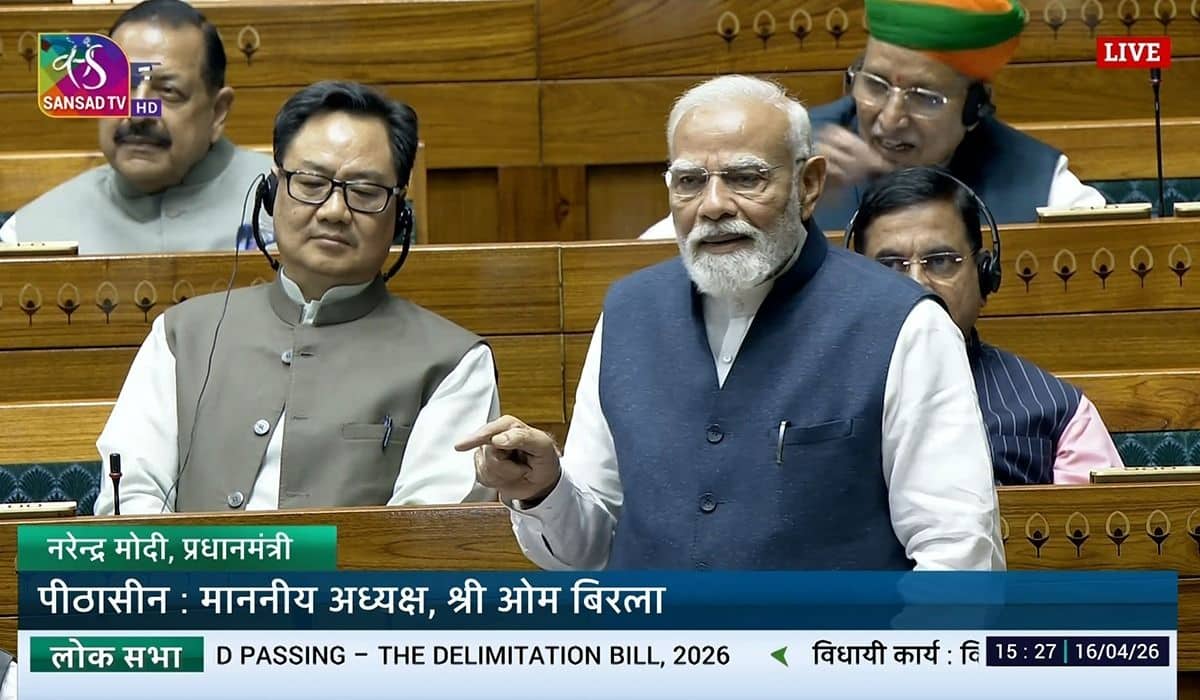
Women’s participation reflects India’s cultural commitment as the Mother of Democracy: PM Modi in Lok Sabha
April 16, 2026
This is a historic opportunity to empower our Nari Shakti : PM
Including Nari Shakti in decision-making is key to building a Viksit Bharat : PM
More and more women are becoming leaders at the grassroots level : PM
We must not assume we are giving something to the Nari Shakti; this is their right : PM
Women's participation in our parliamentary democracy is not just about numbers, but a commitment to democratic values: PM

Hon’ble Mr Speaker Sir,

Discussion on this important bill began this morning. Many colleagues here have touched upon various issues, and they will certainly provide the House with facts and arguments. Therefore, I do not wish to go into those subjects.

Hon’ble Mr Speaker Sir,

There are certain important moments in the life of a nation, and the mindset of society and the capacity of leadership at that time capture those moments and turn them into a national legacy, creating a strong heritage. I believe this is one such moment in the history of India’s parliamentary democracy. Ideally, when this idea first emerged 25–30 years ago, when the need was felt, we should have implemented it then and brought it to maturity by now. Improvements could have been made from time to time as required, and that is the beauty of democracy. We are the Mother of Democracy. Our democracy has a developmental journey of thousands of years, and today we have the auspicious opportunity to add a new dimension to that journey. As I said at the beginning, we are fortunate that we have the privilege of making half of the nation’s population participants in the policy-making process of nation-building. This is our good fortune, and I want all my honorable Members of Parliament to not let this important opportunity slip away. Together, we Indians are going to give a new direction to the country. We are making a meaningful effort to fill our governance system with sensitivity, and I am confident that the nectar that emerges from this churning will not only shape the form of the nation’s politics but also determine the direction and condition of the country. We stand at such a crucial turning point.

Hon’ble Mr Speaker Sir,

In the 21st century, India is moving forward with new confidence. Today, we all feel the recognition of India in the world, and this is a moment of pride for us. A time has come, and we have linked this time with the resolve of a developed India. I firmly believe that a developed India does not mean only excellent railways, roads, infrastructure, or some economic progress figures. We do not have such a limited imagination of a developed India. We want a developed India in which the mantra of “Sabka Saath, Sabka Vikas” is embedded in policy-making. It is the demand of the time that 50% of the country’s population becomes part of policy-making. We have already delayed, whatever the reasons, whoever was responsible, but we must accept this truth. When we meet individually, we admit it, but when we meet collectively, things change. I remember when this process was going on, meetings were held with all parties. Except for one party, everyone agreed in principle. Later, whatever happened, political directions were taken. But those who think only in political terms, I would like to advise them as a friend, and this advice will be useful to all. Since the discussion on women’s reservation began, in every election that followed, those who opposed granting this right to women were never forgiven by the women of the country. They were dealt with harshly. But look at the 2024 election-it did not happen then. Why? Because in 2024 everyone agreed to pass it, so it was no longer an issue. No one gained politically, no one lost politically. Elections were fought on other issues because in 2024 everyone was together. Some are here, some are not, but all were together. Even today I say, if we all move forward together, history is witness that this will not go in favor of any one political party. It will go in favor of the country’s democracy, in favor of the nation’s collective decision-making power, and we all will be entitled to its glory. Neither the Treasury Bench nor Modi will be entitled alone, everyone sitting here will be entitled. Therefore, those who see politics in this, I would like them to look at the results of the past 30 years. Their benefit also lies in this, I am showing the path that benefit lies in this, that you will be saved from the losses. Hence, I believe there is no need to give this a political color.

Hon’ble Mr Speaker Sir,

I remember, at that time I was not in governmental politics, I was working as a worker of an organization. At that time, one often heard discussions in the corridors that when it came to giving reservation in Panchayats, they gave it very easily. Because in Panchayats they did not fear losing their own positions. They felt secure, so they said, give it there. This was a common discussion in the corridors then-that they would never do it here in Parliament, because here they would lose something. That is why Panchayat reservation went up to 50%.

Politically, I want to explain another point, friends,

25–30 years ago, whoever opposed it, the opposition did not go below the political surface. Today, do not make the mistake of thinking the same. In the last 25–30 years, sisters who have won Panchayat elections have developed political consciousness. They are opinion makers at the grassroots level. Thirty years ago, they remained silent, they understood but did not speak. Today, they are vocal. Therefore, now whatever the position, those millions of sisters who have at some time worked in Panchayats, represented, seen the joys and sorrows of the people deeply, they are agitated. They say, you push us into sweeping and cleaning work, which we did earlier in families, but now include us in the decision-making process. Decision-making happens in Assemblies and Parliament. Therefore, I say to those who want progress in political life, whether MPs or MLAs, not speaking of any party, if you want to move forward successfully in political life, you must accept that in the last 25–30 years, millions of sisters have become leaders at the grassroots level. Now they will influence your decisions not only here with 33% but also there. Therefore, those who oppose today will have to pay the price for a long time. Hence, political wisdom also lies in considering the political leadership of women that has emerged at the grassroots level. I heard, since the time of Mulayam Singh ji, this subject has been raised, and his family continues it. Trust the women of the country, trust their wisdom. Allow 33% of sisters to come here, let them decide whom to give, whom not to give, which class to give, which class not to give. They will make decisions. Why do we doubt their capability? Let them come once! Let them come once! When they come, then in 2034… and Dharmendra ji, I am very grateful to you for introducing me. It is true, I come from an extremely backward society. Dharmendra ji, I am very grateful to you, and Akhilesh ji is my friend, so sometimes he helps me. It is true that I come from an extremely backward society, but my responsibility is to take everyone along, and that is what my Constitution shows me. For me, the Constitution is supreme. And it is the strength of the Constitution that a person from such a small, extremely backward society has been given such a great responsibility by the country. Therefore, I am indebted to the people of the country and to the framers of the Constitution, because of whom I am here today.

But Hon’ble Mr Speaker Sir!

Hon’ble Mr Speaker Sir,

Today, in every field of life, if we look, women are not behind in raising the nation’s pride and waving the flag. We can be proud that in different fields of life, our mothers and sisters are making great contributions, our daughters are excelling in every field! Such great strength-why are we spending so much energy to stop them from participation? Their joining will only increase strength. Therefore, I have come today to appeal to you not to weigh this in the scales of politics. This is a decision in the national interest.

Hon’ble Mr Speaker Sir,

Today, this opportunity before us is to sit together, think in one direction, and openly decide to accept the participation of our women power in building a developed India. As I said earlier, today the whole country, especially women power, will watch our decisions, but more than the decisions, they will look at our intent. Therefore, if our intent is flawed, the women power of the country will never forgive us.

Hon’ble Mr Speaker Sir,

In 2023, in this new House, we unanimously accepted this Act. A joyful atmosphere was created across the country, no political color was attached, and therefore it never became a political issue. That was a good situation. Now the question is, how long do we delay it? Those who raise issues of population, do you not know? I would like Amit Bhai to mention in his speech all the details of when we conducted the census, what difficulties arose later due to Covid, what obstacles came. All these matters are before us, there is no issue in that. But when we discussed in 2023, the broad consensus was to do it quickly, everyone was saying do it quickly. In 2024 it was not possible because of the short time. Now in 2029 we have the opportunity. If we do not do it in 2029, then what situation will arise, we can imagine. Then we will not be able to convince the mothers and sisters of the country that we can truly make this effort. Therefore, the demand of the time is that we do not delay further. In the meantime, discussions have been held with political party members, constitutional experts, women activists, and many others. Some have voluntarily given suggestions. Continuous discussions have been held with all parties, both structurally and informally. From all this churning, we must finally find a way to harness the strength of our mothers and sisters.

Hon’ble Mr Speaker Sir,

I would certainly like to say one thing. Sitting here, none of us has been given the right by the Constitution to think of the nation in fragments. The oath we have taken obliges us to think of the nation as one. Whether it is Kashmir or Kanyakumari, we cannot think in pieces, nor can we decide in pieces. Therefore, baseless storms raised only for political gain, without a shred of truth, I want to say with full responsibility from this sacred place in the House: whether it is South, North, East, West, small states or big states, I say with responsibility that this decision-making process will not discriminate against anyone, it will not do injustice to anyone. Whatever delimitation happened in the past under previous governments, whatever ratios have been followed since then, there will be no change in those ratios, and any increase will also be in the same proportion. If the word “guarantee” is needed, I use the word guarantee. If you want the word “promise,” I use the word promise. If there is a good word in Tamil, I am ready to use that too, because when the intent is clear, then we do not need to play with words.

Hon’ble Mr Speaker Sir,

I also want to tell all colleagues in the House that we should not remain in illusion, we should not remain in arrogance. I am using the word “we.” I am not speaking of “I” and “you.” We should not remain in the illusion that we are giving something to the women power of the country. No, it is their right; and we have withheld it for many decades. Today, by repenting, we have the opportunity to free ourselves from that sin. We all know how every time tricks were played, cleverness was used. We always said we were in favor, but every time some technical excuse was added to stop it. Every time such things were brought. No one had the courage to oppose 33% reservation for women, that era has passed, you cannot do it, but you did not even have the courage to say it. Therefore, technical excuses-do this, do that, add this-now you will not be able to explain this to the women of the country. The numbers game in the House will be decided by time, but it is certain that now, by entangling matters with various excuses and technical issues, we have blocked it for three decades. You achieved whatever you wanted, now let it go! Are three decades not enough to block it? For three decades you stopped it, yet you could not achieve anything, so now do it.

Hon’ble Mr Speaker Sir,

Some people here feel so.

Hon’ble Mr Speaker Sir,

Some people here feel that somewhere in this there is Modi’s political self-interest. Let them speak, poor fellow’s mouth is locked there, in Bengal no one lets him speak.

Hon’ble Mr Speaker Sir,

See, if this is opposed, naturally I will gain political benefit. But if we move together, then no one will gain, write this down. No one will gain, because then it becomes a different aspect, then no one benefits. Therefore, we do not want credit. As soon as this is passed, I am ready to give an advertisement tomorrow thanking everyone, ready to publish everyone’s photo. You take the credit! If you are worried about credit, take it. Whoever’s photo you want published, we will do it at government expense. I am giving you a blank cheque of credit from the front.

Hon’ble Mr Speaker Sir,

Women’s participation in our parliamentary democracy is not just a numbers game or a limited improvement in democratic arrangements. As the Mother of Democracy, this decision is India’s commitment, it is a cultural commitment. Because of this commitment, this arrangement was made in Panchayats, and now in more than 20 states it has reached 50%. We have experienced it. For a long time, the people gave me the opportunity to serve as Chief Minister, and during that period I saw women’s leadership at the grassroots level. My experience is that their commitment to solving problems with sensitivity was very effective, it gave momentum to the journey of development. Based on that experience, I say that their voice in this House will become a new strength, a new thought will be added, sensitivity will be added to the country’s direction. When experience joins with facts and arguments, its strength increases manifold, and the House becomes enriched.

Hon’ble Mr Speaker Sir,

There is no shortage of experienced women power in our country, no shortage of capable women. Let us trust them, they will contribute, they will contribute very well. Even today, whenever our sisters here have been given the opportunity, they have expressed themselves very well, enriched the House.

Hon’ble Mr Speaker Sir,

Today, in the country, there are more than 650 district Panchayats, nearly 275 of them are led by women, and they have more responsibility, funds, and arrangements than central cabinet ministers, and they work. Out of about 6,700 block Panchayats, more than 2,700 are led by women. Today, in more than 900 cities, in urban local bodies, whether as mayors or as heads of standing committees, our sisters hold power. I believe that in the progress the country is making today, their contribution is also significant, and this is the opportunity to acknowledge that debt. When this experience is added to the House, it will increase the strength manifold.

Hon’ble Mr Speaker Sir,

A long wait has created a question mark for all of us, and we ourselves have created this situation. This is the opportunity to come out of whatever limitations or difficulties existed in the past, to move forward with courage, and to ensure women’s participation in the nation’s development. I firmly believe that if we decide together today, and I urge that we should move forward unanimously, then when it moves forward unanimously, there is pressure on the Treasury Bench too. They also feel that everyone has a right in this, everyone’s voice must be considered, there is no harm. Collective strength gives us many good results.

Hon’ble Mr Speaker Sir,

Without taking much time, I will only say this: do not weigh this in the scales of politics. Whenever we make a decision, half of this great nation’s responsibility lies with those we are bringing here. They also have a right to come here, we should not stop them. And regarding numbers too, earlier there was discussion that their number should not be reduced, increase it, then it will be quicker. That subject has now come, that the earlier number of 33% should be increased, so that no one feels their right has been taken away. A new strength will be added, additional strength will be added, and the composition of the House will also be adjusted, as we had already thought and prepared space for it.

And Hon’ble Mr Speaker Sir,

In a lighter vein, I must say, everyone has their own political reasons, and fear of defeat is somewhat surprising. But in our tradition, whenever a good work is done, to ward off the evil eye, we apply a black mark. I thank you for applying the black mark!

Thank you very much!