“The number of people practicing Yoga is growing worldwide”
“The atmosphere, energy and experience from Yoga can be felt in Jammu & Kashmir today”
“Today the world is seeing a new Yoga economy emerging”
“The world is looking at Yoga as a powerful agent of global good”
“Yoga helps us live in the present moment, without baggage of the past”
“Yoga is scripting new pathways of positive change in society”
“Yoga helps us realize that our welfare is related to the welfare of the world around us”
“Yoga is not only a discipline but also a science”

I am fortunate to be in the land of yoga and meditation, Kashmir, on International Yoga Day. The environment, energy, and experiences of Kashmir and Srinagar allow us to feel the strength we get from yoga. I extend greetings from the land of Kashmir to all people in the country and to those practicing yoga in every corner of the world on Yoga Day.

Friends,

International Yoga Day has completed a historic journey of 10 years. I proposed International Yoga Day at the United Nations in 2014. This proposal by Bharat was supported by 177 countries, which was a record in itself. Since then, Yoga Day has been setting new records. In 2015, 35,000 people practiced yoga together at Kartavya Path in Delhi, which was also a world record. Last year, I had the opportunity to lead the Yoga Day celebration at the UN Headquarters in the USA, where people from more than 130 countries participated. This journey of yoga continues unbroken. The AYUSH department has established the Yoga Certification Board for yoga practitioners in Bharat. I am pleased that today more than 100 major institutions in the country are recognized by this board. Ten major institutions abroad have also received recognition from this board.

Friends,

The number of people practicing yoga around the world is steadily increasing, and so is the attraction towards yoga. People are increasingly convinced of the utility of yoga. Whenever I meet global leaders anywhere in the world, almost everyone talks to me about yoga. Senior leaders from all over the world always discuss yoga with me and ask questions with great curiosity. Yoga is becoming a part of daily life in many countries. I remember inaugurating a yoga centre in Turkmenistan in 2015. Today, yoga has become very popular there. Yoga therapy is also included in the State Medical University of Turkmenistan. Saudi Arabia has even included yoga in its education system. Several yoga schools are being run in Mongolia under the Mongolian Yoga Foundation. The trend of yoga is also increasing rapidly in European countries. Today, about 1.5 crore people in Germany have become yoga practitioners. You may recall, a 101-year-old female yoga teacher from France was awarded the Padma Shri in Bharat this year. She had never been to Bharat, but she dedicated her entire life to promoting yoga. Today, major institutions and universities worldwide are conducting research on yoga and publishing research papers.

Friends,

The expansion of yoga over the past ten years has changed perceptions associated with yoga. Yoga is now emerging beyond limited boundaries. The world is witnessing the rise of a new yoga economy. In Bharat, a new trend of yoga tourism is being observed from Rishikesh and Kashi to Kerala. Tourists from all over the world are coming to Bharat because they want to learn authentic yoga. Yoga retreats and yoga resorts are being established. Dedicated facilities for yoga are being created at airports and hotels. The market is seeing designer apparel and equipment for yoga. People are now hiring personal yoga trainers for their fitness. Companies are also starting yoga and mindfulness programs as part of employee wellness initiatives. All these have created new opportunities and employment for the youth.

Friends,

The theme of this year’s International Day of Yoga is ‘Yoga for Self and Society’. The world is looking at Yoga as a powerful agent of global good. Yoga helps us live in the present moment, without baggage of the past. It connects us with ourselves and our deepest feelings. It brings about oneness of the mind, body and soul. Yoga helps us realise that our welfare is related to the welfare of the world around us. When we are peaceful within, we can also make a positive impact on the world.

Friends,

Yoga is not just a discipline but also a science. In this era of information revolution, where there is a flood of information resources everywhere, focusing on one subject is proving to be a big challenge for the human mind. Yoga provides a solution to this as well. We know that concentration is the greatest strength of the human mind. This ability is also enhanced through yoga and meditation. Therefore, yoga is being included in the army to sports. Astronauts are also given yoga and meditation training as part of their space program training. This increases productivity and endurance. Nowadays, even prisoners are being made to practice yoga in many jails, so they can focus their minds on positive thoughts. Yoga is paving the way for positive changes in society.

Friends,

I believe that the inspiration from yoga will continue to energize our positive efforts.

Friends,

There was a slight delay today due to rain causing some obstacles, but since yesterday, I have seen the attraction towards yoga and the enthusiasm with which people in Jammu and Kashmir, especially in Srinagar, are eager to join yoga. This itself is an opportunity to strengthen tourism in Jammu and Kashmir. I will certainly meet with people associated with yoga after this program. Due to the rain, we had to hold the program here today. However, I consider it a great achievement that 50-60 thousand people in Jammu and Kashmir participated in the yoga program, and I congratulate the people of Jammu and Kashmir. Once again, I extend my best wishes for Yoga Day to all of you. My best wishes to all yoga enthusiasts around the world.

Thank you very much!

Explore More
Today, the entire country and entire world is filled with the spirit of Bhagwan Shri Ram: PM Modi at Dhwajarohan Utsav in Ayodhya

Popular Speeches

Today, the entire country and entire world is filled with the spirit of Bhagwan Shri Ram: PM Modi at Dhwajarohan Utsav in Ayodhya
India’s higher education enrolment hits 4.5 crore; women, marginalised groups lead way: AISHE report

Media Coverage

India’s higher education enrolment hits 4.5 crore; women, marginalised groups lead way: AISHE report
NM on the go

Nm on the go

Always be the first to hear from the PM. Get the App Now!
...
India-Australia Roadmap for Sports Collaboration
July 10, 2026

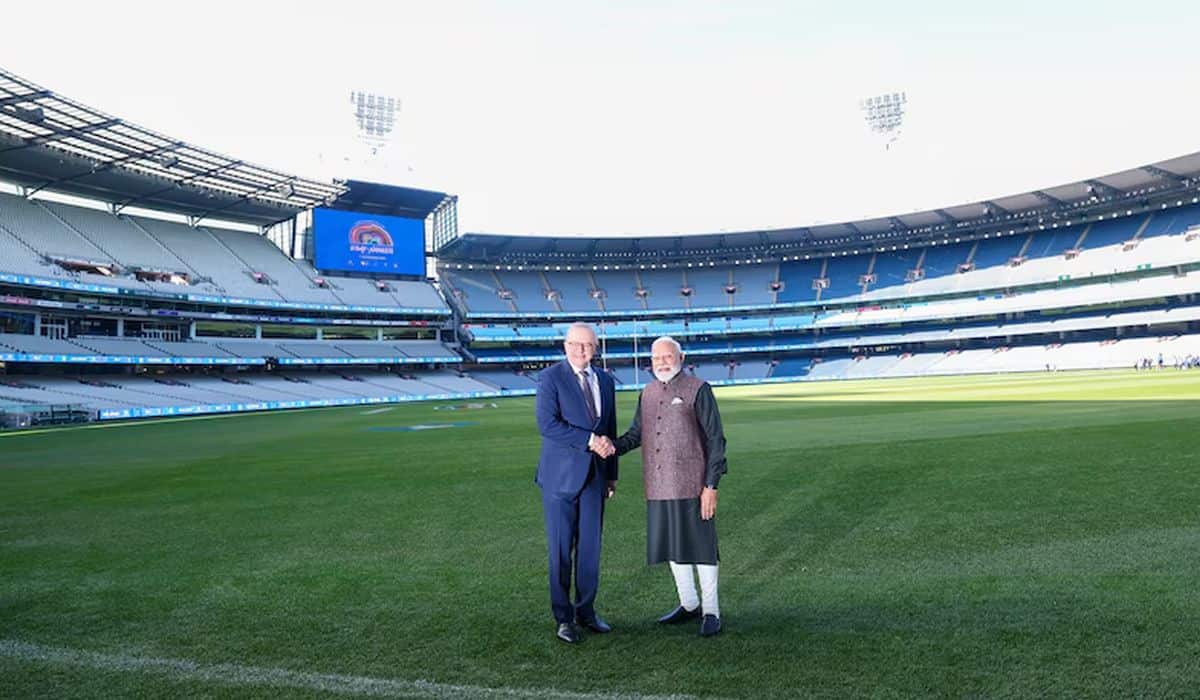
Sports is a powerful bridge between India and Australia, bringing communities together and opening new pathways for collaboration.

Building on the 2023 MoU on Cooperation in Sports, the India-Australia Roadmap for Sports Collaboration sets out practical, future-focused priorities and opportunities to strengthen this cornerstone of our bilateral relationship.

Recognising the decade of opportunity ahead — including the 2030 Commonwealth Games in Ahmedabad, the Brisbane 2032 Olympic and Paralympic Games, and India’s ambition to host a future Olympic and Paralympic Games — this Roadmap identifies targeted areas of cooperation aligned to shared priorities, capabilities and resources.

Respecting differences in the governance of sport and the development of sport ecosystems in Australia and India, and recognising the leadership role of sporting bodies, businesses, state–level governments, universities and community groups in promoting elite and community sports, we are committed to facilitating engagement and supporting collaborative ways of working between relevant institutions, to encourage stronger sports partnerships at all levels that benefits both countries.

Implementation will be pragmatic and outcomes-focused, with activities prioritised in line with available resources and major event timelines.

Cooperation will be delivered through established partnerships, supported by flexible, demand-led arrangements, whereby responsibility for resourcing activities will be negotiated on a case-by-case basis. This approach ensures practical, sustainable and mutually beneficial outcomes.

In this context, the following have been identified as focus areas for collaboration under this Roadmap:

A. Capacity Building:

o Collaborate for sharing best practice in establishing and operating High-Performance Sports Centres in India in priority sports.

o Identify Para sport as a key priority and opportunity for collaboration, including Australian expertise in Para classification, coaching and performance support, with potential links between Indian and Australian universities where appropriate.

o Drawing on Australia’s coach development models, facilitate two-way exchanges that bring Indian coach and coach educators to Australia and Australian coaches and coach educators to India, using a Train the Trainer approach where appropriate.

o A physical education exchange programme between India and Australia may be introduced to facilitate mutual learning, sharing of best practices, and collaboration in areas such as school sports, sports science, and community participation in physical education.

o Recognising the physical and mental health benefits of yoga and the World Yogasana, the federation for yogasana sports based in India, identify opportunities to share knowledge, foster collaboration and encourage participation in yoga in Australia.

o Work with the Australian Sports Commission to build the capability of select Indian coaches as part of the India Australia High Performance Coach Development program.

o Explore opportunities through relevant non-government stakeholders such as sporting organisations and universities to support talented young Indian sportspersons as part of high-performance programs in Australia through student scholarships funded by Government of India.

B. Collaborative Sports Science and Technology Research:

o Encourage joint research and development projects between universities in India and Australia on athlete performance analytics, injury prevention, sports nutrition, wearable performance technology, recovery techniques and Para sport.

o Encourage partnerships between Indian and Australian universities to co-develop sports curriculums.

o Sport Integrity Australia and National Anti-Doping Agency India contribute to international anti-doping efforts by supporting World Anti-Doping Agency (WADA)-led capacity building programs through engagement with the WADA Asia/Oceania Office, and through representation on the UNESCO International Convention against Doping in Sport (Convention) Groups.

C. Major Sporting Events:

o Collaborate with Australian States and Territories, and National Sporting Organisations to exchange best practices for hosting large events.

o Explore opportunities to host exhibition matches and youth events in both countries to promote sports of mutual interest (such as Kabaddi and Kho Kho in Australia, and Australian Football League and basketball in India).

o Leverage the build-up to major sporting events such as Olympic, Paralympic and Commonwealth Games to establish formal, reciprocal arrangements between Indian and Australian sporting bodies for shared facilities, competitions and support networks during and in the build-up to major sporting events.

o Welcoming the inaugural Big Bash League match to be played in India in Chennai in December 2026, encourage Cricket Australia and the Board of Control for Cricket in India to work towards a commitment to host annual BBL matches in India.

D. Sports Industry and Investment Platform:

o Build on the Australia-funded Sports Industry Summit in Mumbai in December 2026 to promote collaboration between Indian and Australian companies on sports equipment manufacturing, sports media and broadcasting, event management, and sports start-ups.

o Facilitate Australian sports sector businesses in the Indian sports market through information sessions and vice-versa.

o Expand India’s export of high quality, competitively priced sports goods to Australia.

o Expand the export of Australian expertise in high performance sports, including coaching, coach development, strength and conditioning, athlete wellbeing, nutrition and psychology.

E. Women in Sports Partnership:

o Launch joint initiatives promoting women’s leadership, health, high performance and participation in sport, including bilateral tournaments for women athletes, drawing on the Australian Sports Commission’s flagship programs, recognising that sport is a powerful pathway for women’s economic empowerment, leadership, health and social inclusion.