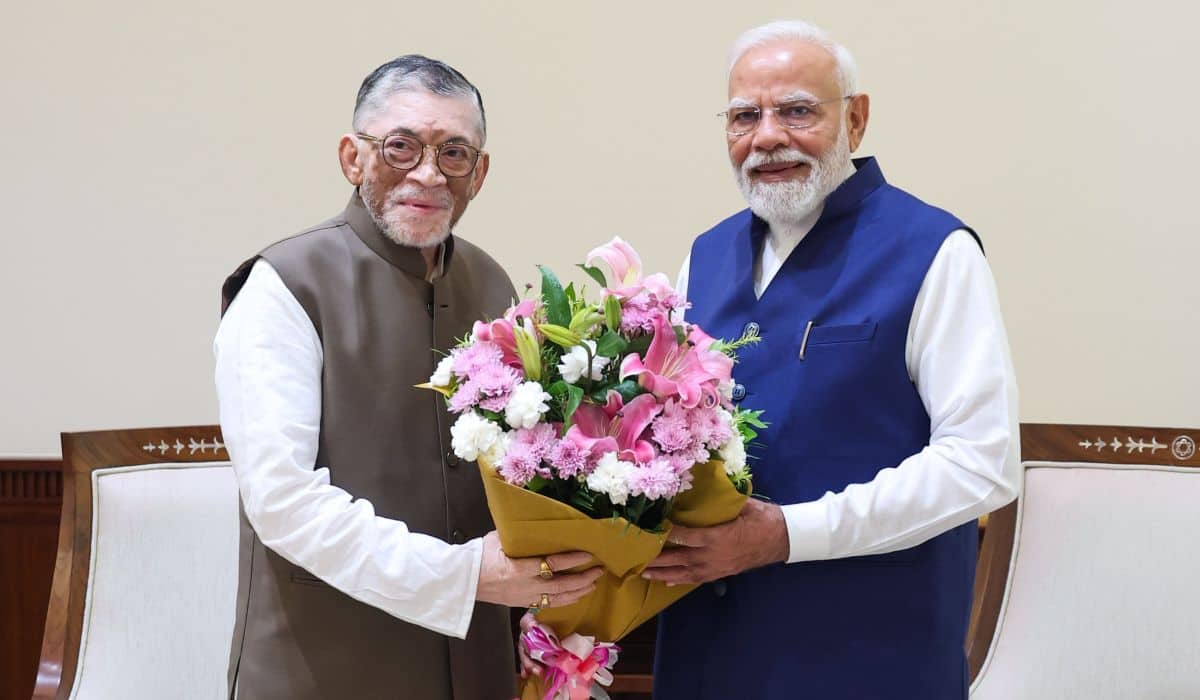
Prime Minister Shri Narendra Modi released the autobiography of Dr. Balasaheb Vikhe Patil titled ‘Deh Vechwa Karani’ today through video conferencing. He renamed Pravara Rural Education Society as ‘Loknete Dr. Balasaheb Vikhe Patil Pravara Rural Education Society’.
Speaking on the occasion, the Prime Minister said one will find stories of Vikhe Patil’s life in every region of Maharashtra. He said Balasaheb Vikhe Patil followed the footsteps of Dr. Vitthalrao Vikhe Patil and dedicated himself to the development of Maharashtra. He added easing the lives of the villagers, the poor, the farmers and reducing their sufferings have been the core of Vikhe Patil's life.
The Prime Minister said Vikhe Patil ji always worked for the betterment of society and always stressed on making politics a medium for bringing meaningful changes in the society, and for solving the problems of the poor and the villages. He said this approach of Balasaheb Vikhe Patil set him apart from the others. He said the autobiography of Balasaheb Vikhe Patil is very important for all of us, as his efforts & contribution for the development of the village, for the poor, for their education, for the success of cooperatives in Maharashtra will inspire generations to come.

The Prime Minister mentioned that Dr Balasaheb Vikhe Patil understood the pain and sufferings of the poor, of the farmers. So he brought the farmers together, connected them with the cooperatives. The Prime Minister said, as a minister in Atal ji's government, he encouraged cooperatives in many areas of the country including Maharashtra.
The Prime Minister said when rural education was not discussed much in the country, Dr Balasaheb Vikhe Patil worked to empower the youth in the villages through the Pravara Rural Education Society. Through this society he worked for the education and skill development of the youth in the village.
The Prime Minister said Vikhe Patil ji understood the importance of education in farming in the village. Today opportunities are being created to lead farmers towards entrepreneurship and make them entrepreneurs.

The Prime Minister said after independence when the country did not have enough food to feed, the priority of the government was how to increase the productivity of the crop. But in this concern for productivity, the focus was not given towards profitability of the farmer. He said the country is now emphasizing on increasing the income of the farmer, and has made constant efforts in this direction, such as the decision to increase MSP, neem coating of urea and better crop insurance. He added due to initiatives like PM-Kisan Samman Nidhi Yojana, farmers now do not have to depend on others for small expenses. Moreover unprecedented work has been done on augmenting infrastructure such as cold chains, mega food parks and agro-processing infrastructure.
Referring to Balasaheb Vikhe Patil’s emphasis on the need to preserve the traditional knowledge of farming, wherein farming was done according to the natural conditions, the PM said we must preserve that knowledge and must also combine new and old methods in agriculture. In this context He cited the example of sugarcane crop, where both new and old ways of farming are used. He said now industries are being set up to extract sugar as well as ethanol from sugarcane.
The Prime Minister said that Dr. Bala Saheb Vikhe Patil always endeavoured to solve the problems in the villages of Maharashtra like the problem of drinking and irrigation water. He added that under the Pradhan Mantri Krishi Sinchayee Yojana, work was done rapidly to complete 26 projects in Maharashtra, which were stuck for several years. Out of these, 9 projects have already been completed. With the completion of these projects, about 5 lakh hectares of land will get irrigation facilities, he added.

He said similarly in July 2018, work started on 90 more major and minor irrigation projects in Maharashtra. When these projects are completed in the next 2-3 years, about 4 lakh hectares of land will be connected with irrigation facilities. He said Atal groundwater scheme is being implemented in the 13 districts in Maharashtra where the groundwater level is very low.
The Prime Minister said under the Jal Jeevan mission, the work on providing piped drinking water to every family in the villages in Maharashtra is also going on at a rapid pace. Over 19 lakh families of Maharashtra have been provided with piped drinking water facilities during the last year. Out of this, over 13 lakh poor families got this facility during the corona pandemic.
He said the Mudra scheme has enhanced the avenues of self-employment in the village. Over 7 crore women belonging to the Self Help Group in the country have been given a loan of more than 3 lakh crore rupees. He added that farmers, fishermen have been provided with the facility of Kisan Credit Cards to get easy access to loans from banks. Nearly two and a half crore small farmer families who were earlier deprived of Kisan Credit Card now have this facility.
The Prime Minister said the boost to self confidence in the poors, in those residing in the villages will strengthen the resolve for self reliance. Balasaheb Vikhe Patil also wanted to instill this belief of self-reliance in villages.
मैं @RVikhePatil जी, उनके परिवार और अहमदनगर के सभी साथियों का आभारी हूं, जिन्होंने मुझे इस पुण्य अवसर से जुड़ने के लिए आमंत्रित किया: PM @narendramodi
— PMO India (@PMOIndia) October 13, 2020
गांव, गरीब, किसान का जीवन आसान बनाना, उनके दुख, उनकी तकलीफ कम करना, विखे पाटिल जी के जीवन का मूलमंत्र रहा है: PM @narendramodi
— PMO India (@PMOIndia) October 13, 2020
उन्होंने सत्ता और राजनीति के जरिए हमेशा समाज की भलाई का प्रयास किया।
— PMO India (@PMOIndia) October 13, 2020
उन्होंने हमेशा इसी बात पर बल दिया कि राजनीति को समाज के सार्थक बदलाव का माध्यम कैसे बनाया जाए, गांव और गरीब की समस्याओं का समाधान कैसे हो: PM @narendramodi
डॉक्टर बालासाहेब विखे पाटिल की आत्मकथा का विमोचन आज भले हुआ हो लेकिन उनके जीवन की कथाएं आपको महाराष्ट्र के हर क्षेत्र में मिलेंगी: PM @narendramodi
— PMO India (@PMOIndia) October 13, 2020
गाँव गरीब के विकास के लिए, शिक्षा के लिए, उनका योगदान हो, महाराष्ट्र में cooperative की सफलता का उनका प्रयास हो, ये आने वाली पीढ़ियों को हमेशा प्रेरणा देगा।
— PMO India (@PMOIndia) October 13, 2020
इसलिए, बालासाहेब वीखे पाटिल के जीवन पर ये किताब हम सभी के लिए बहुत महत्वपूर्ण है: PM @narendramodi
एक प्रकार से उनके लिए सहकारिता सबके साथ से सबके कल्याण का मार्ग थी।
— PMO India (@PMOIndia) October 13, 2020
सिर्फ महाराष्ट्र ही नहीं, अटल जी की सरकार में मंत्री रहते हुए उन्होंने देश के अनेक क्षेत्रों में सहकारिता को बढ़ावा दिया, उसके लिए प्रयास किया: PM @narendramodi
डॉक्टर बालासाहेब विखे पाटिल ने गांव, गरीब और किसानों के दुख को, दर्द को नजदीक से देखा, समझा।
— PMO India (@PMOIndia) October 13, 2020
इसलिए वो किसानों को एक साथ लाए, उन्हें सहकार से जोड़ा।
ये उन्हीं का प्रयास है कि जो इलाका कभी अभाव में जीने को मजबूर था, आज उसकी तस्वीर बदल गई है: PM @narendramodi
इस सोसायटी के माध्यम से गांव के युवाओं के शिक्षा और कौशल विकास को लेकर, गांव में चेतना जगाने के लिए उन्होंने जो काम किया वो हम भली-भांति जानते हैं।
— PMO India (@PMOIndia) October 13, 2020
ऐसे में आज से प्रवरा रूरल एजुकेशन सोसायटी के साथ भी बालासाहेब का नाम जुड़ना उतना ही उचित है: PM @narendramodi
जब देश में ग्रामीण शिक्षा की उतनी चर्चा भी नहीं होती थी, तब प्रूरल एजुकेशन सोसायटी के माध्यम से उन्होंने गांवों के युवाओं को प्रोत्साहित करने का काम किया: PM @narendramodi
— PMO India (@PMOIndia) October 13, 2020
आज खेती को, किसान को अन्नदाता की भूमिका से आगे बढ़ाते हुए, उसको उद्यमी बनाने, Entrepreneurship की तरफ ले जाने के लिए अवसर तैयार किए जा रहे हैं: PM @narendramodi
— PMO India (@PMOIndia) October 13, 2020
बालासाहेब विखे पाटिल जी के मन में ये प्रश्न ऐसे ही नहीं आया।
— PMO India (@PMOIndia) October 13, 2020
ज़मीन पर दशकों तक उन्होंने जो अनुभव किया, उसके आधार पर उन्होंने ये बात कही।
बालासाहेब विखे पाटिल के इस सवाल का उत्तर आज के ऐतिहासिक कृषि सुधारों में है: PM @narendramodi
चाहे वो MSP को लागू करने, उसे बढ़ाने का फैसला हो, यूरिया की नीम कोटिंग हो, बेहतर फसल बीमा हो सरकार ने किसानों की हर छोटी-छोटी दिक्कतों को दूर करने का प्रयास किया है: PM @narendramodi
— PMO India (@PMOIndia) October 13, 2020
डॉक्टर बाला साहेब विखे पाटिल महाराष्ट्र के गांवों की एक और समस्या के समाधान को लेकर हमेशा प्रयासरत रहे।
— PMO India (@PMOIndia) October 13, 2020
ये समस्या है पीने और सिंचाई के पानी कि दिक्कत: PM @narendramodi
प्रधानमंत्री कृषि सिंचाई योजना के तहत महाराष्ट्र में बरसों से लटकी 26 परियोजनाओं को पूरा करने के लिए तेजी से काम किया गया।
— PMO India (@PMOIndia) October 13, 2020
इनमें से 9 योजनाएं अब तक पूरी हो चुकी हैं।
इनके पूरा होने से करीब-करीब 5 लाख हेक्टेयर जमीन को सिंचाई की सुविधा मिली है: PM @narendramodi
किसानों, पशुपालकों और मछुआरों, तीनों को बैंकों से आसान ऋण मिल पाए, इसके लिए सभी को किसान क्रेडिट कार्ड की सुविधा दी गई है: PM @narendramodi
— PMO India (@PMOIndia) October 13, 2020
गांवों की आर्थिक और सामाजिक व्यवस्था में माइक्रो फाइनेंस का विशेष रोल है।
— PMO India (@PMOIndia) October 13, 2020
मुद्रा जैसी योजना से गांव में स्वरोजगार की संभावनाएं बढ़ी हैं।
यही नहीं बीते सालों में देश में सेल्फ हेल्प ग्रुप से जुड़ी करीब 7 करोड़ बहनों को 3 लाख करोड़ रुपए से अधिक का ऋण दिया गया है: PM @narendramodi