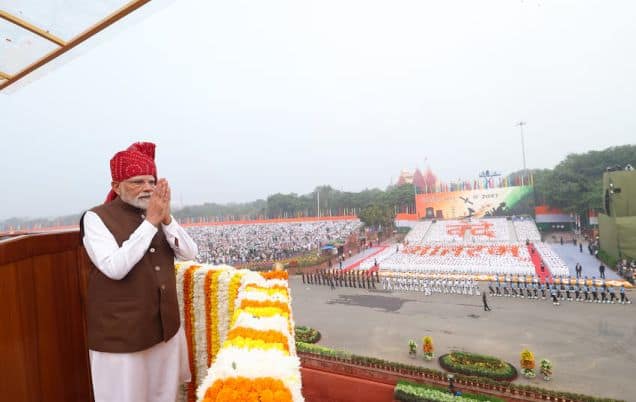
The Prime Minister, Shri Narendra Modi dedicated to the International Exhibition-cum-Convention Centre (IECC) complex at Pragati Maidan in New Delhi today. He also unveiled the G-20 coin and G-20 stamp. The Prime Minister also witnessed the naming ceremony of the Convention Centre as ‘Bharat Mandapam’ carried out via drone and a cultural program that was showcased on the occasion. Visioned by the Prime Minister and developed as a national project at a cost of about Rs 2700 crores, the new IECC complex at Pragati Maidan will help in promoting India as a global business destination.

Addressing the gathering, the Prime Minister initiated his speech with a poem to indicate the new enthusiasm and mood of the nation. He said, “Bharat Mandapam is a call for India’s capabilities and new energy of the nation, it is a philosophy of India’s grandeur and willpower.”
The Prime Minister recalled felicitating the Shramiks this morning and said that the entire nation is impressed after witnessing their hard work and dedication. He congratulated the people of Delhi as well as every Indian for Bharat Mandapam. Noting the historic occasion of Kargil Vijay Diwas, the Prime Minister paid tributes to the martyrs who laid down their lives for India during the Kargil war on behalf of the entire nation.

The Prime Minister elaborated that behind the name ‘Bharat Mandapam’ there is the inspiration of ‘Anubhav Mandapam’ of Bhagwan Basaveshwara. He said that Anubhav Mandapam represented the tradition of debate and expression. He reminded that India is acknowledged as the mother of democracy. He cited many historical and archaeological instances in this regard. “This Bharat Mandapam is a beautiful gift by us Indians to our democracy as we celebrate the 75th anniversary of Independence”, he added. He said the entire world will witness India’s strides and growing stature from here when the G20 Summit takes place in a few weeks from now at the venue.
Elaborating on the need for a world-class convention center in Delhi, the Prime Minister said that “In the 21st century we will have to have construction suitable for the 21st century.” The Prime Minister underlined that Bharat Mandapam will be hugely beneficial for exhibitors from all across the globe and will become a medium for conference tourism in India. He further added that Bharat Mandapam will act as a platform for showcasing the capabilities of the country’s startups, become a witness to the performance of artists and actors and provide a platform to showcase the efforts of handicraft artisans. “Bharat Mandapam will become a reflection of the Atmanirbhar Bharat and Vocal For Local campaign”, the Prime Minister remarked as he highlighted that the convention center will emerge as a stage for every sector ranging from economy to ecology and trade to technology.

The Prime Minister pointed out that an infrastructure like Bharat Mandapam should have been developed decades ago. He emphasized the need to carry on creating infrastructure despite opposition from vested interests. He stressed that no society can progress by working in a fragmented manner. He said that Bharat Mandapam is an example of the far-sighted holistic working style. He explained this by informing about the steps like e-conference visa facility for more than 160 countries. The capacity of Delhi Airport has gone up to 7.5 crore yearly today from 5 crore in 2014. This will be further strengthened once Jewar Airport is operational. The Hospitality Industry in Delhi NCR also expanded considerably. This indicated a planned approach of creating an entire ecosystem for conference tourism, he said.
Underlining the infrastructure developments in the capital city of New Delhi in the last few years, the Prime Minister highlighted the newly inaugurated Parliament building and said that it instills pride in every Indian. He also gave examples of monuments like the National War Memorial, Police Memorial and Baba Saheb Ambedkar Memorial. The Prime Minister reiterated that development work of office buildings surrounding Kartavya Path is underway in full swing as the Government is giving impetus to changing the work culture as well as the work environment. He also touched upon the Pradhan Mantri Sangrahalay which provides a glimpse into the lives of every Prime Minister that India has ever witnessed. He informed that the development of ‘Yuge Yugeen Bharat’ , the world’s largest museum, is coming up fast in New Delhi..
The Prime Minister stressed that we have to think big and achieve big targets in order to be developed. That is why, he said, “India is moving ahead with the principle of ‘Think Big, Dream Big, Act Big’”. He continued “We are creating bigger, better and faster”. He talked about the World’s biggest Solar-wind park, the highest rail bridge, the longest tunnel, the highest motorable road, the biggest cricket stadium, the world’s tallest statue, and Asia’s second-largest railroad bridge in India. He mentioned the strides in green hydrogen,

“The entire nation is witness to the pillars of development of the present government’s this term and the previous term”, the Prime Minister remarked as he affirmed that the development journey of India is now unstoppable. Shri Modi underlined that India was the 10th largest economy in the world when the present government came to power in 2014, but as of today, India is the 5th largest economy in the world. As per track record, the Prime Minister assured that India’s name will be among the top 3 economies of the world in the third term. “This is Modi’s guarantee”, he asserted. The Prime Minister also assured the citizens that in the third term, the pace of the development journey of India will increase manifold and the citizens would see their dreams come true.
The Prime Minister said that today India is witnessing a revolution of rebuilding as in the last 9 years, 34 lakh crore rupees were spent on the creation of infrastructure. This year too, capital expenditure is kept at 10 lakh crore, he informed. India is working at an unprecedented speed and scale. He said that in the last 9 years, electrification of 40 thousand km of railway lines took place as compared to just 20 thousand in the seven decades before that. Before 2014, 600 meter per month metro line was laid, today 6 Km long Metro line is being laid every month. Today, the country has 7.25 km long rural roads compared to just 4 lakh km in 2014. The number of airports increased from about 70 to about 150. City Gas distribution too reached 600 cities compared to just 60 in 2014.

“The New India is moving forward and overcoming all the obstacles that come in the way”, the Prime Minister said as he underlined that the government is focusing on finding permanent solutions to problems. Giving the example of PM Gatishakti Masterplan which is becoming a game-changer for social infrastructure, the Prime Minister said that it comprises more than 1600 layers of data and aims to save the country’s time and money.
The Prime Minister drew attention to the era of the 1930s and said that the third decade of the last century has been critical to India’s freedom struggle where the goal was Swaraj. Similarly, the Prime Minister said, the third decade of this century is extremely crucial for India as our goal is a prosperous India, a ‘Viksit Bharat’. The Prime Minister reiterated that it was the result of the Swaraj movement that India gained independence. “Now in this third decade, we have a target of ‘Viksit Bharat’ for the next 25 years”, the Prime Minister said as he invigorated the citizens to realise the dreams of every freedom fighter. Speaking by experience, the Prime Minister said that he has witnessed many achievements unfolding before him and is aware of the nation’s strengths. “India can become a developed country! India can eliminate poverty”, the Prime Minister said. Citing a report by Niti Aayog, the Prime Minister informed that 13.5 crore people have come out of poverty in India in just 5 years. He also reiterated that extreme poverty is going away in India as mentioned by international agencies and credited the policies made and the decisions taken by the government in the last 9 years.

Emphasizing the need for clean intentions and correct policies the Prime Minister cited G-20 as an example. He said, “We did not confine G-20 to just one city or one place. We took the G-20 meetings to more than 50 cities in the country. We showcased India's diversity through this. We showed the world what is India's cultural power, what is India's heritage.” Further elaborating on the manner of the G20 Presidency, the Prime Minister concluded, “New facilities were built in many cities for G-20 meetings and old facilities were modernised. This benefited the country and the people of the country. This is good governance. We are going to make India developed by following the spirit of Nation First, Citizen First.”
Union Minister for Trade and Commerce, Shri Piyush Goyal, numerous other Union Ministers and Ministers from the government and leading industry experts were present on the occasion.
Background
The Prime Minister’s vision of having a world-class infrastructure for hosting meetings, conferences and exhibitions in the country has led to the conceptualization of the International Exhibition-cum-Convention Centre (IECC) at Pragati Maidan. The project revamps the old and outdated facilities at Pragati Maidan and developed as a National project at a cost of about Rs 2700 crores. With a campus area of approximately 123 acres, the IECC complex has been developed as India’s largest MICE (Meetings, Incentives, Conferences, and Exhibitions) destination. In terms of the covered space available for events, the IECC Complex finds its place among the top exhibition and convention complexes in the world. The newly developed IECC complex at Pragati Maidan comprises multiple state-of-the-art facilities including Convention Centre, Exhibition halls and amphitheatre etc.
The Convention Centre is developed as the centrepiece of the Pragati Maidan complex. It is a grand architectural marvel, designed to host large-scale international exhibitions, trade fairs, conventions, conferences, and other prestigious events. It is equipped with multiple meeting rooms, lounges, auditoriums, an amphitheatre and a business centre making it capable of hosting a wide range of events. Its majestic multi-purpose hall and plenary hall have a combined capacity of seven thousand people, which is larger than the seating capacity of the famous Sydney Opera House in Australia. Its magnificent Amphitheater is equipped with a seating capacity of 3,000 individuals.

The architectural design of the Convention Centre building is inspired by Indian traditions and showcases India’s confidence and conviction in its past while also embracing modern facilities and way of life. The shape of the building is derived from the Shankha (conch shell), and different walls and facades of the Convention Centre depict several elements of India's traditional art and culture including ‘Surya Shakti’ highlighting India’s efforts in harnessing solar energy, ‘Zero to ISRO’, celebrating our achievements in space, Pancha Mahabhuta signifying the building blocks of universal foundation - Aakash (Sky), Vayu (Air), Agni (Fire), Jal (Water), Prithvi (Earth), among others. Also, various paintings and Tribal art forms from different regions of the country adorn the Convention Centre.
Other facilities available in the Convention Centre include 5G-enabled fully Wi-Fi-covered campus, 10G Intranet connectivity, interpreter room equipped with cutting-edge technology to support 16 different languages, advanced AV systems with huge-sized video walls, building management system ensuring optimal functionality and energy efficiency, light management system with dimming and occupancy sensors, state-of-the-art DCN (Data Communication Network) system, integrated surveillance system and energy-efficient centralized air conditioning system.
Further, the IECC complex features seven exhibition halls and each one serves as a versatile space for hosting exhibitions, trade fairs, and business events. The exhibition halls are designed to accommodate a diverse range of industries and showcase products and services from around the world. These state-of-the-art structures are a testament to modern engineering and architectural prowess.
The development of the area outside the IECC is also thoughtfully designed that complements the beauty of the main complex and is a testimony of the careful planning and development that has gone into this project. The sculptures, installations, and murals showcase the rich cultural heritage of India; Musical Fountains add an element of enchantment and spectacle; Water Bodies such as ponds, lakes, and artificial streams, enhance the tranquillity and aesthetics of the area.
The convenience of visitors is a priority at the IECC, reflected in the provision of over 5,500 vehicle parking spaces. The ease of access through signal-free roads ensures visitors can reach the venue without any hassle. Also, the overall design prioritizes the comfort and convenience of attendees, facilitating seamless movement within the IECC complex.
The development of the new IECC complex at Pragati Maidan will help in the promotion of India as a global business destination. It will also play a vital role in boosting trade and commerce, leading to economic growth and job creation. It will support the growth of small and medium enterprises by providing them with a platform to showcase their products and services on a national and international stage. It will also facilitate knowledge exchange and encourage the dissemination of best practices, technological advancements, and industry trends. IECC at Pragati Maidan epitomizes India's pursuit of economic and technological excellence in the spirit of Aatmanirbhar Bharat and is a step towards building a New India.
‘भारत मंडपम’ देखकर हर भारतीय आनंदित है, गौरव से भरा हुआ है। pic.twitter.com/XDoLNkSVnS
— PMO India (@PMOIndia) July 26, 2023
‘भारत मंडपम’ के निर्माण से जुड़े हर श्रमिक भाई-बहन की मेहनत देख, पूरा भारत विस्मित है, चकित है। pic.twitter.com/rb1fkOjveE
— PMO India (@PMOIndia) July 26, 2023
कारगिल युद्ध में अपना बलिदान देने वाले प्रत्येक वीर को मैं कृतज्ञ राष्ट्र की तरफ से श्रद्धांजलि देता हूं: PM @narendramodi pic.twitter.com/etcm7QQVhY
— PMO India (@PMOIndia) July 26, 2023
आज जब हम आजादी के 75 वर्ष होने पर अमृत महोत्सव मना रहे हैं, तो ये ‘भारत मंडपम’, हम भारतीयों द्वारा अपने लोकतंत्र को दिया एक खूबसूरत उपहार है: PM @narendramodi pic.twitter.com/RtnMMN4ezj
— PMO India (@PMOIndia) July 26, 2023
21वीं सदी के भारत में हमें 21वीं सदी की आवश्यकताओं को पूरा करने वाला निर्माण करना ही होगा। pic.twitter.com/FWZp0F7rbu
— PMO India (@PMOIndia) July 26, 2023
कोई भी देश हो, कोई भी समाज हो, वो टुकड़ों में सोचकर, टुकड़ों में काम करके आगे नहीं बढ़ सकता। pic.twitter.com/dI7XZD7q2Z
— PMO India (@PMOIndia) July 26, 2023
आज पूरी दुनिया भारत की ओर देख रही है।
— PMO India (@PMOIndia) July 26, 2023
भारत आज वो हासिल कर रहा है जो पहले अकल्पनीय था। pic.twitter.com/6BcZpVuizD
हम पहले से बड़ा निर्माण कर रहे हैं,
— PMO India (@PMOIndia) July 26, 2023
हम पहले से बेहतर निर्माण कर रहे हैं,
हम पहले से तेज गति से निर्माण कर रहे हैं। pic.twitter.com/QdB7f9RH8Y
आज से सौ साल पहले, जब भारत आजादी की जंग लड़ रहा था, तो वो पिछली शताब्दी का तीसरा दशक था। वो दशक भारत की आजादी के लिए बहुत अहम था।
— PMO India (@PMOIndia) July 26, 2023
इसी प्रकार 21वीं सदी का ये तीसरा दशक भी उतना ही महत्वपूर्ण है। pic.twitter.com/ikhlWa1FWz