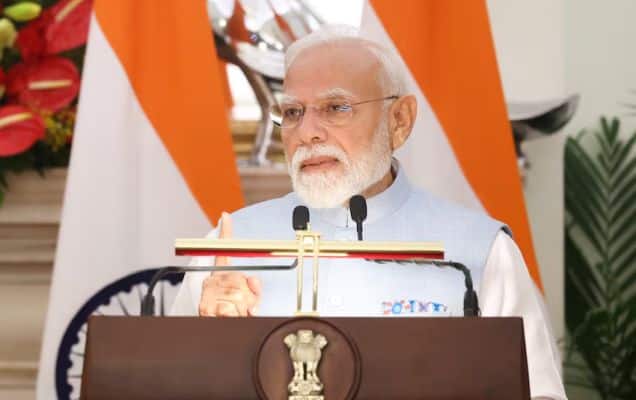
The Prime Minister, Shri Narendra Modi inaugurated the 98th Akhil Bharatiya Marathi Sahitya Sammelan in Vigyan Bhawan, New Delhi today. Addressing the gathering on the occasion, he welcomed all the Marathis to the grand event of Marathi language being organized in New Delhi. He said that the Akhil Bharatiya Marathi Sahitya Sammelan was not confined to a language or a region and added that the Sammelan comprised the essence of freedom struggle as well as the cultural heritage of Maharashtra and the nation.

Remarking that Akhil Bharatiya Marathi Sahitya Sammelan, from its first edition in 1878 till now, has been a witness to 147 years of India’s journey, Shri Modi said that many luminaries like Shri Mahadev Govind Ranade, Shri Hari Narayan Apte, Shri Madhav Shrihari Ane, Shri Shivram Paranjpe, Shri Veer Savarkar had presided the Sammelan. Expressing his gratitude for being invited by Shri Sharad Pawar to be part of this proud tradition, he extended his congratulations to all Marathi enthusiasts across the country and the world for this event.
Highlighting that today was International Mother language day, the Prime Minister remarked that it was quite natural to be reminded of verses of Sant Dnyaneshwar when he thought of Marathi language. Reciting a verse of Sant Dnyaneshwar, Shri Modi explained that the Marathi language was sweeter than nectar and hence his love and affection towards the Marathi language and culture was immense. Informing that although he was not as proficient as Marathi scholars at the event, the Prime Minister humbly said that he has always been in a constant endeavour to learn Marathi.
Shri Modi highlighted that the Sammelan was taking place at a significant time when the nation was witnessing the 350th anniversary of Chhatrapati Shivaji Maharaj's coronation, the 300th birth anniversary of Punyashlok Ahilyabai Holkar, and the 75th anniversary of our Constitution, created through the efforts of Babasaheb Ambedkar. Expressing pride over the fact that a century ago, a distinguished Marathi individual planted the seed of the Rashtriya Swayamsevak Sangh (RSS) on the soil of Maharashtra, Shri Modi highlighted that today, it has grown into a vast tree, celebrating its centenary year. He emphasized that for the past 100 years, the RSS has carried forward the great tradition and culture of India, from the Vedas to Vivekananda, to the new generation through its cultural efforts. He noted that it has been his privilege, along with millions of others, to be inspired by the RSS to live for the country. The Prime Minister also acknowledged that it was through the RSS that he had the opportunity to connect with the Marathi language and tradition. He highlighted that a few months ago, Marathi was accorded the status of a classical language, for which over 12 crore Marathi speakers in India and around the world had been waiting for decades for this recognition. He considered it a great fortune of his life to have had the opportunity to accomplish this task.

“Language is not just a medium of communication but a carrier of our culture”, exclaimed the Prime Minister. He noted that while languages are born in society, they also play a crucial role in shaping it. He highlighted that Marathi has given expression to the thoughts of many individuals in Maharashtra and the nation, contributing to our cultural development. Citing Samarth Ramdas Ji's words on the importance of the Marathi language, the Prime Minister remarked, “Marathi is a complete language, embodying valor, beauty, sensitivity, equality, harmony, spirituality, and modernity”. He noted that Marathi includes devotion, strength, and intellect. Shri Modi pointed out that when India needed spiritual energy, Maharashtra's great saints made the wisdom of the sages accessible in Marathi. He acknowledged the contributions of Sant Dnyaneshwar, Sant Tukaram, Sant Ramdas, Sant Namdev, Sant Tukdoji Maharaj, Gadge Baba, Gora Kumbhar, and Bahinabai, who showed society a new direction through the Bhakti movement in Marathi. In modern times, the Prime Minister highlighted the impact of Shri Gajanan Digambar Madgulkar and Shri Sudhir Phadke's Geet Ramayan.
Highlighting that during centuries of oppression, the Marathi language became a proclamation of liberation from invaders, the Prime Minister mentioned the valor of Maratha warriors like Chhatrapati Shivaji Maharaj, Sambhaji Maharaj, and Bajirao Peshwa, who fiercely opposed their enemies. He noted that in the freedom struggle, fighters like Vasudev Balwant Phadke, Lokmanya Tilak, and Veer Savarkar disrupted the British. He emphasized the significant role of Marathi language and literature in their contributions. Shri Modi highlighted that newspapers like Kesari and Maratha, the powerful poems of poet Govindagraj, and the plays of Ram Ganesh Gadkari nurtured the spirit of nationalism. He pointed out that Lokmanya Tilak wrote the Geeta Rahasya in Marathi, which infused new energy across the nation.
“Marathi language and literature have opened the doors of social emancipation for the oppressed and deprived sections of society”, highlighted Shri Modi. He mentioned the contributions of great social reformers such as Jyotiba Phule, Savitribai Phule, Maharshi Karve, and Babasaheb Ambedkar, who nurtured new age thinking in Marathi. He noted that Marathi language has given the country rich Dalit literature. He emphasized that due to its modern thinking, Marathi literature has also produced science fiction. Acknowledging the exceptional contributions of the people of Maharashtra in Ayurveda, science, and logic in the past, Shri Modi highlighted that this culture has always invited new ideas and talents, leading to Maharashtra's progress. He remarked that Mumbai has emerged as the economic capital not only of Maharashtra but of the entire country. The Prime Minister remarked that when speaking of Mumbai, one cannot complete the discussion of literature without mentioning films. He highlighted that it is Maharashtra and Mumbai that have elevated both Marathi films and Hindi cinema. He noted the current popularity of the movie 'Chhava,' which has introduced the valor of Sambhaji Maharaj through Shivaji Sawant's Marathi novel.

Quoting poet Keshavsut, Shri Modi emphasized that we cannot remain stagnant in old thoughts and human civilization, thoughts, and language continually evolve. He highlighted that India is one of the world's oldest living civilizations because it has consistently evolved, embraced new ideas, and welcomed changes. Pointing out that India's vast linguistic diversity is a testament to this evolution and serves as a fundamental basis for unity, the Prime Minister noted that Marathi exemplifies this diversity, comparing language to a mother who imparts new and vast knowledge to her children without discrimination. He added that language embraces every idea and every development. Shri Modi noted that Marathi originated from Sanskrit and has significant influences from Prakrit. He highlighted the contribution of great thinkers and writers who have broadened human thought. He mentioned Lokmanya Tilak's Geeta Rahasya, which interpreted the Sanskrit Gita and made it more accessible through Marathi. He also mentioned that the Dnyaneshwari Gita, with its Marathi commentary on Sanskrit, has become a standard for scholars and saints to understand the Gita. The Prime Minister remarked that Marathi has enriched and been enriched by other Indian languages. He cited examples like Bhargavram Vitthal Varekar, who translated works like 'Anandmath' into Marathi, and Vinda Karandikar, whose works based on the lives of Panna Dhai, Durgavati, and Rani Padmini have been translated into many languages. “Indian languages have never had mutual enmity; instead, they have always adopted and enriched each other”, he emphasised.
Pointing out that attempts to create divisions in the name of language are countered by the shared heritage of our languages, the Prime Minister emphasized the responsibility of enriching and embracing languages, urging everyone to keep away from such misconceptions. He highlighted that today, all languages in the country are viewed as mainstream languages. He pointed out the efforts to promote education in all major languages, including Marathi. Shri Modi mentioned that now, the youth in Maharashtra can pursue higher education, engineering, and medical studies in Marathi. He emphasized that the mindset of neglecting talents due to the lack of English proficiency has been changed.

“Literature is a mirror as well as a guide for society”, said Shri Modi. He remarked on the crucial role of Sahitya Sammelan and related institutions in the country. He expressed hope that the Akhil Bhartiya Marathi Sahitya Mahamandal will carry forward the ideals established by great personalities like Govind Ranade, Harinarayan Apte, Acharya Atre, and Veer Savarkar. The Prime Minister highlighted that the tradition of the Sahitya Sammelan will complete 150 years in 2027, which will mark the 100th Sahitya Sammelan. He urged everyone to make this occasion special and to start preparations now. He acknowledged the efforts of many young people who are serving Marathi literature through social media and encouraged providing them with a platform to recognize their talents. The Prime Minister emphasized the importance of promoting Marathi learning through online platforms and initiatives like Bhashini. He suggested organizing competitions related to Marathi language and literature among the youth. He expressed confidence that these efforts and inspirations from Marathi literature will energize 140 crore citizens for a Viksit Bharat. He concluded by urging everyone to continue the great tradition of distinguished personalities like Mahadev Govind Ranade, Harinarayan Apte, Madhav Shrihari Ane, and Shivram Paranjape, and thanked everyone.
The Chief Minister of Maharashtra, Shri Devendra Fadnavis; Member of Parliament (Rajya Sabha), Shri Sharad Pawar; President of the 98th Sammelan, Dr. Tara Bhawalkar were present among other dignitaries at the event.

Background
The 98th Akhil Bharatiya Marathi Sahitya Sammelan is being held from 21st to 23rd February and will host a diverse array of panel discussions, book exhibitions, cultural performances, and interactive sessions with eminent literary figures. The Sammelan will celebrate Marathi literature’s timeless relevance and explore its role in contemporary discourse, including themes of language preservation, translation, and the impact of digitalization on literary works.

The Marathi literary gathering being held in the national capital after 71 years also includes a symbolic literary train journey from Pune to Delhi, carrying 1,200 participants, showcasing the unifying spirit of literature. It will feature over 2,600 poetry submissions, 50 book launches, and 100 bookstalls among others. Distinguished scholars, authors, poets, and literature enthusiasts from across the country will participate.
Click here to read full text speech
हमारी भाषा हमारी संस्कृति की संवाहक होती है: PM @narendramodi pic.twitter.com/UwwMwurkyN
— PMO India (@PMOIndia) February 21, 2025
मराठी एक सम्पूर्ण भाषा है। pic.twitter.com/ROhES7EjcX
— PMO India (@PMOIndia) February 21, 2025
महाराष्ट्र के कितने ही संतों ने भक्ति आंदोलन के जरिए मराठी भाषा में समाज को नई दिशा दिखाई: PM @narendramodi pic.twitter.com/WttQQLtz83
— PMO India (@PMOIndia) February 21, 2025
भारतीय भाषाओं में कभी कोई आपसी वैर नहीं रहा। pic.twitter.com/QeaFNFHQsd
— PMO India (@PMOIndia) February 21, 2025