PM performs pooja and aarti at inner sanctum
Project aims to put special emphasis on the conservation and restoration of heritage structures
Total cost of the entire project is around Rs 850 crores
Existing footfall of around 1.5 crores per annum is expected to be doubled

The Prime Minister, Shri Narendra Modi dedicated Phase I of the Mahakal Lok Project to the nation at Shri Mahakal Lok in Ujjain, Madhya Pradesh today.

The Prime Minister arrived clad in the traditional dress of Mahakaal temple. He entered the Mahakaal Lok from Nandi Dwar. He performed pooja and aarti at inner sanctum. The Prime Minister sat in meditation for some time amidst chanting of mantras. Continuing the spiritual solemnity of the momentous occasion, Shri Modi also prayed while sitting near the holy statue of Nandi.

The Prime Minister went on to unveil the plaque to mark the dedication of Shri Mahakal Lok. The Prime Minister also met the temple saints and had a brief conversation with them. The Prime Minister then visited the Mahakal Lok temple complex and took a walk and viewed the Saptrishi Mandal, the Mandapam, Tripurasura Vadh and Navgarh. The Prime Minister also witnessed the murals along the path based on stories about the act of creation, the birth of Ganesha, story of Sati and Daksha among others from Shiva Purana. Shri Modi later watched a cultural programme that was showcased on occasion and witnessed the Malkhamb performance at Mansarovar. This was followed by darshan at the Bharat Mata Mandir.

The Prime Minister was accompanied by the Governor of Madhya Pradesh, Shri Mangubhai Patel, the Chief Minister of Madhya Pradesh, Shri Shivraj Singh Chauhan and Union Minister Shri Jyotiraditya Scindia.

Background

The Prime Minister, Shri Narendra Modi dedicated Phase I of the Mahakal Lok Project to the nation at Shri Mahakal Lok in Ujjain, Madhya Pradesh. Phase I of the Mahakal Lok project will help in enriching the experience of pilgrims visiting the temple by providing them with world-class modern amenities. The project aims to decongest the entire area and also put special emphasis on the conservation and restoration of heritage structures. Under the project, the temple precinct will be expanded nearly seven times. The total cost of the entire project is around Rs 850 crores. The existing footfall of the temple, which is currently around 1.5 crore per annum, is expected to be doubled. The development of the project has been planned under two phases.

The Mahakal Path contains 108 stambhs (pillars) which depict Anand Tandav Swaroop (Dance form) of Lord Shiva. Many religious sculptures depicting the life of Lord Shiva are installed along the Mahakal Path. The mural wall along the path is based on stories about the act of creation, the birth of Ganesha, story of Sati and Daksha among others from Shiva Purana. The area of plaza is spread over 2.5 hectares and is surrounded by a lotus pond which contains the statue of Shiva along with water fountains. The entire premise will be monitored 24x7 by Integrated Command and Control Centre with the help of artificial intelligence and surveillance cameras.


Explore More
শ্রী রাম জন্মভূমি মন্দিরের ধ্বজারোহণ উৎসবে প্রধানমন্ত্রীর বক্তব্যের বাংলা অনুবাদ

জনপ্রিয় ভাষণ

শ্রী রাম জন্মভূমি মন্দিরের ধ্বজারোহণ উৎসবে প্রধানমন্ত্রীর বক্তব্যের বাংলা অনুবাদ
Regional languages take precedence in Lok Sabha addresses

Media Coverage

Regional languages take precedence in Lok Sabha addresses
NM on the go

Nm on the go

Always be the first to hear from the PM. Get the App Now!
...
Cabinet approves three new corridors as part of Delhi Metro’s Phase V (A) Project
December 24, 2025

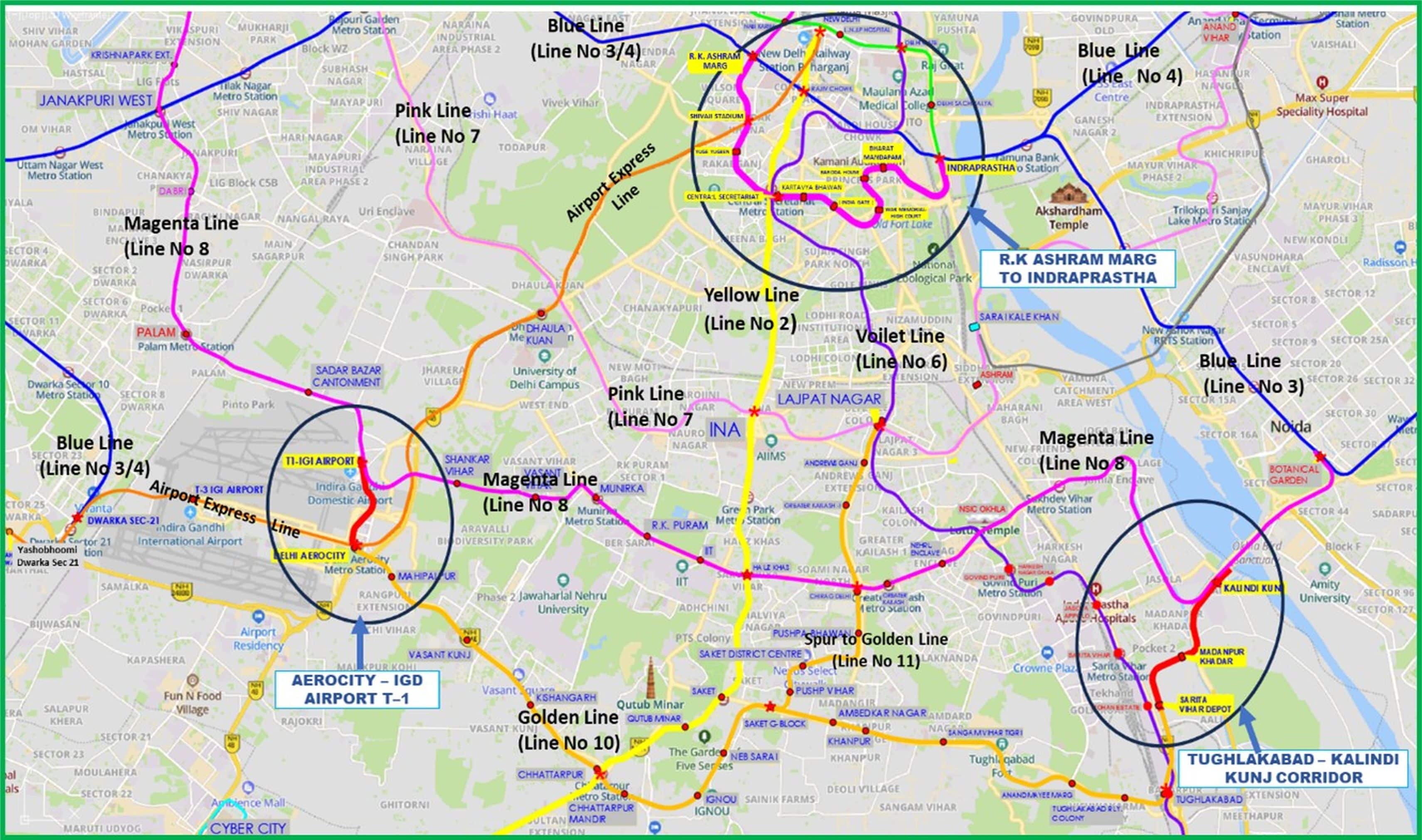
The Union Cabinet chaired by the Prime Minister, Shri Narendra Modi has approved three new corridors - 1. R.K Ashram Marg to Indraprastha (9.913 Kms), 2. Aerocity to IGD Airport T-1 (2.263 kms) 3. Tughlakabad to Kalindi Kunj (3.9 kms) as part of Delhi Metro’s Phase – V(A) project consisting of 16.076 kms which will further enhance connectivity within the national capital. Total project cost of Delhi Metro’s Phase – V(A) project is Rs.12014.91 crore, which will be sourced from Government of India, Government of Delhi, and international funding agencies.

The Central Vista corridor will provide connectivity to all the Kartavya Bhawans thereby providing door step connectivity to the office goers and visitors in this area. With this connectivity around 60,000 office goers and 2 lakh visitors will get benefitted on daily basis. These corridors will further reduce pollution and usage of fossil fuels enhancing ease of living.

Details:

The RK Ashram Marg – Indraprastha section will be an extension of the Botanical Garden-R.K. Ashram Marg corridor. It will provide Metro connectivity to the Central Vista area, which is currently under redevelopment. The Aerocity – IGD Airport Terminal 1 and Tughlakabad – Kalindi Kunj sections will be an extension of the Aerocity-Tughlakabad corridor and will boost connectivity of the airport with the southern parts of the national capital in areas such as Tughlakabad, Saket, Kalindi Kunj etc. These extensions will comprise of 13 stations. Out of these 10 stations will be underground and 03 stations will be elevated.

After completion, the corridor-1 namely R.K Ashram Marg to Indraprastha (9.913 Kms), will improve the connectivity of West, North and old Delhi with Central Delhi and the other two corridors namely Aerocity to IGD Airport T-1 (2.263 kms) and Tughlakabad to Kalindi Kunj (3.9 kms) corridors will connect south Delhi with the domestic Airport Terminal-1 via Saket, Chattarpur etc which will tremendously boost connectivity within National Capital.

These metro extensions of the Phase – V (A) project will expand the reach of Delhi Metro network in Central Delhi and Domestic Airport thereby further boosting the economy. These extensions of the Magenta Line and Golden Line will reduce congestion on the roads; thus, will help in reducing the pollution caused by motor vehicles.

The stations, which shall come up on the RK Ashram Marg - Indraprastha section are: R.K Ashram Marg, Shivaji Stadium, Central Secretariat, Kartavya Bhawan, India Gate, War Memorial - High Court, Baroda House, Bharat Mandapam, and Indraprastha.

The stations on the Tughlakabad – Kalindi Kunj section will be Sarita Vihar Depot, Madanpur Khadar, and Kalindi Kunj, while the Aerocity station will be connected further with the IGD T-1 station.

Construction of Phase-IV consisting of 111 km and 83 stations are underway, and as of today, about 80.43% of civil construction of Phase-IV (3 Priority) corridors has been completed. The Phase-IV (3 Priority) corridors are likely to be completed in stages by December 2026.

Today, the Delhi Metro caters to an average of 65 lakh passenger journeys per day. The maximum passenger journey recorded so far is 81.87 lakh on August 08, 2025. Delhi Metro has become the lifeline of the city by setting the epitome of excellence in the core parameters of MRTS, i.e. punctuality, reliability, and safety.

A total of 12 metro lines of about 395 km with 289 stations are being operated by DMRC in Delhi and NCR at present. Today, Delhi Metro has the largest Metro network in India and is also one of the largest Metros in the world.