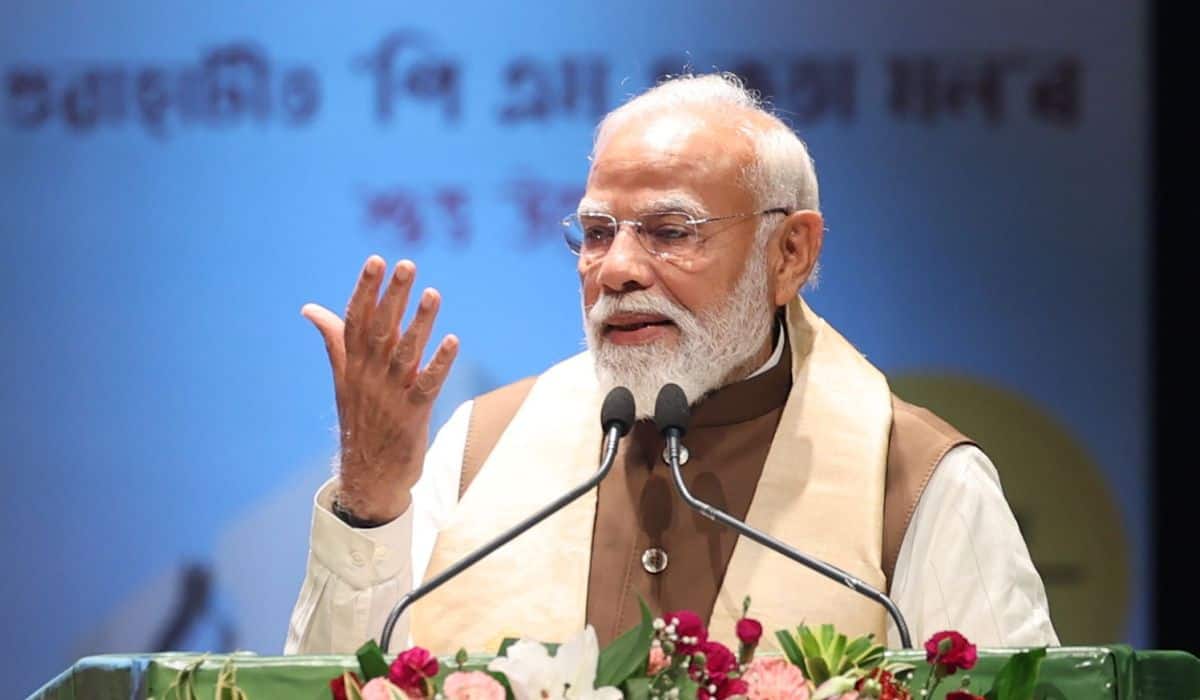
Full Text of Shri Modi’s speech in Jagdalpur, Chhattisgarh

Published By : Admin | November 7, 2013 | 16:35 IST

Bharat Mata Ki...

I pay respect to goddess of Basta Aradhya Devi, Mata Dhanteswar. Brothers, sisters, mothers of Bastar, youths, those MPs present on the stage Sri Dinesh Kashyap, Bhai Kedar Kashyap, Bhai Subhash Kashyap, Bhai Santosh Bapta, Beduram Kashyap, Mahesh Gagda, Sri Bhandavi, Sri Ganiram Barsi, sister Lata Husandi, Sri Kedar Kashyap and those brothers and sisters of Bastar present in large numbers. I have come to Jagdalpur several times before, and have visited the interiors of Bastar as I used to look at the BJP's organisational work. It was then that I had an opportunity to know about Chhattisgarh to a large extent. This Bastar is larger than Kerala state. Bastar has enormous potential, rich natural resources but it has been unfortunate that till the time Chhattisgarh was part of Madhya Pradesh, Congress was ruling but it did not care about the region. This was a picnic spot for the Congress. They used to come here with their friends to visit the forest and used to show them the tribals inhabiting the region, used to show our poverty and used to take all accolades.

Brothers and sisters, the people of Chhattisgarh should not forget the contributions of Atal Behari Vajpayee. It was the foresightedness of Vajpayee Ji, it was his thought that if Chhattisgarh is created as a different state, then it will give an opportunity to develop the state. The soil of this region has immense power and potential.

Chhattisgarh should be made prosperous... this was the dream of Atal Behari Vajpayee ji. Today with the blessings of Maa Dhanteshwari I take pride in the initiatives taken by Vajpayee ji. I pay my respect to Vajpayee ji who laid the foundation of Chhattisgarh. Vajpayee ji had compassion for poor, downtrodden and the exploited tribes and the victims of oppression. He never used to give slogans but had long term policy in his mind. He ensured that government work the welfare the people.

Dear tribal brothers, please tell me since when the tribal society existing in this country. Isn't it for 1000s of years? Wasn't it existing prior to Independence? Aren't the tribal poor people? After Independence, many Congress governments were formed but nobody remembered tribals, their poverty was not looked at, there was no education and career for the children of tribals. After so many years of Independence, Vajpayee was the first PM who created a special ministry for the welfare of tribals. He created separate minister, ministry, department, officials, and budget and ensured that the ministry could work independently. Brothers and sisters, many years after Independence Vajpayee ji took initative for the welfare of tribals. It was only after this that the lifestyle of tribals saw remarkable improvement. It is not only this but in the northeast as well. Nagaland, Arunachal Pradesh, Manipur where tribals are in large in numbers, separate departments were created. He took special care of the tribals in the far-flung areas of Nagaland, Mizoram, Manipur.

Shri Modi’s speech in Jagdalpur, Chhattisgarh

As he created the new state of Chhattisgarh, he created a new system for the tribals. I worked in this region when Chhattisgarh was created, then I was not the Gujarat chief minister. When Chhattisgarh was created it was ruled by the Congress. When I recall the work done during the three years of Congress rule, I am reminded of the atrocities, I get goosebumps. Chhattisgarh was under the rule of repression and oppression. When the party workers of BJP protested for their demands, tribals were beaten up and had to be hopitalised for as long as 6 months. Such cruel rulers were not seen in India. But Chhattisgarh saw the despotic rule, three years before its birth. We feared for the dream of Chhattisgarh as seen by Atal Behari Vajpayee - we feared for its people.

But I will salute the resolute nature of my brothers in Chhattisgarh - dalits, adivasis - they saw it and in the very first elections in Chhattisgarh, they threw off the yoke of misrule and exploitation - in a manner that started the countdown to the fall of Congress in India. For this, I shall congratulate you. Just imagine if you have not given 10 years to Dr Raman Singh and BJP what would have been the state of our Chhattisgarh today. If the looters got hold of Chhattisgarh then nothing would have remained - nothing.

The Central government has got embroiled in the coal scam - who knows if they would have spared even a kilo of Chhattisgarh coal - would have looted that too. It is your farsightedness that prevented Congress rule in Chhattisgarh or else Chhattisgarh would have been doomed under the paws of the Congress in 10 years. I feel the need to compare the state of three states.  Atal Bihari Vajpayee took people into confidence and, without any politicking or bloodshed, carved out three new states - Jharkhand, Uttarakhand and Chhattisgarh. Look at the last 10 years of progress report of these three states - take stock. Jharkhand is where it was 10 years ago, Uttarakhand has gone backwards, Chhattisgarh is the only in these three that has progressed. What is the reason?  Reason is your farsightedness, the understanding shown by my adivasi brothers of Chhattisgarh.

Congress got many a chance in Uttarakhand - that resulted in lack of development in the state. We all witnessed the tragedy of Kedarnath ji - thousands from across the country died. But the government of Uttarakhand cares two hoots about it. Look at Jharkhand. The richest state in terms of mineral wealth, but it is plagued with political instability. The machinations of the Congress-led central government to wrest power in Jharkhand is well known. Engineering defections, splitting parties, continued and look at the result. Jharkhand kept slipping. Chhattisgarh was saved because of your trust in Dr Raman Singh and BJP. The state has seen rapid development under a stable government. Three examples are before you and today I have travelled from Gujarat to beseech you. In the past the people of India voted for parties, castes and creed, relations. But times have changed. You must vote for development. You must have thought about your own good while voting. But today time has come for you to vote for a better tomorrow for your children. And such a future can only be ensured by BJP and Dr Raman Singh.

I would request you to ensure the continued development of Chhattisgarh. The rapid pace at which Chhattisgarh is progressing must be maintained and enhanced. In our families children grow up faster in their teens, say after 13 a boy or a girl grows up quickly. Every six months they outgrow their clothes. From 13 to 18 children grow rapidly. They gain in height, weight. Chhattisgarh is facing such an age, the teens. If it is nurtured along the path of development and growth the heights it can reach is only imaginable. So brothers and sisters, these coming five years are the most crucial in the development of Chhattisgarh.

Dr Raman Singh has provided a solid foundation of development. Now it is time to build on the foundation, time to take Chhattisgarh to newer heights. For that the years from 2013 to 2018 are the most crucial. If during this duration Chhattisgarh establishes itself, Chhattisgarh's development gathers momentum then this journey would not stop for a century to come. That is why I tell you that this election is not about choosing a government for the next five years. It is an election that will establish the foundation for development for the coming 100 years. Vote should be for development and politics of vote banks should be buried once and for all.

Has anyone seen such a huge gathering in Jagdalpur, has anyone imagined? The winds of change are blowing. The country wants development, wants a government that works for the betterment of the downtrodden. The Congress slogan was "Congress Ka Hath Garib Ke Sath". What happened? They showed you their hand and once they got elected they tried their hand and when they attained mastery in that then it is sleight of hand and nothing else. Their palm haven't spared coal either. People are asking for lockers in banks, not for keeping gold or jewellery or money, to keep coal, safe. Someone told me see Modi ji not only coal we shall have to soon ask for lockers to store onions too. When guests come we shall give them a whiff of the onion and keep it back in the locker.

Brothers and sisters, such a government that makes you shed tears without onions, a government that has snatched onion off the menu from the poor who used to supplant his diet of bajra, jowar or wheat roti with onions must be thrown off from power in this country. They promised. Let me ask you a question. You shall answer.  Do you have faith in Congress and its promise?  They promised that when they come to power in Delhi they will control inflation in 100 days. Should you spare those that have broken their promises? Should you hand over Chhattisgarh to them? Should you believe in their false promises?

I firmly believe that my brothers and sisters from Chhattisgarh would not fall prey to the false promises of the Congress. Tell me, my friend, if Atal Bihari Vajpayee had not dreamt about Chhattisgarh, if you had not mandated for Dr Raman Singh and had he not provided you with a stable government - could anybody amongst you have dreamt of a university in Bastar? Today Bastar has a university. Our country faces a shortage of doctors. The poor don't get treatment. Why? Because the Congress is least interested in establishing medical colleges. As long as they do not get their bags of cash they are not interested in medical colleges. When a medical college is established until and unless piles of capitation money changes hands you won't get admission there.

From Where will you get doctors? If there are no doctors from where will the poor get medical care? I would like to praise Dr Raman Singh that he has established a medical college in this backward district and taken the initiative for future medical care here. Dr Raman Singh has a vision. He is easily accessible to the people here. He interacts with them regularly, but people do not usually recognise him by his name. Who is Dr Raman Singh? But when you say 'çhaawal wala baba' (the rice man) the recognition is instant. Ensuring food security for the poor and downtrodden has been the primary focus of BJP.

And listen to what the Shahzada from Delhi says. He misleads people by saying 'we brought food security bill, we ensured food security'. My dear brothers and sisters, you and only you at Chhattisgarh know that it was the BJP government of Chhattisgarh which brought the first ever law related to food security anywhere in India. Even the government at Delhi understood and appreciated the act. Dr Raman Singh has given the people the right to skill development, right to training.

A government for development should be also be a sensitive one. The violence of Maoism, the bombs the bullets, the human casualty, security forces killed, amidst all this bloodbath, a resolute government has gone ahead with the agenda of development. Dr Raman Singh has demonstrated it. I would like to present before you cases of two governments in India. I shall also ask the political pundits to pay attention. One sensitive and the other insensitive. In May, Dr Raman Singh was travelling around Chhattisgarh on a yatra. Around the same time, Congress party leaders were on their yatras. Maoists killed a substantial numbers of Congress leaders. Recently there was a mammoth rally in Patna. Terrorists struck. Serial blasts targeted the dais, leaders of BJP. What did Raman Singh do and what did the Bihar CM do? Dr Raman Singh briefed the media, said that we shall probe the incident and if there has been any lapse at any level it would be addressed. He ordered an inquiry and adjourned his own yatra. He visited the family of the slain Congress leaders, and a couple of days later in the NIA meeting at Delhi his actions were lauded.

On the other hand, after such a grave incident in Patna we found the Bihar government in Rajgir. They seemed least bothered.  Their body language and verbal statements betrayed some sort of pleasure. When media asked them, pat came the reply, not only are they not acknowledging any lapse, they ruled out any probe. Categorically.

See the difference between a sensitive Chief Minister and a proud and vain one whose only goal is to be in power.  The reaction, the difference is there for the country to see. I would like to laud Dr Raman Singh for his patience, his courage in trying situations and I believe that in the next five years Chhattisgarh would outstrip Gujarat in development . And that would be a proud day for me. The way he took up local issues, wiped out the deficit in electricity generation, worked for the uplift of the downtrodden, the adivasis, the poor. I shall urge you to ensure a landslide victory for BJP . Vote for the lotus symbol and ensure the development of Chhattisgarh for the next century. I am thankful to you for the chance you have given us.  I would like to congratulate you.

'Apan sobai Bastar ki bhai bahin manke mocho patle guhar kare che Bhartiya Janata part cho Kamal phool ne vote dyun bhari bahumat se jitwana - samay ke macho - jay johar' (most probably Chhattisgarhi)

Explore More
শ্রী রাম জন্মভূমি মন্দিরের ধ্বজারোহণ উৎসবে প্রধানমন্ত্রীর বক্তব্যের বাংলা অনুবাদ

জনপ্রিয় ভাষণ

শ্রী রাম জন্মভূমি মন্দিরের ধ্বজারোহণ উৎসবে প্রধানমন্ত্রীর বক্তব্যের বাংলা অনুবাদ
Since 2019, a total of 1,106 left wing extremists have been 'neutralised': MHA

Media Coverage

Since 2019, a total of 1,106 left wing extremists have been 'neutralised': MHA
NM on the go

Nm on the go

Always be the first to hear from the PM. Get the App Now!
...
'Vande Mataram' rekindled an idea deeply rooted in India for thousands of years: PM Modi in Lok Sabha
December 08, 2025
Vande Mataram energised our freedom movement: PM
It is a matter of pride for all of us that we are witnessing 150 years of Vande Mataram: PM
Vande Mataram is the force that drives us to achieve the dreams our freedom fighters envisioned: PM
Vande Mataram rekindled an idea deeply rooted in India for thousands of years: PM
Vande Mataram also contained the cultural energy of thousands of years, it also had the fervor for freedom and the vision of an independent India: PM
The deep connection of Vande Mataram with the people reflects the journey of our freedom movement: PM
Vande Mataram gave strength and direction to our freedom movement: PM
Vande Mataram was the all-encompassing mantra that inspired freedom, sacrifice, strength, purity, dedication, and resilience: PM

Honourable Speaker Sir,

I express my heartfelt gratitude to you and to all the distinguished Members of this House for choosing the path of a collective discussion on this significant occasion. To recall with reverence that mantra, that clarion call, which infused the nation’s freedom movement with energy, inspiration, and the spirit of sacrifice and austerity- to commemorate Vande Mataram within this House is a matter of immense privilege for all of us. It is a matter of great pride that we stand witness to the historic occasion marking 150 years of Vande Mataram. This period brings before us countless events from the expanse of history. This discussion will certainly reflect the commitment of this House, but if we collectively utilise this moment well, it may also serve as a source of learning for the generations to come, for every successive generation.

Honourable Speaker Sir,

This is a period in which many inspiring chapters of history have once again come alive before us. Only recently we celebrated, with great pride, 75 years of our Constitution. Today, the nation is also celebrating the 150th birth anniversary of Sardar Vallabhbhai Patel and Bhagwan Birsa Munda, and we have just commemorated the 350th martyrdom anniversary of Guru Tegh Bahadur Ji. Today, we stand here attempting to experience the collective energy of this House on the occasion of 150 years of Vande Mataram. The journey of these 150 years has passed through many phases.

But, Honourable Speaker Sir,

When Vande Mataram completed 50 years, the country was compelled to live under the shackles of slavery. When it completed 100 years, the nation was trapped in the shackles of the Emergency. At the time when the centenary of Vande Mataram should have been celebrated as a grand occasion, the throat of the Constitution of India was being strangled. When Vande Mataram turned 100, those who lived and died for patriotism were thrown behind prison bars. The very song that had infused the nation with the energy to fight for freedom — when it reached its centenary, a dark chapter unfolded in our history. We were trapped in (unclear).

Honourable Speaker Sir,

The 150th year gives us the opportunity to re-establish the greatness of that chapter, that glory, and I believe that neither this House nor the nation should let such an opportunity pass. It is Vande Mataram that ultimately led the country to freedom in 1947.The emotional leadership of the freedom struggle was embodied in the triumphant chant of ‘Vande Mataram’.

Honourable Speaker Sir,

As I stand before you today to initiate this discussion on the occasion of Vande Mataram 150, there is no ruling side or opposition here, because for all of us seated here, this is truly an occasion to acknowledge a profound debt. It is because of Vande Mataram that determined individuals fought the freedom movement, and its outcome is that today we are all seated here. Therefore, for all Members of Parliament and for all public representatives, this is a sacred moment to acknowledge the debt we owe to Vande Mataram. And drawing inspiration from it, we must once again revive the spirit through which Vande Mataram united the nation’s freedom struggle- North, South, East, and West- the entire country marched forward with one voice. Once again, the moment calls upon us to walk together, to carry the nation with us. The dreams cherished by the passionate freedom fighters- Vande Mataram 150 must become our inspiration, our energy, compelling us to make Bharat self-reliant, and to transform India into a developed nation by 2047. This occasion of Vande Mataram gives us a great opportunity to reiterate that pledge.

Honourable Speaker Sir,

Dada, are you feeling well? No, no, at times such things happen at this age.

Honourable Speaker Sir,

The journey of Vande Mataram began when Bankim Chandra Ji composed it in 1875, at a time when, after the 1857 uprising, the British Empire was deeply shaken. They were exerting various forms of pressure upon Bharat, inflicting countless atrocities, and subjecting the people of this land to coercion. During that time, there was a conspiracy to propagate their national anthem, God Save the Queen, into every household in Bharat. It was in such a time that Bankim Da rose to the challenge, responding with strength greater than what he was confronted with, and Vande Mataram was born. A few years later, in 1882, when he wrote Anandamath, he incorporated this song into it.

Honourable Speaker Sir,

Vande Mataram revived that idea which had been embedded in the veins of Bharat for thousands of years. He gifted us that same feeling, that same set of values, that same culture and tradition, through profound and elevated words. Vande Mataram was not merely a mantra for political freedom- not merely a call for the departure of the British so that we could stand independently upon our own path. It inspired far beyond that. The freedom struggle itself was a sacred mission to liberate this motherland. It was a holy battle to free Mother Bharati from her chains. And when we examine the cultural foundation of Vande Mataram, its lineage of values traces back to the Vedic age. When we utter Vande Mataram, the thought that arises is the same as that from the Vedic period: “माता भूमिः पुत्रोऽहं पृथिव्याः”- “The earth is my mother, and I am her son.”

Honourable Speaker Sir,

This is the very sentiment that even Lord Shri Ram expressed when he rejected the splendour of Lanka, proclaiming, “जननी जन्मभूमिश्च स्वर्गादपि गरीयसी”- “The mother and the motherland are greater even than heaven.” Vande Mataram is the modern embodiment of this sublime cultural tradition.

Honourable Speaker Sir,

When Bankim Da composed Vande Mataram, it naturally became the voice of the freedom movement. From East to West, North to South, Vande Mataram became the resolve of every Indian. In praise of Vande Mataram, these lines were written:

“मातृभूमि स्वतंत्रता की वेदिका पर मोदमय, मातृभूमि स्वतंत्रता की वेदिका पर मोदमय, स्वार्थ का बलिदान है, ये शब्द हैं वंदेमातरम, है सजीवन मंत्र भी, यह विश्व विजयी मंत्र भी, शक्ति का आह्वान है, यह शब्द वंदे मातरम। उष्ण शोणित से लिखो, वक्‍तस्‍थलि को चीरकर वीर का अभिमान है, यह शब्द वंदे मातरम।”

(On the altar of the motherland’s freedom, there is joyous sacrifice of self-interest- these are the words Vande Mataram.
This is a life-giving mantra, a world-conquering mantra; it is an invocation of strength- these words Vande Mataram.
Write with warm blood, tear open the chest- this is the pride of the brave- these words Vande Mataram.)

Honourable Speaker Sir,

A few days ago, when the Vande Mataram 150 celebrations began, I had said at that event that Vande Mataram symbolised thousands of years of cultural energy. It embodied the spirit of freedom as well as the vision of a free Bharat. During the British period, it had become fashionable to portray Bharat as weak, useless, lazy, and indolent- to demean Bharat in every possible way. Those who had been shaped under that British influence also adopted that same language. To shake the nation free of that inferiority complex and to reveal Bharat's strength, Bankim Da, through his powerful hymn, wrote:

“त्वं हि दुर्गा दशप्रहरणधारिणी, कमला कमलदलविहारिणी, वाणी विद्यादायिनी। नमामि त्वां नमामि कमलाम्, अमलाम् अतुलां सुजलां सुफलां मातरम्॥ वन्दे मातरम्॥”

Meaning that Maa Bharati is the goddess of knowledge and prosperity, and also the fierce warrior Durga, who stands with her weapons before her enemies.

Honourable Speaker Sir,

These words, this emotion, this inspiration uplifted the Indians who were sinking into despair under colonial rule. These lines made crores of countrymen realise that this battle was not for a piece of land, not merely for a seat of power, but for liberating the nation from the shackles of slavery and for giving rebirth to its ancient traditions, its great culture, and its glorious history.

Honourable Speaker Sir,

The deep connection of Vande Mataram with the masses is expressed through the long saga of our freedom struggle.

Honourable Speaker Sir,

Whenever a river is spoken of- whether the Sindhu, Saraswati, Kaveri, Godavari, Ganga or Yamuna- alongside it also flows a cultural stream, a developmental journey, a chronicle of human life. But has anyone ever thought that every phase of Bharat's freedom struggle flowed through the emotions of Vande Mataram? It blossomed along its banks. Such a poetic sentiment may scarcely be found anywhere else in the world.

Honourable Speaker Sir,

The British understood that after 1857 it would be difficult for them to remain in Bharat for long. They realised that unless they divided Bharat, unless they fragmented its people and made them fight amongst themselves, their rule could not survive. They adopted the policy of “divide and rule”, making Bengal their laboratory, for they too knew that Bengal’s intellectual strength once provided direction, power, and inspiration to the entire nation. Hence the British wished to weaken that strength, believing that if Bengal were divided, the entire country would fall apart, and they would rule as long as they wanted to. In 1905, they partitioned Bengal. But when they committed that sin in 1905, Vande Mataram stood firm like a rock. It became the voice of every street, every corner, echoing for the unity of Bengal. That slogan became the people’s inspiration. With Bengal’s partition, the British intensified their efforts to weaken Bharat further, but Vande Mataram, as one voice and one thread, became an ever-growing challenge for them and a rock of strength for the nation.

Honourable Speaker Sir,

The partition of Bengal did indeed take place, yet an immense Swadeshi movement rose in its wake, and at that time Vande Mataram resounded everywhere. The British had realised that something extraordinary had emerged from the soil of Bengal- this emotional mantra of Bankim Da… ...All right, thank you, thank you, thank you, I respect your sentiments. Bankim Babu… Bankim Babu- thank you, Dada, thank you. May I call you Dada? Otherwise you may object to that as well. The emotional universe that Bankim Babu had created through this stirring hymn shook the British to their core. And look at the extent of their weakness, and the strength of this song - the British were compelled to impose a legal ban upon it. One could be punished for singing it, punished for printing it, and not only that, even uttering the words Vande Mataram invited punishment. Such harsh laws were enforced. Hundreds of women led the freedom movement of our nation, and countless women contributed with great determination. I wish to recall one incident. In Barisal, the gravest atrocities were committed for singing Vande Mataram. That Barisal is no longer a part of Bharat today. At that time, our mothers, sisters, and children of Barisal took to the streets; they stepped onto the battlefield for the honour of Vande Mataram, in defiance of this ban. And then emerged this valiant woman of Barisal- Smt Sarojini Ghosh. Behold the spirit of that era- she had declared that until the ban on Vande Mataram was lifted, she would remove the bangles she wore. In Bharat, in those days, removing one’s bangles was considered a momentous act in a woman’s life. Yet, for her, Vande Mataram was an emotion above all else. She removed her gold bangles and vowed that until the ban on Vande Mataram was withdrawn, she would not adorn them again. Such was the great vow she undertook. The little children of our country were not left behind either. They were flogged; at such tender ages they were thrown into prison. And in those days, especially in the lanes of Bengal, morning processions chanting Vande Mataram would take place unfailingly. They had become a constant thorn in the side of the British. At that time, a song echoed through Bengal:

“Jaaye jaabe jeebono choley, jaaye jaabe jeebono choley, jogoto maajhe tomar kandhe Vande Mataram bole.” (in Bengali)

Meaning: O Mother, if life passes while serving you and chanting Vande Mataram, then even such a life is blessed. This is what the children in the lanes of Bengal were proclaiming. That song was the voice of the courage of those children, and their courage gave strength to the nation. The voice that emerged from the alleys of Bengal became the voice of the entire country. In 1905, in a village in Haritpur, very young children were shouting the slogan Vande Mataram when the British mercilessly flogged them. They were forced to fight a battle between life and death itself. Such was the brutality inflicted upon them. In 1906, similar atrocities were committed by the British upon the children of Neel City High School in Nagpur. Their only “crime” had been standing together and raising one united cry: Vande Mataram. Through their strength, they sought to demonstrate the sacred power of this mantra. Our brave revolutionaries embraced the gallows without fear, and until their final breath, their resounding proclamation remained: Vande Mataram, Vande Mataram, Vande Mataram. Khudiram Bose, Madan Lal Dhingra, Ram Prasad Bismil, Ashfaqulla Khan, Roshan Singh, Rajendranath Lahiri, Ramkrishna Biswas- countless others embraced the noose while chanting Vande Mataram. This happened in different jails, in different regions. The faces of the persecutors differed, the people being tortured differed, their languages differed — but the mantra of 'Ek Bharat Sreshtha Bharat', was the same for all: Vande Mataram. The youth of Chittagong who challenged the British in the Swadeshi revolution are also radiant names in our history. Hargopal Kaul, Pulin Bikash Ghosh, and Tripura Sen — all sacrificed themselves for the nation. When Master Surya Sen was hanged in 1934, he wrote a letter to his comrades, and that letter echoed with only one word- Vande Mataram.

Honourable Speaker Sir,

We Indians should be proud. In the history of the world, there can be no poem, no inspirational song that can motivate millions of people for centuries toward one single goal, that can inspire them to dedicate their lives. There can be no such emotional song anywhere in the world except Vande Mataram. The whole world should know that even during the era of slavery, such extraordinary people were born in our country who could create a song of this nature. This is a wonder for the world. We should say this with pride, and then the world will also begin to honour it. It was the mantra of our freedom, the mantra of sacrifice, the mantra of energy, the mantra of purity, the mantra of dedication, the mantra of renunciation and penance, the mantra that gave the strength to endure hardships and that mantra was Vande Mataram. And that is why Gurudev Rabindranath Tagore had written: एक कार्ये सोंपियाछि सहस्र जीवन—वन्दे मातरम् (in Bengali), meaning “Thousands of hearts bound in a single thread, thousands of lives dedicated to one mission: Vande Mataram”. This is what Rabindranath Tagore wrote.

Honourable Speaker Sir,

During the same period, recordings of Vande Mataram reached different parts of the world. London had become a kind of sacred land for revolutionaries, and in that London India House, Veer Savarkar sang Vande Mataram, and the song echoed there time and again. It was a great source of inspiration for those ready to live and die for the nation. At that time, Bipin Chandra Pal and Maharshi Aurobindo Ghosh started a newspaper and they named it Vande Mataram. In fact, Vande Mataram was enough to disturb the sleep of the British at every step, and that is why they chose this name. When the British banned newspapers, Madam Bhikaji Cama started a newspaper in Paris and named it Vande Mataram.

Honourable Speaker Sir,

Vande Mataram also showed Bharat the path of self-reliance. At that time, from matchboxes to large ships, a tradition began of writing Vande Mataram on them. It became a means of challenging foreign companies, a mantra of Swadeshi. The mantra of freedom began expanding like the mantra of Swadeshi.

Honourable Speaker Sir,

I would also like to mention another incident. In 1907, when V. O. Chidambaram Pillai built a Swadeshi company’s ship, Vande Mataram was written on it. The national poet Subramania Bharati translated Vande Mataram into Tamil and composed hymns of praise. In many of his Tamil patriotic songs, one can clearly see the devotion towards Vande Mataram. Perhaps people from Tamil Nadu may know this, but others may not. Bharat’s flag song was written by V. Subramania Bharati himself. The description of that flag song was based on the flag on which Vande Mataram was written. The title of this song in Tamil was: Thayin manikodi pareer, thazhndu paninthu Pukazhnthida Vareer! (in Tamil). Meaning “O lovers of the motherland, come, behold, bow in reverence, and praise the divine flag of my mother.”

Honourable Speaker Sir,

Today, I also want to present Mahatma Gandhi’s feelings about Vande Mataram in this House. A weekly newspaper published from South Africa, Indian Opinion, carried what Mahatma Gandhi wrote on 2nd December 1905. I am quoting it. Gandhi wrote: “The song Vande Mataram, composed by Bankim Chandra, has become extremely popular throughout Bengal. During the Swadeshi movement, massive gatherings were held in Bengal where hundreds of thousands assembled and sang this song of Bankim.” Gandhiji further writes and this is very important and he wrote this in 1905: “This song has become so popular that it has become like our national anthem. Its emotions are noble and it is sweeter than the songs of other nations. Its sole purpose is to awaken the spirit of patriotism within us. It regards Bharat as a mother and offers praises to her.”

Speaker Sir,

The Vande Mataram that Mahatma Gandhi viewed as a national anthem in 1905 and the song that lived in every corner of the country, in the life of every person who lived and breathed for the nation held enormous power for all who awakened for the cause of Bharat. Vande Mataram was so great, its spirit so noble, then why was such grave injustice done to it in the last century? Why was there betrayal against Vande Mataram? Why did this injustice happen? What was that force whose will became more powerful than even the sentiments of revered Bapu himself? Who dragged such a sacred emotion as Vande Mataram into controversy? I believe that as we celebrate 150 years of Vande Mataram today, it is our responsibility to tell our new generations about the circumstances that led to this betrayal. The Muslim League’s politics of opposition to Vande Mataram was intensifying. On 15th October 1937, Muhammad Ali Jinnah raised a strong slogan against Vande Mataram from Lucknow. The then Congress President Jawaharlal Nehru saw his political ground shaking. Instead of strongly countering the baseless statements of the Muslim League, condemning them, and expressing his and the Congress Party’s loyalty to Vande Mataram, the opposite happened. Why he acted so is neither asked nor known, but he began scrutinising Vande Mataram itself. Five days after Jinnah’s opposition, Nehru wrote a letter to Netaji Subhas Bose on 20th October. Echoing Jinnah’s sentiment, he agreed in that letter that the Anandamath background of Vande Mataram might irritate Muslims. I will read Nehru ji’s quote. Nehru ji says: “I have studied the background of the song Vande Mataram.” Nehru ji then writes: “I feel that Muslims may be provoked because of this background.”

Friends,

Following this, a statement came from the Congress that the Congress Working Committee would meet in Kolkata from 26th October onward to review the use of Vande Mataram. Bankim Babu’s Bengal, Bankim Babu’s Calcutta was chosen for this review. The whole country was shocked, the whole nation astonished. Across the country, patriots organized morning marches, singing Vande Mataram in protest. But unfortunately, on 26th October, the Congress compromised on Vande Mataram. They decided to break Vande Mataram into parts. They wore the mask, the robe of “social harmony” behind this decision, but history stands witness that Congress kneeled before the Muslim League. Congress accepted this under the pressure of the Muslim League. It was a way to pursue their politics of appeasement.

Honourable Speaker Sir,

Congress bowed for dividing Vande Mataram under the pressure of appeasement politics. That is why Congress had to bow for the partition of Bharat. It seems Congress outsourced its decision-making. Unfortunately, Congress’ policies remain the same. And not only this the INC has gradually turned into an MMC. Even today, Congress and its allies, all those associated with Congress, still try to create controversy around Vande Mataram.

Honourable Speaker Sir,

The character of any nation is revealed not in its best times, but in times of challenge and crisis. True strength is tested only when the test comes how firm, powerful, and capable we are. After independence in 1947, the country’s challenges changed, the priorities changed, but the nation’s character and resilience remained the same, drawing inspiration from the same spirit. Whenever Bharat faced crises, the country always moved forward with the spirit of Vande Mataram. Let it be whatever may have happened in the middle years. But even today, on 15th August and 26th January, or during “Har Ghar Tiranga,” that same emotion is visible everywhere. Tricolours wave proudly. There was a time when the country faced a food crisis and it was the spirit of Vande Mataram that filled our granaries through the efforts of our farmers. When attempts were made to crush Bharat’s freedom, when the Constitution itself was attacked, when Emergency was imposed, it was the strength of Vande Mataram that made the nation rise and defeat it. Whenever wars were imposed on the country, whenever we were pushed into conflict, it was the spirit of Vande Mataram that made our soldiers stand firm at the borders, waving the flag of Maa Bharati in victory. When a global crisis like Corona struck, it was with the same spirit that the nation stood together, overcame it, and moved ahead.

Honourable Speaker Sir,

This is the strength of the nation, a powerful current of energy that connects the nation with deep emotion. It is a stream of consciousness, a reflection of our unbroken cultural flow, its expression. Vande Mataram is not merely something for us to remember; it should become a time for drawing new energy, new inspiration, and dedicating ourselves to it. As I said earlier, we are indebted to Vande Mataram. It is Vande Mataram that created the path on which we have reached where we stand today and therefore, we owe it a debt. Bharat has the strength to overcome every challenge and this strength comes from the spirit of Vande Mataram. Vande Mataram is not just a song or an inspirational hymn; it is a force that awakens us to our duties towards the nation. This is why we must continue to embrace it. We are moving forward with the dream of ‘Aatmanirbhar Bharat’ (a self-reliant India), and we must fulfil it. Vande Mataram is our inspiration. We want to strengthen the Swadeshi movement. Times may have changed, forms may have changed, but the spirit expressed by revered Gandhi still exists today, and Vande Mataram continues to unite us. The dream of our great leaders was an independent Bharat; the dream of today’s generation is a prosperous Bharat. The spirit of Vande Bharat nurtured the dream of an independent Bharat; the spirit of Vande Mataram will nurture the dream of a prosperous Bharat. It is with these emotions that we must move forward. We must build ‘Aatmanirbhar Bharat’. By 2047, the country must become ‘Viksit Bharat’ (Developed India). If 50 years before independence someone could dream of a free Bharat, then 25 years before 2047, we too can dream of a prosperous, ‘Viksit Bharat’ and we can dedicate ourselves to realizing this dream. With this mantra and resolve, may Vande Mataram continue to inspire us. Let us acknowledge our debt to Vande Mataram. Let us carry its spirit forward, take along the people of the nation, walk together, and fulfil this dream. With this thought, this discussion begins today. I am confident that this will become a reason to ignite that spirit within the country, to inspire the nation, to energize our new generation in both Houses of Parliament. With these words, I express my deep gratitude to you for giving me this opportunity. Thank you very much!

Vande Mataram!

Vande Mataram!

Vande Mataram!