“If we clean up the garbage, at least Rs. 6500 will be saved in the pockets of the underprivileged. They will be saved from diseases. One, who cannot find work, will be saved from unemployment. Getting rid of the garbage is an important task for the health of the poor. That is why the service to this nation means the service to the poor.”
There has been a deep effect of PM Modi’s efforts on the cleanliness drive in his constituency of Varanasi. Being a public representative, he himself handled the cleanliness drive, twice. The First time he participated in Shramdaan at the Assi Ghat to clean up the garbage and the second time he held the broom and participated in the cleaning drive at the Jagannath temple on the occasion of Good governance day.
It is the result of PM Modi’s agility that in the past two and a half years, enough work has been done to keep kashi clean and beautiful. Many tasks are being carried out in the city for waste management & cleanliness with a cost of Rs. 108.26 crores. The ILFS & ECOPAL companies have been put in charge of door-to-door collection, cleaning and carriage of household refuse. For this task, a sum of Rs 45 crores has been allotted. Under the ‘Namami Gange’ scheme, ILFS will work on cleaning of all ghats. This will incur an expense of Rs. 5 crores per year.
NTPC has begun work at the Karsada Waste Disposal plant, which is pending for 7 years, with a cost of Rs. 7 crore. And now it has begun producing organic manure. In the same way, IOCL has begun operation of Electricity from decentralized waste plant with a capacity of 10 Metric Tonne, in Bhavnia Pokhari. Such plants are being set-up at 9 other places in Varanasi with a cost of Rs. 19 Crores.
Under the Swachh Bharat Mission, Varanasi Municipal Corporation has been provided with Road sweeping machine, garbage truck, compactor & waste collection bins. More than 50 public urinals & 153 Public toilets have been constructed. Also, 2263 personal toilets have been constructed and 8122 more have been approved.
It is quite evident that swachhta mission has a very positive effect on this historical and sacred city. The people have also welcomed this initiative of the Prime Minister.
Cabinet approves infrastructure projects between National Highway-19 and Varanasi Ring Road in Uttar Pradesh worth Rs.14447.64 crore
July 15, 2026
Share
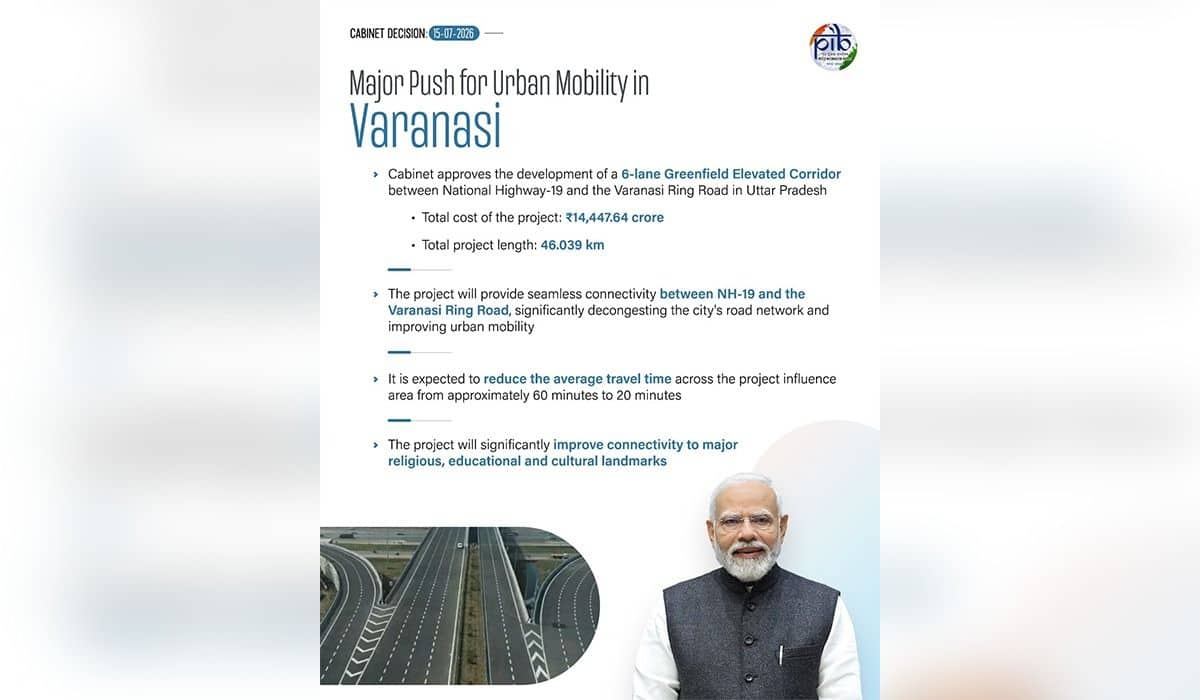
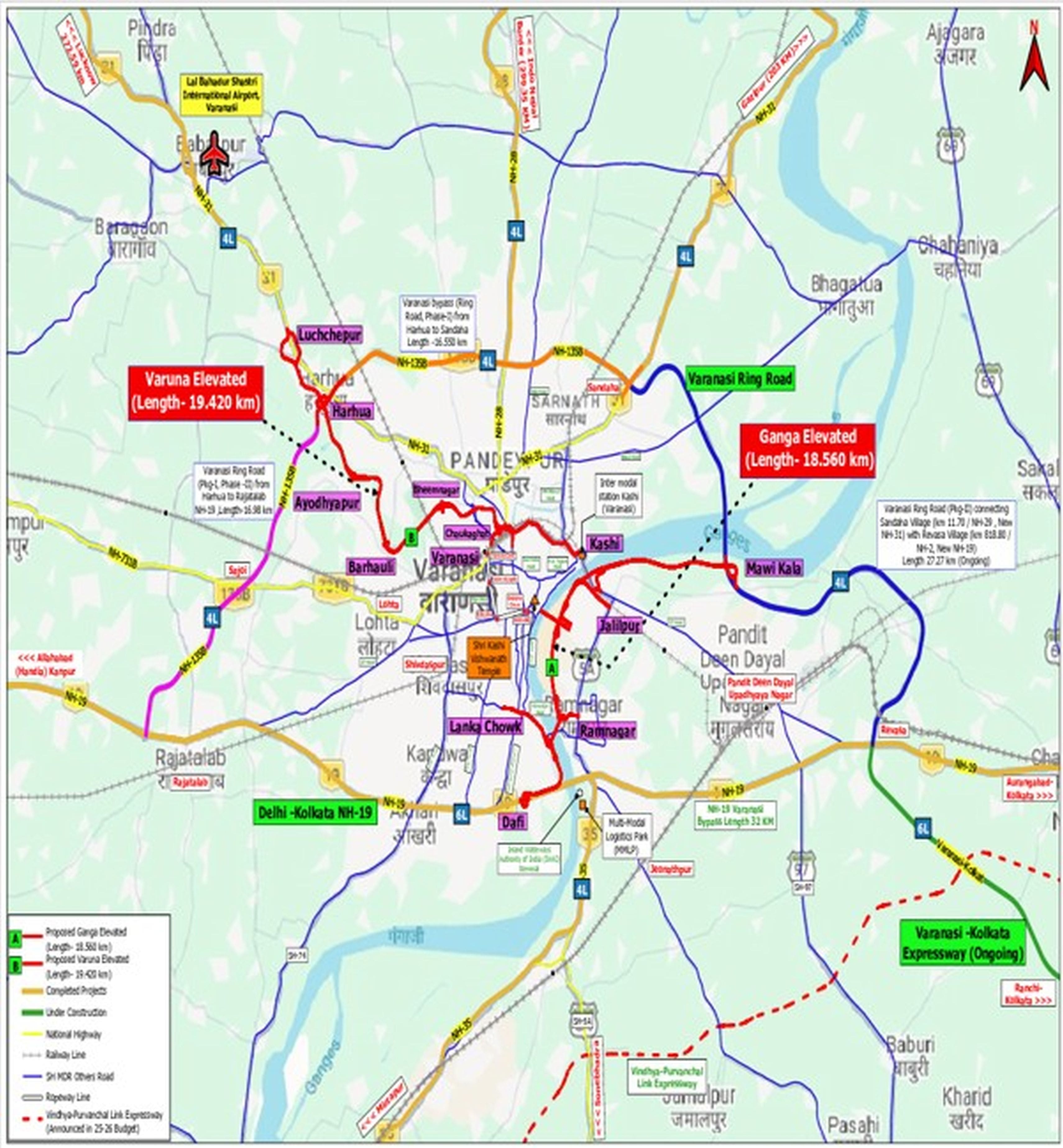
The Cabinet Committee on Economic Affairs, chaired by the Prime Minister Shri Narendra Modi, today has approved the development of a Link/Connector Corridor between National Highway-19 (NH-19) and the Varanasi Ring Road with riverbank connectivity along the River Ganga for the decongestion of Varanasi City in Uttar Pradesh. The 46.039 km project, comprising a six-lane elevated main carriageway, an iconic cable-stayed bridge, an extradosed Foot Over Bridge-cum-Major Bridge, loops, ramps, link roads and service roads, will be implemented under the Hybrid Annuity Model (HAM) at a total capital cost of Rs.14,447.64 crore including a civil construction cost of Rs.6,037.85 crore (including utility shifting, excluding GST) and a land acquisition cost of Rs.541.11 crore under NH(O).
The project will provide seamless connectivity between NH-19 and the Varanasi Ring Road, significantly decongesting the city’s road network and improving urban mobility. Designed for an operating speed of 80–100 km/h, it is expected to reduce the average travel time across the project influence area from approximately 60 minutes to 20 minutes, representing a reduction of nearly 67 per cent. Travel time between NH-19 and Kashi Railway Station will be reduced from approximately 50 minutes to about 25 minutes, resulting in a saving of about 25 minutes (nearly 50 per cent).
Aligned with the PM Gati Shakti National Master Plan, the corridor will strengthen multimodal connectivity by providing seamless access to major highways, railway stations, Lal Bahadur Shastri Airport and Ramnagar IWAI Port, while significantly improving connectivity to key religious, educational and cultural landmarks, including the Kashi Vishwanath Temple, Banaras Hindu University (BHU), Namo Ghat, Ramnagar Fort and the Ghats of Varanasi. By linking important economic, social and logistics nodes, the project will improve logistics efficiency, enhance road safety, facilitate tourism and pilgrimage, and support sustainable regional economic growth across eastern Uttar Pradesh.
The corridor has been conceived as a transformative urban mobility project to decongest the road network of Varanasi & Chandauli by providing a high-speed, access-controlled connection between NH-19, the Varanasi Ring Road (NH-135B), Ramnagar/ BHU and other major urban destinations. With more than 15 crore tourists and pilgrims visiting Varanasi every year, the project will significantly improve connectivity to major religious, educational and cultural landmarks, including the Kashi Vishwanath Temple, Banaras Hindu University (BHU), Namo Ghat, Ramnagar Fort, the Ghats of Varanasi, and Kashi Railway Station, while substantially reducing congestion on the existing city road network. An elevated spur between BHU/Lanka and Samne Ghat will further ease traffic congestion at the heavily trafficked Lanka Junction by separating through traffic from local traffic movements.
The project will improve road safety through controlled-access movement, reduce vehicle operating costs and emissions, enhance travel reliability, and facilitate the efficient movement of passenger and freight traffic. It will also decongest NH-19, the BHU-Ramnagar Corridor and NH-35 by diverting through traffic away from the densely developed urban core.
The project incorporates several landmark engineering features, including an iconic 910 m cable-stayed bridge across the River Ganga, a 1.32 km extradosed Foot Over Bridge-cum-Major Bridge with travelators providing seamless pedestrian connectivity to the Kashi Vishwanath Temple, a Rail Over Bridge over the existing/proposed Malviya Bridge, dedicated emergency parking bays, noise barriers, façade lighting and architectural elements inspired by the cultural heritage of Varanasi. These features will not only improve transportation efficiency but also enhance the city’s urban landscape, create an iconic addition to Varanasi’s skyline, and reinforce its position as one of India’s foremost religious and cultural destinations.
Planned in accordance with the PM Gati Shakti National Master Plan, the corridor will strengthen multimodal connectivity by linking one Economic Node (Chandauli SEZ), one Social Node (Chandauli Aspirational District) and six major Logistics Nodes, namely Lal Bahadur Shastri Airport, Kashi Railway Station, Banaras Railway Station, Varanasi City Railway Station, Pt. Deen Dayal Upadhyay Junction and Ramnagar IWAI Port. By providing seamless connectivity between these transport hubs and key destinations such as the Kashi Vishwanath Temple, Banaras Hindu University (BHU), Namo Ghat, Ramnagar Fort and the Ghats of Varanasi, the project will enhance multimodal integration, improve logistics efficiency, facilitate tourism and pilgrimage, and support sustainable regional economic development across eastern Uttar Pradesh.
Overall, the proposed Ganga Elevated Corridor will create a modern, high-capacity urban transport corridor that transforms mobility in Varanasi by providing faster, safer and more reliable connectivity, significantly reducing congestion, strengthening multimodal integration, enhancing tourism and pilgrimage infrastructure, and supporting sustainable economic growth in line with the vision of PM Gati Shakti and Viksit Bharat.
Map of Corridor:
काशी में वर्ल्ड क्लास इंफ्रास्ट्रक्चर के विकास के लिए हम प्रतिबद्ध हैं। इसी कड़ी में आज हमने गंगा के किनारे 6-लेन के अत्याधुनिक कॉरिडोर के निर्माण को मंजूरी दी है। इससे शहर के प्रमुख धार्मिक, शैक्षणिक और सांस्कृतिक स्थलों तक पहुंच और बेहतर होगी। इसके साथ ही रोड नेटवर्क पर यातायात…