"Gujarat Chief Minister Narendra Modi meets active representatives of minority communities"
Gandhinagar, Wednesday: A group of active representatives of minority communities, led by Mr. Zafar Sareshwala, called on Gujarat Chief Minister Narendra Modi here today and congratulated him on his being elected as the Chief Minister for successive fourth term and for providing a successful leadership for the development of the state.
Speaking with the group, Mr. Modi talked about Gujarat keeping itself free for the last twelve years from the grave dangers of the mainstream vote bank politics out to divide the nation.
“I am busy uniting the entire cent percent population of the society around the process of development, irrespective of their caste and community, with a view to make each one of them partners of progress, which alone could absolve the nation from the poisonous cycle of vote bank politics,” he said.
Even as the state has reached unprecedented heights in economic and industrial development, Mr. Modi gave details of the steps taken by the state government to make the state an educational hub, needed for the human resources development. Eleven out of 41 universities set up in the last decade offer specialised and novel courses as the state is starting the first-ever Skill University, The state has set up world-class incubation centre ‘iCreate’ to promote innovative talents, creating opportunity for talented youths.
The state has opened the doors of ITI-trained youth to higher education. Efforts are on to let students studying in the state getting degrees of foreign universities. The state is also considerate towards empowerment of the poor and have-nots.
The group included active representatives of Parsis, Muslims and other minority communities from north, south, central Gujarat and Saurashtra-Kutch regions, from Ahmedabad, Surat, Mumbai and other cities. They were impressed by Mr. Modi’s leadership qualities, political will, his good intentions, untiring efforts for ‘sauno saath, sauna vikas’, meaning inclusive growth through collective efforts.
The group also extended keenness to contribute their mite for the development of the state.
Cabinet approves three new corridors as part of Delhi Metro’s Phase V (A) Project
December 24, 2025
Share
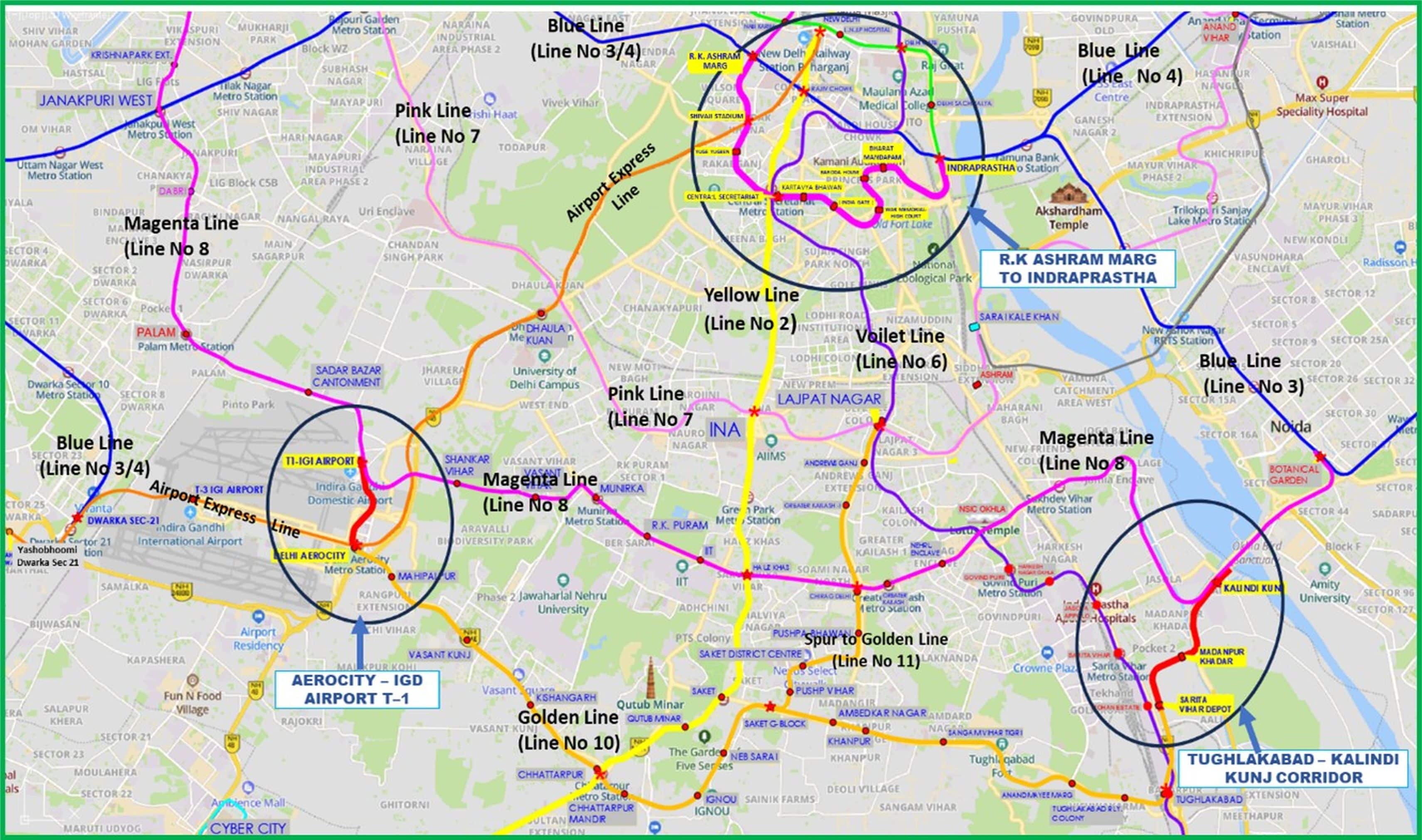
The Union Cabinet chaired by the Prime Minister, Shri Narendra Modi has approved three new corridors - 1. R.K Ashram Marg to Indraprastha (9.913 Kms), 2. Aerocity to IGD Airport T-1 (2.263 kms) 3. Tughlakabad to Kalindi Kunj (3.9 kms) as part of Delhi Metro’s Phase – V(A) project consisting of 16.076 kms which will further enhance connectivity within the national capital. Total project cost of Delhi Metro’s Phase – V(A) project is Rs.12014.91 crore, which will be sourced from Government of India, Government of Delhi, and international funding agencies.
The Central Vista corridor will provide connectivity to all the Kartavya Bhawans thereby providing door step connectivity to the office goers and visitors in this area. With this connectivity around 60,000 office goers and 2 lakh visitors will get benefitted on daily basis. These corridors will further reduce pollution and usage of fossil fuels enhancing ease of living.
Details:
The RK Ashram Marg – Indraprastha section will be an extension of the Botanical Garden-R.K. Ashram Marg corridor. It will provide Metro connectivity to the Central Vista area, which is currently under redevelopment. The Aerocity – IGD Airport Terminal 1 and Tughlakabad – Kalindi Kunj sections will be an extension of the Aerocity-Tughlakabad corridor and will boost connectivity of the airport with the southern parts of the national capital in areas such as Tughlakabad, Saket, Kalindi Kunj etc. These extensions will comprise of 13 stations. Out of these 10 stations will be underground and 03 stations will be elevated.
After completion, the corridor-1 namely R.K Ashram Marg to Indraprastha (9.913 Kms), will improve the connectivity of West, North and old Delhi with Central Delhi and the other two corridors namely Aerocity to IGD Airport T-1 (2.263 kms) and Tughlakabad to Kalindi Kunj (3.9 kms) corridors will connect south Delhi with the domestic Airport Terminal-1 via Saket, Chattarpur etc which will tremendously boost connectivity within National Capital.
These metro extensions of the Phase – V (A) project will expand the reach of Delhi Metro network in Central Delhi and Domestic Airport thereby further boosting the economy. These extensions of the Magenta Line and Golden Line will reduce congestion on the roads; thus, will help in reducing the pollution caused by motor vehicles.
The stations, which shall come up on the RK Ashram Marg - Indraprastha section are: R.K Ashram Marg, Shivaji Stadium, Central Secretariat, Kartavya Bhawan, India Gate, War Memorial - High Court, Baroda House, Bharat Mandapam, and Indraprastha.
The stations on the Tughlakabad – Kalindi Kunj section will be Sarita Vihar Depot, Madanpur Khadar, and Kalindi Kunj, while the Aerocity station will be connected further with the IGD T-1 station.
Construction of Phase-IV consisting of 111 km and 83 stations are underway, and as of today, about 80.43% of civil construction of Phase-IV (3 Priority) corridors has been completed. The Phase-IV (3 Priority) corridors are likely to be completed in stages by December 2026.
Today, the Delhi Metro caters to an average of 65 lakh passenger journeys per day. The maximum passenger journey recorded so far is 81.87 lakh on August 08, 2025. Delhi Metro has become the lifeline of the city by setting the epitome of excellence in the core parameters of MRTS, i.e. punctuality, reliability, and safety.
A total of 12 metro lines of about 395 km with 289 stations are being operated by DMRC in Delhi and NCR at present. Today, Delhi Metro has the largest Metro network in India and is also one of the largest Metros in the world.