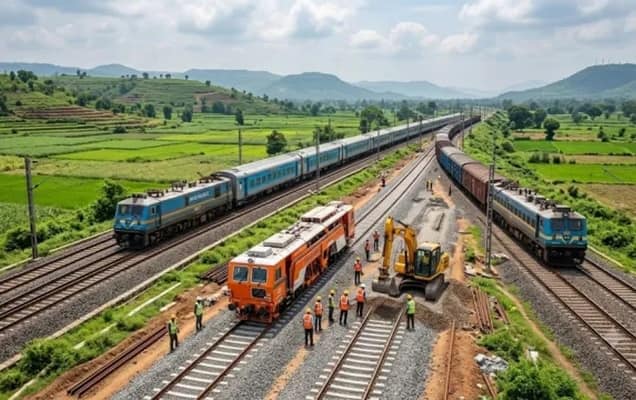
GIFT is a landmark initiative that will revolutionze India’s financial and infrastructural landscape. 

With top quality infrastructure, business oriented and environemnt friendly approach, GIFT will redefine how we look at urban space. 

From domestic corportates, global industries to foreign countries, the entire world is looking at GIFT as an idea whose time has come!


Just a few days ago, Gujarat International Finance Tec-City, popularly known as GIFT did the entire nation proud when it was adjudged the ‘Best Industrial Development & Expansion Project’ by World Finance Magazine. A variety of considerations from infrastrusure, scope, size etc ensured that GIFT emerged victorious, ahead of Moscow’s Internatinal Finance Centre and Songdo in South Korea.

Recent news in TOI states that, “a team from WN Media was in Gandhinagar for an for an on-site inspection of various sustainable processes that will be part of urban planning in Gift city. The WN-Media has three categories of awards, World Finance Banking awards, World Finance Legal awards and World Finance Infrastructure Investment awards. GIFT won in the third category.”

The last few years have witnessed unprecedented growth in India’s financial services sector. Both in terms of share if the GDP and in job creation, this importance of this sector is gaining pace and this is bound to increase even more as time passes. You may have noticed that several developed countries have created high-tech financial hubs serving as focal points of their nation’s development journey be it Shinjuku in Tokyo, Lujiazui in Shanghai or the London Dockyards in UK. With a condusive environment, these centres enhance capital flow and give a great impetus to talent.

It was this vision to revolutionize India’s financial and infrastructure landscape that made Chief Minister Shri Narendra Modi conceptualize GIFT and announced its launch on 28th June 2007.

Situated on the banks of the iconic Sabarmati river, GIFT is located 12 km from Ahmedabad’s International Airport and 8 km from Gujarat’s capital Gandhinagar. GIFT primarily caters to India’s massive financial services sector by offering  world class infrastructure, a business oriented and environment friendly atmosphere. With a target of more than  5,00,00 direct and the same number of indirect jobs, GIFT will provide opportunities to many bright youngsters of India.

The implementation of GIFT marks a wonderful example of how public-private partnership can together script a new roadmap to economic development. Along with a determined vision comes state of the art infrastrucute. GIFT would have 24/7 water supply, electricity along with the communication and transport technologies.

It is not only India but also the world that is seeing an ocean of opportunity in GIFT. Till now, GIFT has attracted a variety of investments from various sectors. Countries from Singapore, Malayasia to China are also serving as active particpiants in this landmark project. Companies such as Fortis and CISCO are among those that have signed MoUs to invest in GIFT.

In December 2011, GIFT created history when it was notified as the International Financial Service Centre (IFSC) for its multi-service Special Economic Zone (SEZ). This accreditation affirms GIFT’s ability to emerge as an international financial hub. 

The future of the world economy lies in stellar infrastructure backed by top quality finance services. It is these international demands that propelled the launch of GIFT project. The project is a ‘win-win’ situation for both India and the world.


Presentation - GIFT: A Global FInancial Hub


Explore More
شری رام جنم بھومی مندر دھوجاروہن اتسو کے دوران وزیر اعظم کی تقریر کا متن

Popular Speeches

شری رام جنم بھومی مندر دھوجاروہن اتسو کے دوران وزیر اعظم کی تقریر کا متن
'Housing for all' by 2029: Centre approves Rs 10,021 crore fund for PMAY-G in 12 states

Media Coverage

'Housing for all' by 2029: Centre approves Rs 10,021 crore fund for PMAY-G in 12 states
NM on the go

Nm on the go

Always be the first to hear from the PM. Get the App Now!
...
Cabinet approves Price Stabilization Fund for Scheduled Indian Airlines towards ATF pricing
June 03, 2026

The Union Cabinet chaired by the Prime Minister Shri Narendra Modi has approved one-time budgetary support not exceeding Rs.10,000 crore for Oil Marketing Companies (OMCs) to provide ATF price stabilisation support to Scheduled Indian Airlines for their domestic and international operations. The budgetary support shall be in the form of interest-free advances to OMCs through the Demands for Grants of the Ministry of Petroleum and Natural Gas. The support shall be provided to OMCs to facilitate stable ATF pricing for airlines during the ongoing period of exceptional fuel price volatility arising from the West Asia crisis.

Key component of the approved of Price Stabilization Fund:

(i) Interest-Free advance to OMCs

A one-time budgetary support of up to Rs.10,000 crore shall be provided as an interest-free advance to OMCs to support ATF price stabilisation for Scheduled Indian Airlines. The corpus shall compe
It will help ensure optimum utilisation of airport infrastructure developed across the country, including airports operationalised under the UDAN scheme.nsate OMCs for losses arising from elevated international ATF prices whenever the prevailing Import Parity Price exceeds the benchmark price determined under the approved mechanism.

(ii) Recovery and True-Up Mechanism

When international ATF prices moderate, the differential amount shall be recovered from OMCs and returned to the Consolidated Fund of India. The arrangement shall continue until the entire support amount is fully recovered and settled.

(iii) Coverage of Domestic and International Operations

The scheme shall be available to all willing Scheduled Indian carriers for both domestic and international operations.

(iv) Fixed ATF Price Arrangement

The mechanism provides greater predictability in fuel costs by adopting a fixed-price arrangement for domestic and international operations, thereby reducing airline’s exposure to sudden fuel price spikes.

(v) Exclusive rights of ATF supply to OMCs

The arrangement will be implemented through an MoU between participating Indian airlines and OMCs, with the Ministry of Civil Aviation and the Ministry of Petroleum & Natural Gas as signatories. Under this one-time arrangement, participating airlines will procure ATF only from OMCs for up to three years, subject to annual review or until the advance amount is fully recovered, whichever is earlier.

(vi) Monitoring and Audit

A Monitoring Committee comprising representatives of the Ministry of Civil Aviation, Ministry of Petroleum & Natural Gas and Department of Expenditure shall oversee implementation, claim verification, reconciliation and settlement. All claims and recoveries shall be subject to audit.

(vii) Duration of Prise Stabilization support

ATF price stabilisation support will be in force for a period of thirty-six months with provision for annual review or until the advance amount is fully recovered/settled, whichever is earlier. The proposal may be extended beyond thirty-six months with the approval of the Competent Authority in case the corpus is not fully trued up within this period.

Expected outcome:

  • The proposed mechanism will provide enhanced stability and predictability in ATF pricing for Indian airlines, enabling better operational and financial planning.
  • It will shield Oil Marketing Companies (OMCs) from losses arising from volatile and elevated ATF prices during the ongoing West Asia crisis.
  • The measure will help protect and sustain domestic and international air connectivity, ensuring continuity of air services.
  • It will reduce the pass-through of fuel price shocks to passengers, thereby helping to moderate fare volatility.
  • The arrangement will support continued air connectivity to remote, regional, Tier-II and Tier-III cities, promoting balanced regional development and inclusive growth.

Key Benefits:

  • Stable airline operations help sustain employment across airlines, airports, ground handling agencies, MROs, travel agencies, hospitality and logistics sectors.
  • Continued air connectivity will facilitates movement of passengers, high-value cargo, business travellers and tourists, thereby supporting economic activity across sectors.
  • The measure will have positive spill-over effects on tourism, hospitality, trade, exports, regional development and investment.
  • It will help ensure optimum utilisation of airport infrastructure developed across the country, including airports operationalised under the UDAN scheme.
  • By preserving domestic and international connectivity, the initiative will strengthen India's integration with global markets and support long-term economic growth.

Background:

The aviation sector has been impacted by unprecedented volatility in global ATF prices following the West Asia crisis.

  • Due to the ongoing West Asia crisis, international ATF prices have surged nearly 2.5 times from Rs.60.50/ litre in March 2026 to Rs.142/litre in May 2026. ATF accounts for nearly 40% of an airline's operating cost. Therefore, this volatility in ATF prices has resulted in high cost pressure on airline financials.
  • ATF accounts for nearly 40% of airline operating costs and during periods of extreme fuel volatility, can constitute up to 60% of total operating expenditure.
  • While ATF price has been capped for domestic operations, Indian carriers continue to purchase ATF for international operations at Import Parity Prices (IPP), exposing them to elevated fuel costs.
  • However, the capping of ATF prices is a temporary measure and not sustainable in the long run for OMCs. Due to the capping of ATF prices, OMCs are also incurring losses particularly with volatile and surging ATF prices during the West Asia crisis.
  • Closure of Pakistan airspace for Indian carriers has resulted in longer flight paths to Europe, North America and Central Asia, increasing fuel burn and operational costs.
  • Long-haul passenger fares have increased substantially, international demand has declined and airlines have reduced or suspended services on several international routes.