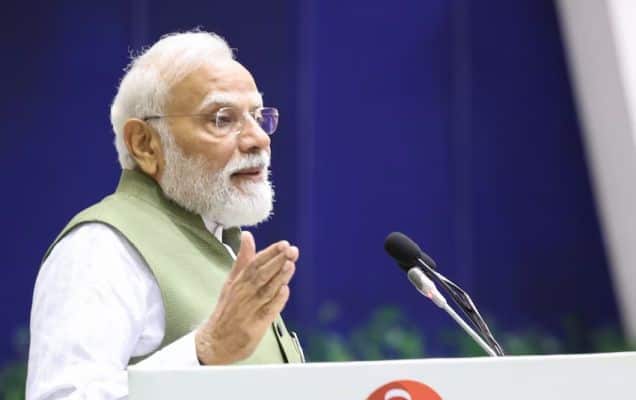
The first meeting of the Governing Council of the National Skill Development Mission (NSDM) was held under the Chairmanship of Hon’ble Prime Minister of India, Shri Narendra Modi on 2 June 2016.
In his remarks at the meeting, the Prime Minister stressed on the need for proper skill mapping and identification of the future requirements for skills, so that school-children and parents are well aware of the emerging trends in the job market. Further, he said a similar exercise should also be done to map the skilled manpower requirements at the global level, so that India can meet the global requirement of skilled workforce.

The Prime Minister also emphasized the importance of imbibing safety norms and soft skills as integral parts of skill development.
The meeting was attended by Chief Ministers of Maharashtra, Arunachal Pradesh and Jammu and Kashmir; Shri Rajiv Pratap Rudy, Minister of State (Independent Charge) Skill Development and Entrepreneurship; Smt Smriti Zubin Irani, Minister of Human Resource Development; Shri Kalraj Mishra, Minister of Micro, Small and Medium Enterprises and Shri Ravi Shankar Prasad, Minister of Communication and Information Technology. Senior bureaucrats, and corporate leaders, including, Shri Cyrus P. Mistry, Chairman, Tata Group; Shri Sachin Bansal, Founder and CEO Flipkart’ and Shri Manish Sabharwal, Chairman and Founder, Team Lease Services also participated in the Governing Council meeting.
Some of the major decisions taken at the meeting included the following:
· Skill training to be scaled up to cover at least 1.5 crore people during 2016-2017.
· The Central Board for Skills Certification to be set up by September 2016 to infuse quality into India’s skill development ecosystem.
· Unutilized infrastructure in existing engineering colleges to be leveraged for skill training courses.
· Profit making Public Sector Units (PSUs) will be mandated to scale up apprenticeships, upto 10% of total manpower, over the course of this year. Private corporations are also expected to follow suit.
· 500 Pradhan Mantri Kaushal Kendras, which will provide skill training free of cost to be opened this year, to impart training to India’s aspiring youth.
· 50 Overseas Employment Skill Training Centres to be opened this year, in migratory pockets of the country.
· 500 Rozgar Utsavs will be held across Industrial Training Institutes (ITIs), Central Training Institutes, PMKVY training centres, toolrooms etc., to make skill training aspirational amongst youth.
· A national skills competition, known as ‘India Skills’ will be launched during 2016-2017, to recognize the skills of India’s youth. This will be an annual event.
· This year, a national level Convocation will be held for candidates who successfully complete ITI courses, to recognize their success.
· Over the next one year, the capacity of ITIs to be further enhanced from 18.5 lakhs to 25 lakhs and over 5000 new ITIs will be created.
· Traditional skills will be recognized, nurtured and promoted through informal apprenticeships, under various programmes.

Background
65% of Indians are under the age of 35. By 2025, almost 1 in 5 of the world’s working age population (18.3%) will be Indian. In order to leverage India’s demographic dividend and prioritise skill development, a dedicated new Ministry for Skill Development and Entrepreneurship (MSDE) was set up, for the very first time, by the newly elected NDA government in November 2014 to steer and coordinate skill development efforts. Skill India is anchored within this new Ministry.
MSDE inherited a highly fragmented ecosystem. 21 Central Government Ministries and departments were implementing over 50 skill training programmes, operating in silos. Conflicting norms between schemes, poor monitoring mechanisms, varying assessment and certification systems and the absence of a coherent vision of success, limited the effectiveness of these initiatives. While there were previous attempts to consolidate this ecosystem through centralised organisations such as the National Skill Development Coordination Board or the Prime Minister’s National Council of Skill Development, 2008 - the fact that multiple bodies existed under different organisations and the lack of focus on execution, made these institutions ineffective.
MSDE has made great strides in a relatively short span of time. Within just six months, key organizations in the skill training and entrepreneurship ecosystem were brought under the Ministry. In just 8 months, MSDE created a National Policy for Skill Development and Entrepreneurship, which articulated an overarching vision to boost the skills development and entrepreneurship ecosystem in India and designed the India’s first National Skill Development Mission to coordinate and scale up skill training efforts. Both these policy initiatives were formally launched by the Hon’ble Prime Minister on 15 July 2015.
The Mission seeks to converge, coordinate, implement and monitor skilling activities on a pan-India basis. It brings key the stakeholders under the Central Government and the States together under one umbrella Mission with a three-tier structure, consisting of: the Governing Council for policy role, Steering Committee for coordination role and Mission Directorate (along with an Executive Committee) for execution. The Governing Council of the Mission is headed by the Hon’ble Prime Minister of India, and is guided by his vision of a ‘Skilled India’.
Skill India has led to transformational change in India’s vocational training ecosystem. Over the last one year, over 1.04 crore youth have been trained under the Mission. This figure is 36.8% higher than the previous year’s recorded data. In the current arrangement, 60% of the trainings are directly under MSDE while 40% are across other Central Ministries. MSDE’s Flagship Scheme, Pradhan Mantri Kaushal Vikas Yojana (PMKVY), which was launched on July 15, 2015 by the Hon’ble Prime Minister, has trained more than 20 lakh people, of which 40 per cent are women candidates, being trained in their choice of skills.
Speed, Scale, Standards and Sustainability are the four core principles of the NSDM. The first Governing Council Meeting was aimed to review the progress undertaken under the Mission on each of these core principles and sought to discuss a concrete agenda for rapidly scaling up skill training efforts, while maintaining high standards.