



My dear fellow countrymen,
I am with you again almost after a month. A month is quite a long time. Lots of things keep happening in the world. You all have recently celebrated the festival of Diwali with great fervour and joy. It is these festivals which bring happiness in our daily lives from time to time. Be it poor or rich, people from village or from urban areas, festivals hold a different significance in everyone’s lives. This is my first meeting after Diwali, so I convey my very warm wishes to you all.
Last time we had some general conversation. But then I came to some new realizations after that conversation. Sometimes we think leave it... nothing is going to change, people are indifferent, they will not do anything, our country is like this. From my last conversation in Mann Ki Baat to this one, I would urge you all to change this mindset. Neither is our country is like this nor our people indifferent. Sometimes I feel the Nation is way ahead and the government is lacking behind. And from my personal experience I will say that the governments too needs to change their mindsets. And I say that because I can see tremendous sense of commitment in the Indian youth. They are very eager to do their bit and are just seeking an opportunity where they can do their bit. And they are making efforts at their own end. Last time I had asked them to buy at least one khadi outfit. I had not asked anyone to be Khadidhari, But the feedback I got from Khadi stores was that in a week’s time the sales had jumped up by 125%. In this way, as compared to last year the sales this year is more than double in the week following 2nd Oct. This means, the people of our country is many times more than we think of. I salute all my fellow Indians.
Cleanliness……….. Can anyone imagine that cleanliness will become a such a huge public movement. The expectations are high and they should be so. I can see some good results, cleanliness can now be witnessed in two parts. One is those huge garbage piles which keep lying in the city; well the people in the government will work to remove those. It is a big challenge but you cannot run away from your responsibilities. All state governments and all municipalities will now have to take concrete actions due to the rising public pressure. Media is playing a very positive role in this. But there is the second aspect which gives me immense pleasure, happiness and a sense of satisfaction that the general public has started feeling that leave what happened in the past, now they will not dirty their surroundings. We will not add to the existing dirt. A gentleman Mr Bharat Gupta has sent me a mail on mygov.in from Satna, Madhya Pradesh. He has related his personal experience during his tour of the railways. He said that people eat on trains and usually litter around. He continues to say that he has been touring from the past many years but it is this time around no one was littering, rather they were looking for dustbins to throw their trash. When they could not see any arrangements they collected all their litter in a corner. He says that it was a very gratifying experience for me. I thank Bharat ji for sharing this experience with me.
What I am seeing is that this campaign has had a great influence on kids. Many families mention that now whenever kids eat a chocolate they themselves pick the wrapper and disposes it. I was seeing a message on the social media. Someone had posted a picture with the Title “My hero of the Day”. This picture was that of a little kid who, picks up trash, wherever he goes, even when going to school. He is himself motivated to do this. Just see…people now feel it is their country and they will not make it dirty. We will not add to the existing dirt pile. And those do litter feel ashamed for someone is around to point it out to them. I consider all these to be good omens.
Another thing is that many people come to meet me who are from all the sections of the society. They can be government officers, from film world, sports world, industrialists, scientists ……. All of them, whenever they interact with me, in ten minutes discussion, about four to five minutes the discussion is on social issues. Someone talks about cleanliness, while some others talk about education, while someone talks about social reforms. Some people discuss the ruining of family life. I initially thought if a businessman comes, he will definitely talk of things of his personal interest. But I am seeing a major change.
They talk less about their interest and more about taking on some or the other social responsibility. When I add up all these small incidents I see a larger picture and I realize that we are moving in the right direction. It is true that unhealthy environment leads to diseases and sickness, but where does sickness strike first. It first strikes the poor household. When we work towards cleanliness, we make a major effort in the direction of helping the poor. If the poor families are saved from diseases, then they will be saved from a lot of financial problems. If a person is healthy, then he will work hard, earn for the family and help in running the family smoothly. And so this cleanliness drive is directly related to the health and welfare of my poor brethren. We may not be able to do something to help the poor, but even keeping the environs clean helps the poor in a big way. Let us view it from this perspective; it will be very beneficial.
I receive different kinds of letters. Last time I had mentioned about our specially abled children. Whom God has given some kind of deficiencies; I had expressed my feelings regarding those people. I see that people who work in this field are sending me their success stories. But I came to know about two things from my people in the government. The people from the HRD ministry after hearing my talk, felt the need to do something. And the officers came together to work out an action plan. This is an example of how changes are coming about in governance. One they have decided that those specially abled who want to pursue technical education, a thousand of them who are good will be selected for Special Scholarships, and a plan has been made. I congratulate the officials who could think in those lines. Another important decision is that all the Kendriya Vidyalaya’s and all Central Universities will have a special infrastructure for the specially abled, for example if they can’t climb stairs then there will be provision for ramps to facilitate movement by wheel chair. They need different kinds of toilets. The HRD ministry has decided to allocate an additional Lakh rupees to the Kendriya Vidyalays and Central universities. This fund will be used by these institutions to create infrastructure for the specially abled. This is an auspicious beginning……………these things will lead us to change.
I had the chance to visit Siachin a few days back. I spent Diwali with the Jawans who are ready to lay down their lives for the nation. When the nation was celebrating Diwali I was at Siachin. It is because of them that we were able to celebrate Diwali, so I wanted to be with them. I experienced the difficulties in which they spent their time there. I salute all my Jawans. But I want to share another matter of great pride with you. Our Jawans work in the field of security. In calamities, they risk their lives to save our life. They also fetch medals for us in sporting events. You will be glad to know that these Jawans have won a gold medal in a very prestigious event in Britain called Cambrian Patrol, defeating contestants from 140 nations. I offer these Jawans my heartiest congratulations.
I also got an opportunity to meet, the young and dynamic students, boys and girls over tea who had won medals in Sports. They give me renewed energy. I was seeing their zeal and enthusiasm. The facilities in our country are quite less as compared to other nations, but instead of complaining they were just sharing their joy and excitement. For me, this tea programme for these players was very inspiring, and I felt really good.
I would like to tell you something more and that too from my heart. I truly believe that people of my country trust my words and my intentions. But, today one more time, I want to reiterate my commitment. As far as black money is concerned, my people, please trust your Prime Servant, for me this is the Article of Faith. This is my commitment that the hard-earned money of the poor people stashed abroad, every penny of that should be brought back. The ways and means to be followed can be different. And this is very obvious in a democratic country, but on the basis of as much I understand and as much I know, I assure you that we are on the right track. Today, nobody, neither me, nor the government, nor you, nor even the previous government knew how much money is stashed abroad. Everyone gives estimate calculated in his/her own way. I don’t want to get lost in some such figures and estimates, Its my commitment that, be it 2 rupees, or 5 rupees, or millions or even billions, this is the hard-earned money of the poor people of my country and it has to come back. And I assure you that I will keep trying till the end. No efforts will be spared. I want your blessings to be always with me. I assure you that I will do whatever and whenever something is required to be done for you. I give my commitment to you.
I have received a letter. It has been sent by Sri Abhishek Pareekh. The same sentiments were expressed to me by many mothers and sisters when I was not even the Prime Minister. Some doctor friends had also expressed their concern and I too have expressed my views on this issue a number of times in the past. Mr. Parikh has drawn my attention towards the increase of drug addiction that is fast catching up with our young generation. He has asked me to discuss this topic in “Mann ki Baat.” I agree with his concern and I will definitely include this topic, in my next edition of Mann Ki Baat. I will discuss the topic of drugs, drug addiction and drug mafia and how they are a threat to our country’s youth. If you have some experience, any information in this regard, if you have ever rescued any child from this drug addiction, if you know of any ways and means to help, if any government official has played a good role, if you give me any such information, I will convey such efforts to the public and together we will try to create an environment in each family that no child ever thinks of choosing this vice out of sheer frustration. I will definitely discuss this in detail in the next edition.
I know I am choosing those topics which put the government in the dock. But how long will we keep these things hiding? How long will we brush these important concerns under the carpet? Some day or the other we need to take a call, follow our instincts and for grand intentions tough calls are equally important. I am mustering the courage to do so because your love inspires me to do so. And I will continue to do such things because of your love.
Some people told me “ Modi ji you asked us to send you suggestions on Facebook, twitter or email. But a large section of the social class does not have access to these facilities, so what can they do. Your point is very valid. Everyone does not have this facility. Well then, if you have something to say related to Mann Ki Baat, that you hear on the radio even in the villages then do write into me on the following address
Mann Ki Baat
Akashvani
Sansad Marg
New Delhi.
Even if you send some suggestions through letters they will definitely reach me. And I will take them seriously as active citizens are the biggest asset for development. You write one letter, it indicates that you are very active. When you give your opinion, it means that you are concerned with national issues and this is strength of the nation. I welcome you.
For my Mann Ki Baat, your mann ki baat sould also reach me. Maybe you will definitely write a letter. I will try and interact with you again next month. I will try, that whenever I talk, it is Sunday, around 11 am. So I am getting closer to you.
The weather is changing. Winters are slowly setting in. This is a good month for health. Some find it a good season for eating. Some find it good for wearing nice clothes. Besides food and clothes it is a good season for health. Don’t let it go waste. Make the most of it.
Thank You.
(The original speech was in Hindi, this is the English rendering. Original speech remains the authoritative version)
Published By : Admin |
November 2, 2014 | 11:28 IST
-
Share
-

-

-


Login or Register to add your comment
Explore More

Popular Speeches
Today, the entire country and entire world is filled with the spirit of Bhagwan Shri Ram: PM Modi at Dhwajarohan Utsav in Ayodhya

Nm on the go
Always be the first to hear from the PM. Get the App Now!

Our government is fully committed to creating a modern sports ecosystem for the 21st century in India: PM Modi
August 27, 2026
-
Share
-
-
-
Khelo India has become a wonderful platform for nurturing sporting talent across the country; It is providing young athletes with opportunities and support to pursue their dreams: PM
When I talk about sports, it isn't just about winning medals; It is a campaign to integrate India's sports power and youth energy to build a Viksit Bharat: PM
Other countries are winning medals in sports where India does not even participate; we must master these sports as well: PM
Sports teaches us not only to become champions, but also to become better competitors; to rise, to fall, and to rise again: PM
Sports centres are more important than screens; Playgrounds are more important than PlayStations: PM
Namaskar.
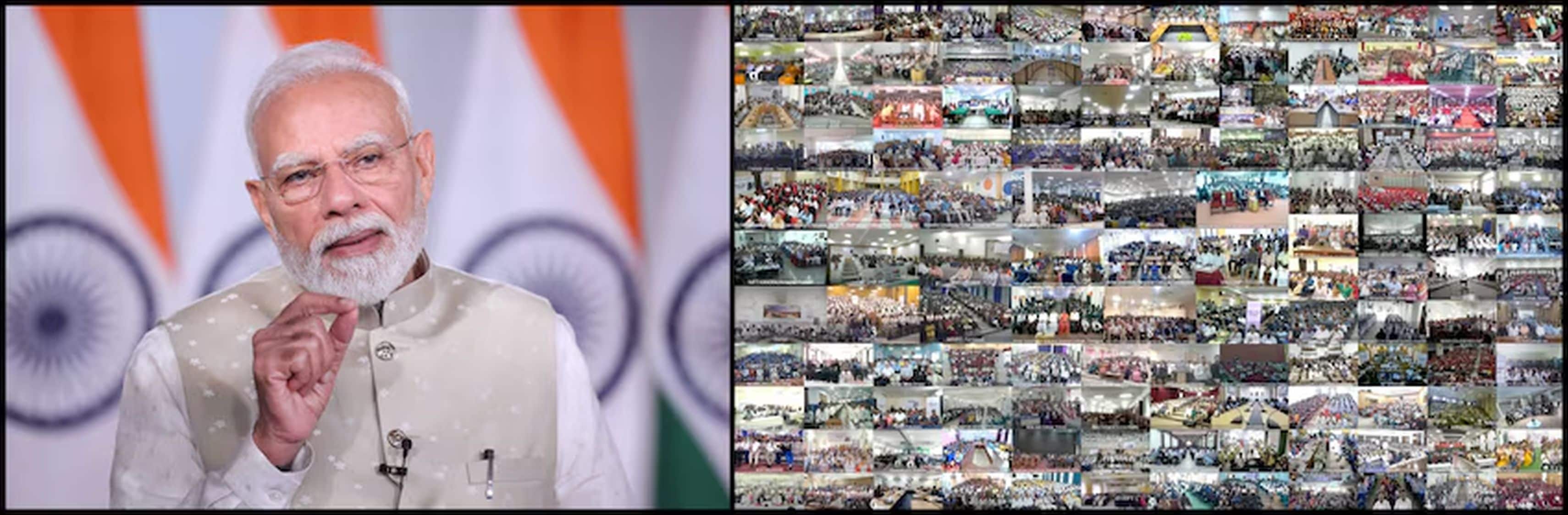
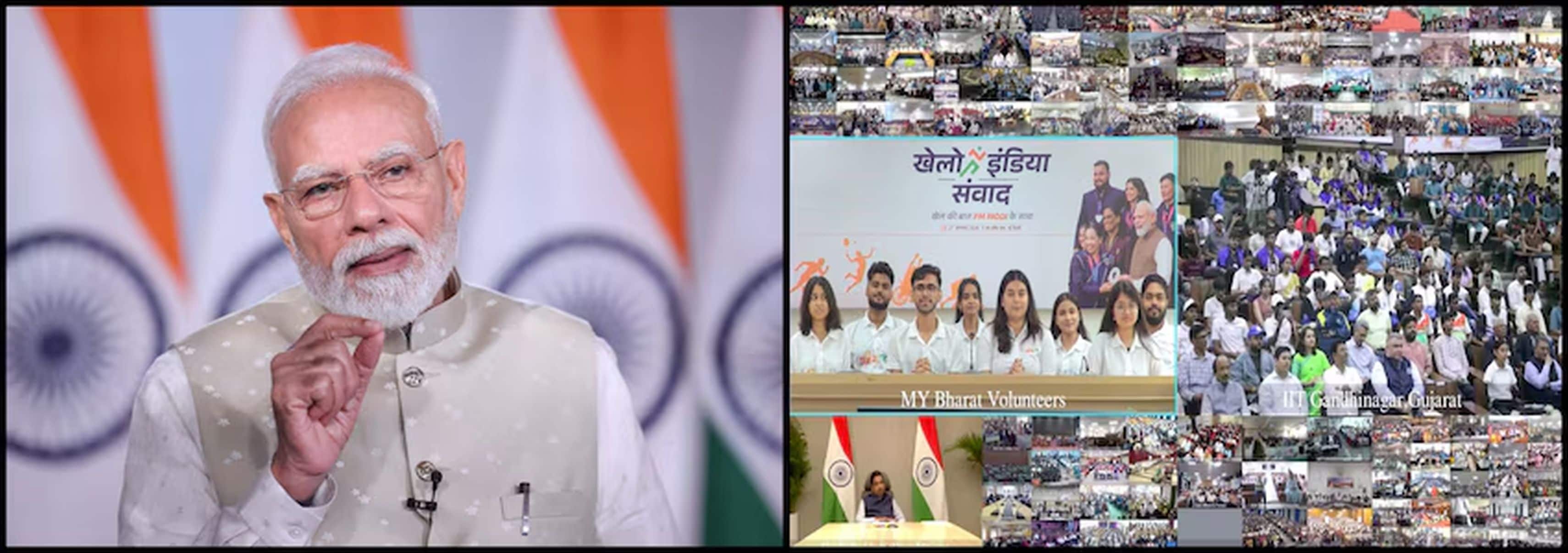
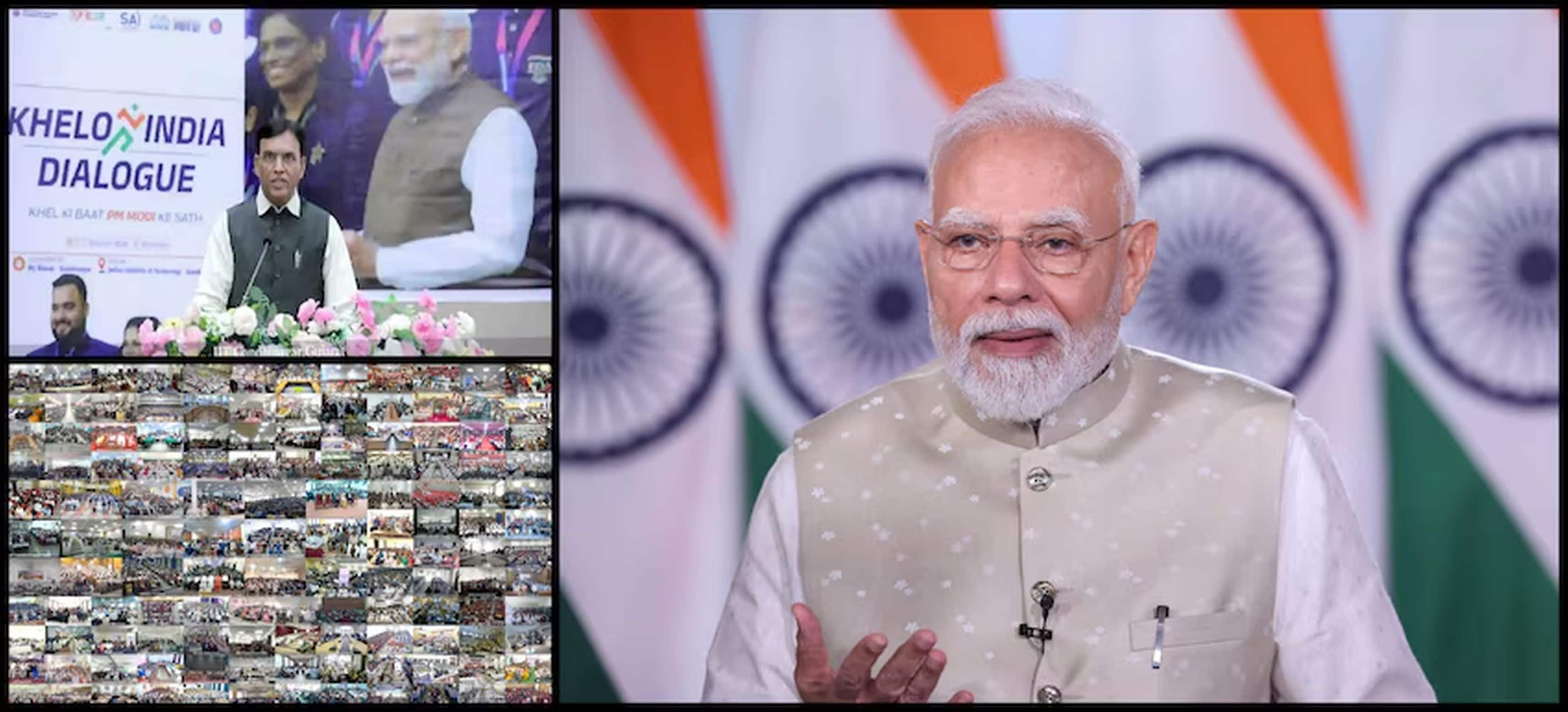
You all have organized this Khelo India Samvad program in such a wonderful way. I extend my heartfelt congratulations to all of you. Through technology, I warmly greet my colleagues from the Union Cabinet connected with this program, all Chief Ministers, many ministers from state governments, my colleagues in Parliament, and the lakhs of volunteers of My Bharat. Today, athletes from across the country and distinguished personalities from the sports world have also joined us in this program.
You all know, friends,
Two days later, on 29th August, it will be National Sports Day. I extend advance greetings of Sports Day to all of you, to the youth across the country, and to all companions connected with the sports world. This day is also an occasion to remember one of Mother India’s great sons, Major Dhyan Chand ji. A hundred years ago, the Indian Army’s hockey team went on a tour to New Zealand, and Dhyan Chand ji was part of that team. That tour laid the foundation of 100 years of sports relations between India and New Zealand. A few days ago, I visited New Zealand. There too, I remembered him. The relationships that Major Dhyan Chand ji laid the foundation for, today India is continuously working for their prosperity.
Friends,
On this 15th August from the Red Fort, I placed India’s sports vision before the nation. When I speak of sports, it is not limited only to winning medals. It is a campaign to combine India’s sports power and India’s youth power together in building a developed India. I have always said - jo khelega, woh khilega - “whoever plays, will blossom.” And blossoming in sports is not only about winning on the field. Blossoming in sports means blossoming of personality, blossoming of family, and increasing the pride of the nation.
Friends,
When a player succeeds, that success is not only his or hers. That success builds the identity of his family, increases their prestige. The school and college where he studied, their prestige increases. The identity of his district and state becomes stronger. That is, the world begins to recognize that city or state by the name of that player. And when many such successes make a region shine on the global sports map, the world’s perspective of that city also changes. In today’s program, players from hundreds of districts of the country are connected. Every district has the strength to shine on the world’s sports map. Understanding this strength, we must carry forward this dialogue program.
Friends,
This time from the Red Fort I also drew the nation’s attention to a very big challenge related to sports. This challenge is connected with the Olympics. A bitter truth is that in the Olympics, of all the different sports, India’s teams participate in only half of them. That means for a very large part of the medal tally, we do not even compete. And this has been going on for decades. In the 2012 Olympics, India participated in only 13 sports. In more than 20 sports, India had no participation. And in those 20+ sports, many are such that people in the country may hardly have even heard their names. Other countries win medals in those sports, and we do not even participate. To increase our medal tally, we must achieve mastery in those sports too. For example, surfing and sports climbing - we have such a large coastline, such a vast mountainous region, where there can naturally be interest in these sports. We have both the demography and the geography for water sports and winter sports. Yet we are not visible in such sports globally. Therefore, we must explore possibilities in different districts where an ecosystem for a particular sport can be developed. And in this, today’s program has a very big role.
Friends,
When we talk of preparing for the 2036 Olympics, our focus should be that we must prepare today those players who will qualify and compete in different sports in 2036. That is why, from the Red Fort, I announced a major talent hunt campaign to identify players between the ages of 5 and 15. And in this too, we must not only see which child is interested in which sport, but also which child is fit for which sport. We must train the child accordingly. And I assure you all, whatever support is needed from the government, the government will walk shoulder to shoulder with you.
Friends,
Our government is fully committed to building a modern sports ecosystem of the 21st century in India. Today, from sports universities to modern training centers, a system is being created in the country where at every level - from identifying talent to bringing it to the world stage - support is available. We are also increasing cooperation with other countries of the world to share sports science, training, coaching, and experiences.
Friends,
How serious the government is about sports, this very event is an example of it. Khelo India Samvad is not just a program to talk about sports. It is a platform of dialogue where every idea can give a new direction to the country’s sports vision. And along with this, the youth dialogue happening here is a great medium to connect your ideas and aspirations with the dreams of the nation. In this program, what the youth think about the sports ecosystem, talent development, governance, and developed India, what their suggestions are - these will be heard and included in the policy process. Therefore, I urge you all to make maximum meaningful use of this platform, bring new ideas. These new ideas of youth power will become the strength for achieving a developed India.
Friends,
We often hear that for a healthy society, for a good family system, for a better work culture, sports‑person spirit is very necessary. And this sports‑person spirit is very difficult to learn without going to the sports field. Sports not only teach us to become champions, but also teach us to become better competitors. To rise, to fall, to rise again after falling - sports bring this spirit within us.
Friends,
A big example of how sports change life is our para‑athletes. When someone sees para‑athletes on the field, their perspective on life changes. And when they achieve something, along with that athlete, their entire family gets a new life. The parents, brothers, sisters, who saw their child struggling in the early days - for them, the success of that differently‑abled athlete gives their dreams and courage a new height.
Friends,
I myself have always been inspired by such players. For example, you have all heard the name - in archery, our daughter, an amazing player, you know her name? Sheetal. When she won a medal in the Paralympics, the whole of Jammu & Kashmir, the whole of Hindustan was filled with pride. Similarly, our daughter Avani Lekhara, who has won medals twice in the Paralympics. Whenever I meet daughter Avani, I feel very proud. Whether it is Sumit Antil, Nitesh Kumar, or just recently you must have heard the name of our Jhandu Kumar - such para‑athletes, such companions, inspire us too.
Friends,
Sports are a guarantee of a better life. Sports make us fit to live a better life, improve our quality of life. We all know about Fauja Singh ji. Last year, at more than 100 years of age, Fauja Singh ji passed away. Love for sports, fitness - how it continues lifelong, Fauja Singh ji was an example of this. His life is a great inspiration that shows how sports and quality of life are connected.
Friends,
Another very big benefit of sports is that true players develop the willpower to stay away from drugs and intoxication. Today, when such a big challenge of addiction is before the youth, sports play a very meaningful role in this too.
Friends,
I am happy that today in India sports have emerged as an excellent profession. Society’s perspective toward sports has changed. Today you can see, people in our country are participating in triathlons, running 5K and 10K races. Friends are coming together to complete challenges like Hyrox. Someone is celebrating doing a headstand for the first time, someone is playing pickleball and badminton with friends and family. These are small things, but if you look at them from a larger perspective, you see a big change. The change is that sports are now becoming part of our lives. If timetables are being made for study and career, then sports are also getting a place in the daily routine. And this is the change, this is the transformation, because of which trust in India’s sports future is increasing.
Friends,
A sports culture in the country is built only when ordinary people are connected with it. When schools consider sports periods not as co‑curricular, but as part of life. When this happens, the talent pool increases, and children who want to take sports as a career also get support from their families. That is why I say - more important than screens are sports centers. More important than PlayStation is the playground. And this will happen only when all you young companions carry forward this approach.
Friends,
I have great trust in the capability and success of India’s youth power. I want to say to every youth of the country - whether on the sports field or in society, your participation is India’s strength. If you love sports, then many avenues are being created to connect with it. Now new sports equipment has come, new technology has come. Training and coaching methods have changed. The needs of organizing sports, of competition, of disciplines have changed. Equipment design, sports technology, sports medicine, nutrition, psychology, analytics - in all these areas new opportunities are being created for youth. You must not miss these opportunities. Therefore, in this dialogue, present your ideas openly. This participation of youth power is the greatest strength of developed India. Once again, I extend my best wishes to all you young companions.
Thank you.
Vande Mataram.
- Tags

- Khelo India Dialogue
- Khelo India
- Sports
- Yuva Shakti
- Technology
- MY Bharat
- National Sports Day
- Major Dhyan Chand
- Hockey
- New Zealand
- Independence Day
- Red Fort
- Viksit Bharat
- Athletes
- Olympics
- Khelo India Centres of Excellence
- Indian Coast Guard
- Water Sport
- Khelo India Winter Games
- National Sports University
- Training
- Good Governance
- World Para Athletics Championship
- Divyang
- Archery
- Avani Lekhara
- Sumit Antil
- Futuristic Reform
- Speech


Posted via www.narendramodi.in