Lays foundation stone for 3 semiconductor facilities worth about Rs 1.25 lakh crores
“India is set to become a prominent semiconductor manufacturing hub”
“A self-confident youth changes the destiny of the nation”
“India's rapid progress is driving confidence in our Yuva Shakti”
“India commits, India delivers and democracy delivers”
“Chip manufacturing will take India towards self-reliance, towards modernity”
“Chip manufacturing opens the door to limitless possibilities”
“Youth of India are capable and they need an opportunity. The Semiconductor initiative has brought that opportunity to India today”

Namaskar!

My cabinet colleague Shri Ashwini Vaishnaw ji, Rajeev Chandrasekhar ji, as well as the Chief Ministers of Assam and Gujarat, Chairman of Tata Group Shri N Chandrasekaran, Chairman of CG Power Vellayan Subbiah ji, and all other dignitaries from the Centre, State, and Industry. Ladies and gentlemen!

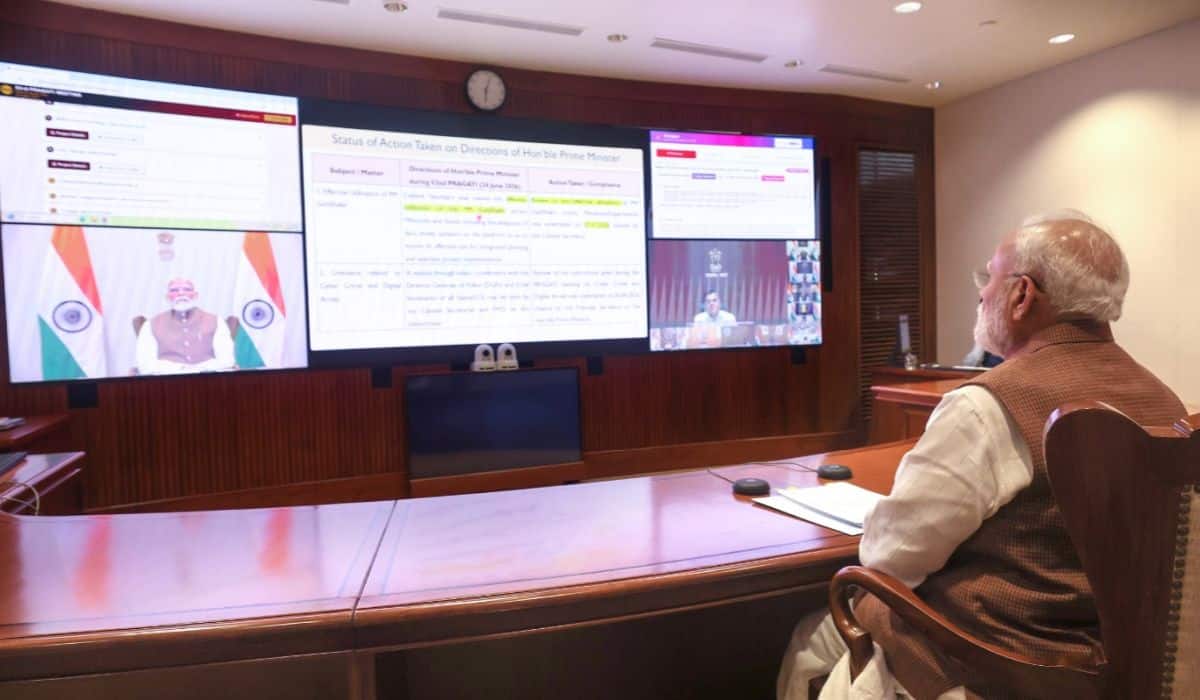
Today marks a historic occasion as we embark on a journey to create history and take a significant stride towards a brighter future. The foundation stones for three major projects, collectively worth approximately Rs 1.25 lakh crore, dedicated to semiconductor manufacturing, have been laid. These semiconductor facilities, located in Dholera and Sanand in Gujarat, and Morigaon in Assam, will contribute to positioning Bharat as a major global hub for semiconductor manufacturing. I extend my heartfelt congratulations to all fellow countrymen for this significant initiative, marking a pivotal beginning and a decisive step forward. It is noteworthy that our friends from Taiwan have also participated in this programme virtually. These efforts by Bharat are also exciting me tremendously!

Friends,

On this remarkable occasion, we are honoured to be joined by over 60 thousand colleges, universities, and educational institutions from across the country, setting a record in itself! I had specifically requested the Ministry to ensure maximum participation of our youth in today's program, recognizing it as the cherished dream of the nation's youth. Today's event is indeed the beginning of semiconductor projects, but the youngsters, the students seated before me today are the true stakeholders of Bharat's future, embodying the vigour and potential of our nation. Hence, it was my earnest desire that students from every corner of Bharat witness this historic moment firsthand. Today, they witness Bharat's comprehensive efforts towards progress, self-reliance, and bolstering its global presence in the supply chain, which in turn will bolster their confidence. As we know, a confident youth has the power to shape the destiny of their nation. I extend a warm welcome and hearty congratulations to every student participating in this programme.

Friends,

The 21st century is indisputably driven by technology, with electronic chips playing a pivotal role. The development of 'Made In India chips', designed in India, holds immense potential in propelling our nation towards self-sufficiency and modernization. Despite being left behind during the first, second, and third industrial revolutions due to various reasons, Bharat is now confidently forging ahead to lead the fourth industrial revolution, Industry 4.0. We are determined not to squander a single moment, exemplified by the rapid progress showcased in today's programme. It is a testament to our commitment and efficiency in working towards our goals. Two years ago, we initiated the Semiconductor Mission, and within a few months, we signed our first MoUs. Today, within just a few months, we are laying the foundation stone of three projects. India commits, India delivers, and democracy delivers!

Friends,

Only a handful of countries around the globe are currently engaged in semiconductor manufacturing. The COVID-19 pandemic has underscored the critical importance of a reliable and resilient supply chain, prompting Bharat to play a significant role in this domain. Already established as a space, nuclear, and digital power, Bharat is poised to venture into commercial production of semiconductor-related products in the near future. The day is not distant when Bharat will emerge as a global powerhouse in this field. Moreover, the decisions and policies being implemented by Bharat today will confer strategic advantages in the future. Efforts to promote Ease of Doing Business and simplify regulations have led to the elimination of over 40,000 compliances by our government in recent years. Furthermore, Foreign Direct Investment (FDI) rules have been streamlined to facilitate investment in Bharat, with liberalization extending to sectors such as defence, insurance, and telecom. In recent years, we have also strengthened our position in electronics and hardware manufacturing. Concurrently, initiatives like the Production-Linked Incentive (PLI) schemes for large-scale electronics manufacturing and IT hardware, as well as incentives for electronic components and electronics manufacturing clusters, have opened up new avenues for progress in the electronics sector. Presently, Bharat ranks as the world's second-largest mobile phone manufacturer. Additionally, initiatives like the National Quantum Mission and the establishment of the National Research Foundation to promote innovation are underway. The India AI Mission is poised for rapid expansion, indicating our country's stride not only towards technology adoption but also technological advancement.

Friends,

The youth of Bharat stand to benefit most from the semiconductor industry. This industry encompasses various sectors, from communication to transportation, and plays a significant role in generating revenue and employment on a global scale, amounting to billions of dollars. Chip manufacturing isn't just an industry; it represents a pathway to development, brimming with boundless possibilities. Not only will this sector create new employment opportunities in Bharat, but it will also foster significant progress in technological advancements. Presently, the majority of semiconductor chip designs worldwide are conceived by the brilliant minds of Indian youth. Therefore, as Bharat strides forward in semiconductor manufacturing, we are effectively completing this cycle of talent ecosystem. The youth participating in today's programme understand the emerging opportunities unfolding in the country. Bharat has opened up sectors such as space and mapping for its youth. The incentives and encouragement that our government has given to the start-up ecosystem are unprecedented. Remarkably, Bharat has ascended to become the third-largest startup ecosystem globally within a short span. Following today's event, our startups will find fresh avenues in the semiconductor sector. I am confident that this new initiative will provide our young generation with opportunities to embark on advanced technology careers.

Friends,

You may recall my declaration from the ramparts of the Red Fort: "This is the moment, the opportune time." When we formulate policies and decisions with this mindset, we see results. Bharat has now transcended old ideologies and approaches, forging ahead with swifter decision-making and policy implementation. While we may have lost precious decades that could have been used towards semiconductor manufacturing, we refuse to squander another moment, and such stagnation shall not recur.

Bharat first aspired for semiconductor manufacturing back in the sixties. Despite this aspiration, governments of those times failed to capitalize on the opportunities. The primary hindrances were a lack of will, inability to translate resolutions into achievements, and failure to make bold decisions for the nation's benefit. Consequently, Bharat’s semiconductor dream remained unfulfilled for years. The leadership of those times adopted a complacent attitude, believing that progress would naturally occur in due course. They regarded semiconductor manufacturing as a future necessity, overlooking its immediate relevance. Governments believed that semiconductor manufacturing was a future necessity, so why address it presently? They failed to prioritize the country's needs and lacked the foresight to recognize its potential. They viewed Bharat as a poor nation incapable of managing high-tech industries like semiconductor manufacturing. Using Bharat's poverty as an excuse, they neglected investments in modern requirements. While indulging in scams worth thousands of crores, they neglected investments of similar magnitude in semiconductor manufacturing. Such thinking hinders a country's development. Therefore, our government adopts a forward-thinking and futuristic approach.

Today, we are advancing in semiconductor manufacturing with ambitions that rival those of developed countries. All the priorities of our country have been duly addressed. On one hand, we are constructing pucca houses for the poor, while on the other, Bharat is investing lakhs of crores of rupees to foster research. Simultaneously, we are spearheading the world's largest sanitation campaign while advancing in semiconductor manufacturing. Furthermore, we are swiftly alleviating poverty while simultaneously enhancing Bharat's infrastructure and fostering self-reliance. In 2024 alone, I have inaugurated schemes worth over Rs 12 lakh crore, symbolizing Bharat's rapid progress. Yesterday we witnessed the 21st century Bharat's strides in defence technology with a glimpse of the self-reliant defence sector in Pokhran. Just two days ago, Bharat witnessed its entry into the exclusive league of nations with the Agni-5. Moreover, the Drone revolution started in the country's agriculture sector just 2 days ago, with thousands of drones distributed to women through the Namo Drone Didi scheme. Additionally, Bharat's preparations for Gaganyaan have gained momentum, and the country celebrated the unveiling of its first domestically produced fast breeder nuclear reactor. These collective endeavours and projects are propelling Bharat towards its developmental objectives at an accelerated pace. Undoubtedly, the significance of these three projects unveiled today will further contribute to this trajectory of progress.

And friends,

You are likely aware of the prevalent discourse surrounding Artificial Intelligence (AI). Bharat's talent pool holds significant sway in the AI domain globally. Perhaps you have observed the series of speeches I have delivered over the past few weeks. Some young individuals approached me and expressed their desire to disseminate every word of my speeches to every village, in every language. Leveraging AI tools, they have enabled you to soon listen to my speeches in your native language. Whether it's Tamil, Punjabi, Bengali, Assamese, Oriya, or any other language, this technological marvel, orchestrated by the youth of our nation, is remarkable. This is the miracle of AI. I extend my gratitude to this team of youngsters for their exceptional AI-driven initiative, facilitating the interpretation of my speeches in all Indian languages. It brings me immense joy and satisfaction. Soon, our message will transcend language barriers through AI as well. What I wish to convey is that Bharat's youth, brimming with potential, require opportunities. Our semiconductor initiative has presented a significant opportunity for the youth of our nation.

Friends ,

Once again, I extend my best wishes to all of you. I wholeheartedly agree with Himant Ji that no one in the NorthEast region had ever imagined that such significant initiatives could be undertaken, but we have resolved to do so. I firmly believe that as our ties with Southeast Asia strengthen, the North East will emerge as the most influential region for fostering connections with Southeast Asia. I foresee this clearly, and I see the commencement of this transformation. Therefore, today, I extend my heartfelt congratulations and best wishes to the people of Assam and the entire North East region.

Friends,

I urge all of you to continue contributing to Bharat's progress, to keep forging ahead. I assure you, 'Modi's guarantee' is unwaveringly behind you, supporting you and your future endeavours.

Thank you very much.

Explore More
శ్రీరామ జన్మభూమి ఆలయ ధ్వజారోహణ ఉత్సవం సందర్భంగా ప్రధానమంత్రి ప్రసంగం

ప్రముఖ ప్రసంగాలు

శ్రీరామ జన్మభూమి ఆలయ ధ్వజారోహణ ఉత్సవం సందర్భంగా ప్రధానమంత్రి ప్రసంగం
India-US trade deal will expand cotton demand, benefit farmers: Piyush Goyal

Media Coverage

India-US trade deal will expand cotton demand, benefit farmers: Piyush Goyal
NM on the go

Nm on the go

Always be the first to hear from the PM. Get the App Now!
...
In this decade of the 21st century, India is riding the Reform Express: PM Modi at ET Now Global Business Summit
February 13, 2026
Amid numerous disruptions, this decade has been one of unprecedented development for India, marked by strong delivery and by efforts that have strengthened our democracy: PM
In this decade of the 21st century, India is riding the Reform Express: PM
We have made the Budget not only outlay-focused but also outcome-centric: PM
Over the past decade, we have regarded technology and innovation as the core drivers of growth: PM
Today, we are entering into trade deals with the world because today's India is confident and ready to compete globally: PM

You are all welcome to this Global Business Summit; I extend my greetings to each one of you. We are here to discuss the theme “A Decade of Disruption, A Century of Change.” After listening to Vineet ji’s speech, I feel my task has become much easier. But let me make a small request-since you know so much, it should sometimes also be reflected in ET.

Friends,

The past decade of the 21st century has been one of unprecedented disruption. The world has witnessed a global pandemic, tensions and wars in different regions, and supply chain breakdowns that shook the global balance, all within a single decade. But friends, it is said that the true strength of a nation is revealed in times of crisis, and I take great pride in the fact that amid so many disruptions, this decade has been one of unprecedented development for India, marked by remarkable delivery and the strengthening of democracy. When the previous decade began, India was the eleventh-largest economy. Amid such turbulence, there were strong apprehensions that India might slip further down. But today, India is moving rapidly toward becoming the world’s third-largest economy. And the “Century of Change” that you speak of will, I say with great responsibility, rest significantly on India. Today, India contributes more than 16 percent to global growth, and I am confident that in every coming year of this century, our contribution will keep increasing steadily. I have not come here like an astrologer making predictions. India will drive global growth; it will emerge as the new engine of the world economy.

Friends,

After the Second World War, a new global order took shape. But after seven decades, that system is breaking down. The world is moving toward a new world order. Why is this happening? It happened because the foundation of the earlier system was based on a “One Size Fits All” approach. It was believed that the world economy would be centered in the core and that supply chains would become strong and dependable. Nations were seen merely as contributors within that framework. But today, this model is being challenged and is losing its relevance. Every country now realizes that it must build its own resilience.

Friends,

What the world is discussing today, India made part of its policy as early as 2015, ten years ago. When NITI Aayog was established, its founding document clearly articulated India’s vision: India would not import a single development model from any other country. We would pursue an Indian approach to India’s development. This policy gave India the confidence to make decisions according to its own requirements and in its own national interest. That is a key reason why, even during a decade of disruption, India’s economy did not weaken but continued to grow stronger.

Friends,

In this decade of the 21st century, India is riding on a Reform Express. The greatest feature of this Reform Express is that we are accelerating it not out of compulsion but with conviction, and with a commitment to reform. Many distinguished experts and stalwarts of the economic world are present here. You have seen the period before 2014. Reforms were undertaken only when circumstances forced them, when crises struck, when no other option remained. The reforms of 1991 happened when the country faced the danger of bankruptcy and had to pledge its gold. That was the approach of earlier governments-they undertook reforms only out of compulsion. After the 26/11 terrorist attack, when the Congress government’s weaknesses were exposed, the NIA was formed. When the power sector collapsed and grids began to fail, only then did reforms in the power sector occur out of necessity.

Friends,

There is a long list of examples reminding us that when reforms are made under compulsion, neither the correct results nor the desired national outcomes are achieved.

Friends,

I am proud that in the last eleven years, we have carried out reforms with complete conviction-reforms in policy, in process, in delivery, and even in mindset. Because if policy changes but processes remain the same, if the mindset remains unchanged, and if delivery does not improve, reforms remain merely pieces of paper. Therefore, we have made sincere efforts to transform the entire system.

Friends,

Let me speak about processes. A simple yet crucial process is that of Cabinet notes. Many here would know that earlier, it would take months just to prepare a Cabinet note. How could a nation develop at that speed? So we changed this process. We made decision-making time-bound and technology-driven. We ensured that a Cabinet note would not remain on any officer’s desk beyond a fixed number of hours-either reject it or take a decision. The nation is witnessing the results today.

Friends,

Let me also give the example of approvals for railway overbridges. Earlier, it would take several years to get a single design approved. Multiple clearances were required, and letters had to be written at various levels-and I am speaking not about the private sector, but about the government. We changed this as well. Today, see the pace at which road and railway infrastructure is being built. Vineet ji elaborated on this extensively.

Friends,

Another interesting example is border infrastructure, which is directly linked to national security. There was a time when even constructing a simple road in border areas required permissions from Delhi. At the district level, there was practically no authority empowered to make decisions; there were wall upon walls, and no one could take responsibility. That is why, even decades later, border infrastructure remained in poor condition. After 2014, we reformed this process, empowered local administration, and today we are witnessing rapid development in border infrastructure.

Friends,

One reform in the past decade that has created a stir worldwide is UPI, India’s digital payment system. It is not merely an app; it represents an extraordinary convergence of policy, process, and delivery. Those who could never even imagine accessing banking and financial services are now being served by UPI. Digital India, the digital payment system, the Jan Dhan-Aadhaar-Mobile trinity-these reforms were not born of compulsion but of conviction. Our conviction was to ensure the inclusion of citizens whom previous governments had never reached. Those who were never cared for, Modi honors and empowers. That is why these reforms were undertaken, and our government continues to move forward with this same spirit.

Friends,

This new mindset of India is also reflected in our Budget. Earlier, when the Budget was discussed, the focus was only on outlay-how much money was allocated, what became cheaper or costlier. On television, budget discussions would revolve almost entirely around whether income tax had increased or decreased, as if nothing beyond that existed in the country. The number of new trains announced would dominate headlines, and later no one would ask what happened to those announcements. Therefore, we transformed the Budget from being merely outlay-centric to being outcome-centric.

Friends,

Another significant change in the Budget discourse is this: before 2014, there was extensive discussion about off-budget borrowing. Now, there is the discussion about off-budget reforms. Beyond the Budget framework, we implemented next-generation GST reforms, replaced the Planning Commission with NITI Aayog, removed Article 370, enacted legislation against triple talaq, and passed the Nari Shakti Vandan Act.

Friends,

Whether announced within the Budget or beyond it, the Reform Express continues to gather speed. In just the past year, we have carried out reforms in the ports and maritime sector, taken numerous initiatives for the shipbuilding industry, advanced reforms under the Jan Vishwas Act, enacted the Shanti Act for energy security, implemented labor law reforms, introduced the Bharatiya Nyaya Sanhita, reformed the Waqf law, and introduced a new GRAM G Act to promote rural employment. Numerous such reforms have been undertaken throughout the year.

Friends,

This year’s Budget has propelled the Reform Express even further. While the Budget has many dimensions, I will speak about two important factors-Capex and Technology. As in previous years, infrastructure spending has been increased to nearly ₹17 lakh crore in this Budget as well. You are aware of the significant multiplier effect of capex; it enhances the nation’s capacity and productivity and generates large-scale employment across numerous sectors. The construction of five university townships, the creation of city economic regions in Tier-2 and Tier-3 cities, and seven new high-speed rail corridors, such Budget announcements are, in the truest sense, investments in our youth and in the nation’s future.

Friends,

Over the past decade, we have regarded technology and innovation as core drivers of growth. With this vision, we promoted a start-up culture and a hackathon culture across the country. Today, India has more than two lakh registered start-ups operating across diverse sectors. We encouraged our youth and fostered a spirit that rewards risk-taking. The results are evident before us. This year’s Budget further strengthens this priority. Significant announcements have been made, particularly for sectors such as biopharma, semiconductors, and AI.

Friends,

As the country’s economic strength has grown, we have also empowered the States proportionately. Let me share another figure. Between 2004 and 2014, over ten years, the States received around ₹18 lakh crore as tax devolution. In contrast, from 2014 to 2025, States have been given ₹84 lakh crore. If I add the approximately ₹14 lakh crore proposed in this year’s Budget, the total tax devolution to States under our government will reach nearly ₹100 lakh crore. This amount has been transferred by the Union Government to various State governments to advance development initiatives in their respective regions.

Friends,

These days, there is considerable discussion about India’s FTAs-Free Trade Agreements. As I entered here, the conversations had already begun, and analyses are taking place across the world. Today, however, let me present another interesting perspective-perhaps not the angle the media seeks, but one that may be useful. I firmly believe that what I am about to say may not have crossed your minds either. Have you ever wondered why such extensive free trade deals with developed nations did not materialize before 2014? The country was the same, the youthful energy was the same, the government system was the same-so what changed? The change came in the government’s vision, in its policy and intent, and in India’s capabilities.

Friends,

Reflect for a moment-when India was labeled among the “Fragile Five” economies, who would have engaged with us? In a village, would a wealthy family agree to marry their daughter into an impoverished household? They would look down upon it. That was our situation in the world. When the country was gripped by policy paralysis, surrounded by scams and corruption, who could have placed their trust in India? Before 2014, India’s manufacturing base was extremely weak. Earlier governments were hesitant; hardly anyone approached India, and even if efforts were made, they feared that deals with developed nations would result in those countries flooding our markets and capturing them. In that atmosphere of despair, before 2014, the UPA government managed comprehensive trade agreements with only four countries. In contrast, the trade deals concluded by India over the past decade cover 38 countries across different regions of the world. Today, we are entering trade agreements because India is confident. Today’s India is prepared to compete globally. Over the past eleven years, India has built a robust manufacturing ecosystem. Therefore, India today is capable and empowered, and that is why the world trusts us. This transformation forms the foundation of the paradigm shift in our trade policy, and this paradigm shift has become an essential pillar in our journey toward a Developed India.

Friends,

Our government is working with full sensitivity to ensure that every citizen participates in development. Those left behind in the race for progress are being prioritized. Previous governments only made announcements for persons with disabilities; we too could have continued that path. But sensitivity defines governance. The example I am about to give may seem small to some of you. Just as our country has linguistic diversity, sign language too was fragmented-one form in Tamil Nadu, another in Uttar Pradesh, a third in Gujarat, a fourth in Assam. If a differently-abled person from one state travelled to another, communication became difficult. This may not appear to be a major task, but a sensitive government does not consider such matters trivial. For the first time, India has institutionalized and standardized Indian Sign Language. Similarly, the transgender community had long struggled for their rights; we enacted legislation granting them dignity and protection. In the past decade, millions of women were freed from the regressive practice of triple talaq, and reservation for women in the Lok Sabha and State Assemblies was ensured.

Friends,

The mindset within the government machinery has also transformed, becoming more sensitive. This difference in thinking is visible even in schemes like providing free food grains to the needy. Some in the opposition mock us; certain newspapers amplify such mockery. They ask why free rations are given when 250 million people have supposedly risen out of poverty. It is a peculiar question. When a patient is discharged from a hospital, does the doctor not still advise precautions for several days? Yes, the person has come out of poverty, but that does not mean support should immediately cease. Those with narrow thinking fail to understand that lifting someone out of poverty is not sufficient; we must ensure that those who have entered the neo-middle class do not slip back into poverty. That is why continued support in the form of free food grains remains necessary. Over the past years, the Central Government has spent lakhs of crores on this scheme, providing immense support to the poor and the neo-middle class.

Friends,

We also observe a difference in thinking in another context. Some people question why I speak of 2047. They ask whether a Developed India will truly materialize by then, and whether it matters if we ourselves are not present at that time. This, too, is a prevalent mindset.

Friends,

Those who fought for India’s independence endured lathi charges, imprisonment in Cellular Jail, and even mounted the gallows. Had they thought that independence might not come in their lifetime and questioned why they should suffer for it, would India ever have attained freedom? When the nation comes first, when national interest is paramount, every decision and every policy is shaped for the country. Our vision is clear-we must continue working tirelessly to build a Developed India. Whether we are present in 2047 or not, the nation will endure, and future generations will live on. Therefore, we must dedicate our present so that their tomorrow is secure and bright. I sow today so that the generations of tomorrow may reap the harvest.

Friends,

The world must now prepare to live with disruption. Its nature may evolve over time, but rapid change in systems is inevitable. You can already witness the disruption brought by AI. In the coming years, AI will usher in even more revolutionary transformations, and India is prepared. In a few days, India will host the Global AI Impact Summit. Nations and technology leaders from across the world will gather here. Together with all of them, we will continue striving to build a better world. With this confidence, I once again extend my best wishes to all of you for this Summit.

Thank you very much.

Vande Mataram.