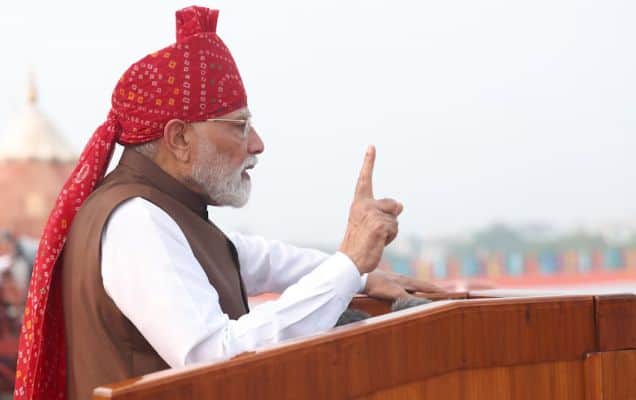
It is a great honour to be present here in Mirzapur. I am elated to meet you all in the lap of Mother Vindhyavasini. You have been waiting for me for so long. I bow down and salute you all for that. After looking at the crowd, I am confident that Mother Vindhyavasini has showered her blessings on me and with your grace her blessings will always be with me.
The Governor of UP, Mr. Ram Naik, the Chief Minister Shri Yogi Adityanathji, the Deputy Chief Minister Shri Keshav Prasad Mauryaji, my colleague from the Council of Ministers at the centre, sister Anupriyaji, Minister of the state government Mr. SidhharthNathji, Mr. Dharampal Singh, Mr. AshutoshTandon, Mr. Rajesh Aggarwal and leader of the BharatiyaJanata Party as well as my old friend MP Dr. Mahendranath Pandey, Mr. Virendra Singh, MP Chhote Bhai Lal and my dear brothers and sisters who are present here in large numbers.
I have been watching from this stage that the people are continually pouring in from all sides. People are still gathering. Brothers and sisters, this entire area is divine. This region situated between the VindhyanMountains and river Bhagirathi is the centre of immense possibilities. Today, I have got the opportunity to look for these possibilities and to seek your blessings from these developmental activities. The last time when I had come here in the month of March to inaugurate the solar plant, the French President had also come along with me and we were welcomed with the goddess's photo and stole. The President of France, Macron was enthralled with the gesture. So, he wished to know about the goddess's glory and greatness. When I enlightened him about her greatness, he was absolutely stupefied! We are committed to the comprehensive development of this land of devotion and traditions.

Since the NDA government has been formed under the leadership of Yogi ji, one can clearly see the rapid pace of development across Uttar Pradesh in general and Purvanchal in particular. We all are relentlessly striving towards fulfilling the dreams of industrious people like Sonelal Patel ji for uplifting the poor, the deprived and the oppressed people of this region. In the last two days, I have got the opportunity to start and dedicate new developmental projects to the people of Purvanchal. These include the longest Expressway of the country i.e. the Purvanchal Expressway, the perishable cargo centre for the peasants in Varanasi and the railway-related projects. These projects will provide unprecedented speed to the development of Purvanchal.
I have again come here to further give impetus to this chain of development. A little while ago, several projects along with the historic Bansagar dam project worth Rs.4000 crores were inaugurated. These projects related to irrigation, health and transport will bring a pleasant transformation in the life of a common man in this region. Agriculture has been an important part of the lives of the people of Mirzapur, Sonbhadra, Bhadohi, Chandauli or Allahabad. The previous governments used to make incomplete schemes for the farmers and kept them suspended. You all had to bear the brunt of it and you all are a witness to it. Friends, the Rs.3500 crore worth project of Bansagar canal is going to benefit the 1.5 lakh hectares of land including that of Mirzapur and the entire region along with Allahabad in terms of irrigation. If at all this project had been completed two decades before, you would have already started reaping the benefits back then but unfortunately your two decades have been wasted. But brothers and sisters, the previous governments were not concerned about you or the farmers of this region. The draft of this project was drawn 40 years ago! The foundation of this project was laid in 1978 but the work started only 20 years later. In the years that followed, several governments came to power, made promises and that was it. Nothing was done for the public.
In 2014, when you all gave us an opportunity to serve and our government started going through the old and suspended projects, this project also came to the surface. This project was lost between the files. Thereafter, it was brought under the Pradhan MantriKrishisinchaiyojana and the entirefocus was divertedtowards its completion. As a result of Yogi ji and his team's concerted efforts over the last 1 year and 3 months, the nectar in the form of Bansagar canal could be obtained to deliver happiness to you all. Besides Bansagar, work is underway for the long suspended Sarayu canal project and Madhya Ganga Sagar project.

Friends,
The Bansagar project is also an example of that incomplete thought and limited will power whose price had to be paid by you all my farmer brothers and sisters, my poor brothers and sisters and all the people of this region. The facility that you all were supposed to receive long ago was not provided and the country as a whole had to face financial losses. At that time the cost of this project was only Rs.300 crores. It could have been completed within that amount. However, due to its suspension, time passed and its cost started shooting up. The Rs.300 crore project could now be completed only after using Rs.3500 crores. You tell me, aren't the previous governments to be blamed? Haven't they kept you deprived of your rights? Therefore brothers and sisters, you must ask those who shed crocodile tears as to why they had turned a blind eye to such incomplete irrigation projects across the country during their tenure. This is not just a single case of Bansagar, there are several incomplete and suspended projects for the welfare of the farmers in every state of the country. They were not at all concerned. Why did they leave these projects incomplete?
Brothers and sisters,
I want to demand something from you. Will you give me? This is the land of mother Vindhyavasini. You have promised me. Will you fulfil that promise? See, Rs.3500 crore was spent and 40 years were wasted. We cannot do anything about the past. Now, water has reached at your place. Now, can those of my farmer brothers and sisters who have access to water and are living close to the canal practice drip and sprinkler irrigation in order to save water? I just want this promise from you all; nothing else. This water is like mother Vindhyavasini'sprasad. Just like we don't let even a single grain of mother Vindhyavasini'sprasad to go waste, we must not let even a single drop of the water that we have received in the form of mother'sprasad to go waste. We will cultivate crops by utilizing every drop of water. Drip irrigation can aid in all types of cultivation. It saves money, water, labour and the yield is good. So, if you decide to save water, the amount of water available today that can irrigate 1-1.25 lakh hectares of land, can be used to irrigate a land of 2 lakh hectares. If today, few lakh farmers are getting the benefits, the number of beneficiaries will double in the future. If you find this amount of water is not sufficient and save the water during 0cultivation, it will last longer. This water will also benefit your future generations.
Therefore my brothers and sisters, I am demanding something from you as your servant and as a devotee of mother Vindhyavasini. Will you give me? Will you fulfil the promise? There is a government scheme for micro-irrigation under which subsidy is provided. You must take advantage of it and I have come here to serve you.

My dear farmer brothers and sisters,
These people were shedding crocodile tears for the farmers. There was MSP, no purchases were made, a notice was published in newspapers with the decided amount, photos were printed and everyone used to hail the attempt. However, the farmers never received anything. Files regarding a raise in the MSP used to pile up and no action was taken to address that. Several years ago, a proposal was already made to set the MSP to 1.5 times of the cost of cultivation. However, those people who used to politicize the issue of farmers had no time to provide an increased MSP at 1.5 times the cost. They were immersed in politics. They had no time to think of the villages or the poor farmers of the country. They kept sitting over the files. The work that the previous governments were hesitating from doing for several years, has been done by your servant my brothers and sisters. I can humbly say that we had promised to increase the MSP by 1.5 times. Today, that promise has turned into a ground reality. We have increased the MSP of 14 kharif crops including paddy, corn, tur, urad and moong from Rs.200 to Rs.1800. It has been decided that the farmers should directly get50% profit vis-à-vis theproduction cost of these crops.
Brothers and sisters,
The farmers of UP and Purvanchal are going to gain out of this decision. From now onwards, 1 quintal of paddy will fetch you Rs.200 more. Friends, the estimated cost of producing 1 quintal of paddy is Rs.1100- Rs.1200 approximately. The MSP decided for paddy is now Rs.1750. This means that 50% profit is ensured. I was told that last year in UP, the purchase of paddy was 4 times than that of the previous year. I would like to congratulate Yogi ji and his team for this great achievement.
Brothers and sisters,
The MSP of pulses has also been increased along with that of paddy. It means that there has been an increase by Rs.200-225 in the MSP of Arhar. That is, the farmers will get the direct benefit of 65% of the cost of cultivation.
Friends,
Our government is working day in and day out to resolve all the small and big issues of the farmers. A system is being created right from the seeds to the market so that the farmer's income increases and his cost of cultivation reduces. Earlier, the farmers were lathi-charged for urea; they had to queue up all night and had to purchase Urea in black. This issue has been resolved in the last four years. Everything is being accomplished just because of your blessings, support and cooperation.
Brothers and sisters,
I want to request the farmers of this region. We want to double the incomes of the farmers of the country by 2022 and it is not a difficult job. Let me give you an example. Today we erect fences around the edges of the field. Sometimes sharp nails are placed or plants are grown along the boundaries. A lot of area is wasted in the process. Now the government has placed bamboo under the category of grass. Therefore, you can now plant bamboo along the edges of the agricultural field. You can easily cut down the bamboo and sell them in the market. The government cannot stop you. Bamboo worth thousands of crores of rupees is imported from abroad while it could be easily cultivated by the farmers along the boundaries of their agricultural fields. We have changed the law. Earlier bamboo was considered as a tree but we made changes and categorized it as grass. We had to import bamboo even for making incense sticks and kites. The farmers of my country can completely change the scenario within one month. There are several such uses. I would like to urge my farmer brothers to avail the benefits of the myriad schemes of the government in order to increase their incomes besides engaging in cultivation. Our government is moving ahead with the goal of carrying the ray of development to every individual and at every corner of the country to empower the villages and the poor. The foundation stone of some bridges have also been laid today in order to create better connectivity and to make your lives easier. ChunarBridge has now shortened the distance between Varanasi and Chunar. I was also told that thousands of people of this part of the country used to be cut off from the rest of the country during the Monsoon season. Now this new bridge will resolve this issue.

Brothers and sisters,
To make affordable and better quality healthcare facilities available to the poorest of the poor is one of the greatest resolutions of the government. The Medical Colleges that will come up here will benefit not only the people of Mirzapur and Sonbhadra but also of Bhadohi, Chandauli and Allahabad. Now the district hospital of this place will have 500 beds. Consequently, you will not have to travel longer distances to get treated for serious illnesses. Besides, more than 100 Jan Aushadhikendras across Uttar Pradesh were also launched today. These Jan Aushadhikendras will prove to be a great support for the poor, the middle class and the lower middle class. More than 700 medicines and more than 150 tools that are needed by the patients after surgery are available in these stores at affordable prices. More than 3500 such stores have been established across the country. More than 800 medicines have been brought under price control measures. Prices of knee implants and stents used for heart have been reduced. Several such measures taken by the government will bring relief to the poor and the middle class.
If there are elderly members in a middle class family, one or two diseases ought to become part of the family’s day to day affairs. Medicines have to be taken on a regular basis for diseases like diabetes and blood pressure. Medicines are needed daily for one or the other member of the family and the medical bill rises to Rs.1000, Rs.2000, Rs.3000 and even Rs.5000 by the end of the month. However, now due to Jan Aushadhi scheme, the thousand rupees bill is reduced to Rs.250-300 for a month. You can imagine the extent to which this will serve the people. The previous governments could have done this but they were not ready to think beyond their party, their family and seat. Therefore, welfare of the common man of the country was never their priority.
Friends,
These days, dialysis has become an absolute necessity. Several families from different villages have to travel larger distances for getting a dialysis done. We have started the Pradhan Mantri National Dialysis Programme and have taken the responsibility of helping the poor people in solving their one of the greatest issues. Under the Dialysis Programme, we are setting up dialysis centres in the districts. The poor, the middle class and the lower middle class can get the dialysis done for free. Till date, about 25 lakh dialysis sessions have been conducted for free. With every dialysis session, a poor person's Rs.1500, Rs.2000 or Rs.2500 is being saved. Moreover, the Swachh Bharat Mission has proved to be effective in combating the diseases. According to a report last year, the incidents of diseases in the people and children of the villages where the usage of the toilets has increased have fallen considerably! Moreover, every family in the villages that were declared open defecation free has annually saved Rs.50,000 approximately. Earlier, this amount used to be spent on hospital visits and leaves from work.
Friends,
The government is about to start a massive scheme to break the vicious cycle of poverty and diseases. Some people call it 'Modi Care' and others call it 'Ayushman Bharat'. Under this scheme, almost 50 crore poor people will get annual treatment of up to 5 lakh rupees for free. The work is underway at a rapid pace. Soon the government is going to launch this programme across the country. You can imagine if the government provides 5 lakh rupees to a family whose one of the members has been suffering from a serious illness; it will provide a new lease of life to that family. Won't that family be rescued from these many troubles? When crores of families come out of the problems, won't my country be out of the problems as well? Therefore brothers and sisters, we have formulated the Ayushman Bharat Mission for a healthy and bright future of the country.

Brothers and sisters,
Reducing the burden of worries and making the lives of the poor, the deprived and the oppressed section of the society easier and better is the priority of the government. Therefore, we are constantly engaged in the process. Keeping this in mind, the poor people of the country are being covered under a shield of social security with a premium of Re.1 per month and 90 Paisa per day. It is not a hefty amount even for a poor person. The life insurance and accident insurance with this premium rate are working as an unflickering flame in the lives of the people. Earlier there was a fractured ideology that only the upper class people, the educated class and the middle class could have bank accounts. The poor could never have bank accounts. Similarly, people used to believe that only the rich and the educated could have gas cylinders, the poor could not. The people of our country also believed that transactions through cards could be done only by the bureaucrats and the upper class people but never by the poor. Friends, we decided to break this ideology. All the 125 crore Indians should stand on an equal platform. The poor could never think of getting insurance. They used to believe that only the rich who had cars could be insured. They thought that they didn't even have a cycle; why would they be insured? We broke all these myths and brought an insurance scheme with a premium of 90 paisa per day and Re.1 per month for the poor. This insurance is benefitting the poor at the time of adversity. We have been introducing schemes that will end the discrimination between the rich and the poor. You will soon get discernible results in the coming days. Our poor can now look in the eye and speak. We are working towards making them confident and self-reliant.
More than 1.5 crore people of Uttar Pradesh are now connected to these two schemes. The claim amount of approximately Rs.300 crores through these schemes has already reached the people in adversity. This is just from Uttar Pradesh. If my government had announced even Rs.100 crores, it would have been the headline in the front page of the newspapers. With our scheme, Rs.300 crores reached the people and they were rescued from the adversity. This is a living example of how work is done and the system is modified.

Friends,
I request those of you who are yet not connected with the scheme to do so at the earliest and start availing the benefits. No one wants that adversity befalls anyone. However, no one can predict the cycle of fate. In times of adversities, this scheme will prove to be a boon for you and benefit you. Therefore, we have brought this scheme. All the decisions and schemes brought by the government for the welfare of the poor are aimed at empowering them and improving their standard of living. According to a recent international report, 5 crore people of India have come out of extreme poverty in the last 2 years. Although this news will be printed in the newspapers but only in a corner and probably the television channels won't even talk about it. There would have been a hullabaloo about the report if it was a negative one. However, when the report is positive, no one notices it. Therefore, I want you all to inform everyone about this international report. You tell me; can't you see the positive results of every scheme? Don't you want the lives of the poor to transform for the better? Don't you want the poor to come out of poverty? You can clearly see the results today. Definitely, these also have the impact of the government schemes that aim at reducing the financial burden on the poor. Certainty is also one of the factors that is providing opportunities to them. For example, the UjjwalaYojana has not only rid the women of the smoke from burning of the fossil fuels but has also provided them with an opportunity to work for getting an additional income for their family. Now they don't have to sit in front of the firewood for hours.More than 80 lakh women in Uttar Pradesh have been handed over the free gas connections under the UjjwalaYojana. Similarly, under Jan DhanYojana, more than 5 crore bank accounts have been created in Uttar Pradesh. More than 1 crore loans without bank guarantee have been given under the MUDRA Yojana. Under Pradhan MantriAwasYojana more than 18 lakh houses have been built and inflation has also been controlled. These are some of the schemes to pull the poor people out of poverty.
Friends,
We are committed to fulfilling our resolution of a 'New India' where the poor will be assured of medicines, the farmers will be assured of irrigation, the children will be assured of income and the youth of employment and where the system will be transparent with unprecedented facilities. I once again congratulate you all for the schemes that have been launched today. I congratulate Yogi ji, his government and his entire team for successfully carrying UP towards the path of development. My best wishes to them. Once again I would like to remind you; don't forget to use Mother Vindhyavasini'sprasad i.e. every drop of water. I thank you all from the bottom of my heart for coming in large numbers, attending this event in scorching heat and showering your blessings. Say along with me by raising your fists - Victory to Mother India! Victory to Mother India! Victory to Mother India!
Thanks a lot!