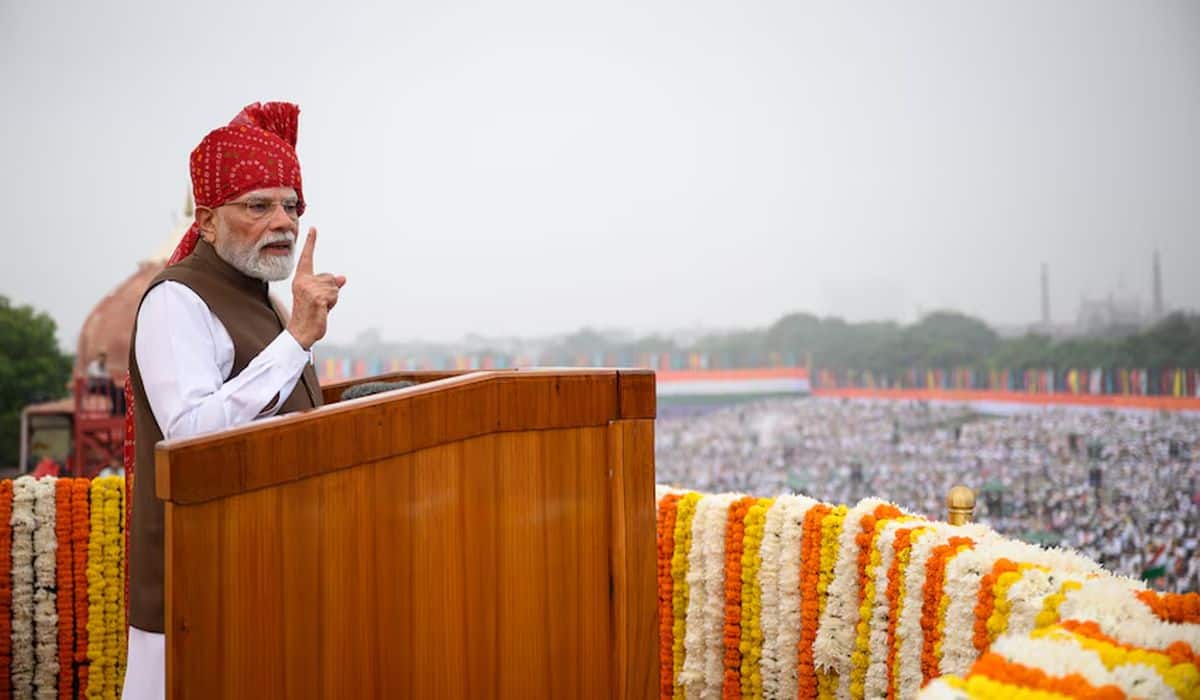
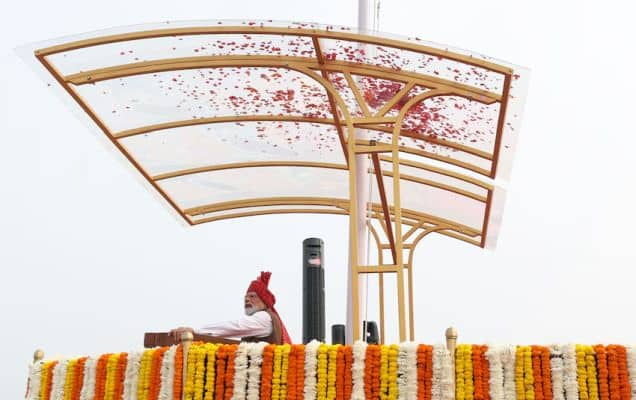
మహారాష్ట్రలోని రామ్‌టెక్‌లో నివాళులు అర్పిస్తూ ఉత్సాహపూరితమైన సభను ఉద్దేశించి ప్రధాని మోదీ ప్రసంగించారు
సామూహిక మద్దతు మరియు సంఘీభావానికి ప్రతీకగా రానున్న లోక్‌సభ ఎన్నికలు 2024లో ఎన్‌డిఎకు తమ ఆశీర్వాదాలు అందజేయాలని ప్రేక్షకులను పిఎం మోదీ కోరారు.
అట్టడుగు వర్గాలను బలోపేతం చేయడానికి, సామాజిక న్యాయం మరియు సమ్మిళిత అభివృద్ధికి భరోసా ఇవ్వడానికి ఎన్‌డిఎ ప్రభుత్వం చేపట్టిన పరివర్తన కార్యక్రమాలను ప్రధాని మోదీ హైలైట్ చేశారు
పేదలకు సౌకర్యాలు కల్పించేందుకు, వారి ఆందోళనలను తగ్గించేందుకు మోదీ పనిచేశారు: రామ్‌టెక్‌లో ప్రధాని మోదీ
అవకాశవాద పొత్తుల విభజన ఎజెండాకు వ్యతిరేకంగా హెచ్చరిస్తూ, దేశ ఐక్యత మరియు పురోగతి కోసం ఓటు వేయాలని మహారాష్ట్ర ప్రజలను పిఎం మోదీ కోరారు

Commending the efforts of those involved in the de-addiction campaign spearheaded by Baba Jumdev Ji through the 'Paramatma Ek Sevak Mandal', PM Modi highlighted the significance of such initiatives in fostering societal well-being.

Addressing the enthusiastic crowd, PM Modi remarked, "Evening is setting in, but looking at your enthusiasm, it seems the day has just begun." Encouraging the audience to participate actively, he urged them to use their mobile phones to send blessings to the stage, symbolizing unity and collective support.

“Nowadays, these TV and media people are continuously showing surveys regarding the elections. Every survey indicates a clear victory for the NDA. These media people also spend a lot of money on these surveys. I want to share a formula today to save money. When criticism against Modi intensifies, then understand the trend, then it's the Modi government once again. When these people start insulting my late father or mother, understand the trend, then it's the Modi government once again. When questions arise about EVMs, understand the trend, then it's Modi government once again,” he added.

Reflecting on the upcoming elections, PM Modi emphasized the pivotal role of the electorate in shaping the future of the nation. He stated, "On April 19th, you are not just choosing a Member of Parliament. You are voting to strengthen the foundation of India for the next thousand years."

Asserting the importance of unity and solidarity, PM Modi condemned divisive politics propagated by certain factions. He urged the people of Maharashtra to vote for the country's unity and progress, cautioning against the divisive agenda of opportunistic alliances.

PM Modi said, “These INDI Alliance people are fully engaged in dividing the country's people. They know that if the people of the country unite, the politics of the INDI Alliance people will end. Therefore, I urge the people of Maharashtra, I urge the people of the country, vote for the country by uniting. If these INDI Alliance people become powerful, they will divide the country into pieces. Even today, they leave no stone unturned in pitting one community against another. Even today, they do not miss any opportunity to target Indian culture. Ramtek is that place where the feet of Bhagwan Ram himself have stepped.”

Highlighting the government's commitment to social justice and empowerment, PM Modi outlined various initiatives aimed at uplifting marginalized communities, including the SC-ST-OBC society. “Since independence, Congress has kept the SC-ST-OBC society behind in every way under a conspiracy. Congress ended Baba Saheb Ambedkar's politics. Congress kept Baba Saheb deprived of Bharat Ratna. When the BJP-supported government was formed at the Centre, Baba Saheb was awarded the Bharat Ratna. When the NDA government was formed in 2014, the son of a Dalit mother became the President of India. When the NDA government was formed again in 2019, the daughter of a tribal mother became the first citizen of the country, the President,” said the Prime Minister.

PM Modi underscored the government's efforts to ensure inclusive development and provide equal opportunities to all sections of society and said, “In the NDA government, we have appointed a record number of ministers from the OBC community. This NDA government is the one that gave constitutional status to the OBC Commission. This NDA government is the one that ensured reservation for OBCs in medical education. It was the NDA government that established a separate Ministry for Tribal Affairs. In the past 10 years, the budget for tribal welfare has been increased fivefold. It is due to the policies of the NDA government that the enrollment of SC/ST/OBC youth in schools and colleges has significantly increased.”

Addressing the audience, PM Modi reaffirmed his government's dedication to promoting the principles of 'Sabka Saath, Sabka Vikas' and fostering an environment of inclusive growth. “Modi worked to provide facilities to the poor, to reduce their worries. Today, when Modi guarantees 100% beneficiaries, 100% benefits of schemes, this is true social justice. This is true secularism. Guaranteeing a home for the poor, guaranteeing free ration, free treatment, guaranteeing toilets, electricity-water-gas connections, these guarantees of Modi benefit the SC-ST-OBC families the most,” said PM Modi.

Touching upon critical policy decisions, PM Modi emphasized the significance of constitutional reforms, including the abrogation of Article 370 and the enactment of the Citizenship Amendment Act (CAA), aimed at ensuring justice and equality for all citizens. “When Modi removed Article 370, the Congress president asked what benefit the country got from it? This is also evidence of Congress's anti-Dalit, tribal, and women policies, and vote bank politics. Removing Article 370 has given constitutional rights to all these sections in Jammu and Kashmir for the first time. Congress and the INDI Alliance are not liking this. Congress is also opposing the CAA, which provides citizenship because the biggest beneficiaries of this are the Dalits and Buddhists.”

In his address, PM Modi lauded the transformative development initiatives undertaken in Maharashtra, particularly in the Nagpur and Vidarbha regions. He highlighted the establishment of premier educational institutions, infrastructure projects, and economic initiatives aimed at bolstering regional growth and prosperity. “Such development can only be achieved by an honest, strong, and stable NDA government,” the Prime Minister stated.

Speaking ahead, PM Modi expressed his vision for the future, promising to accelerate the pace of development and usher in a new era of progress for Maharashtra and the nation as a whole.

During his concluding address, PM Modi urged the electorate to vote decisively in favor of the NDA candidates, reaffirming their commitment to good governance and inclusive development. He called upon every citizen to actively participate in the democratic process and uphold the values of unity, integrity, and progress.

Click here to read full text speech


Explore More
శ్రీరామ జన్మభూమి ఆలయ ధ్వజారోహణ ఉత్సవం సందర్భంగా ప్రధానమంత్రి ప్రసంగం

ప్రముఖ ప్రసంగాలు

శ్రీరామ జన్మభూమి ఆలయ ధ్వజారోహణ ఉత్సవం సందర్భంగా ప్రధానమంత్రి ప్రసంగం
‘Have to isolate dimaagi Naxals’: PM Modi in Independence Day speech from Red Fort

Media Coverage

‘Have to isolate dimaagi Naxals’: PM Modi in Independence Day speech from Red Fort
NM on the go

Nm on the go

Always be the first to hear from the PM. Get the App Now!
...
12 Years of Transformation: PM Modi Highlights India’s Progress in Independence Day Address
August 15, 2026

In his Independence Day address, Prime Minister Shri Narendra Modi highlighted India’s transformation over the last 12 years, outlining the progress made across manufacturing, digital infrastructure, basic amenities, energy security, youth empowerment, innovation, social security and other key sectors.

Key highlights from the Prime Minister’s address include:

1. Manufacturing: Scale and Self-Reliance

Over the last 12 years:

  • Defence production has increased nearly 4 times.
  • Khadi and Village Industries production has increased nearly 5 times.
  • Electronics manufacturing has increased nearly 7 times.
  • Modern railway coach production has increased 21 times.
  • Mobile phone production has increased 35 times.

2. Digital India and Innovation

The Prime Minister highlighted the rapid expansion of India’s digital and innovation ecosystem:

  • Internet consumers have increased nearly 4 times.
  • Patent grants have increased 4 times.
  • Digital transactions have increased around 100 times.
  • India has built a significantly larger digital and innovation ecosystem.

3. Faster Delivery of Basic Amenities

The Prime Minister highlighted the faster pace at which basic facilities are reaching ordinary citizens:

  • Tap-water connections have been provided at an average annual pace nearly 15 times faster.
  • LPG connections have been provided at an annual pace nearly 6 times faster.
  • Toilets for the poor have been constructed at an annual pace nearly 4 times faster.
  • Pucca houses for the poor have been provided at an annual pace nearly 3 times faster.
  • Hundreds of obsolete laws have been abolished.
  • Modern public transport, including metro systems, has reached several more cities.

4. Building the Semiconductor Ecosystem

The Prime Minister highlighted India’s progress in building domestic semiconductor capabilities:

  • India earlier had no major semiconductor manufacturing plant.
  • A complete semiconductor ecosystem is now being built in India.
  • Three semiconductor plants have been initiated.
  • India has also started exporting chips.

5. Securing Critical Minerals

Highlighting the importance of critical minerals for emerging technologies, the Prime Minister referred to the steps being taken to strengthen India’s capabilities in this sector:

  • National Critical Mineral Mission has been launched.
  • Critical Mineral Corridor has been announced in the Budget.
  • Agreements have been signed with several countries for critical mineral supplies.

6. Strengthening Energy Security

The Prime Minister underlined that energy security is an essential condition for building a developed India, particularly as technologies such as chips, AI and data centres require huge quantities of electricity.

Underlining the role of nuclear energy, the Prime Minister highlighted:

  • The SHANTI Act as a major reform in the nuclear energy sector.
  • India crossing an important milestone in Fast Breeder Nuclear Technology.
  • The potential of the technology to play a major role in making India self-reliant in nuclear fuel.

7. Expanding Oil and Gas Exploration

The Prime Minister highlighted the change in India’s approach towards offshore exploration:

  • Nearly 99% of India’s offshore area was earlier classified as a No-Go Area.
  • The approach has now changed from No-Go Area to Go Ahead Area.
  • Previously restricted areas have been opened for exploration.
  • This has created possibilities for discovering new oil and gas reserves.

8. Energy Diversification

The Prime Minister highlighted the rapid expansion in different sources of energy.

City Gas Distribution

  • 2014: Available in fewer than 70 cities.
  • Today: Available in around 700 cities.

Piped Cooking Gas


  • 2014: Around 20–22 lakh households.
  • Today: Nearly 1.75 crore households.

Solar Energy


  • 2014: Around 2 GW.
  • Today: Around 160 GW.

PM Surya Ghar Muft Bijli Yojana


  • The scheme has crossed 50 lakh households.
  • Lakhs of families are benefiting through lower or zero electricity bills.
  • Families can also sell surplus electricity and earn.
  • Assistance of up to around ₹80,000 per household is available.

9. Railways: Electrification and Future Fuels

The Prime Minister highlighted the transformation of Indian Railways:

  • In 2014, after nearly 90 years, only around 30% of the railway network had been electrified.
  • Today, Indian Railways has moved towards near-complete electrification.
  • India has started work on its first Made-in-India hydrogen train.
  • It is being developed as the world’s longest and most powerful hydrogen train.

10. India’s Resilience During Global Crises

The Prime Minister said that the capabilities built over the last 10–12 years were tested during:

  • COVID-19 pandemic.
  • Russia-Ukraine war.
  • Conflicts in West Asia.

11. Affordable Fertiliser for Farmers

Highlighting the Government’s efforts to protect farmers from high global fertiliser prices, the Prime Minister stated:

  • Urea: Around ₹3,000 per bag internationally; Indian farmers get it for less than ₹300.
  • DAP: More than ₹5,000 internationally; Indian farmers get it for ₹1,350.

12. Trade and Export Opportunities

The Prime Minister highlighted the new opportunities being created for Indian producers and exporters:

  • Since 2014, India has entered into FTAs with around 40 countries.
  • New opportunities have opened for agriculture, fisheries, MSMEs, textiles and other export sectors.

13. Youth at the Centre of Viksit Bharat

The Prime Minister said that India’s youth have a major role in building Viksit Bharat and highlighted the new pathways opened up for them:

  • Startup India: New avenues for innovation and entrepreneurship.
  • ₹1 lakh crore Research Fund: New opportunities for young researchers.
  • Digital India: Empowerment through affordable data.
  • Skill India: National skills ecosystem.
  • Space Sector: Opened for private participation.
  • National Drone Policy: New opportunities for young entrepreneurs and innovators.
  • Khelo India: Strengthened sports ecosystem.

14. Education and Innovation

The Prime Minister highlighted the expansion of educational and innovation opportunities:

  • National Education Policy 2020: Introduced after a gap of 35 years.
  • Universities: Fewer than 350 during 2004–2014; around 650 new universities added in the following decade.
  • Medical Colleges: Fewer than 400 before 2014; around 850 today.
  • More than 10,000 Atal Tinkering Labs have been established in schools.
  • Focus has been placed on developing a technology and innovation mindset from an early age.

15. Startups, Space and AI

The Prime Minister highlighted India’s growing startup and innovation ecosystem:

  • An Indian space startup has launched a Made-in-India rocket.
  • India now has around 2.5 lakh registered startups.
  • AI is creating new opportunities for young Indians.
  • India hosted the AI Impact Summit this year.

16. New Sectors and New Opportunities

Bioeconomy

  • 2014: Around ₹60,000 crore.
  • Today: Nearly ₹20 lakh crore.
  • The expansion is creating new jobs and entrepreneurial opportunities.

Electric Vehicles


  • Towards the end of the previous decade: Around 1.5 lakh EVs sold annually.
  • Last year: Around 25 lakh EVs sold.

Aviation


  • New airports and routes are creating employment.
  • MRO is opening new opportunities.
  • India is moving towards Made-in-India aircraft manufacturing.
  • The Made-in-India C-295 defence transport aircraft has successfully completed its flight.

17. Rural Empowerment through SVAMITVA

The Prime Minister highlighted the impact of the SVAMITVA initiative:

  • Around 3.25 crore families have received property cards.
  • Around ₹140 lakh crore of economic potential has been unlocked in rural areas.
  • Property records are enabling villagers to access bank loans against their property.
  • New avenues for rural employment, self-employment and entrepreneurship have opened up.

18. Growth in Defence Exports

The Prime Minister highlighted the expansion of India’s defence exports:

  • Defence exports have increased more than 50 times.
  • Indian defence equipment is now exported to around 100 countries.

19. Women-Led Development: Lakhpati Didi

Highlighting the growing role of women in India’s development:

  • The target of 3 crore Lakhpati Didis has been achieved.
  • Women from general, Dalit, backward and tribal families have become Lakhpati Didis.

20. Expanding Social Security

The Prime Minister highlighted the expansion of social security coverage:

  • Before 2014, around 25 crore people were covered by social security.
  • Today, around 100 crore Indians are covered by one or another social security scheme.

21. Ayushman Bharat

The Prime Minister highlighted the financial relief provided to families through Ayushman Bharat:

  • Beneficiary families have avoided an estimated ₹2 lakh crore in medical expenditure.