United Nation’s coveted Public Service Award to SWAGAT

Published By : Admin | August 4, 2010 | 13:05 IST

State has adopted State wide Attention on Grievances by Application of Technology-SWAGAT- , through which State reiterates its commitment to citizens, who can get appropriate remedy to their problems pertaining to the services of Government of Gujarat. Gujarat Chief Minister Shri Narendra Modi is the driving force behind the success of the On-Line complains’ redressal mechanism. He firmly believes in Good Governance, which is a key to social justice and inclusive growth. We are a democratic nation, not an authoritarian system. In democracy: People’s voice is always supreme and sovereign. Governments are obliged to protect rights and defend interest of the citizens. Delay in disposal is a bane for the society. Shri Modiji has found one stop solutions to people’s grievances through SWAGAT on line programme.

Under the dynamic and foresighted leadership of Shri Narendra Modi Gujarat has witnessed a remarkable transformation. Chief Minister, who dares to make impossible possible, says that the flow of complain is an indication to take corrective measures in time. Administration must be proactive in solving problems of citizens, officials must sit together to find out lasting solutions of the problems faced by people. For, five to ten complains are enough to take the right standing. Emphasis is to enhance the sensitivity of administration.

For the first time, when SWAGAT was implemented in April-2003, in his address through video-conferencing to district top brass CM asserted that if citizen has to approach Gandhinagar for trifle matters, it is not at all a good sign for the Government. Village level problems must be solved at village level and Taluka level problems must have solutions at Taluka places only. He stressed on the need to change the attitude of governance. CM always says there is life in file; attend to each issue with utmost sensitivity and dedication.

Technologically Gujarat has changed and progressed a lot. SWAGAT was originally designed by National Informatics’ Centre, a web-browsed programme that not only preserves the applicant’s data, but also enables follow-up, gives reminder after 15 days. Status of application may be explored through internet by entering the specific I.D. number being allotted for to that particular complain. Scrutiny of application helps administration plotting the charts and drafting people centric policies. Complain documents are scanned, the E-File is prepared, and it reaches up to concerned secretary or collector. On 4th Thursday of every month, after giving patient hearing to applicant, CM gives directives to officials for the solution. Through video conferencing, CM can listen to applicant; he can interact with the applicant. Chief Secretary, senior secretaries and district administration participates in SWAGAT, which is being held on 4th Thursday of each month, giving full solutions to complain lodged by applicant, within the framework.

SWAGAT, now extended up to Taluka places, till date received 100349 complains, out of that 98203 have been solved , if we take a glimpse on break up- 51170 complains received under State and District level SWAGAT programme, out of that 50810 found prompt solutions, in Taluka level SWAGAT programme -49179 complains were received out of that 47393 were solved. This is a shining example of people centric governance.

United Nations observes Public Service Day on 23rd June. Administrative and Management Department of Economic and Social Affairs adjudged SWAGAT programme as the best functioning programme, for bringing about quality enabled changes through modern technology; it also considered transparency and accountability factors. SWAGAT scored a double triumph when the coveted public-service award came while Gujarat is celebrating Golden Jubilee of its inception. It has happened because of disciplined efforts and meticulous planning. The achievement is attributed to better work culture, which gives assurance of time-bound solutions.

Explore More
Today, the entire country and entire world is filled with the spirit of Bhagwan Shri Ram: PM Modi at Dhwajarohan Utsav in Ayodhya

பிரபலமான பேச்சுகள்

Today, the entire country and entire world is filled with the spirit of Bhagwan Shri Ram: PM Modi at Dhwajarohan Utsav in Ayodhya
UPI — an eventful journey

Media Coverage

UPI — an eventful journey
NM on the go

Nm on the go

Always be the first to hear from the PM. Get the App Now!
...
PM chairs 53rd PRAGATI Meeting
August 25, 2026
PM reviews six key infrastructure projects across the Railway, Road and Power sectors
Projects reviewed span across 9 States with cumulative investment of more than ₹30,000 crore
PM says Infrastructure projects should be viewed as an integrated whole, rather than as individual sections or packages
PM calls for continuous reforms across all stages of project implementation and a proactive work culture across Ministries and States
PM says Speed must go hand-in-hand with quality
While reviewing AgriStack, PM emphasises the need to leverage the latest digital technologies including AI to derive greater value from agricultural data
On cyber fraud and ‘digital arrest’, PM stresses training, public awareness, cyber-safety education and coordinated action

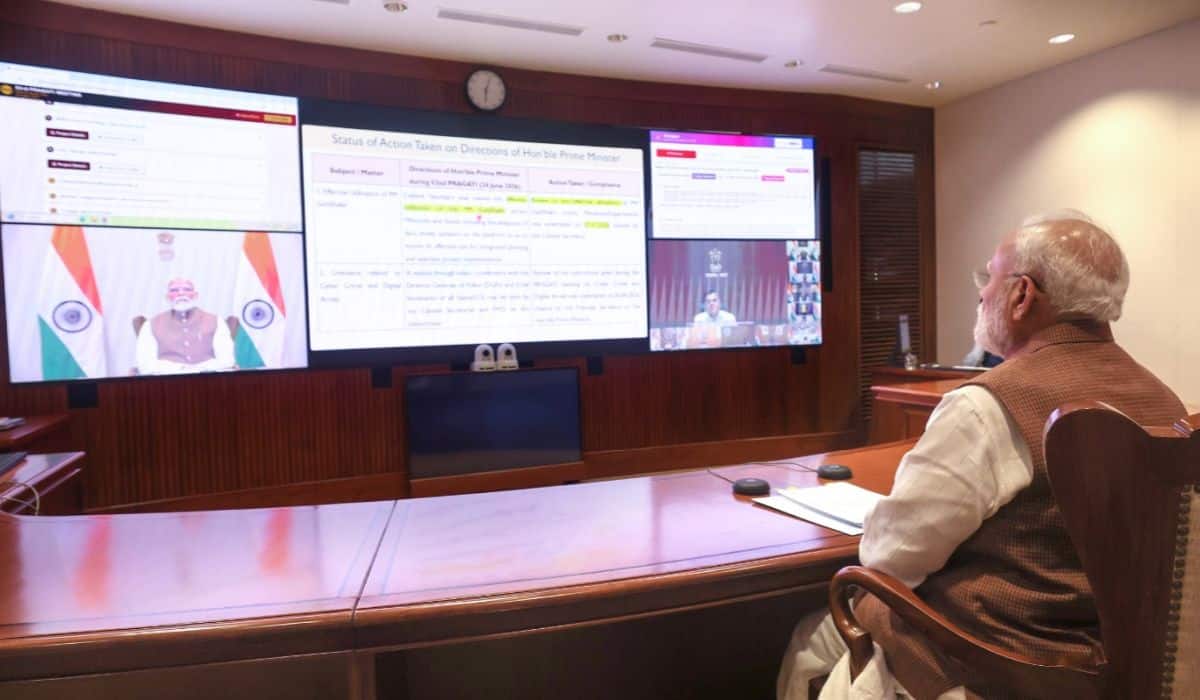
Prime Minister Shri Narendra Modi chaired the 53rd meeting of PRAGATI, the ICT-enabled, multi-modal platform for Pro-Active Governance and Timely Implementation, at Seva Teerth earlier today.

During the meeting, Prime Minister reviewed six key infrastructure projects across the Railway, Road and Power sectors, spanning nine States with a cumulative cost of more than ₹30,000 crore. The projects, significant for strengthening connectivity, supporting industrial and economic activity and improving public services, were reviewed with particular emphasis on adherence to timelines, inter-agency coordination, resolution of pending issues and expeditious completion.

Prime Minister emphasised that delays in infrastructure projects have consequences beyond cost escalation, as they also postpone the benefits intended for citizens, businesses and the economy. He said that infrastructure projects should be viewed and monitored as an integrated whole, rather than as isolated sections, stretches or packages. He noted that progress in individual packages should ultimately translate into timely completion and operationalisation of the entire project. Ministries and States were therefore asked to adopt an end-to-end approach, and address critical gaps that could delay the overall commissioning and delivery of benefits. He called for fostering a proactive work culture across Ministries and State Governments, with greater ownership at every level of project implementation.

Prime Minister stressed the need to explore common utility corridors for infrastructure services, wherever feasible, particularly while planning major transport and infrastructure projects. He called upon Ministries and States to examine such integrated approaches at the planning stage itself, keeping in view their technical and economic feasibility.

Prime Minister said that speed of execution must be accompanied by uncompromising quality. He called upon Ministries, States and implementing agencies to adopt modern technologies and strengthen quality assurance and supervision at every stage.

While reviewing AgriStack under the Digital Agriculture Mission, Prime Minister emphasised the need to leverage the latest digital technologies, including Artificial Intelligence, to derive greater value from agricultural data. He stressed that the data ecosystem should be effectively utilised across the agricultural value chain, from input planning to processing, enabling more informed interventions, better targeting and data-driven decision-making. He appreciated the efforts of the States and the Central Government in building the AgriStack ecosystem and called for further strengthening its use for delivering better outcomes for farmers.

During the review of cyber fraud cases, including incidents of digital arrest, Prime Minister said that prevention must be strengthened through a sustained focus on training, awareness and education. He stressed the need for continuous and targeted public-awareness campaigns, particularly for senior citizens, youth and other vulnerable sections, to familiarise them with common fraud techniques, warning signs and safe digital practices. He also called for regular capacity-building of personnel involved so that emerging modes of cyber fraud are identified and acted upon swiftly.