Skill development of the new generation is a national need and is the foundation of Aatmnirbhar Bharat: PM
Celebration of skills is part of our culture: PM
Calls for due regard for skilled workers in society.
More than 1.25 crore youth have been trained under ‘Pradhanmantri Kaushal Vikas Yojna’: PM
India providing smart and skilled man-power solutions to the world should be at the core of our strategy of skilling our youth: PM
India’s skilled workforce helped in an effective battle against the pandemic: PM
Mission of skilling, re-skilling and up-skilling the youth should go on relentlessly: PM
Skill India Mission is fulfilling visionary dream of Dr Babasaheb Ambedkar by skilling weaker sections: PM

Namaskar!

My heartiest wishes to all the young friends on World Youth Skills Day! This is the second time that we are celebrating this day amid the Corona epidemic.

The challenges of this pandemic have multiplied the importance of World Youth Skills Day. Another important fact is that we are celebrating 75 years of Indian independence at this time. Today's youth, born in the 21st century, are going to carry India's development journey forward till the 100th year of Indian independence. That is why skill development of the youth of this new generation is a national need; it is the foundation stone for a self-reliant India. We have to accelerate the Skill India Mission afresh by using all the strength of the new institutions that have been formed in the last 6 years.

Friends,

When a society gives importance to skill, then there is not only 'Up-skilling' but also progress that takes place in the society. The world knows this very well. But India's thinking has been two steps ahead of this. Our ancestors had given immense importance to skills while celebrating the same, making skills a part of the joy of the entire society. You see, we worship weapons on Vijayadashami. On Akshaya Tritiya, farmers worship the crops and agricultural machinery. Worship of Lord Vishwakarma has been a major festival in our country for the people associated with every skill and craft. Here, we have been instructed in the scriptures-

विवाहदिषु यज्ञषु, गृह आराम विधायके।

सर्व कर्मसु सम्पूज्यो, विश्वकर्मा इति श्रुतम्॥

That is, be it marriage, house warming ceremony, or any other yagya or social work, worship of Lord Vishwakarma in it is essential. Worship of Vishwakarma means honouring all the Vishwakarmas in our society who engage with different types of creative work in social life. It is also a mark of respect towards Skills. There are so many people like Woodworkers, metal workers, scavengers, gardeners who beautify the garden, potters who create pottery, weavers who weave cloth by hand, whom our tradition has given special respect.

In a verse of Mahabharata also it is said-

विश्वकर्मा नमस्तेस्तु, विश्वात्मा विश्व संभवः॥


That is, salutations to Vishwakarma due to whom everything is possible in the world. Vishwakarma is called Vishwakarma because without his work, without skills, the existence of society would have been impossible. But unfortunately during the long period of colonial rule, the system of skill development had gradually weakened in our social system and our education system.

Friends,

If education provides us with the information on what we have to do, then skill teaches us how that work will be done practically on ground! The country's 'Skill India Mission' is a campaign to connect with this fact or necessity to keep the pace. I am delighted to say that with 'Pradhan Mantri Kaushal Vikas Yojana', more than 1.25 crore youth have been trained so far.

Friends,

I want to share one more incident. Once some officers working for skill development had met me. I told them, "you are working hard in this direction, why not make a list of such skills that we use in our daily lives." You will be surprised to know that when they conducted a cursory listing, more than 900 such skills came out which we require for our daily needs. You can imagine how crucial skill development is! Today it is important that learning does not stop with your earning. There is so much demand for skills in the world today that the one, who is skilled will grow. This applies not only to individuals but also to the country as well! In order to help India provide a Smart and Skilled Man-power Solutions to the world, this fact should be at the core of the skilling strategy of our youth. In view of this, the mapping of the Global Skill Gap, which is being done, is a laudable step. Therefore, the mission of skilling, re-skilling and up-skilling for our youth should go on relentlessly.

Today, experts are predicting that as technology is changing rapidly, a large number of people will need re-skilling in the coming 3-4 years. We have to prepare the country for this as well. And during the Corona period itself, we all have seen and felt the importance of skills and skilled workforce very closely. The country was able to fight such an effective battle against Corona and our skilled workforce has a major contribution in this too.

Friends,

Babasaheb Ambedkar had laid a great emphasis on the skilling of the youth as well as the weaker sections. Today, through Skilled India, the country is making every effort to fulfill this visionary dream of Baba Saheb. For example, the country has started 'Going Online As Leaders' ie GOAL programme for the tribal society. This programme will help tribal brothers and sisters in digital literacy and skills, and in developing entrepreneurship in the areas of traditional skills, be it art, culture, handicraft or textile. Similarly, Van Dhan Yojana is also becoming an effective medium to connect the tribal society with new opportunities. We have to make such campaigns more widespread in the coming times, to make ourselves and the country self-reliant through skills.

With these thoughts, my best wishes to you all. Thank you so much!


Explore More
Today, the entire country and entire world is filled with the spirit of Bhagwan Shri Ram: PM Modi at Dhwajarohan Utsav in Ayodhya

பிரபலமான பேச்சுகள்

Today, the entire country and entire world is filled with the spirit of Bhagwan Shri Ram: PM Modi at Dhwajarohan Utsav in Ayodhya
UPI — an eventful journey

Media Coverage

UPI — an eventful journey
NM on the go

Nm on the go

Always be the first to hear from the PM. Get the App Now!
...
PM chairs 53rd PRAGATI Meeting
August 25, 2026
PM reviews six key infrastructure projects across the Railway, Road and Power sectors
Projects reviewed span across 9 States with cumulative investment of more than ₹30,000 crore
PM says Infrastructure projects should be viewed as an integrated whole, rather than as individual sections or packages
PM calls for continuous reforms across all stages of project implementation and a proactive work culture across Ministries and States
PM says Speed must go hand-in-hand with quality
While reviewing AgriStack, PM emphasises the need to leverage the latest digital technologies including AI to derive greater value from agricultural data
On cyber fraud and ‘digital arrest’, PM stresses training, public awareness, cyber-safety education and coordinated action

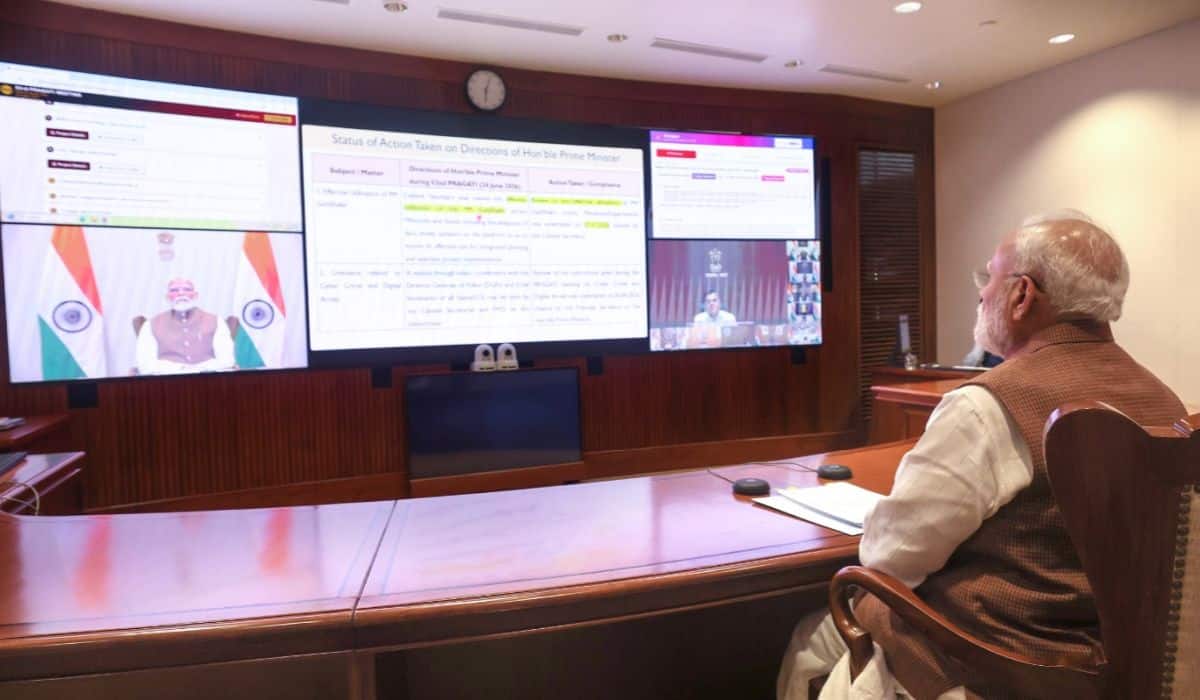
Prime Minister Shri Narendra Modi chaired the 53rd meeting of PRAGATI, the ICT-enabled, multi-modal platform for Pro-Active Governance and Timely Implementation, at Seva Teerth earlier today.

During the meeting, Prime Minister reviewed six key infrastructure projects across the Railway, Road and Power sectors, spanning nine States with a cumulative cost of more than ₹30,000 crore. The projects, significant for strengthening connectivity, supporting industrial and economic activity and improving public services, were reviewed with particular emphasis on adherence to timelines, inter-agency coordination, resolution of pending issues and expeditious completion.

Prime Minister emphasised that delays in infrastructure projects have consequences beyond cost escalation, as they also postpone the benefits intended for citizens, businesses and the economy. He said that infrastructure projects should be viewed and monitored as an integrated whole, rather than as isolated sections, stretches or packages. He noted that progress in individual packages should ultimately translate into timely completion and operationalisation of the entire project. Ministries and States were therefore asked to adopt an end-to-end approach, and address critical gaps that could delay the overall commissioning and delivery of benefits. He called for fostering a proactive work culture across Ministries and State Governments, with greater ownership at every level of project implementation.

Prime Minister stressed the need to explore common utility corridors for infrastructure services, wherever feasible, particularly while planning major transport and infrastructure projects. He called upon Ministries and States to examine such integrated approaches at the planning stage itself, keeping in view their technical and economic feasibility.

Prime Minister said that speed of execution must be accompanied by uncompromising quality. He called upon Ministries, States and implementing agencies to adopt modern technologies and strengthen quality assurance and supervision at every stage.

While reviewing AgriStack under the Digital Agriculture Mission, Prime Minister emphasised the need to leverage the latest digital technologies, including Artificial Intelligence, to derive greater value from agricultural data. He stressed that the data ecosystem should be effectively utilised across the agricultural value chain, from input planning to processing, enabling more informed interventions, better targeting and data-driven decision-making. He appreciated the efforts of the States and the Central Government in building the AgriStack ecosystem and called for further strengthening its use for delivering better outcomes for farmers.

During the review of cyber fraud cases, including incidents of digital arrest, Prime Minister said that prevention must be strengthened through a sustained focus on training, awareness and education. He stressed the need for continuous and targeted public-awareness campaigns, particularly for senior citizens, youth and other vulnerable sections, to familiarise them with common fraud techniques, warning signs and safe digital practices. He also called for regular capacity-building of personnel involved so that emerging modes of cyber fraud are identified and acted upon swiftly.