Your Excellency, my dear friend, President Macron,
VCs, industry leaders and innovators,
Bonjour!
Namaste!
I extend my greetings to all participants associated with Bharat Innovates. I also convey my best wishes to everyone for the success of this programme.
Friends,
Countries across the world engage in trade with one another, and strategic partnerships also exist between nations. However, there are certain relationships that are driven not only by shared interests, but also by a shared vision. The relationship between India and France is one such partnership.
This relationship is marked by both connection and conviction. It embodies both innovation and inspiration. It is founded upon shared values as well as a shared vision.
It is upon the foundation of this relationship that, over the past years, we have jointly launched new initiatives, guided new ideas, and made every possible effort to find solutions to global challenges.
Whether it is the International Solar Alliance, dialogue related to AI, or our cooperation spanning from security to sustainability, our two nations have consistently worked together to provide solutions to challenges concerning humanity.
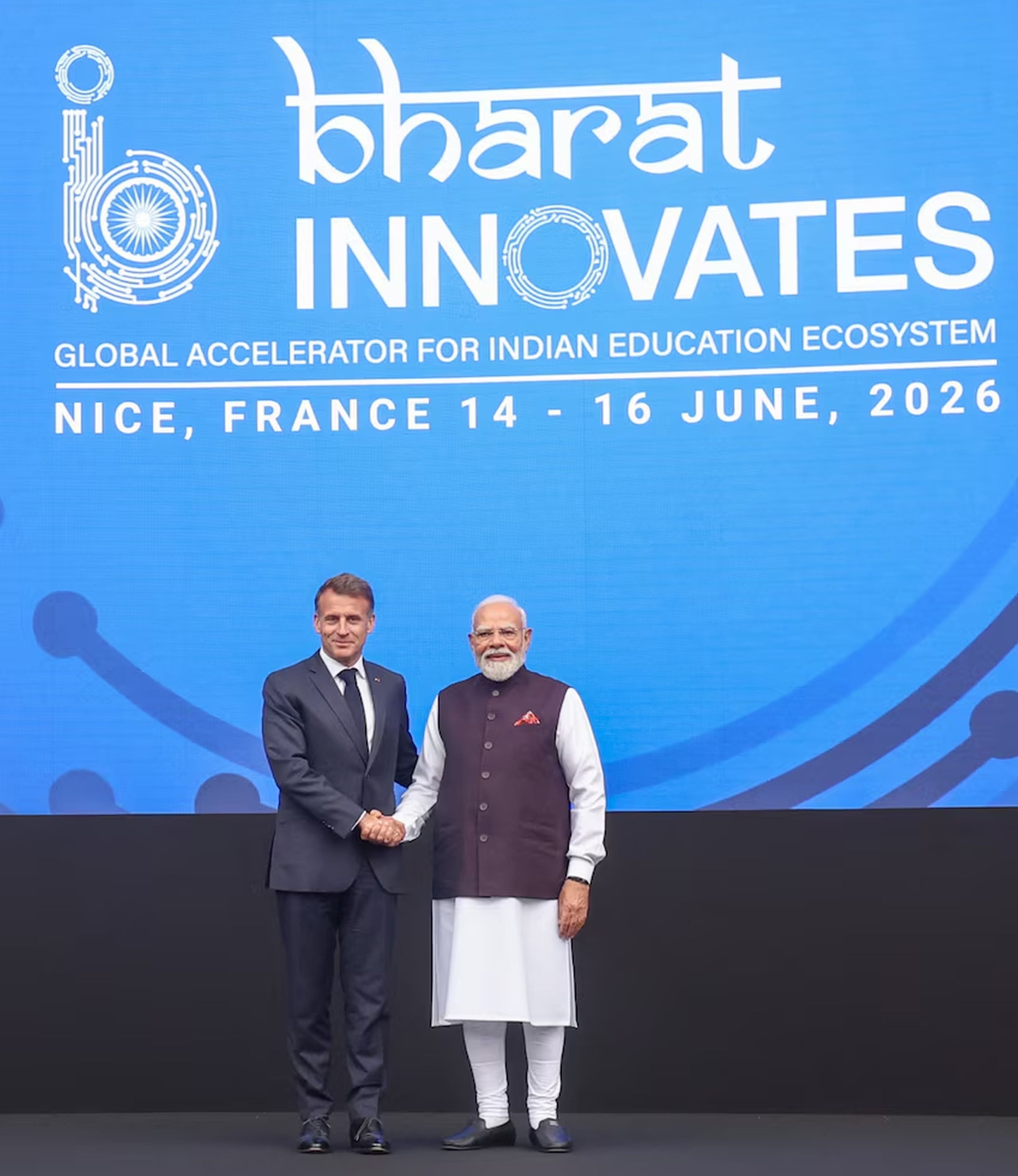
Earlier this February, the India–France Year of Innovation was launched. Today, we are equally delighted that the launch of Bharat Innovates is also being undertaken in partnership with France.
I express my sincere gratitude to my friend, President Macron, for being present here on this occasion. During your recent visit to India, President Macron, you had said that India and France must come together to address the challenges of this century. Today, I can proudly say that this initiative is a significant step in that very direction.
The Bharat Innovates platform is emerging as a bridge between Indian talent and European capital. It is a platform where young minds from India are getting the opportunity to connect with European expertise.
Friends,
Today, 21st century India is undergoing a period of profound transformation. India is witnessing a startup revolution. In this revolution, the youth of India, with a new mindset, are seeking solutions to problems for the benefit of humanity. Bharat Innovates serves as a platform to bring the world-class solutions developed by our young innovators to the global stage. My friend, Mr. Harish Salve, Chairperson of the Board of IIT Delhi, has made a significant contribution to the organisation of this initiative, and I congratulate him and the entire team for their efforts.
Friends,
A large number of young entrepreneurs are gathered here today. In them, one can witness a glimpse of India’s future. One can see the confidence of India’s youth. One can also see the energy of a new India.
An India that is emerging not merely as a consumer of solutions, but as a contributor of solutions. Here, some are working to transform rural life through AI, while others are using satellite technology to support farmers. Some young innovators are shaping the future through smart cities, advanced manufacturing, and new materials. Others are ensuring a sustainable future through green hydrogen, electric mobility, and battery technologies. At the same time, several start-ups are developing new technologies in the fields of defence and security.
Looking at your capabilities, I would say: Bharat innovates with scale and speed. Bharat innovates for a sustainable future. And Bharat innovates for the whole world.
Friends,
Today, many venture capitalists and industry leaders are also part of this programme. In their presence, I would especially like to commend these young participants who have come from India.
All those who have come here chose not to follow the conventional path. Instead, they charted a new course and created a new direction for themselves. Here, you may be seeing around 100 to 125 start-ups, but India today has a vast pool of more than 200,000 such start-ups. These start-ups are now contributing with renewed energy to the growth of both the Indian and the global economy.
Friends,
For the world, this decade is one of both disruption and development. Amid ongoing conflicts and the growing impact of climate change, the world is passing through a period of unprecedented upheaval. Yet, while the challenges facing humanity today are immense, the opportunities before us are equally significant.
Artificial Intelligence, Quantum Computing, Biotechnology, Space Technologies, and Advanced Materials are all technologies that will shape the future of humanity. They represent the next chapter of human civilisation.
Every technological revolution presents humanity with a new opportunity. And every opportunity also brings with it a new responsibility. Today, the world is looking towards technologies that are trusted, inclusive, human-centric, and aimed at global good. At such a time, India’s priority is Technology for Humanity; human-centric innovation.
Friends,
This very mantra has been at the core of our digital revolution. It also reflects the essence of India’s Digital Public Infrastructure. The foundational principle of our AI vision is also the same - AI for All - for the welfare and well-being of all. This was also the central theme of the AI Impact Summit held in Delhi.
Friends,
India has demonstrated that innovation and inclusion are not contradictory to one another, but complementary. This means that the greatness of any innovation does not lie merely in its valuation, its true greatness lies in its human impact.
This is the spirit of Bharat Innovates. This is India’s vision. Along with the start-up ecosystem present here, it serves as an equally great source of inspiration for all of you as well.
Friends,
Innovation is in India’s DNA. For thousands of years, India has provided new direction to the world through its knowledge and innovation. From mathematics to astronomy, from medicine to yoga, India’s contributions have formed the foundation of progress for all humanity. Today, we have given this very legacy a new momentum and a new direction.
Friends,
Over the past 11 – 12 years, India has built a strong ecosystem for innovation. From patent filings to incubation networks, from Startup India to policy support, this entire journey has progressed in a mission mode.
Today, India is the world’s third-largest start-up ecosystem. However, our vision is not limited only to major cities. We have worked to take innovation to the grassroots level.
Atal Tinkering Labs have been established in schools, young people are being connected with hackathons and innovation challenges, incubators and research institutions are being expanded across the country, and women innovators in particular are being linked with a wide range of new technologies.
As a result of all these efforts, India has witnessed transformative change on a large scale. Today, from Drone Didis to founders of start-ups, our women power is scripting new success stories.
Friends,
To further harness the energy of our youth, India’s defence sector has also been opened up for innovation. Today, hundreds of start-ups associated with the defence and space sectors are doing remarkable work in India.
Recently, India has also undertaken significant reforms in the nuclear energy sector. These reforms are set to create new opportunities in the fields of clean energy, advanced reactors, and frontier research.
This express of reforms will not stop; it will continue to move forward relentlessly. And the number of start-ups emerging from India will continue to grow manifold.
Friends,
Until a decade ago, the world viewed India as a technology adopter. Today, India is emerging as a technology provider. Whatever India innovates, whatever solutions it offers, benefit a large section of humanity. This is also the objective of Bharat Innovates.
Bharat Innovates is an invitation to the world to co-create the next chapter of global innovation with India.
I extend my very best wishes for your sessions and discussions over the next three days. We seek partnership. We seek co-development. We seek joint research. We seek shared manufacturing. And we seek long-term collaboration.
I earnestly invite every investor, every university, every research institution, and every entrepreneur present here today. Come to India. Work together with us. Design in India. Develop in India. And create solutions for the world.
Thank you very much.