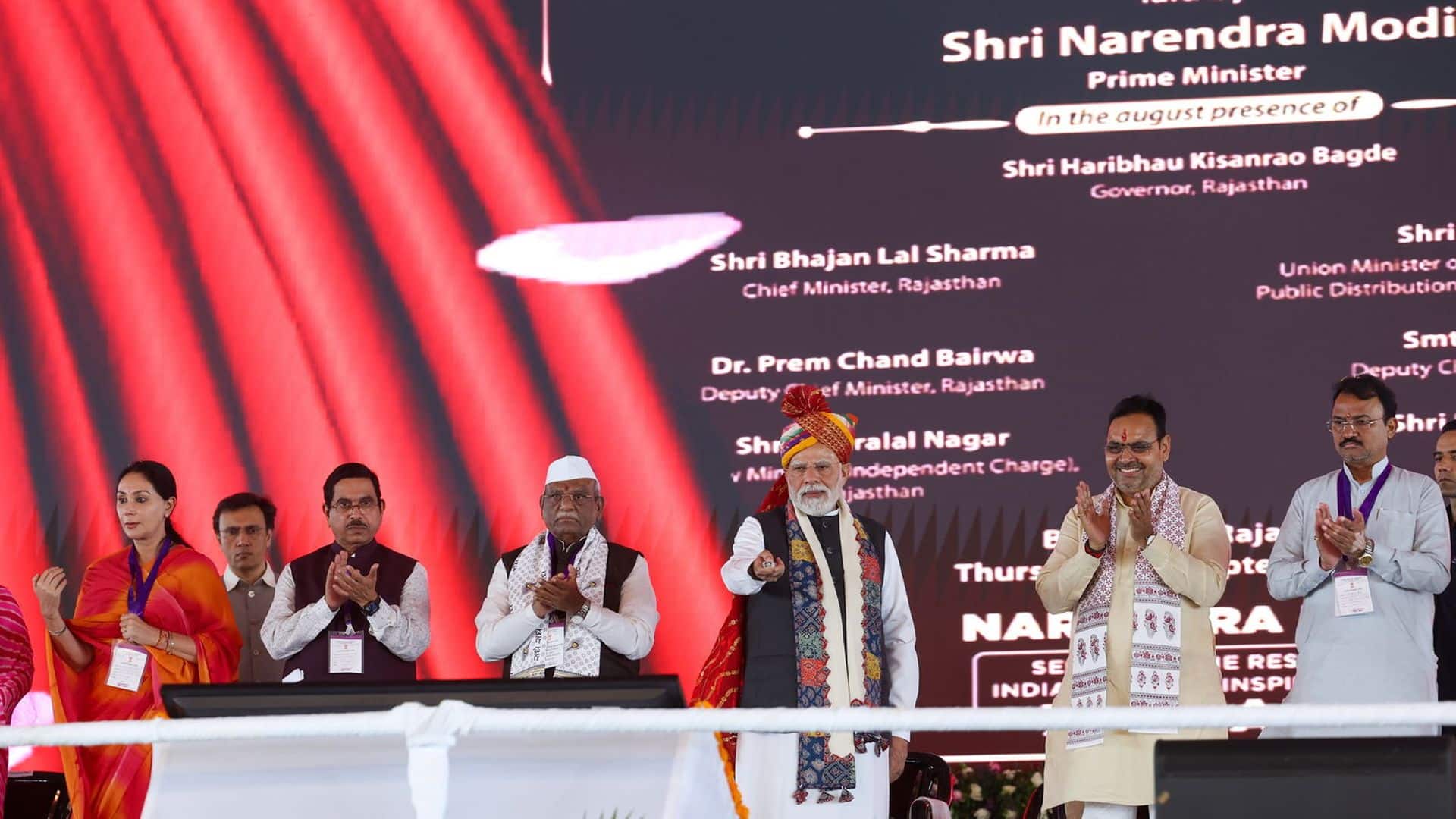


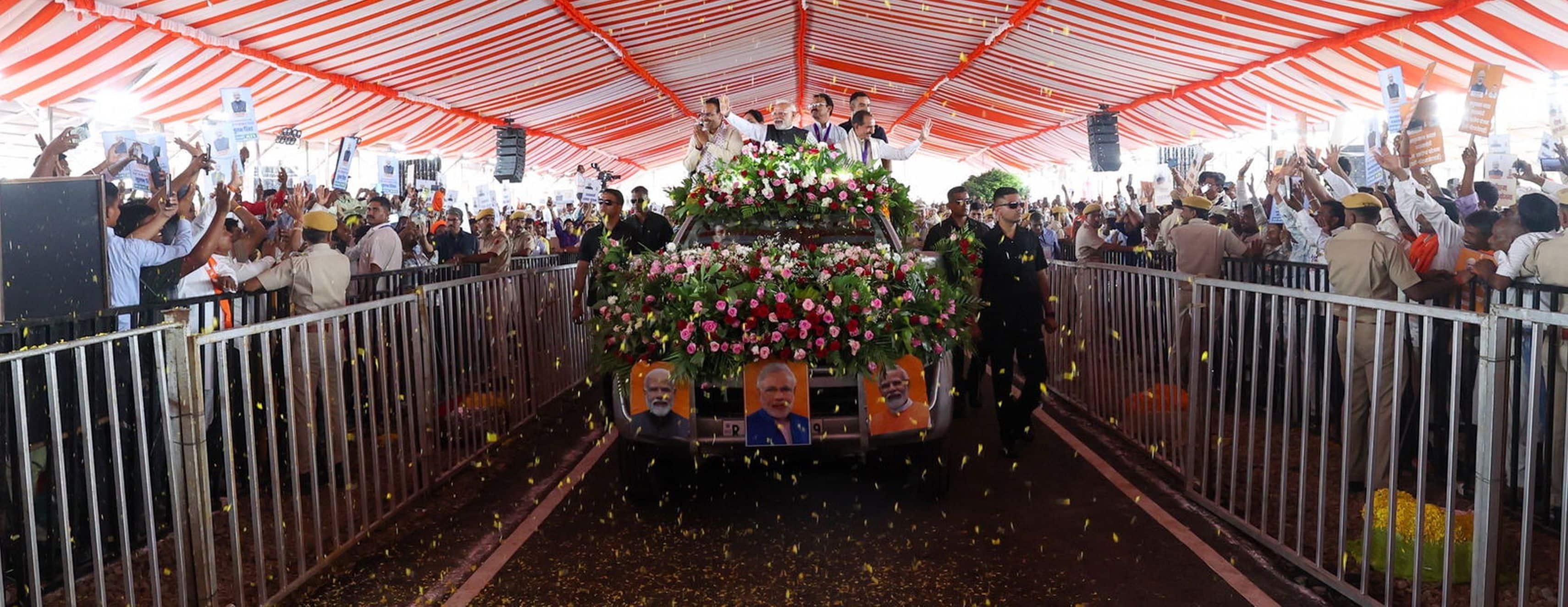
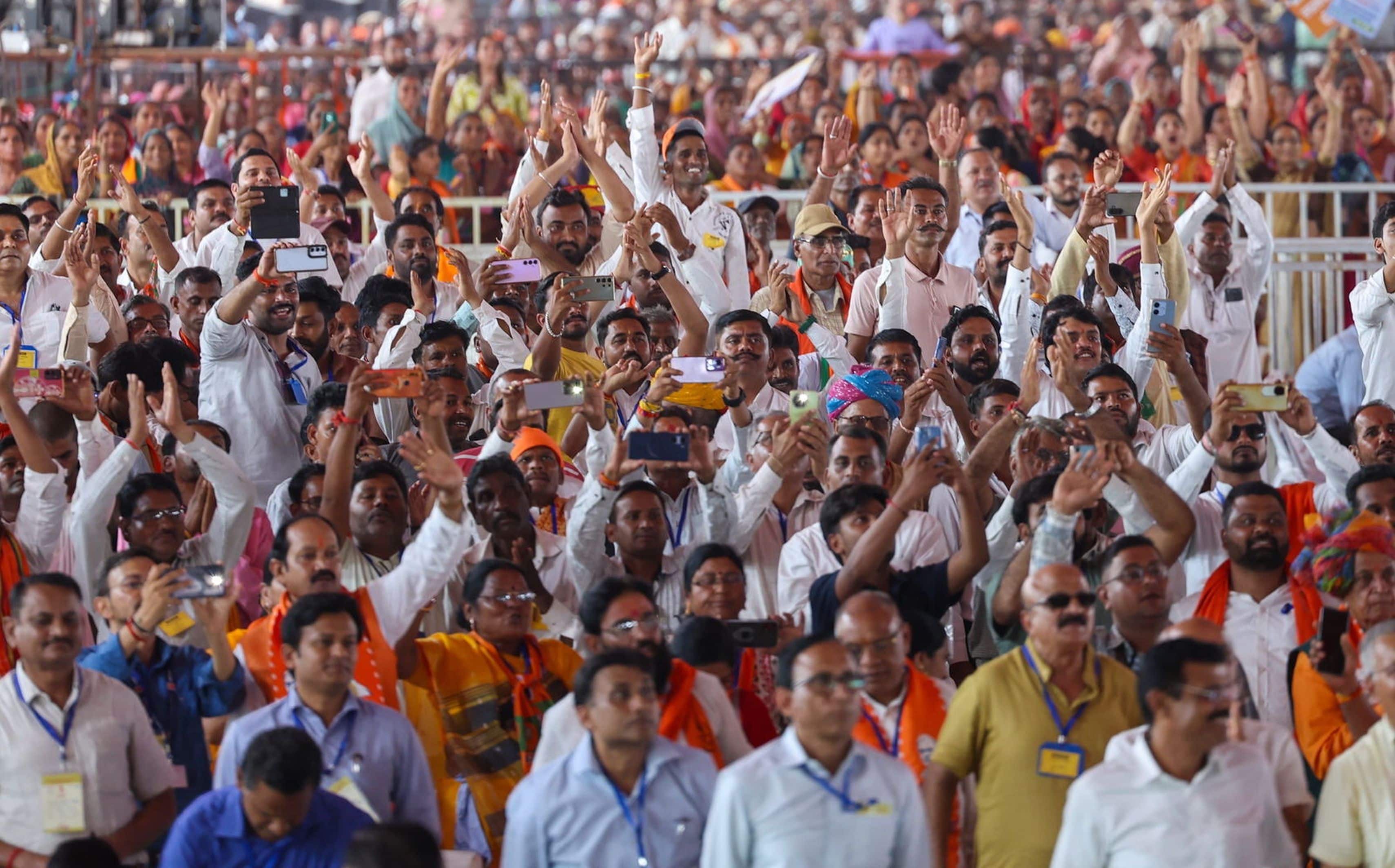
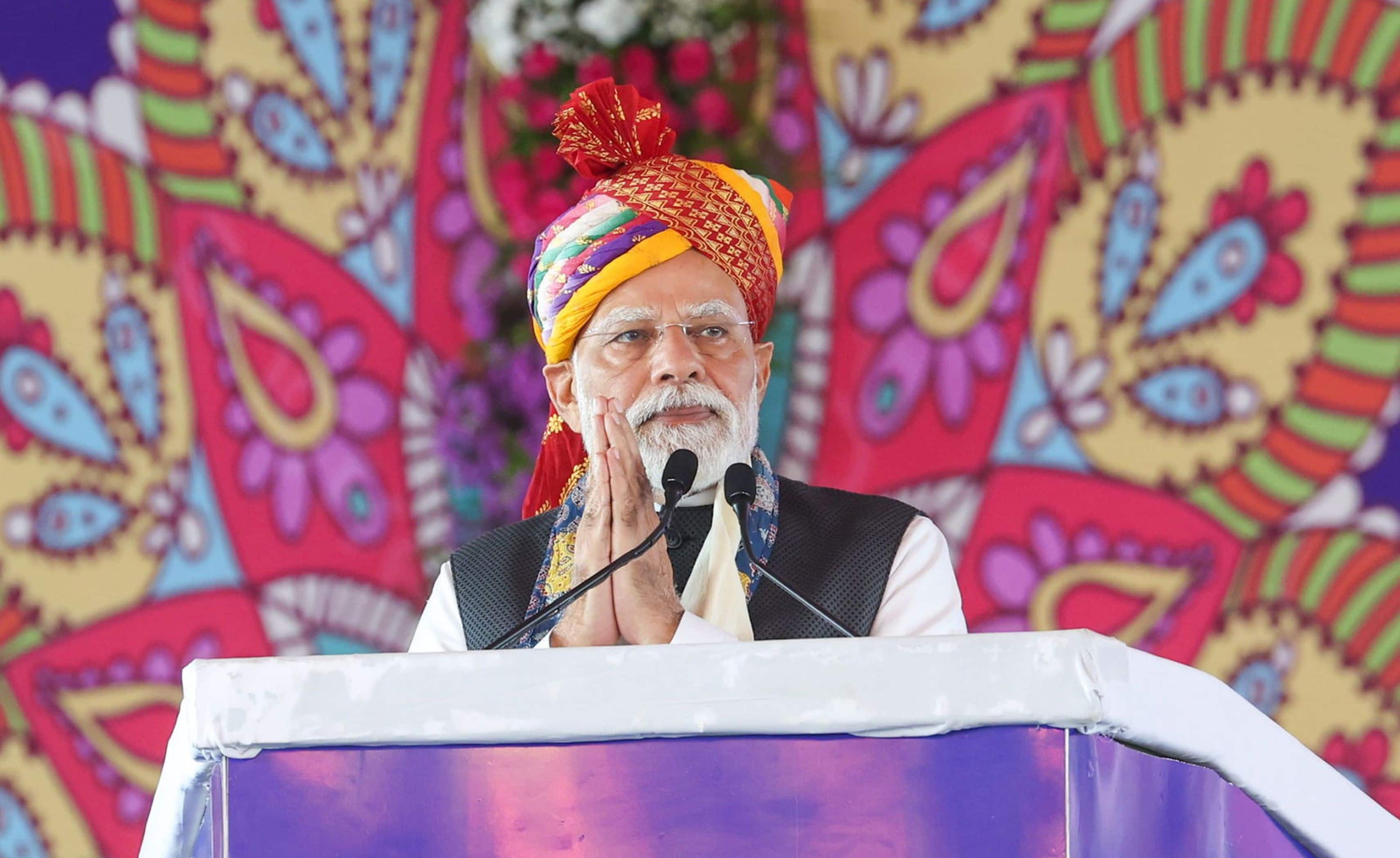
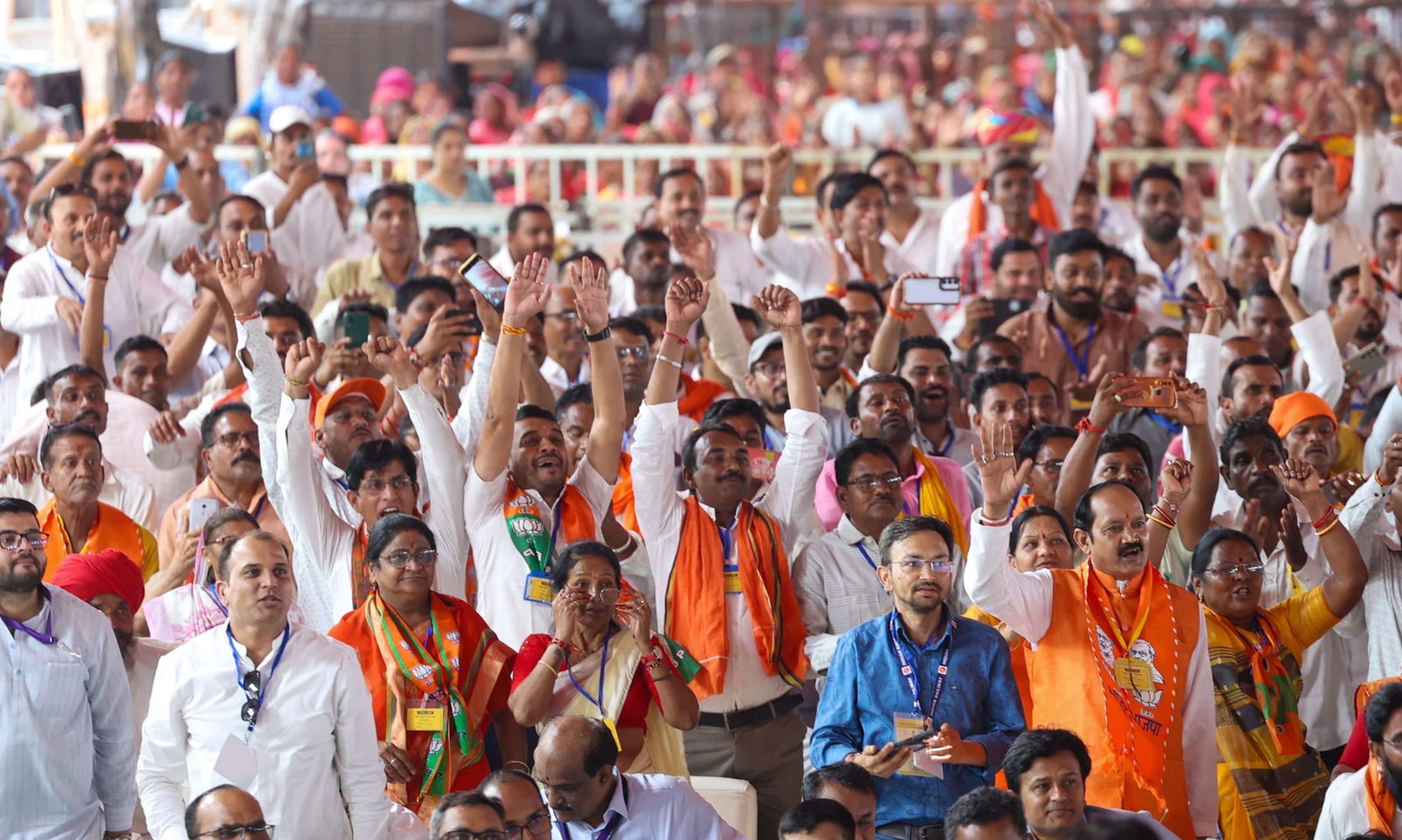
Prime Minister Shri Narendra Modi inaugurates, lays foundation stone of development works worth over Rs 1,22,100 crore in Banswara, Rajasthan. On the fourth day of Navratri, the Prime Minister expressed his privilege to visit the sacred land of Maa Tripura Sundari in Banswara. He shared that he also had the opportunity to witness Maa Mahi, revered as the Ganga of Kanthal and Vagad. The Prime Minister remarked that the waters of Mahi symbolize the resilience and struggle of India’s tribal communities. He highlighted the inspiring leadership of Mahayogi Govind Guru Ji, whose legacy continues to resonate, with the holy waters of Mahi bearing witness to that great saga. Shri Modi paid homage to Maa Tripura Sundari and Maa Mahi, and from this land of devotion and valor, he also offered his respects to Maharana Pratap and Raja Bansia Bhil.
Shri Modi remarked that during Navratri, the nation worships the nine forms of Shakti, and today’s major event in Banswara is dedicated to Urja Shakti—energy generation. He highlighted that a new chapter in India’s power sector is being written from the soil of Rajasthan. The Prime Minister announced the launch of power projects worth over ₹90,000 crore across Rajasthan, Madhya Pradesh, Andhra Pradesh, Karnataka, and Maharashtra. He emphasized that the simultaneous initiation of such large-scale projects reflects India’s accelerating progress in the energy sector, with every region of the country actively contributing with all states being given priority. In Rajasthan, the foundation stones for clean energy projects and transmission lines have been laid. Shri Modi also inaugurated solar energy projects and announced the commencement of the Rajasthan Atomic Power Project in Banswara. He underscored that from solar to nuclear energy, India is scaling new heights in power generation capacity.
“In today’s era of technology and industry, development runs on the power of electricity; electricity brings light, speed, progress, connectivity, and global access”, remarked the Prime Minister. He criticized previous governments for neglecting the importance of electricity. Shri Modi stated that when his government came to power in 2014, 2.5 crore households lacked electricity connections, and even after 70 years of independence, 18,000 villages had not seen a single electric pole. He highlighted that major cities faced hours-long power cuts, and in villages, even 4–5 hours of electricity was considered significant. The absence of electricity hindered factory operations and the establishment of new industries, affecting states like Rajasthan and the entire country. The Prime Minister affirmed that in 2014, his government resolved to change this situation. He stated that electricity was delivered to every village and 2.5 crore households received free connections. Wherever power lines reached, electricity followed—making lives easier and enabling the growth of new industries.
The Prime Minister stated that for any nation to achieve rapid development in the 21st century, it must scale up its electricity generation. He emphasized that the most successful countries will be those leading in clean energy. “Our government is transforming the clean energy mission into a people’s movement”, highlighted Shri Modi, announcing the launch of the PM Surya Ghar Muft Bijli Yojana, under which solar panels are being installed on rooftops in both urban and rural areas. To ensure affordable electricity for farmers, the PM-KUSUM scheme is facilitating the installation of solar pumps in agricultural fields. The Prime Minister noted that several solar projects have been inaugurated across states today, directly benefiting lakhs of farmers. He reiterated that the PM Surya Ghar scheme provides free electricity for homes, while the PM-KUSUM scheme ensures free electricity for farms. Shri Modi shared his earlier interaction with beneficiaries of the PM-KUSUM scheme, who told him that solar-powered free electricity has become a major blessing in their lives.
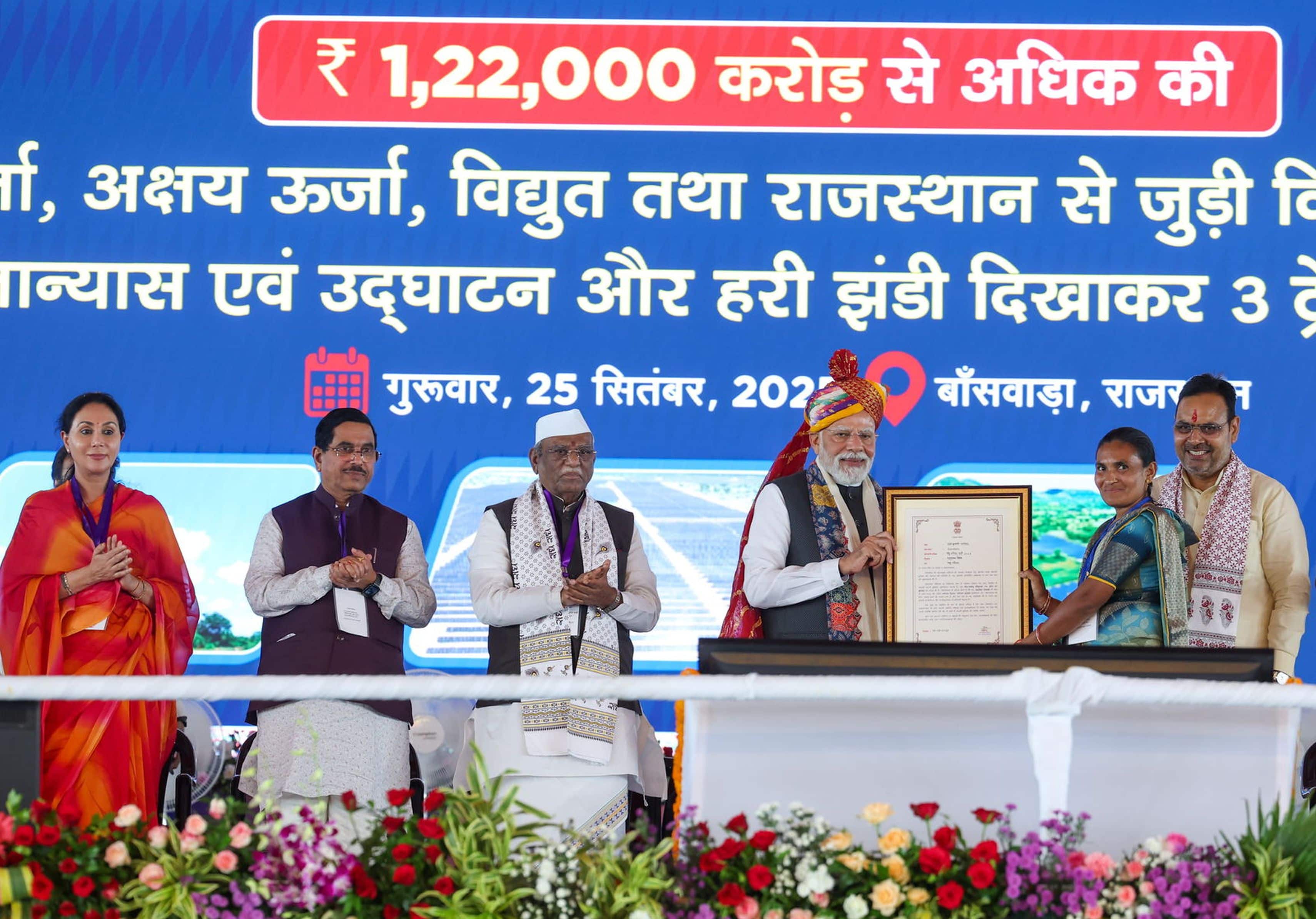
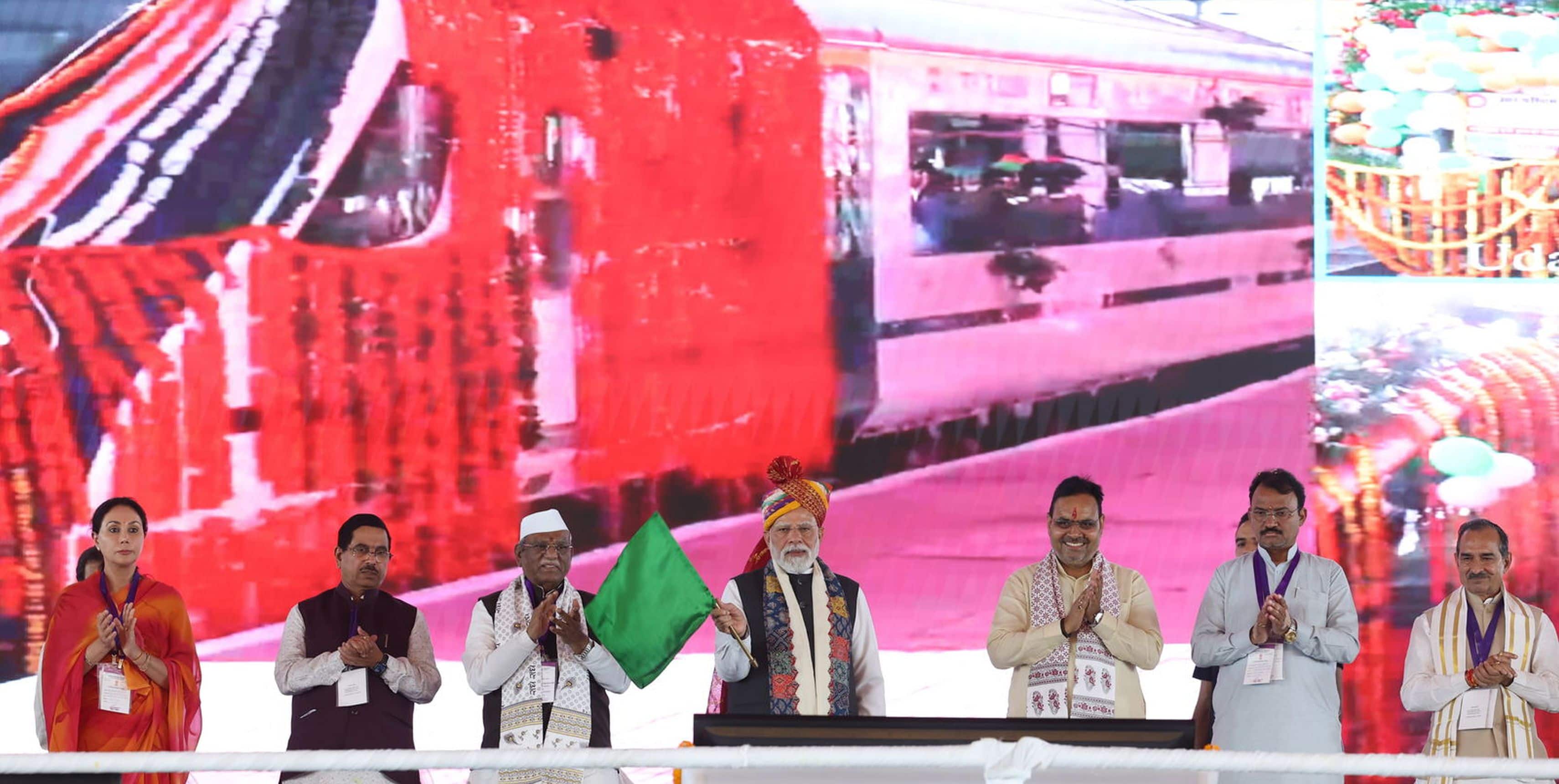
“India is working at high speed to become a developed nation, with Rajasthan playing a significant role in this journey”, exclaimed Shri Modi. He announced the launch of additional projects worth ₹30,000 crore for the people of Rajasthan, aimed at improving access to water, electricity, and healthcare. The Prime Minister flagged off three new trains, including a Vande Bharat service. He highlighted the nationwide campaign to generate new employment opportunities, under which 15,000 youth in Rajasthan received appointment letters for government jobs today. Shri Modi extended his best wishes to these young individuals as they embark on a new chapter in their lives and congratulated the people of Rajasthan on the launch of these development initiatives.
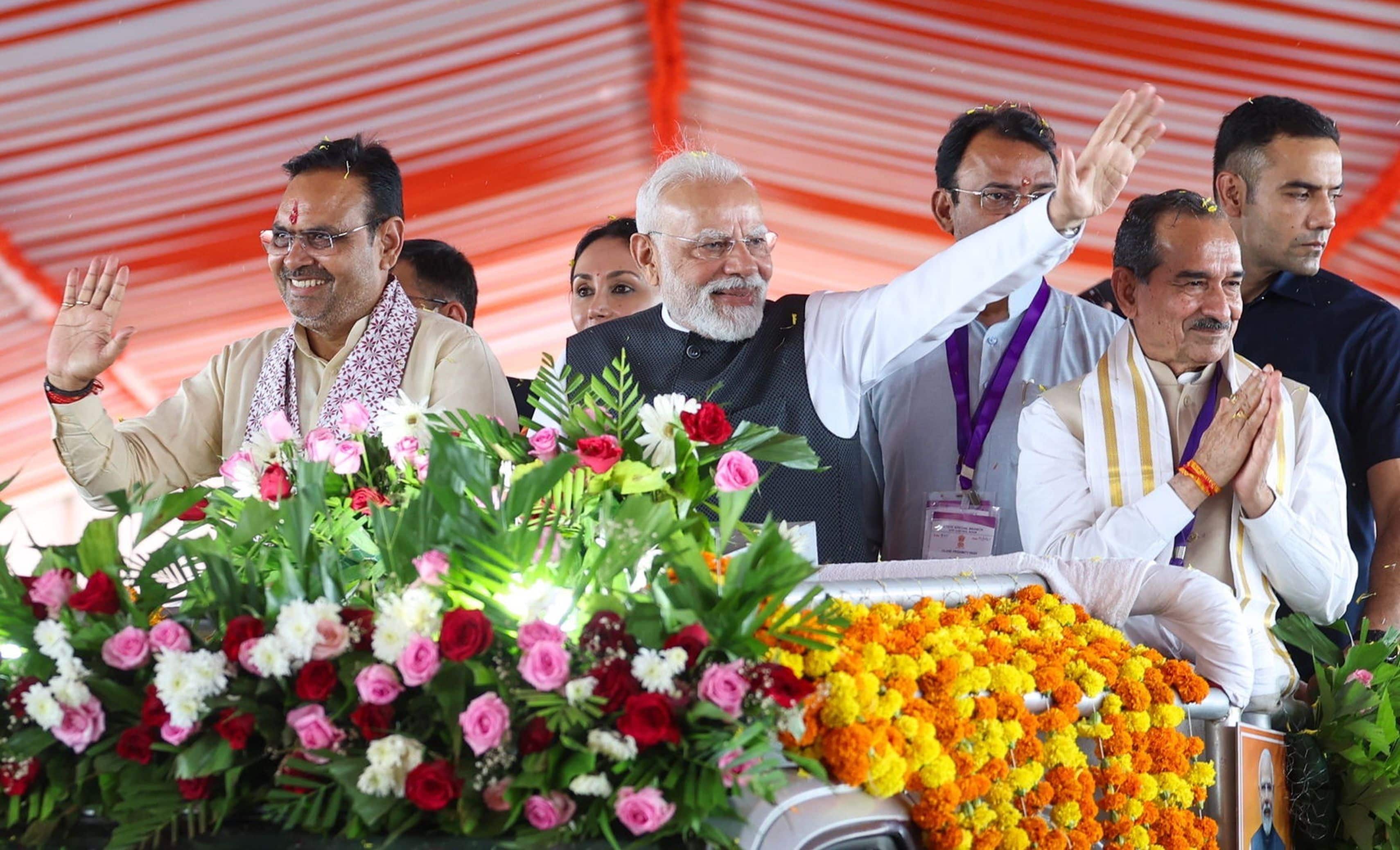
Expressing satisfaction that their government in Rajasthan is working with full integrity toward the state’s development, the PM stated that the wounds inflicted on Rajasthan by previous dispensation through misgovernance and exploitation are now being healed by the current administration. Shri Modi alleged that under opposition rule, Rajasthan had become a center for paper leaks and that the Jal Jeevan Mission was compromised by corruption. He highlighted that atrocities against women had peaked, with protection being extended to perpetrators. He pointed out that during the opposition's tenure, regions like Banswara, Dungarpur, and Pratapgarh witnessed a surge in crime and illegal liquor trade. The Prime Minister remarked that once the people gave them a chance, law and order was strengthened and the pace of development accelerated. He noted that major projects are now being implemented, with a growing network of highways and expressways across Rajasthan. The Prime Minister affirmed that their government is propelling Rajasthan, especially South Rajasthan, onto a fast track of development.
Noting that today marks the birth anniversary of Pandit Deendayal Upadhyaya, who gave the nation the principle of Antyodaya—upliftment of the person standing on the last rung of society, Shri Modi emphasized that this vision has now become the government’s mission. He stated that the administration is working with a deep sense of service for the welfare of the poor, Dalits, backward classes, and tribal communities.
Criticising the opposition for consistently neglecting the tribal community and failing to understand their needs, the Prime Minister emphasized that it is their government that prioritized tribal welfare by establishing a dedicated ministry, for the first time under Prime Minister Atal Bihari Vajpayeeji, a separate ministry for Tribal affairs was made. The Prime Minister remarked that during opposition rule, it was unimaginable for such large-scale projects to reach tribal regions. He affirmed that under their government, these developments are now becoming a reality. He announced the launch of a major PM MITRA Park in Dhar, Madhya Pradesh, which will bring significant benefits to tribal farmers.
Mentioning that it is through the efforts of their party that the daughter of a poor tribal family, Smt. Droupadi Murmu, has become the President of India, Shri Modi highlighted that the President herself raised the issue of the most marginalized tribal communities, which inspired the launch of the PM Janman Yojana. Under this initiative, special priority is being given to the most deprived segments within tribal society. The Prime Minister noted that through the Dharti Aaba Janjatiya Gram Utkarsh Abhiyan, tribal villages are being modernized, benefiting over five crore tribal citizens. He added that hundreds of Eklavya Model Residential Schools are being established across the country. The Prime Minister affirmed that the government has also recognized the forest rights of forest dwellers and Scheduled Tribes.
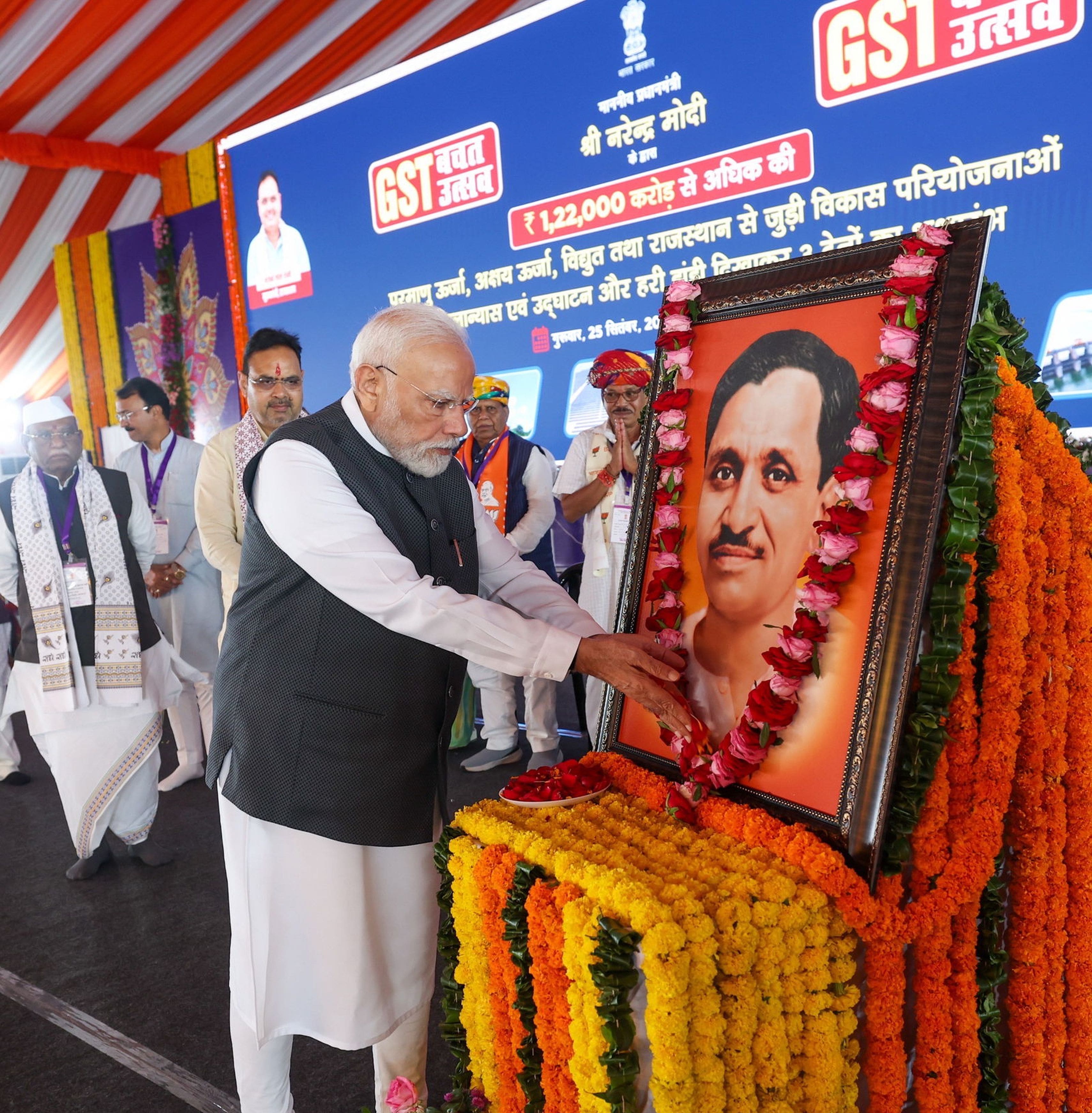
“India’s tribal communities have been sustainably using forest resources for thousands of years”, said Shri Modi. To ensure these resources become a means of progress for them, the government launched the Van Dhan Yojana. He highlighted that the Minimum Support Price (MSP) for forest produce has been increased and tribal products have been linked to market access. As a result, the Prime Minister noted, India has witnessed record growth in forest produce across the country.
Affirming the government's commitment to ensuring that the tribal community lives with dignity, the PM stated that protecting their faith, self-respect, and cultural heritage is a solemn resolve. He emphasized that when the life of an ordinary citizen becomes easier, they themselves take the lead in driving the nation’s progress. He recalled the dire conditions 11 years ago under opposition rule, attributing them to exploitation and systemic looting of citizens. He pointed out that during that period, taxes and inflation were at record highs. The Prime Minister remarked that once the people blessed their government, it put an end to the opposition's exploitative practices.
Shri Modi stated that the implementation of GST in 2017 liberated the country from the complex web of taxes and tolls. He highlighted that on the first day of Navratri this year, a major GST reform was introduced, resulting in the celebration of the GST Savings Festival across India. The Prime Minister remarked that most everyday items have become more affordable. Addressing the large gathering of women present, he emphasized that household kitchen expenses have significantly reduced, bringing direct relief to mothers and sisters nationwide.
Highlighting that before 2014, spending ₹100 on daily essentials like soap, shampoo, toothpaste, and tooth powder resulted in a total cost of ₹131 due to high taxation under the opposition government, Shri Modi stated that opposition levied ₹31 tax on every ₹100 purchase. With the implementation of GST in 2017, the same ₹100 worth of goods cost ₹118, marking a direct saving of ₹13 under their government. Following the GST reforms introduced on September 22, the cost has further reduced to ₹105, resulting in a total saving of ₹26 compared to the previous dispensation era. The Prime Minister emphasized that mothers and sisters meticulously manage household budgets, and under the new tax regime, families are now saving hundreds of rupees every month.
Highlighting that footwear is a basic necessity for all, the Prime Minister stated that under the previous dispensation’s rule, purchasing a ₹500 shoe cost ₹575 due to a ₹75 tax burden. With the implementation of GST, this tax was reduced by ₹15. Following the latest GST reforms, the same shoe now costs ₹50 less. The Prime Minister noted that earlier, footwear priced above ₹500 attracted even higher taxes. He emphasized that the government has now significantly reduced tax rates on shoes priced up to ₹2,500, making them more affordable for the common citizen.
Shri Modi further stated that owning a scooter or motorcycle is a common aspiration for every household, but under the opposition rule, even this was out of reach. He highlighted that opposition levied over ₹19,000 in tax on a ₹60,000 motorcycle. With the introduction of GST in 2017, this tax was reduced by ₹2,500. Following the revised rates implemented on September 22, the same motorcycle now attracts only ₹10,000 in tax—resulting in a direct benefit of ₹9,000 compared to 2014.
The Prime Minister stated that under the previous dispensation rule, building a home was prohibitively expensive. He highlighted that a ₹300 cement bag attracted over ₹90 in taxes. With the introduction of GST in 2017, this tax was reduced by approximately ₹10. Following the latest GST reforms implemented on September 22, the same cement bag now incurs only ₹50 in tax—resulting in a direct saving of ₹40 compared to 2014. Shri Modi remarked that while governance under the opposition party was marked by excessive taxation, their government has ushered in an era of savings for the common citizen.
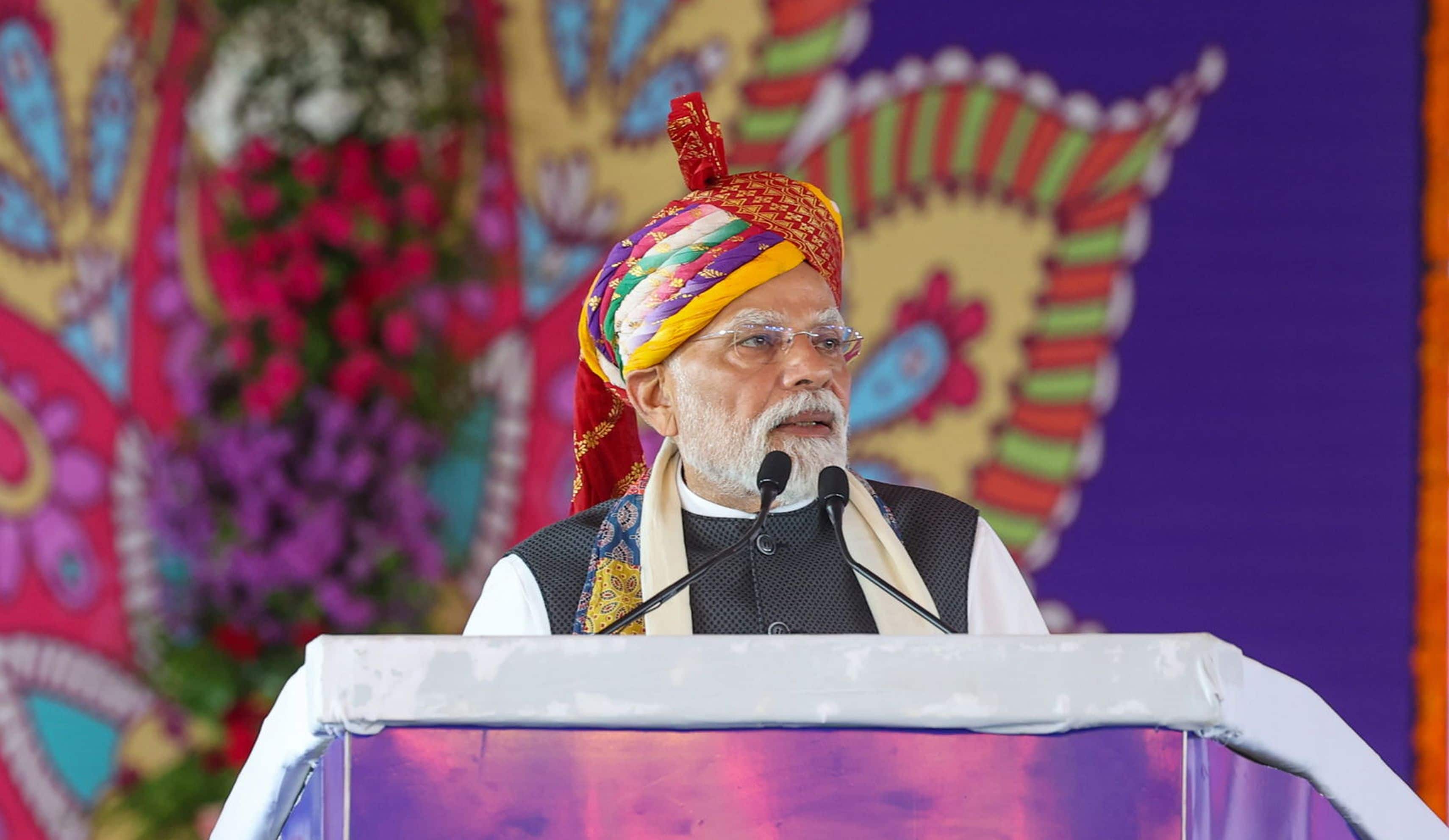
Emphasising that amid the GST Savings Festival, Shri Modi said that we should not forget the goal of Self-Reliant India. He added that the mantra of swadeshi must not be forgotten, Shri Modi urged that what we sell should be swadeshi, and what we buy must also be swadeshi. He encouraged citizens to proudly declare, “This is swadeshi.” The Prime Minister remarked that when people buy swadeshi products, the money stays within the country—reaching local artisans, workers, and traders. This money contributes directly to national development rather than flowing abroad, helping build new highways and roads. He called on everyone to make swadeshi a symbol of national pride. The Prime Minister appealed to citizens to pledge to buy only swadeshi goods during the festive season and once again extended his congratulations on the launch of development and employment-linked projects.
The Governor of Rajasthan, Shri Haribhau Kisanrao Bagade, Chief Minister of Rajasthan, Shri Bhajanlal Sharma, Union Minister, Shri Pralhad Joshi were present among other dignitaries at the event.
Background
In line with his commitment to transform India’s power sector to ensure affordable, reliable, and sustainable power supply for all, Prime Minister laid the foundation stone of Anushakti Vidhyut Nigam Ltd’s (ASHVINI) Mahi Banswara Rajasthan Atomic Power Project (4X700 MW) worth around Rs 42,000 crore. It will be one of the largest nuclear plants in the country supplying reliable base load energy and will strengthen India’s position in the environmental stewardship and evolving nuclear energy landscape. Furthering the spirit of Aatmanirbhar Bharat, Mahi Banswara Rajasthan Atomic Power Project comprises four indigenous 700 MW Pressurized Heavy Water Reactors with advanced safety features, designed and developed by NPCIL. It is part of India’s broader “fleet mode” initiative, where ten identical 700 MW reactors are being built across India under uniform design and procurement plans. The project will bring in cost efficiencies, faster deployment, and consolidated operational expertise.
In a major boost to India’s clean energy infrastructure, Prime Minister inaugurated and laid the foundation stone of green energy projects worth around Rs 19,210 crore in Rajasthan. He inaugurated solar projects at Phalodi, Jaisalmer, Jalore, Sikar among others. He also laid the foundation stone of the solar project at Bikaner. Additionally, he will also lay the foundation stone of a Solar Park at Ramagiri in Andhra Pradesh. The projects will significantly contribute to India’s clean energy capacity, generating substantial amounts of green power while preventing millions of tonnes of carbon dioxide emissions.
Prime Minister also laid the foundation stone of three power transmission projects worth over Rs 13,180 crore under Renewable Energy Zone (REZ) initiative of Government of India, which aims to develop 181.5 GW of renewable energy capacity by 2030 across eight states. To ensure efficient dispersal of this renewable power towards load centers and to enhance grid stability, PowerGrid is implementing key transmission systems for Rajasthan REZ.
It includes 765 KV transmission lines from Beawar in Rajasthan to Mandsaur in Madhya Pradesh and extension of associated substations; from Sirohi in Rajasthan to Mandsaur and to Khandwa in Madhya Pradesh along with augmentation of transformation capacity at Sirohi Substation and extension at Mandsaur & Khandwa Substations; and 765 KV & 400 KV transmission line from Bikaner in Rajasthan to Siwani and Fatehabad in Haryana and further to Patran in Punjab along with establishment of substations at Bikaner and extension of Siwani substation. Cumulatively, these projects will facilitate seamless transfer of 15.5 GW green energy from generation hubs in Rajasthan to demand centers in beneficiary states across India.
Prime Minister laid the foundation stone of three Grid Substations (GSS) which include 220 KV and associated lines at Jaisalmer and Bikaner. He will also inaugurate a 220 KV GSS at Shiv in Barmer district. These projects, worth over Rs 490 crore, will significantly contribute to ensuring energy security in the region.
In line with his commitment to empower farmers, Prime Minister inaugurated Feeder Level Solarization projects of 3517 MW, worth over Rs 16,050 crore, in the states of Rajasthan, Maharashtra, Madhya Pradesh and Karnataka under PM-KUSUM (Pradhan Mantri Kisan Urja Suraksha evam Utthaan Mahabhiyan) Scheme (Component C). The agricultural feeders are being solarized to ensure affordable, reliable, and sustainable irrigation power benefitting lakhs of farmers by lowering electricity costs, cutting irrigation expenses, and promoting rural energy self-reliance.
In a major boost to Ramjal Setu Link Project and furthering his vision of water security, Prime Minister laid the foundation stone and inaugurated multiple water resources projects in Rajasthan worth over Rs 20,830 crore. He will lay the foundation stone for the construction of various feeders from Isarda, construction of Mor Sagar artificial reservoir in Ajmer district and its feeder from Chittorgarh. Other works include intake pump house at Bisalpur Dam, rejuvenation of Khari feeder and various other feeder canal works. Prime Minister also inaugurated Isarda Dam, Dholpur Lift Project, Takli Project among others.
In line with his commitment to safe and clean drinking water for all, Prime Minister laid the foundation stone for major drinking water supply projects, worth over Rs 5,880 crore, in Banswara, Dungarpur, Udaipur, Sawai Madhopur, Churu, Ajmer, Bhilwara districts among others under the Atal Mission for Rejuvenation and Urban Transformation (AMRUT) 2.0.
In a major boost to road infrastructure, Prime Minister laid the foundation stone of construction of flyovers at Bharatpur city, a bridge over the Banas River, and 116 Atal Pragati Path projects. He also inaugurated and dedicated to the nation multiple road projects related to National and State Highways in Barmer, Ajmer, Dungarpur districts among others. These projects worth over Rs 2,630 crore will improve regional road connectivity, ensure smoother traffic and enhance road safety.
Prime Minister also inaugurated a 250-bed RBM Hospital in Bharatpur, an IT Development and E-Governance Centre in Jaipur, sewerage system including treatment plants and pumping stations in Makrana city, and sewerage and water supply project in Mandawa and Jhunjhunu district.
In a major boost to rail connectivity, Prime Minister flagged off three trains, Vande Bharat Express Train between Bikaner & Delhi Cantt, Vande Bharat Express Train between Jodhpur & Delhi Cantt and Udaipur City – Chandigarh Express. These trains will significantly improve connectivity between Rajasthan and other northern states.
Furthering his vision of employment for all, distribute more than 15,000 appointment letters to newly appointed youth in Government departments and organizations in Rajasthan. These include over 5770 animal attendants, 4190 junior assistants, 1800 junior instructors, 1460 junior engineers, 1200 third-grade level-2 teachers among others.
Click here to read full text speech
Turning the clean energy mission into a people's movement. pic.twitter.com/GFItpbhqEu
— PMO India (@PMOIndia) September 25, 2025
Working with a spirit of service for the welfare of all sections of society. pic.twitter.com/mohk8YmFsK
— PMO India (@PMOIndia) September 25, 2025
It is our commitment to ensure that tribal communities live with dignity and self-respect. pic.twitter.com/V29wcgOMKa
— PMO India (@PMOIndia) September 25, 2025