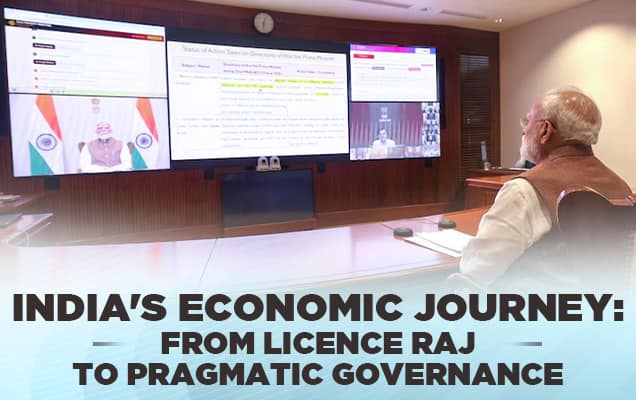
The development works launched today will strengthen infrastructure and accelerate the growth of Andhra Pradesh: PM
Amaravati is a land where tradition and progress go hand in hand: PM
NTR Garu envisioned a developed Andhra Pradesh, Together, we have to make Amaravati, Andhra Pradesh, the growth engine of developed India: PM
India is now among the countries where infrastructure is rapidly modernising: PM
Viksit Bharat will be built on four pillars - poor, farmers, youth and Women power: PM
The Navdurga Testing Range will strengthen the country's defense power just like Maa Durga, I congratulate the country's scientists and the people of AP for this: PM

The Prime Minister Shri Narendra Modi inaugurated, laid the foundation stone and dedicated to the nation multiple development projects worth over Rs 58,000 crore in Amaravati, Andhra Pradesh today. The Prime Minister expressed that standing on the sacred land of Amaravati, he does not see just a city but a dream coming true—a new Amaravati, a new Andhra. "Amaravati is a land where tradition and progress go hand in hand, embracing both the peace of its Buddhist heritage and the energy of building a developed India”, remarked the Prime Minister. He added that today, foundation stones and inaugurations have been laid for projects, and these projects are not just about concrete structures but the strong foundation of Andhra Pradesh’s aspirations and India’s vision for development. Prime Minister Modi extended his greetings to the people of Andhra Pradesh, offering prayers to Bhagwan Veerabhadra, Bhagwan Amaralingeshwara, and Tirupati Balaji. He also conveyed his best wishes to Chief Minister Shri Chandrababu Naidu and Deputy Chief Minister Shri Pawan Kalyan.

Remarking that Indra Lok’s capital was once called Amaravati, and now Amaravati is the capital of Andhra Pradesh, Shri Modi emphasized that this is not a mere coincidence but a positive sign for the creation of ‘Swarna Andhra’, which will strengthen India’s path toward development. The Prime Minister highlighted that Amaravati will energize the vision of ‘Swarna Andhra’, making it a center for progress and transformation. “Amaravati is not just a city, it is a force, it is the strength that will transform Andhra Pradesh into a modern state and a power that will transform Andhra Pradesh to an advanced state", stated Shri Modi in Telugu.

Envisioning Amaravati as a city where the dreams of Andhra Pradesh’s youth will come true, the Prime Minister highlighted that in the coming years, Amaravati will emerge as a leading city in Information Technology, Artificial Intelligence, Green Energy, Clean Industry, Education, and Healthcare. The Prime Minister remarked that the Central Government is fully supporting the State Government in rapidly developing the necessary infrastructure to accelerate growth across these sectors.

Shri Modi lauded Shri Chandrababu Naidu’s acumen for envisioning future tech on a large scale and implementing it swiftly. He recalled that in 2015, he had the privilege of laying the foundation stone for Praja Rajadhani, emphasising that over the years, the Central Government has extended comprehensive support for Amaravati’s development, ensuring all necessary steps for basic infrastructure. He remarked that with Shri Naidu’s leadership, the new state government has accelerated development efforts. He highlighted that key institutions, including the High Court, Assembly, Secretariat, and Raj Bhavan, are now being prioritized for construction.

“NTR Garu envisioned a developed Andhra Pradesh”, exclaimed the Prime Minister, urging collective efforts to make Amaravati and Andhra Pradesh the growth engine of a developed India, reaffirming the commitment to fulfilling NTR Garu’s dream. Addressing the Chief Minister and Deputy Chief Minister, the Prime Minister said in Telugu that it is our responsibility and something we must achieve together.

Emphasising that over the past 10 years, India has focused extensively on physical, digital, and social infrastructure, Shri Modi highlighted that India is now among the fastest-modernizing infrastructure nations in the world, and Andhra Pradesh is benefiting significantly from this progress. He noted that thousands of crores worth of road and rail projects have been allocated to Andhra Pradesh, accelerating its development. “Andhra Pradesh is witnessing a new era of connectivity, which will enhance district-to-district links and improve connectivity with neighboring states”, he stated, stressing that farmers will find it easier to access larger markets, and industries will benefit from improved logistical efficiency. Shri Modi also highlighted that the tourism and pilgrimage sectors will also gain momentum, making key religious sites more accessible. He cited the Renigunta-Naidupeta Highway as an example, stating that it will significantly ease access to Tirupati Balaji shrine, allowing devotees to visit Lord Venkateswara Swami in much less time.

Prime Minister emphasized that countries that have rapidly developed have given immense importance to their railway networks. He highlighted that the past decade has been a transformational period for Indian Railways, with the Government of India allocating record funds for railway development in Andhra Pradesh. The Prime Minister pointed out that between 2009 and 2014, the combined railway budget for Andhra Pradesh and Telangana was less than ₹900 crore, whereas today, Andhra Pradesh alone has a railway budget exceeding ₹9,000 crore, marking an increase of more than tenfold. “With the enhanced railway budget, Andhra Pradesh has achieved 100% railway electrification”, stated the Prime Minister, noting that the state now operates eight pairs of modern Vande Bharat trains, along with the Amrit Bharat train, which passes through Andhra Pradesh. He further highlighted that over the past 10 years, more than 750 rail flyovers and underpasses have been constructed across the state. Additionally, the Prime Minister stated that over 70 railway stations in Andhra Pradesh are being modernized under the Amrit Bharat Station Scheme, ensuring world-class infrastructure for passengers.

Underscoring the multiplier effect of infrastructure development, highlighting its direct impact on the manufacturing sector, Shri Modi noted that raw materials such as cement, steel, and transportation services benefit significantly from large-scale infrastructure projects, strengthening multiple industries. He stressed that infrastructure development directly benefits India’s youth, creating more employment opportunities. He remarked that thousands of young people in Andhra Pradesh are gaining new job prospects through these ongoing infrastructure projects.

“The foundation of a developed India rests on four key pillars—the poor, farmers, youth, and women empowerment”, the Prime Minister reiterated his statement from his address at Red Fort. He emphasised that these pillars remain central to their government’s policies, with special priority given to farmers’ welfare. He highlighted that to reduce the financial burden on farmers, the Government of India has spent nearly ₹12 lakh crore over the past 10 years to provide affordable fertilizers. He remarked that thousands of new and advanced seed varieties have been distributed to farmers, boosting agricultural productivity. The PM said that under the PM Fasal Bima Yojana, farmers in Andhra Pradesh have received claim settlements worth ₹5,500 crore. Additionally, under the PM Kisan Samman Nidhi, more than ₹17,500 crore has been directly transferred to the accounts of lakhs of farmers in Andhra Pradesh, ensuring financial support for their livelihoods, he added.

Emphasising that India is rapidly expanding irrigation projects across the country, along with launching river-linking initiatives to ensure water reaches every farm and farmers do not face water shortages, Shri Modi underlined that with the formation of the new state government, the Polavaram Project has gained fresh momentum. He stated that millions of people in Andhra Pradesh will see their lives transformed by this project. He reaffirmed that their government is fully supporting the state government to accelerate the completion of the Polavaram Project.

Underlining Andhra Pradesh’s pivotal role in establishing India as a space power over the decades, the Prime Minister said that every mission launched from Sriharikota fills millions of Indians with pride, inspiring the country's youth toward space exploration. He announced a major development in India’s defense sector, stating that a new defense institution has been established. He also mentioned that the foundation stone has been laid for DRDO’s new missile testing range. The Prime Minister emphasized that the Nava Durga Testing Range in Nagayalanka will serve as a force multiplier for India's defense capabilities, drawing strength from Maa Durga's divine power. He extended his congratulations to the nation's scientists and the people of Andhra Pradesh for this landmark achievement.

“India’s strength lies not just in its weaponry but in its unity”, said the Prime Minister, highlighting that this spirit of unity is further reinforced through Ekta Malls, which are being set up in cities across the country. He announced that Visakhapatnam will soon have its own Ekta Mall, where artisans and craftsmen from across India will have their products showcased under one roof. He noted that these malls will connect people with India’s rich diversity, while boosting the local economy and strengthening the "Ek Bharat, Shreshtha Bharat" vision.

The Prime Minister announced that this year’s International Day of Yoga (21st June) marking the 10th edition will be celebrated at Andhra Pradesh and he would also attend it. He urged the people to undertake more activities on Yoga in the next 50 days and set a world record. Remarking that Andhra Pradesh neither has shortage of dreamers nor achievers, the Prime Minister expressed confidence that the state is on the right path and has picked up the right speed for growth. He urged for sustained momentum in accelerating Andhra Pradesh’s progress and concluded by reassuring his unwavering support, stating that he will stand shoulder to shoulder with them.

The Governor of Andhra Pradesh, Shri Syed Abdul Nazeer, Chief Minister of Andhra Pradesh, Shri N. Chandrababu Naidu, Union Cabinet Ministers were present among other dignitaries at the event.

Background

In line with his commitment to ensure world-class infrastructure and connectivity across the country, Prime Minister inaugurated 7 National Highway projects in Andhra Pradesh. These Projects include widening of various sections of National Highways, construction of Road over bridge and subway among others. These projects will further enhance road safety; create employment opportunities; provide seamless connectivity to religious and tourist places like Tirupati, Srikalahasti, Malakonda and Udayagiri Fort among others.

Prime Minister also dedicated to the nation railway projects aimed at enhancing connectivity and boosting capacity. These projects are doubling of the rail line between Bugganapalle Cement Nagar and Panyam stations, enhancing connectivity between Rayalaseema and Amaravati and construction of a third rail line between New West Block Hut Cabin and Vijayawada stations.

Prime Minister also laid the foundation stone of 6 National Highway projects and one Railway project. These Projects include widening of various sections of National highways; construction of elevated corridor, half clover leaf and Road over bridge among others. These projects will improve connectivity, inter-state travel, reduce congestion and improve overall logistics efficiency. Construction of Rail over Rail between Guntakal West and Mallappa gate stations aims to bypass freight trains and reduce congestion at the Guntakal Junction.

Prime Minister laid the foundation stone for multiple infrastructure projects that include the Legislative Assembly, High Court, Secretariat, other administrative buildings and housing buildings for over 5,200 families, worth over Rs 11,240 crore. It will also include trunk infrastructure and flood mitigation projects featuring a 320 km world-class transport network with underground utilities and advanced flood management systems, worth over Rs 17,400 crore. The Land Pooling Scheme Infrastructure projects will cover 1,281 km of roads equipped with central medians, cycle tracks, and integrated utilities across the capital city of Amaravati, worth over Rs 20,400 crore.

Prime Minister also laid the foundation stone of Missile Test Range at Nagayalanka in Andhra Pradesh worth around Rs 1,460 Crore. It will comprise a launch center, technical instrumentation facilities, Indigenous Radars, Telemetry and Electro-Optical systems enhancing the country's defence preparedness.

Prime Minister also laid the foundation stone of PM Ekta Mall at Madhurawada in Visakhapatnam. It has been envisioned with the objective of fostering national integration, supporting the Make in India initiative, promoting One District One Product, generating employment opportunities, empowering rural artisans, and enhancing the market presence of indigenous products.

Click here to read full text speech

Explore More
Today, the entire country and entire world is filled with the spirit of Bhagwan Shri Ram: PM Modi at Dhwajarohan Utsav in Ayodhya

Popular Speeches

Today, the entire country and entire world is filled with the spirit of Bhagwan Shri Ram: PM Modi at Dhwajarohan Utsav in Ayodhya
PM Modi pitches India as stable investment destination amid global turbulence

Media Coverage

PM Modi pitches India as stable investment destination amid global turbulence
NM on the go

Nm on the go

Always be the first to hear from the PM. Get the App Now!
...
India – Germany Joint Statement
January 12, 2026

At the invitation of Hon’ble Prime Minister Shri Narendra Modi, Federal Chancellor of the Federal Republic of Germany, H.E. Mr. Friedrich Merz, paid an official visit to India from 12-13 January 2026. The Chancellor was accompanied by a high-level delegation including 23 leading German CEOs and industry leaders.

This was Chancellor Merz’s first official visit to India and his first visit to Asia as Federal Chancellor, reflecting the high priority Germany attaches to India as a key strategic partner in the Indo-Pacific. The visit followed the successful 7th India–Germany Inter-Governmental Consultations (IGC) held in New Delhi on 25 October 2024, and comes at a high point in the journey of bilateral ties between the two countries, with completion of 25 years of India–Germany Strategic Partnership in 2025, and commemoration of 75 years of diplomatic relations in 2026. Both leaders sincerely appreciated the renewed momentum in bilateral engagement across government, business, civil society and academia that has played an instrumental role in advancing and deepening the Strategic Partnership.

Prime Minister Modi welcomed Chancellor Merz in Ahmedabad. The two Leaders paid floral tribute at the statue of Mahatma Gandhi at Sabarmati Ashram, and participated in the famous Kite Festival. The two Leaders also addressed India-Germany CEOs Forum. Chancellor Merz will also visit Bangalore with engagements focusing on business and technological collaboration between India and Germany.

Prime Minister Modi and Chancellor Merz held restricted and delegation-level talks in Ahmedabad on 12 January 2026. They reaffirmed the shared democratic values, commitment to a rules-based international order, and mutual respect underpinning the Strategic Partnership. Both leaders reviewed bilateral relations and discussed regional and global developments.

Defence and Security

The Leaders reaffirmed their commitment to strengthening defence and security cooperation. They welcomed the outcomes of the High Defence Committee meeting held in New Delhi in November 2025 to further augment bilateral defence cooperation including institutionalised services Staff Talks and visits of Service Chiefs. The leaders endorsed the commitment of both sides to deepen military-to-military cooperation through joint exercises, training and exchanges of senior officials, and noted with satisfaction regular reciprocal port calls by the Naval ships of both countries. The leaders welcomed the establishment of a new Track 1.5 Foreign Policy and Security Dialogue between the two countries.

Prime Minister Modi welcomed Germany’s intent to participate in Naval Exercise MILAN, and 9th Indian Ocean Naval Symposium (IONS) Conclave of Chiefs in February 2026, Air Combat Exercise TARANG SHAKTI in September 2026, as well as Germany’s decision to deploy a Liaison Officer to the Information Fusion Centre–Indian Ocean Region (IFC-IOR). Both sides expressed satisfaction at ongoing cooperation between Defence Research and Development Organisation (DRDO) and Organisation for Joint Armament Cooperation (OCCAR) for the Eurodrone MALE UAV programme, which will enable India to collaborate and harness advanced military technology and strengthen its strategic and defence ties with Europe.

The Leaders welcomed the signing of a Joint Declaration of Intent to develop a Defence Industrial Cooperation Roadmap to promote long-term industry-level collaboration, including technology partnerships, co-development and co-production of defence platforms and equipment. India welcomed Germany’s efforts to facilitate expeditious export clearances of defence equipment. The Leaders appreciated the growing interaction between Indian and German Defence businesses through Defence Roundtables/Seminars held in Berlin and New Delhi and welcomed regular exchanges in this area. Both Leaders lauded the continuing cooperation in submarines, obstacle avoidance system for helicopters and Counter Unmanned Aerial Systems (C-UAS), and looked forward to enhanced defence industrial collaboration by building a deepened relationship based on shared goals and complementarity of strength, namely skilled workforce and competitive costs from India and high technologies and investment from Germany.

In the context of cooperation on training and exchange, the two Leaders welcomed progress towards concluding a Memorandum of Understanding (MoU) on Peacekeeping training between institutions of both countries, Reciprocal Logistics Support Agreement between armed forces, and knowledge exchange in the field of new Defence Technologies between DRDO and Federal Office of Bundeswehr Equipment, Information Technology and In-Service Support (BAAINBw).

The two leaders unequivocally and strongly condemned terrorism and violent extremism in all its forms and manifestations including cross border terrorism. They called for concerted international efforts to combat terrorism in a comprehensive and sustained manner, in accordance with the UN Charter and international law. They condemned in the strongest terms the terrorist attack in Pahalgam, Jammu and Kashmir on 22 April 2025 and the terror incident in Delhi on 10 November 2025. They committed to strengthen co-operation against terrorists and terrorist entities, including those listed in the UN 1267 Sanctions Committee. Both sides also called upon all countries to continue to work towards eliminating terrorist safe havens and infrastructure as well as to disrupt terrorist networks and financing in accordance with international law. The Leaders welcomed the ratification of the Mutual Legal Assistance Treaty and noted the progress under the Joint Working Group on Counter-Terrorism.

Trade and Economy

The Leaders welcomed the sustained growth in bilateral trade and investment and noted that bilateral trade reached a record high in 2024, with the positive trend continuing through 2025. India-Germany bilateral trade in goods and services surpassed USD 50 billion in 2024, amounting to over 25% of India’s trade with EU. The leaders noted the strong two-way investments between India and Germany and the positive impacts of such investments in diversifying global supply chains. They reaffirmed their commitment to fully realising untapped economic potential, including through SMEs, startups, digitalization, AI, and innovation-driven enterprises. Prime Minister Modi invited German companies to invest / expand businesses in India to benefit from its strong economic growth, business-friendly environment, large highly-skilled workforce and immense opportunities to scale up operations. Chancellor Merz recommended Germany as an attractive location for investment by Indian companies.

Prime Minister Modi and Chancellor Merz reiterated their support for the conclusion of the India–EU Free Trade Agreement as a key outcome of the upcoming EU-India Summit, which will facilitate trade flows and inject further momentum into German-Indian economic relations.

The Leaders welcomed the signing of a Joint Declaration of Intent on strengthening the bilateral economic cooperation through the German-Indian CEO Forum, which will further promote business and industry collaboration, supported by the long-standing presence of German businesses in India and Indian businesses in Germany.

PM Modi and Chancellor Merz welcomed holding of the CEO forum, and interacted with leading CEOs and industry leaders of both sides to encourage more business collaboration and investment in areas such as technology, automotives, defence, shipbuilding, smart infrastructure, pharma, chemicals, bio-technology, industrial equipment engineering and energy.

Technology, Innovation, Science and Research

The Leaders welcomed progress in cooperation in critical and emerging technologies, including semiconductors, critical minerals, digitalisation, telecommunications, health and the bioeconomy; which consolidates the Innovation and Technology Partnership Roadmap.

They welcomed the strong willingness on both sides to establish an institutional dialogue across the semiconductor value chain through a new Joint Declaration of Intent on Semiconductor Ecosystem Partnership. They underlined the significance of enhanced institutional research and industrial collaboration between Indian and German semiconductor ecosystems. PM Modi welcomed opening of the Global Capability Centre (GCC) by German technology enterprise Infineon in GIFT city in March last year.

Recognizing the importance of resilient supply chains, the Leaders noted the progress on fostering collaboration in the field of critical minerals through a Joint Declaration of Intent (JDoI) on Critical Minerals cooperation. The two sides aim to explore opportunities in the areas of exploration of critical minerals, R&D, value addition through processing and recycling, as well as acquisition and development of critical mineral assets in both countries and third countries.

Regarding the Indo-German Digital Dialogue, the Leaders noted the finalization of its Work Plan for 2026–27 and emphasised the importance of collaboration on internet & data governance, AI, semiconductors and Industry 4.0, and emerging technologies. The Leaders acknowledged the signing of a JDoI on cooperation in the field of Telecommunications.

The leaders noted the extension of tenure of the Indo-German Science and Technology Centre (IGSTC) and expressed their satisfaction of IGSTC’s flagship role in promoting bilateral industry-academia strategic research in areas of advanced manufacturing, medical technologies, sustainable production, bioeconomy, waste to wealth initiatives, and artificial intelligence for sustainability. The leaders acknowledged the contribution of programmes under the IGSTC such as (2+2) industry-academia projects and Women Involvement in Science and Engineering Research (WISER).

Both Leaders welcomed the progress to establish Indo-German Centres of Excellence on Innovation (IG-CoE) focusing on Digital Convergence, Battery Technology, Green Transportation, and Affordable Healthcare. The Leaders expressed their appreciation on initiation of a bilateral cooperation on Bioeconomy, to deliver transformative outcome in genomics, 3D bioprinting & biomanfacturing. The Leaders also appreciated the high-level of engagement reflected in India’s participation in major science facilities at Facility for Antiproton and Ion Research (FAIR) and Deutsches Elektronen Synchrotron (DESY), and expressed confidence in the continued cooperation at PETRA-III and the free-electron laser facilities at DESY.

The Leaders noted the enhanced dialogue in the area of Space between Indian Space Research Organization (ISRO) and German Space Agency (DLR) and welcomed the possibility to further expand the cooperation between the two agencies. Both sides agreed to enhance space industry level engagements.

The Leaders reaffirmed their commitment to foster evidence-based and people centric traditional medicine practices for affordable healthcare. They welcomed the MoU between the All- India Institute of Ayurveda and Charité University of Germany to promote scientific cooperation in traditional medicine.

Green and Sustainable Development Partnership/Renewable Energy

The leaders noted that 2026 marks half-time of the commitment period of the Green and Sustainable Development Partnership (GSDP), and expressed satisfaction at implementation of this flagship initiative between India and Germany, which has intensified bilateral cooperation on sustainable development and climate action and strengthened the strong commitment to the SDGs and the implementation of the Paris Agreement. Out of German government’s total commitment of 10 billion euros until 2030, mostly as concessional loans, approximately 5 billion euros have already been used or earmarked since 2022 for projects on climate mitigation and adaptation, renewable energy, sustainable urban development, green urban mobility, natural resource management, forestry, biodiversity, agroecology, circular economy and skilling. In that way, Indo-German collaboration under GSDP has contributed to Government of India’s flagship programmes and projects such as PM e-Bus Sewa, the Solar Rooftop Programme, the National Green Hydrogen Mission, Ahmedabad, Surat and Bangalore Metro Rail Projects, the Water Vision 2047 as well as for, climate-resilient urban infrastructure in Tamil Nadu, battery storage project in West Bengal, the new Indo-German collaboration in the area of agro-photovoltaic and financing for public financial institutions to expand renewable energy.

The Leaders reaffirmed the importance of mobilising finance and investment for renewable energy and welcomed the joint efforts under the India-Germany Platform for Investments in Renewable Energy Worldwide, such as the launch of joint working groups on solar energy manufacturing and wind energy in October 2025, as well as the newly established Joint Working Group on Battery Energy Storage Solutions. These joint working groups will deepen bilateral collaboration in technology, standards, regulation and supply chain resilience for renewable energy, and foster exchange and investments of companies from India and Germany.

The Leaders expressed satisfaction at the ongoing cooperation on Green Hydrogen, including work under the joint roadmap within the Indo-German Energy Forum, and underscored the need to align India’s National Green Hydrogen Mission and Germany’s National Hydrogen Strategy through deeper technological, commercial and regulatory collaboration, as well as strengthened business-to-business linkages. To further advance cooperation on developing hydrogen regulations and standards in India, the Leaders welcomed the signing of the MoU between the Petroleum and Natural Gas Regulatory Board (PNGRB) and the German Technical and Scientific Association for Gas and Water Industries (DVGW). They also welcomed the signing of one of the largest Offtake Agreement under India's National Green hydrogen Mission, for supply of Green Ammonia from AM Green to Uniper Global Commodities.The Leaders welcomed the progress which has so far been made by committed stakeholders in the private sector, in particular a recently signed binding large-scale offtake agreement for Indian-produced green ammonia.

The leaders expressed satisfaction at the outcomes of Triangular Development Cooperation (TDC) projects in Africa and Latin America and reaffirmed the commitment of both sides to mobilizing complementary strengths and capabilities for supporting sustainable and inclusive development in third countries. They welcomed the decision to scale up TDC projects in Ghana, Cameroon and Malawi.

Indo-Pacific, Connectivity and Global Issues

The Leaders reaffirmed their commitment to a free and open Indo-Pacific, respect for international law including UNCLOS, and announced a new bilateral Indo-Pacific consultation mechanism. India welcomed Germany’s continued and growing engagement in the region, including activities under the Capacity Building and Resource Sharing pillar of the Indo-Pacific Oceans Initiative (IPOI) co-led by India and Germany.

Reaffirming their strong support to India–Middle East–Europe Economic Corridor (IMEC), the leaders emphasized its transformational potential in reshaping and promoting global commerce, connectivity and prosperity. In this context, they look forward to the first IMEC ministerial meeting to take concrete steps for advancing this initiative.

India and Germany reiterated the urgent need for comprehensive reforms of the UN Security Council, through the expansion of permanent and non-permanent categories of membership to reflect contemporary realities. In this regard, the two countries called for moving forward towards commencing text-based negotiations at the IGN.

The two leaders reiterated their concern over the ongoing war in Ukraine, which continues to cause immense human suffering and negative global consequences. They expressed support for efforts to achieve a comprehensive, just and lasting peace in Ukraine in accordance with international law and the principles of the UN Charter.

The two leaders welcomed the Gaza Peace Plan and noted the adoption of United Nations Security Council Resolution 2803 of 17 November 2025 as a step forward to end the conflict in Gaza. They encouraged all parties to implement this resolution in its entirety. They underlined the need for unhindered and at scale delivery of humanitarian aid to Gaza as well as unimpeded access for humanitarian organizations. They reaffirmed their readiness to support efforts towards just and durable peace and reiterated their call for a just, lasting and comprehensive resolution of the conflict in the Middle East in the form of a negotiated Two State Solution.

The Leaders underscored the urgent need for accelerated global action on climate change and welcomed the UNFCCC process. They highlighted the significance of the Paris Agreement and reaffirmation of COP 30 in Belém and the decisions taken under it in recent years, especially to create a Just Transition Mechanism and Technology Implementation Programme and look forward to the Global Stocktake. They called for significantly enhanced climate action and increasing efforts in the areas of climate finance and technology transfer to support developing countries in a just transition to green and sustainable energy systems and economies and in adapting to the increasing impacts of climate change. They emphasized the potential of well-designed climate action for economic development and poverty reduction and the importance of scaling up climate finance by all actors for shaping and accelerating the transition along national and cross-border value chains. They also recognized the threats by natural disasters and severe weather events as well as the implications arising from climate change, environmental degradation and biodiversity loss for security.

They agreed to strengthen cooperation in addressing global health challenges, including pandemic preparedness and response, combating antimicrobial resistance, and ensuring equitable access to affordable healthcare and medicines.

Education, Skilling, Mobility and Culture

Both leaders reaffirmed that strong people-to-people ties constitute a vital pillar of the Strategic Partnership and welcomed growing exchanges of students, researchers, skilled professionals, artists, and tourists. They recognized the valuable contribution of the Indian community to Germany's economy, innovation and cultural life, while underscoring the importance of expanded cooperation in education, research, vocational training, culture and youth exchanges to foster mutual understanding. PM Modi thanked Chancellor Merz for the announcement of the visa free transit facility for Indian passport holders for transiting through Germany which will not only facilitate and ease travel of Indian nationals, but will further intensify people to people links. Both sides expressed willingness to further strengthen legal mobility and strengthen cooperation on return of persons required to leave the country and in the fight against irregular migration, human trafficking and document and visa fraud[ by fully implementing the provisions of the Migration and Mobility Partnership Agreement (MMPA).

The Leaders noted the growing number of Indian students in Germany, as well as the expanding network of joint and dual degree programmes, collaborative research and institutional partnerships in higher education. The deepening exchanges are also reflected in projects designed to support Indian students’ and graduates’ job market integration in Germany. They welcomed the institutional linkages between Indian Institutes of Technology and Technical Universities in Germany. They welcomed the creation of an Indo-German Comprehensive Roadmap on Higher Education to deepen institutional linkages. PM Modi invited leading German universities to open campuses in India under the New Education Policy.

The Leaders expressed satisfaction at the ongoing cooperation in skilled migration under the Migration and Mobility Partnership Agreement. In line with this commitment and the German skilled labour strategy both countries aim to facilitate the mobility of skilled workers in a manner that benefits all parties while safeguarding against exploitation and ensuring compliance with international labour standards. The Leaders welcomed the signing of the JDI on Global Skills Partnership, which focuses on creating an ethical and sustainable framework for skilled mobility, particularly to address Germany’s growing demand for healthcare professionals, while safeguarding the rights and welfare of workers. The Leaders also welcomed the signing of the JDI to establish an Indo-German Centre of Excellence for Skilling in Renewable Energy, which will strengthen cooperation in curriculum development for the Indian and German job market, cooperation with German and Indian Industry and training of trainers in the renewable energy sector. In this context, both sides remain committed to the goal of expanding the teaching of the German language in India, including in secondary schools, universities and vocational education centers.

India and Germany share strong historical and cultural connections. The leaders welcomed the MoU between the German Maritime Museum - Leibniz Institute for Maritime History (DSM), Bremerhaven, and the National Maritime Heritage Complex at Lothal, which will deepen cooperation on maritime heritage and showcase shared elements of maritime history. In this context, there is renewed interest in museum collaborations. The leaders welcomed the finalization of the JDoI on Cooperation in Sport, which will strengthen collaboration inter alia in athlete training, sports governance, integrity and athletes' rights, as well as research in sport science.

Chancellor Merz thanked Prime Minister Modi for the warm hospitality extended to him and his delegation. Both Leaders agreed that the next India–Germany Inter-Governmental Consultations will be held in Germany later in 2026 and reaffirmed their shared commitment to further deepening the Strategic Partnership.