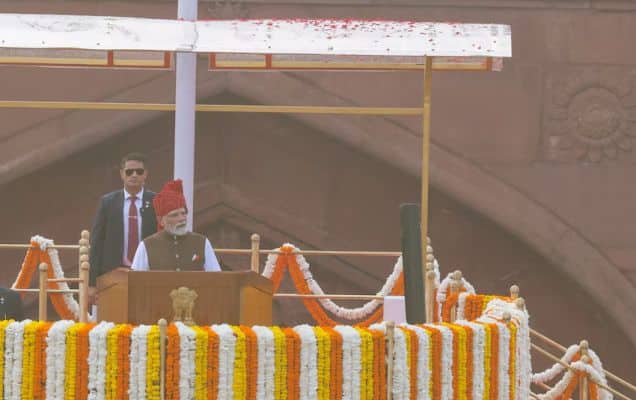
Prime Minister Shri Narendra Modi inaugurated the Defence Offices Complexes at Kasturba Gandhi Marg and Africa Avenue in New Delhi today. He also visited the Defence Office Complex at Africa Avenue and interacted with Army, Navy, Air Force and Civilian Officers.
Addressing the gathering, the Prime Minister said that in today’s inauguration of complexes, India has taken another step in developing the nation’s capital according to needs and aspirations of a new India in the 75th year of India’s independence. He lamented the fact that for a very long time the defence related work was being conducted from hutments constructed during the second World War which were made keeping in mind horse stable and barracks needs. “This new defence office complex will strengthen the efforts of making the working of our defence forces convenient and effective”, he said.

The Prime Minister said these modern offices built at KG Marg and Africa Avenue, will go a long way in effectively carrying out all the work related to the security of the nation. This is a big step towards the construction of a modern defense enclave in the capital. He appreciated the inclusion of attractive artefacts by Indian artists in the complexes as symbols of AaatmNirbhar Bharat. “The complexes reflect the modern form of diversity of our culture while preserving the vitality of Delhi and environment”, he said.

The Prime Minister remarked when we talk about the capital, it is not just a city. The capital of any country is a symbol of the thinking, determination, strength and culture of that country. India is the mother of democracy. Therefore, the capital of India should be such, in which there are citizens, people in the center.

The Prime Minister stressed the role of modern infrastructure in the government’s focus on ease of living and ease of doing business. “The ongoing construction work of Central Vista is going on with this thought only”, said the Prime Minister. Enumerating the efforts of new constructions as per the aspirations of the capital, the Prime Minister said that many constructions like residences for people’s representatives, Efforts to preserve Baba Saheb Ambedakar’s memories,, many bhawans, memorials for our martyrs are enhancing the glory of the capital today.

The Prime Minister said the work of the Defense Office Complex which was to be completed in 24 months has been completed in a record time of just 12 months. That too when all the other challenges ranging from labor were to the fore in the circumstances created by Corona. Hundreds of workers got employment in this project during the Corona period. The Prime Minister credited this to a new thinking and approach in the government’s functioning. “ When policies and intentions are clear, will power is strong and efforts honest, everything is possible”, said the Prime Minister.

The Prime Minister said that these defence office complexes are the manifestation of changing work culture and priorities of the government. Optimal and proper use of available land with various departments of the government is one such priority, he said. Illustrating thi, the Prime Minister informed that these defence office complexes are constructed in 13 acre land parcels unlike earlier times when five times more land was used for similar complexes. The Prime Minister also highlighted that in next 25 years i.e. ‘Azadi ka Amrit Kaal’ productivity and efficiency of the government system will be supported by such efforts. Availability of a common central Secretariat, connected conference hall, easy connectivity like metro etc will help a great deal in making the capital people-friendly, the Prime Minister concluded.
आज़ादी के 75वें वर्ष में आज हम देश की राजधानी को नए भारत की आवश्यकताओं और आकांक्षाओं के अनुसार विकसित करने की तरफ एक और कदम बढ़ा रहे हैं।
— PMO India (@PMOIndia) September 16, 2021
ये नया डिफेंस ऑफिस कॉम्लेक्स हमारी सेनाओं के कामकाज को अधिक सुविधाजनक, अधिक प्रभावी बनाने के प्रयासों को और सशक्त करने वाला है: PM
अब केजी मार्ग और अफ्रीका एवेन्यु में बने ये आधुनिक ऑफिस, राष्ट्र की सुरक्षा से जुड़े हर काम को प्रभावी रूप से चलाने में बहुत मदद करेंगे।
— PMO India (@PMOIndia) September 16, 2021
राजधानी में आधुनिक डिफेंस एऩ्क्लेव के निर्माण की तरफ ये बड़ा स्टेप है: PM @narendramodi
जब हम राजधानी की बात करते हैं तो वो सिर्फ एक शहर नहीं होता।
— PMO India (@PMOIndia) September 16, 2021
किसी भी देश की राजधानी उस देश की सोच, संकल्प, सामर्थ्य और संस्कृति का प्रतीक होती है।
भारत तो लोकतंत्र की जननी है।
इसलिए भारत की राजधानी ऐसी होनी चाहिए, जिसके केंद्र में लोक हो, जनता हो: PM @narendramodi
आज जब हम Ease of living और Ease of doing business पर फोकस कर रहे हैं, तो इसमें आधुनिक इंफ्रास्ट्रक्चर की भी उतनी ही बड़ी भूमिका है।
— PMO India (@PMOIndia) September 16, 2021
सेंट्रल विस्टा से जुड़ा जो काम आज हो रहा है, उसके मूल में यही भावना है: PM @narendramodi
डिफेंस ऑफिस कॉम्प्लेक्स का भी जो काम 24 महीने में पूरा होना था वो सिर्फ 12 महीने के record समय में complete किया गया है।
— PMO India (@PMOIndia) September 16, 2021
वो भी तब जब कोरोना से बनी परिस्थितियों में लेबर से लेकर तमाम दूसरी चुनौतियां सामने थीं।
कोरोना काल में सैकड़ों श्रमिकों को इस project में रोजगार मिला है: PM